
The big picture
Ezra 10 turns confession into a communal process, but the Book of Ezra does not make that process light or tidy. While Ezra weeps before the house of God, a great assembly gathers, and Shechaniah proposes a covenant to dismiss foreign wives and the children born to them. Ezra accepts the proposal and requires an oath. A compulsory summons then brings the returned community to Jerusalem under threat of forfeiture and exclusion, where heavy rain makes an immediate mass hearing impractical. The people agree to separation but ask for scheduled examinations with local elders and judges. The inquiry takes months. Priests, Levites, singers, porters, and other Israelites are named among those implicated. The book closes with the affected marriages and children still visible, offering no final feast to soften the human consequences.
Central truth
Ezra and the assembled community answer covenant-breaking marriages with sworn action and an extended inquiry, naming offenders across their ranks while a separation proposal reaches wives and children.

The study notes have a page of their own
The movement by movement analysis, the words to trace, the verse by verse notes and where readers differ are written for someone studying alone. They are on the Deep Personal Reflections page for this chapter. This page is the lesson.
A chapter-specific teaching brief
These anchors come from this chapter itself. They help a teacher use the Level 1 overview, the Level 2 study, and the Scripture text as one lesson.
Open with the chapter’s first image
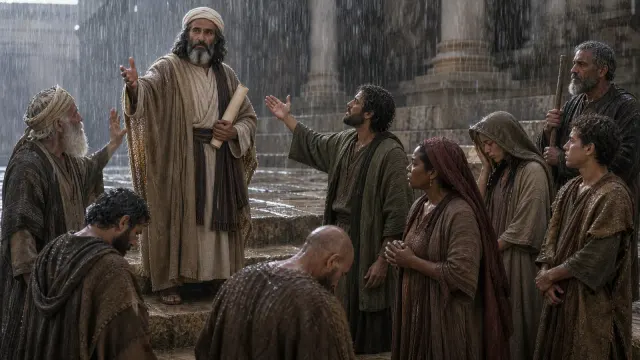
Ezra 10:1: “Now when Ezra had prayed, and when he had confessed, weeping and casting himself down before the house of God, there assembled unto him out of Israel a…”
Slow down at the turning point
Ezra 10:14: “Let now our rulers of all the congregation stand, and let all them which have taken strange wives in our cities come at appointed times, and with them the…”
Keep this word trail visible
sons, wives, strange, Ezra, taken, Israel
What to explain, in order
Teach the passage in this order. Each step names the verses it rests on, so every point can be shown in the text before it is applied.
Ezra 10:1
A weeping assembly
Begin where the chapter begins, with Ezra praying, confessing, weeping and casting himself down before the house of God. A very great congregation gathers, "of men and women and children", and they weep bitterly. Point out that grief spreads from one man to many before anyone proposes anything. Point out too that women and children are in the crowd, and keep them in view; what follows will touch them most. Teach this first so the chapter is heard as a people's repentance, not as a ruler's purge.
Ezra 10:2-5
Shechaniah's proposal
Read Shechaniah's words slowly. He confesses, "We have trespassed against our God", and then says "yet now there is hope in Israel concerning this thing". Explain strange wives as foreign wives, women from the peoples named in 9:1. His proposal is a covenant to put away the wives and their children "according to the law", and he urges Ezra to act. Note that a Jehiel of the sons of Elam appears in 10:26 among those who had foreign wives; if he is Shechaniah's father, the proposal touched his own family, though the text does not say so. Ezra makes the leaders swear.
Ezra 10:6-8
Fasting, and a summons
Ezra withdraws to the chamber of Johanan the son of Eliashib and fasts without bread or water, still mourning. Then the proclamation goes out: all the returned exiles must come to Jerusalem within three days. Explain the sanction in 10:8: property forfeited, which means devoted and taken away, and the person separated from the assembly of the exiles. Teach this so learners see both the depth of Ezra's grief and the seriousness of the leaders' measures. The Book of Ezra records the summons as the counsel of the princes and elders.
Ezra 10:9-15
In the rain
Read the date: the twentieth day of the ninth month, the depth of the rainy winter. The people sit in the open square before the house of God, trembling at the matter and at the rain. Ezra charges them in 10:10-11 to confess to the LORD, do his pleasure, and separate from the peoples of the land and from the foreign wives. They agree, then ask for a proper process. Explain the difficulty of 10:15: this Bible says four men "were employed about this matter", while many other translations read the same words as opposing it. Present both readings and do not build on either.
Ezra 10:16-17
Three months of examination
Read 10:16-17 and put the dates on the timeline: from the first day of the tenth month to the first day of the first month. Ezra and the heads of the fathers' houses, each named, sit down to examine the matter. Explain what this implies: hearings, case by case, with local elders and judges. Tell learners plainly what it does not tell us: the outcome of each case, whether any were found to be exceptions, or how families were provided for. Teach this so the response is understood as deliberate and named, not a crowd acting in a single hour.
Ezra 10:18-44
The names, and the last line
Read the register beginning with the priests: sons of Jeshua, then Immer, Harim and Pashur; then Levites, a singer, porters, and the lay families, a little over a hundred men in all. The high priest's family gives their hands and offers a ram for their guilt. Then read 10:44 slowly: some of them had wives by whom they had children. The Book of Ezra ends there. Teach this last and do not hurry past it. Name the cost honestly, keep the women and children in view as people, and let the class sit for a moment with what the text leaves unsaid.
Where learners get stuck
The misreadings this passage tends to produce, and how to answer each from the text.
"This chapter means Christians married to unbelievers should divorce them."
The New Testament speaks directly to that situation. Paul writes of a believing husband with an unbelieving wife who is content to stay, "let him not put her away" (1 Corinthians 7:12), and says the children are holy (7:14); 1 Peter 3:1-2 speaks to wives in the same position. Ezra 10 records a specific covenant act in Judah's restoration, under the law of Moses. Teach this early and clearly, because people in the room may be in exactly that situation.
"God commanded Ezra to send the women and children away."
The text records Shechaniah's proposal (10:2-3), Ezra's oath and charge (10:5, 10-11), and the assembly's agreement (10:12). It does not record a direct word from the LORD ordering this particular action; the people act on their understanding of the law, "let it be done according to the law" (10:3), drawing on passages such as Deuteronomy 7:3-4. Readers weigh this differently. The teacher should report what is written and not add a divine speech.
"The women and children did not matter to the Book of Ezra."
The book notes them: women and children are in the weeping congregation (10:1), the proposal names "such as are born of them" (10:3), and the final verse ends with children (10:44). The book does not give their side, and that silence is painful. Teachers should name it without filling it, and let learners feel what covenant unfaithfulness cost people who had no say in it, especially the children.
"Jonathan and Jahaziah opposed Ezra."
In this Bible 10:15 says they "were employed about this matter", with Meshullam and Shabbethai the Levite helping them. Many modern translations read the same Hebrew as standing against it. Tell the class both readings exist, and that the verse does not explain the men's motives either way. Do not build a lesson on either reading; the rest of the chapter does not depend on it.
"Everyone in Israel had married foreign wives."
The register names a little over a hundred men (10:18-43), in a community that numbered tens of thousands (2:64; 8:1-14). The trespass was serious and its leaders were prominent (9:2), but the list is specific, not universal. The examination by names (10:16) took care to identify actual cases rather than accuse the whole people. That care is worth teaching to any community facing a failure.
Learning objectives
- Identify who proposes the covenant of separation.
- Distinguish Ezra's instructions from a directly reported divine speech.
- Describe the assembly's deadline, sanctions, and heavy rain.
- Trace the examination from the tenth month to the first.
- Identify the inclusion of priests and other service groups.
- Name unresolved consequences for wives and children.
Teacher preparation
- Read chapters 9-10 together; distinguish the reported trespass, Shechaniah's proposal, Ezra's charge, and the inquiry's recorded actions.
- Explain strange wives as foreign wives, not unusually behaving women; retain the covenant setting without making ancestry a modern measure of worth.
- Prepare the ninth-, tenth-, and first-month dates in 10:9, 16-17; the examination spans months rather than one rain-soaked meeting.
- Notice the interpretive difficulty in 10:15: the KJV presents men employed about the matter, while the underlying wording is also understood as opposition.
- Read 1 Corinthians 7:12-16 before teaching; do not turn this account into a blanket instruction to dissolve present-day marriages with unbelievers.
Evidence and interpretation checks
Explicit
Read 10:2-5: Shechaniah proposes putting away wives and their children, and Ezra secures an oath; 10:10-11 records Ezra's public charge.
Scripture-supported
Compare 10:18-24 with 9:1-2: the final register confirms that priestly and Levitical service groups are among those implicated.
Strong inference
Infer from 10:13-17 that the response requires individual examination rather than resolution by a crowd's single shout; do not infer unreported safeguards.
Possible or traditional reading
Explain that 10:15 has been read as administrative involvement or dissent. Preserve the KJV wording and acknowledge the disputed interpretation without claiming to know the men's motives.
Limit
State that 10:19 records a priestly pledge and 10:44 mentions children; the ending does not describe every separation, the wives' responses, or arrangements for their future support.
Discussion with answer guidance
1. Who first proposes putting away wives and children?
What a good answer contains
Shechaniah the son of Jehiel, of the sons of Elam: "We have trespassed against our God, and have taken strange wives of the people of the land: yet now there is hope in Israel concerning this thing" (10:2). He proposes a covenant "to put away all the wives, and such as are born of them" (10:3), and Ezra makes the leaders swear (10:5). A good answer names Shechaniah and notes that the proposal comes from the people, with Ezra's agreement. A weak answer says God spoke the command directly, which the text does not record.
Show teacher guidance
Name Shechaniah in 10:2-3; distinguish his proposal and Ezra's endorsement from an invented direct speech from God.
2. What brings the later assembly together, and why does it tremble?
What a good answer contains
A proclamation summons everyone within three days, on pain that "all his substance should be forfeited, and himself separated from the congregation" (10:8). They gather on the twentieth day of the ninth month and sit in the open street, "trembling because of this matter, and for the great rain" (10:9). A good answer gives both reasons for trembling: the seriousness of the matter and the winter weather. A weak answer keeps only one.
Show teacher guidance
Use 10:7-9: a three-day summons carries forfeiture and exclusion, while both the matter and heavy rain cause trembling.
3. Does the request for more time simply reject Ezra's charge?
What a good answer contains
No. They answer with a loud voice, "As thou hast said, so must we do" (10:12), and then explain that the people are many, it is the rainy season, and "neither is this a work of one day or two" (10:13). They propose that rulers stand for the congregation and that each case come with its city's elders and judges at appointed times (10:14). A good answer sees agreement joined to a practical plan. A weak answer calls it stalling.
Show teacher guidance
Compare 10:12-14: the assembly voices agreement but cites numbers, weather, and the need for appointments; do not dismiss logistics as mere evasion.
4. How does a public pledge become an inquiry?
What a good answer contains
Through a process. Leaders are appointed, and those concerned come at set times with the elders and judges of their cities (10:14). Ezra and heads of houses, "all of them by their names", sit down on the first day of the tenth month "to examine the matter" (10:16), and they finish by the first day of the first month (10:17), three months later. A good answer notices the case-by-case examination. A weak answer imagines one mass expulsion on the day of the rain.
Show teacher guidance
Follow 10:14, 16-17: rulers, local elders, judges, and named examiners take part over months, not one afternoon.
5. Why begin the final register with priests?
What a good answer contains
Because the trespass began at the top (9:2), and the register shows it. First come sons of Jeshua the son of Jozadak, the high priest's own family (10:18), who "gave their hands that they would put away their wives; and being guilty, they offered a ram of the flock for their trespass" (10:19). Then the Levites, a singer and porters (10:23-24), then the lay families (10:25-43). A good answer sees that rank gave no exemption. A weak answer misses that the list begins with the priests.
Show teacher guidance
Read 10:18-24 beside 9:2; accountability reaches prominent religious workers, not only less influential households.
6. What must remain unresolved when the class reaches 10:44?
What a good answer contains
Much. The last verse says "some of them had wives by whom they had children" (10:44), and then the Book of Ezra ends. It does not tell us what became of these women and children, whether any of the wives had turned to the LORD, how they were provided for, or how the men grieved. A good answer names these gaps honestly and treats the women and children as real people. A weak answer invents a tidy outcome or details of suffering the text does not give.
Show teacher guidance
Name the missing wives' perspectives, individual outcomes, and support arrangements; do not invent either a painless resolution or details of suffering absent from the text.
Responsible application
Heart and habits
Ask learners to distinguish an acknowledgment of wrong from an examined response, using a fictional institutional failure rather than anyone's marriage.
Relationships and community
Have groups identify people affected by a proposed remedy, including those without a recorded speaking role; distinguish their questions from answers the chapter supplies.
Accountability without shortcuts
Draft principles for careful inquiry from 10:13-17 while explicitly rejecting public coercion or this separation procedure as automatic modern policies.
Session plans
Two timings of the same lesson. The shorter keeps the reading, the central discussion and one response; the longer gives the confusions and the application their own time.
45 minutes
The weeping assembly
Read 10:1 and point out the women and children in the crowd.
The proposal
Read 10:2-5. Ask question one and take confusion two.
The summons and the rain
Read 10:6-11 and ask question two.
A process
Read 10:12-17. Ask questions three and four and take confusion four.
The names and the last line
Read 10:18-19 and 10:44. Ask questions five and six and take confusions three and five.
Boundary and close
Take confusion one with 1 Corinthians 7:12-14, read the key verse together, give out the handout and pray for families.
90 minutes
Begin with care
Say at the outset that this chapter is hard and that it is not a command about marriages today. Read 1 Corinthians 7:12-14 first, with confusion one, so no one listens in fear.
The weeping assembly
Read 9:15 and 10:1. Point out the women and children in the crowd.
Shechaniah's proposal
Read 10:2-5. Ask question one, take confusion two, and mention the Jehiel of 10:26 as a possibility only.
Summons and rain
Read 10:6-11. Ask question two and explain the forfeiture of 10:8.
A request for process
Read 10:12-15. Ask question three and take confusion four.
Three months
Read 10:16-17. Ask question four and mark the ninth, tenth and first months on a timeline.
The names
Read 10:18-24 and part of 10:25-43. Ask question five and take confusion five.
The last line
Read 10:44. Ask question six, take confusion three and keep a short silence.
Close
Read the key verse together, give out the handout, and pray for families divided by unfaithfulness and for faithfulness in the room.
Adapting the lesson
Children
For younger children, do not teach the separation itself. Focus on 10:1, where men, women and children all wept and turned back to God, and on 10:12, where the people said they would do what was right. If older children ask about the wives and children, answer honestly that it was a very sad time, and that today God tells believing husbands and wives to stay together. Never let a child leave thinking their family might be sent away.
Youth
Read the chapter honestly and let them react; many will find it troubling, and that reaction is worth hearing. Separate three things: what the text records, what it does not tell us, and how the New Testament speaks to marriages today. Be alert to students from mixed-faith or mixed-heritage homes. Discuss the cost of compromise for whole families, and why the leaders' sin in 9:2 fell on people who had no say.
Adults
Adults can handle the difficulties: the source of the proposal, the reading of 10:15, the three-month process, the silence about the women and children, and how Christians read this beside 1 Corinthians 7. Some in the room may be divorced, remarried, or married to someone who does not share their faith. Say clearly what the passage does not require of them, and leave room for lament.
One to one
Ask first whether the person has a personal reason for finding this chapter hard, and let that shape everything. If they are married to someone who does not share their faith, read 1 Corinthians 7:12-16 and 1 Peter 3:1-2 with them before Ezra 10. If they carry guilt for a past choice, read 10:2, "yet now there is hope", and talk about confession and grace without promising easy outcomes.
Song and video learning lab
A song or video may interpret, compress, or dramatize the text. Its value becomes clearer when its choices are compared with Scripture.
- Before the media: the exact passage and its central movement.
- During the media: the words, people, events, and emotions the artist emphasizes.
- After the media: what it clarifies, what it leaves out, and what belongs back in the biblical text.
Handout
One page for learners to take home. The print button prints this section alone.
Ezra 10:1–44
The passage in brief
After Ezra's prayer, a great crowd of men, women and children gathered and wept. Shechaniah confessed that many had married foreign wives and proposed a covenant to send them and their children away according to the law, and Ezra had the leaders swear to it. The men of Judah were summoned and sat trembling in heavy rain. They agreed, but asked for time, and over three months leaders examined each case by name. The chapter lists the men, beginning with priests, and ends noting that some had children. The New Testament tells believers married to unbelievers to stay (1 Corinthians 7:12-14).
A verse to keep
Now when Ezra had prayed, and when he had confessed, weeping and casting himself down before the house of God, there assembled unto him out of Israel a very great congregation of men and women and children: for the people wept very sore.
Ezra 10:1 · King James Version
Questions to take home
Who wept with Ezra in 10:1?
How did the people ask for the matter to be handled in 10:12-14, and why?
What does the last verse of the book tell you, and what does it leave unsaid?
This week
Pray this week for families divided by unfaithfulness, and ask God to show you any compromise you need to bring before him.
Music and video connected to the passage
Related media appears when its Scripture reference overlaps this study. Music and video can illuminate a theme while the biblical text remains the foundation.