

The big picture
Matthew 13 turns the act of hearing into one of its central subjects. A sower scatters the same seed into different ground, and Jesus’ explanation shows that initial reception, endurance, competing cares, understanding, and fruit are not the same thing. Parables both disclose and expose, making the disciples’ privileged hearing a responsibility rather than a decorative status. Wheat and tares delay final separation to the harvest, while mustard seed and leaven describe a kingdom whose visible beginnings do not reveal its eventual reach. Treasure and pearl show discovery that reorganizes value, and the net returns to judgment at the end of the age. The chapter closes in Jesus’ own country, where people possess detailed family knowledge yet cannot receive the wisdom and works in front of them without offence.
Central truth
Jesus’ parables distinguish fruitful hearing from resistant hearing, reveal the kingdom’s surprising growth and worth, and reserve its final separation of righteous and wicked for the judgment he describes.

The study notes have a page of their own
The movement by movement analysis, the words to trace, the verse by verse notes and where readers differ are written for someone studying alone. They are on the Deep Personal Reflections page for this chapter. This page is the lesson.
A chapter-specific teaching brief
These anchors come from this chapter itself. They help a teacher use the Level 1 overview, the Level 2 study, and the Scripture text as one lesson.
Open with the chapter’s first image
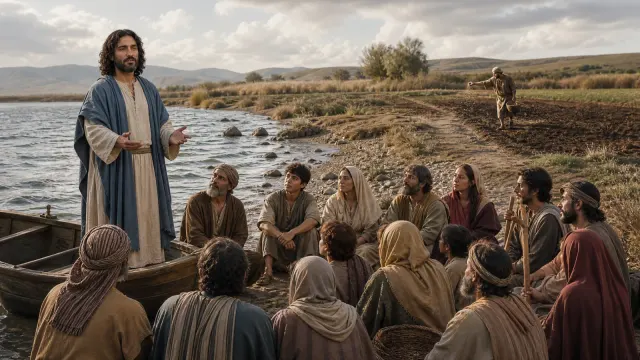
Matthew 13:1: “The same day went Jesus out of the house, and sat by the sea side.”
Slow down at the turning point
Matthew 13:29: “But he said, Nay; lest while ye gather up the tares, ye root up also the wheat with them.”
Keep this word trail visible
kingdom, hear, seed, some, heaven, tares
What to explain, in order
Teach the passage in this order. Each step names the verses it rests on, so every point can be shown in the text before it is applied.
Matthew 13:1-9
A sower went forth
Set the scene: Jesus sits in a boat, the crowd stands on the shore. Explain parable as a comparison drawn from ordinary life, and say that Matthew 13 gathers seven of them. Read the sower without explanation first. Explain that farmers scattered seed and then ploughed, so seed fell on paths, on thin soil over rock and among thorn roots. Note the closing call: “Who hath ears to hear, let him hear”. Teach the parable first and alone, so the class hears what the crowd heard and must ask what it means.
Matthew 13:10-17
Given to you to know
Read the disciples' question and Jesus' answer. Explain mystery as something hidden that God reveals. Then read Isaiah 6:9-10 in its own setting: Isaiah's preaching would expose hearts already closed. Explain that the parables do the same. They draw the willing nearer and leave the unwilling outside. Do not try to resolve how God's purpose and human refusal relate; traditions differ, and the text holds both. End with the blessing of 13:16-17: prophets longed to see what the disciples now see. This step frames all the parables as a test of hearing.
Matthew 13:18-23
The sower explained
Now teach Jesus' own explanation, soil by soil. Draw four patches on the board. Explain “the wicked one” as Satan, “dureth” as lasts, “offended” as caused to stumble. Notice that every hearer hears the word; the difference lies in understanding, endurance and what competes with the word. Explain the harvest of thirty, sixty and a hundredfold as remarkable abundance. Teach this before the other parables because it gives the key Jesus himself supplies, and because it turns the parable into a question every hearer must answer.
Matthew 13:24-43
Tares, mustard and leaven
Teach the three growth parables, then the explanation of the tares in 13:36-43. Explain tares as darnel, a weed that looks like wheat until it ripens. The enemy sows it; the owner forbids uprooting. The mustard seed and the leaven show growth from tiny or hidden beginnings. Then Jesus explains: the field is the world, the enemy the devil, the harvest the end of the world, the reapers angels. Note 13:43, echoing Daniel 12:3: “Then shall the righteous shine forth as the sun”. Teach patience with a mixed world, and real judgment at the end.
Matthew 13:44-52
Treasure, pearl, net and the householder
Read the two short parables of value together. Explain that burying treasure was common in a land often invaded. Both men sell all, one with joy. Readers differ on whether the buyer pictures the disciple who gives all for the kingdom or Christ who gives all for his people; present both. Then the net and its sorting, which repeats the warning of the tares. Finish with 13:51-52: the scribe instructed in the kingdom brings out treasure “new and old”. Ask the class what old and new treasure they have been given in this chapter.
Matthew 13:53-58
Rejected at home
End in Nazareth. The townspeople are astonished at his wisdom and mighty works, then ask questions meant to cut him down: the carpenter's son, his mother Mary, his brothers and sisters. Explain that traditions understand the brothers and sisters differently, as children of Mary and Joseph, children of Joseph by an earlier marriage, or cousins; set these out without choosing. Then the proverb about a prophet and his own country, and the result of their unbelief. Teach it last as a live example of the stony ground: astonishment that becomes offence.
Where learners get stuck
The misreadings this passage tends to produce, and how to answer each from the text.
“The parables mean God made some people unable to be saved.”
Jesus calls everyone to hear (13:9, 13:43). The quotation from Isaiah describes people who “have closed” their eyes (13:15). The disciples receive understanding because they come and ask (13:10, 13:36). Traditions weigh God's sovereignty and human response differently, and the text holds both. Keep the class on the urgent invitation to hear and understand.
“The tares are people in my church I do not like, and we should get rid of them.”
Jesus says the field is the world, not only the church (13:38), and he forbids the servants to pull up tares in case they uproot wheat (13:29). The separation belongs to the angels at the end (13:41). This does not forbid correcting wrong conduct in a church (18:15-17), but it forbids anyone from deciding who is a weed destined for burning.
“Leaven always means sin, so the kingdom here is corrupted.”
Elsewhere Jesus warns against the leaven of the Pharisees (16:6), and Paul uses leaven for sin (1 Corinthians 5:6-8). But images take meaning from their context. Here Jesus says “The kingdom of heaven is like unto leaven” (13:33), pairing it with the mustard seed. The point is quiet, pervasive growth. Read each parable on its own terms first.
“Selling all for the pearl means you can buy salvation.”
The parables picture worth, not payment. The man finds the treasure, and he sells all “for joy thereof” (13:44), because what he found is worth more than everything he had. The kingdom is given (13:11). The response it draws is total. Present the readings of the buyer as the disciple or as Christ, and keep the joy at the centre.
Learning objectives
- Distinguish the boat teaching from the later house explanation.
- Match the four soils with Jesus’ stated interpretations.
- Explain why parables both disclose and expose failure to understand.
- Identify the field and reapers in the tares explanation.
- Compare growth, treasure, and judgment across the parables.
- Explain the hometown response without confusing familiarity with understanding.
Teacher preparation
- Read Matthew 13; mark the movement from house to boat and back inside at verse 36.
- Prepare separate image cards for soils, tares, mustard, leaven, treasure, pearl, and net; do not merge their explanations.
- Gloss anon as immediately, tares as weeds among the crop, and end of the world in its judgment setting.
- Read Isaiah 6:9–10 and Psalm 78:2 beside Matthew 13:14–15 and 35; retain the difficult language about hearing and disclosure.
- Prepare anonymous sample interpretations; never ask learners to classify themselves or others as particular soils.
Evidence and interpretation checks
Explicit
Use Matthew 13:18–23 and 37–43 for Jesus’ explanations; the field is the world and the reapers are angels.
Scripture-supported
Compare Matthew 13:14–15 with Isaiah 6:9–10; the discussion concerns perception and response, not entertainment alone.
Strong inference
Compare Matthew 13:31–33; infer that small or hidden beginnings do not indicate a small final effect in the kingdom images.
Possible or traditional reading
Present disciple-as-buyer and Christ-as-buyer readings of Matthew 13:44–46 as interpretations; the verses do not explicitly identify every figure with a theological counterpart.
Limit
State that Matthew 13:24–30, 36–43 does not authorize learners to identify living individuals as irredeemable weeds or perform the angels’ final separation.
Discussion with answer guidance
1. What changes among the four soils while the sown word remains the focus?
What a good answer contains
The seed is the same; the ground changes. Wayside: the hearer “understandeth it not, then cometh the wicked one” (13:19). Stony ground: “hath he not root in himself, but dureth for a while” and stumbles under persecution (13:21). Thorns: “the care of this world, and the deceitfulness of riches, choke the word” (13:22). Good ground hears, understands and bears fruit (13:23). A good answer names each danger. A weak answer makes the soils fixed personality types.
Show teacher guidance
Match 13:3–9 with 18–23: understanding, endurance under trouble, competing cares, and fruit. Do not turn the soils into permanent personality types Jesus commands the class to assign.
2. Why does Jesus not describe parables as making everything equally obvious to everyone?
What a good answer contains
Because parables reveal and conceal at once. To the disciples Jesus says, “it is given unto you to know the mysteries of the kingdom of heaven” (13:11). Of others Jesus says, “they seeing see not; and hearing they hear not” (13:13), fulfilling Isaiah 6:9-10. A strong answer adds 13:16, “blessed are your eyes, for they see”, and notices that the disciples are those who came and asked (13:10). A weak answer treats parables as simple illustrations anyone grasps at once.
Show teacher guidance
Read 13:10–17, including the gift of understanding and the cited failure to hear. Retain both revelation and resistance; a pleasing illustration is not automatically understood.
3. Why does the owner refuse the servants’ offer to pull up the tares immediately?
What a good answer contains
“Nay; lest while ye gather up the tares, ye root up also the wheat with them” (13:29). The two look alike while growing, and the sorting belongs to the harvest. Jesus explains: “The field is the world”, and “the reapers are the angels” (13:38-39). A good answer sees that judgment is real and future, and belongs to God's angels, not to servants now. A weak answer makes the field only the church or makes the teacher a reaper.
Show teacher guidance
Use 13:28–30: they may uproot wheat. Then use 13:38–39 to identify world and angels; do not silently replace the field with only the church or the reapers with teachers.
4. What do mustard and leaven contribute beside the warning about tares?
What a good answer contains
Both begin small and end large. A mustard seed becomes a tree where birds lodge (13:31-32). Leaven is hidden “in three measures of meal, till the whole was leavened” (13:33). A strong answer sees that the kingdom's beginnings look unimpressive and its end is complete. A weak answer insists leaven must mean evil because it does elsewhere; here Jesus says the kingdom of heaven is like it.
Show teacher guidance
Compare 13:31–33 for growth and permeation from unimpressive beginnings. Do not assign leaven a negative meaning merely because another passage uses it that way.
5. What unites treasure and pearl, and what does the net add?
What a good answer contains
The treasure and the pearl are both found, and both finders sell everything; the first does it “for joy thereof” (13:44). The kingdom is worth more than all else. The net gathers every kind, and at the end “the angels shall come forth, and sever the wicked from among the just” (13:49). A good answer holds the joy and the seriousness together. A weak answer turns the kingdom into something bought with money or good works.
Show teacher guidance
Identify the decisive response to surpassing value in 13:44–46, then final sorting in 13:47–50. Keep the joy of discovery and seriousness of judgment without making salvation a retail purchase.
6. Why does knowing Jesus’ family not settle the hometown’s question about his wisdom?
What a good answer contains
They know him too well, or think they do: “Is not this the carpenter's son?” (13:55). They name his mother and brothers, and are offended. Jesus answers, “A prophet is not without honour, save in his own country” (13:57). Then “he did not many mighty works there because of their unbelief” (13:58). A strong answer says familiarity became an excuse for unbelief. A weak answer says their unbelief drained his power.
Show teacher guidance
Read 13:54–58: astonishment gives way to offence and unbelief. Matthew says he did not do many mighty works there, not that familiarity had mechanically drained his power.
Responsible application
Heart and habits
Ask learners to revise a fictional reading routine crowded out by competing concerns, using Matthew 13:22 without demanding financial disclosures.
Relationships and community
Examine why a class should correct harmful conduct without declaring particular people to be the weeds destined for final judgment.
Teach the image Jesus gives
Have learners explain one parable using its own details before borrowing meanings from another image or passage.
Session plans
Two timings of the same lesson. The shorter keeps the reading, the central discussion and one response; the longer gives the confusions and the application their own time.
45 minutes
The sower
Read 13:1-9 aloud without explanation. Ask what the class thinks it means.
Why parables
Read 13:10-23. Take questions one and two, drawing the four soils on the board. Handle confusion one briefly.
Weeds and growth
Read 13:24-33 and 13:36-43. Take questions three and four and confusion two.
Treasure and net
Read 13:44-50. Take question five.
Rejected at home
Read 13:53-58. Take question six.
Response and handout
Ask each person to consider silently which danger of 13:19-22 threatens them most. Read the key verse together and give out the sheet.
90 minutes
Seeds in hand
Pass round seeds and a weed. Read 13:1-9.
Given to know
Read 13:10-17 with Isaiah 6:9-10. Take question two and confusion one.
The soils
Read 13:18-23. Take question one. In groups, describe what each soil looks like in daily life.
Tares
Read 13:24-30 and 13:36-43 with Daniel 12:3. Take question three and confusion two.
Mustard and leaven
Read 13:31-35. Take question four and confusion three.
Treasure, pearl and net
Read 13:44-52. Take question five and confusion four.
The carpenter's son
Read 13:53-58. Take question six. Set out the readings about his brothers without choosing.
Application
Use the application on teaching each parable from its own details.
Handout and prayer
Read the key verse together and pray for hearts that understand and bear fruit.
Adapting the lesson
Children
Plant seeds in four cups: gravel, a path drawing, a cup with a weed, good soil. Talk about which will grow. Hide a coin in a sand tray for the treasure and let a child find it and show joy. Explain the tares simply: God will sort good and bad at the end, and it is not our job to pull people out. Keep the furnace of fire out of a young children's lesson.
Youth
Ask which soil best describes how they treat what they hear at church and online. Be honest about thorns: worries, phones, money. Let them argue about the tares and whether churches should try to sort people. Talk about the treasure: what would they give everything for, and is the kingdom worth that. End with Nazareth and the danger of thinking you already know Jesus.
Adults
Spend time on 13:10-17 and the Isaiah background. Let the soils search adult lives: cares and riches are adult thorns. Discuss the tares as a guard against harsh church judgment, and the net as a reminder that judgment is real. Present the readings of the treasure and pearl and of Jesus' brothers fairly in mixed groups.
One to one
Read the sower and its explanation together. Ask which soil they recognise in themselves now, without judging them. If they are discouraged by how small their faith seems, read the mustard seed. If they have recently found faith, let the treasure parable speak to their joy. Pray that the word would take root in them.
Song and video learning lab
A song or video may interpret, compress, or dramatize the text. Its value becomes clearer when its choices are compared with Scripture.
- Before the media: the exact passage and its central movement.
- During the media: the words, people, events, and emotions the artist emphasizes.
- After the media: what it clarifies, what it leaves out, and what belongs back in the biblical text.
Handout
One page for learners to take home. The print button prints this section alone.
Matthew 13
The passage in brief
Jesus teaches the crowds in parables from a boat. A sower's seed falls on a path, rocky ground, thorns and good soil, and only the good soil bears fruit; the soils show how people hear God's word. An enemy sows weeds among wheat, and both grow until harvest. The kingdom is like a tiny mustard seed, yeast in dough, hidden treasure, a precious pearl and a net that gathers everything. At the end of time God will separate the wicked from the righteous. In his hometown, people take offence at him.
A verse to keep
But he that received seed into the good ground is he that heareth the word, and understandeth it; which also beareth fruit, and bringeth forth, some an hundredfold, some sixty, some thirty.
Matthew 13:23 · King James Version
Questions to take home
What are the dangers to the seed in 13:19-22?
Why does the owner of the field let the weeds grow until the harvest?
What do the man with the treasure and the merchant with the pearl both do?
This week
Read one parable from Matthew 13 every day this week and ask what kind of soil you are giving God's word.
Music and video connected to the passage
Related media appears when its Scripture reference overlaps this study. Music and video can illuminate a theme while the biblical text remains the foundation.
 Watch and Be ReadyMatthew 24-25; Mark 13; Luke 21:5-38Listen to related music →The Sower Went Forth to SowMatthew 13:1-52Listen to related music →
 This Do in RemembranceMatthew 26:17-35; Mark 14:12-31; Luke 22:7-38; John 13-17Listen to related music →Matthew, Part OneMatthew 1:1-13:58Listen to related music →