The big picture
The final chapter tests the promises made after the wall was built and the law was heard. Nehemiah has been away at the royal court, and his return exposes failures in precisely the areas the community had pledged to maintain. Tobiah occupies a temple chamber once used for offerings and portions. Levites and singers have gone back to their fields because support has failed. Sabbath trade has resumed, with local buyers as implicated as outside merchants. Marriage commitments have also broken down, reaching even into the high priest's family through a connection to Sanballat. Nehemiah's responses range from administrative reorganization to physical severity, and the Book of Nehemiah reports them without softening them into cheerful leadership anecdotes. The ending is deliberately ordinary: priests, Levites, wood offerings, firstfruits, and another prayer to be remembered. The wall still stands, but maintenance, boundaries, provision, and mercy remain unfinished work.
Central truth
Nehemiah 13 closes the book with Nehemiah confronting renewed compromise in temple space, Levite support, Sabbath commerce, and mixed marriages, showing how quickly earlier covenant commitments required enforcement and repair.
The study notes have a page of their own
The movement by movement analysis, the words to trace, the verse by verse notes and where readers differ are written for someone studying alone. They are on the Deep Personal Reflections page for this chapter. This page is the lesson.
A chapter-specific teaching brief
These anchors come from this chapter itself. They help a teacher use the Level 1 overview, the Level 2 study, and the Scripture text as one lesson.
Open with the chapter’s first image
Nehemiah 13:1: “On that day they read in the book of Moses in the audience of the people; and therein was found written, that the Ammonite and the Moabite should not come…”
Slow down at the turning point
Nehemiah 13:17: “Then I contended with the nobles of Judah, and said unto them, What evil thing is this that ye do, and profane the sabbath day?”
Keep this word trail visible
sabbath, Levites, Jerusalem, king, house, Israel
What to explain, in order
Teach the passage in this order. Each step names the verses it rests on, so every point can be shown in the text before it is applied.
Nehemiah 13:1-3
The law read again
Begin with the reading. On that day they read in the book of Moses that Ammonites and Moabites were not to enter the congregation, because of what their ancestors did when Israel came out of Egypt (Deuteronomy 23:3-6). Explain that this concerns the assembly of worship and that the text recalls that God turned Balaam's curse into a blessing. Mention that Ruth the Moabitess was welcomed into Israel, and that readers differ on how these fit together. Teach this first because it sets the theme: the people's response to the law as it is read.
Nehemiah 13:4-9
A room for Tobiah
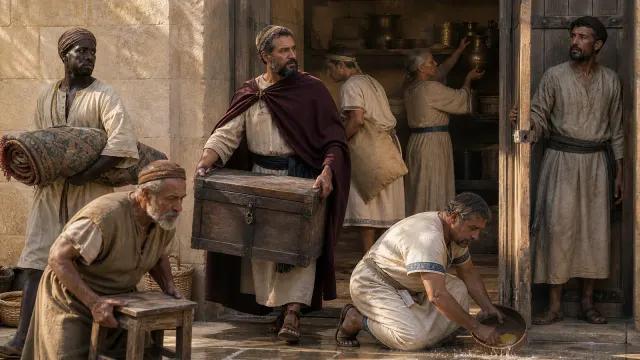
Explain the time frame from 13:6: Nehemiah went back to the king in the thirty second year of Artaxerxes and returned some time later. While he was away, Eliashib the priest, who was related to Tobiah, gave him a temple storeroom. Read Nehemiah's response: grieved, he throws out Tobiah's household goods, has the rooms cleansed, and restores the vessels and offerings. Many readers take him to be the high priest who led the building in 3:1, though here he is called the priest over the chambers. Teach it to show how quickly an opponent kept out of the walls was let into the temple.
Nehemiah 13:10-14
Why is the house of God forsaken
The Levites' portions have stopped, so the Levites and singers have gone back to their fields. Read Nehemiah's question to the rulers, "Why is the house of God forsaken?", and set it beside 10:39, "we will not forsake the house of our God". The covenant has been broken at exactly that point. Then read the remedy: the tithes brought in, and faithful treasurers appointed to distribute. Close with the first remember prayer in 13:14. Teach this to show that worship depends on ordinary faithfulness in giving.
Nehemiah 13:15-22
Guarding the Sabbath
Describe what Nehemiah sees: wine presses trodden, loads carried in, men of Tyre selling fish on the Sabbath. Read his challenge in 13:17-18, which links Sabbath breaking to the judgment that destroyed the city. Then his practical steps: shutting the gates before dark, posting servants, warning the traders, and handing the gates to the Levites. Set it beside the promise of 10:31. Teach this as a leader enforcing a promise the people had made, and avoid turning it into a rule for modern Sunday trading laws.
Nehemiah 13:23-29
Marriages and the next generation
This is the hardest section. Read 13:23-24: marriages with women of Ashdod, Ammon and Moab, and children who cannot speak the language of the law. Then 13:25: Nehemiah contends, curses, strikes some men, pulls out their hair and makes them swear. Do not soften it, and do not hold it up as a pattern to copy. Read the argument from Solomon in 13:26-27, and 13:28, a grandson of the high priest married to Sanballat's daughter, driven away. Explain that the concern throughout is faithfulness to God in worship, and teach it with great pastoral care.
Nehemiah 13:30-31
Remember me, O my God, for good
End where the book ends. Nehemiah cleanses the priesthood, sets out the duties of priests and Levites, and provides for the wood offering and firstfruits. Then his last prayer: "Remember me, O my God, for good." Point out the four remember prayers in this chapter. Explain that the book closes on unfinished business: the people have slipped, been corrected, and will need correcting again. Teach this last to leave learners with the honest truth that renewal requires constant faithfulness and dependence on God's mercy.
Where learners get stuck
The misreadings this passage tends to produce, and how to answer each from the text.
"Nehemiah's violence in verse 25 shows it is right to hit people who disobey God."
The Book of Nehemiah records what he did; it does not command anyone to do it. His actions as governor in a crisis of covenant faithfulness are reported, not offered as a method. Elsewhere Scripture tells believers to correct with gentleness (Galatians 6:1, 2 Timothy 2:24-25), and Christians are not given authority to strike anyone. Teach the passage honestly, without softening it, and say plainly that it gives no permission for physical punishment in families or churches today.
"Nehemiah 13 means people of different nationalities should not marry."
The problem in 13:23-27 is covenant faithfulness: the children cannot understand the law, and Solomon's example shows such marriages leading to idolatry (13:26, 1 Kings 11:4). The concern is worship, not ethnicity, and Ruth the Moabitess, who said "thy God my God" (Ruth 1:16), became David's ancestor. Christian traditions apply these passages to marriage today in different ways; do not resolve that here. Be very careful with learners from mixed families, and never let this chapter become a racial rule.
"The book ends badly, so the reforms failed."
The reforms did correct real problems: Tobiah was removed (13:8), the tithes came in (13:12), the Sabbath was kept (13:21), and the priesthood was cleansed (13:30). But the book ends with "Remember me, O my God, for good" rather than a triumph. The ending is honest: God's people needed repeated correction and could not sustain renewal by their own effort. Many readers see it pointing beyond itself to a deeper renewal that only God can bring; teach that hope without forcing it.
"Nehemiah keeps asking God to remember him because he is proud of his good deeds."
His prayers in 13:14, 22, 29 and 31 ask God to remember him and to "spare me according to the greatness of thy mercy" (13:22). He also asks God to remember those who defiled the priesthood (13:29). He is entrusting his work and its outcome to God, not boasting to people. Readers hear these prayers differently, and some find them self-focused. Let the class weigh them, but note that the last request is for mercy and good, not for praise.
Learning objectives
- Identify the four major reforms Nehemiah undertakes in the chapter.
- Explain why Tobiah’s chamber inside the temple courts is a direct institutional problem.
- Trace how neglected portions affect the Levites and temple service.
- Describe Nehemiah’s escalating response to Sabbath commerce.
- Explain the marriage and language problem reported in verses 23 to 27.
- Evaluate the repeated 'remember me' prayers within the chapter’s unsettled ending.
Teacher preparation
- Read Nehemiah 10:30 to 39 beside chapter 13 because this chapter revisits marriage, Sabbath, tithes, and temple support.
- Prepare Deuteronomy 23:3 to 6 for verses 1 to 3 and keep the restriction in its covenant setting.
- Explain that Eliashib prepared a large temple chamber for Tobiah where offerings and supplies had been stored.
- Do not soften verses 25 and 28: Nehemiah curses, strikes some men, pulls hair, imposes an oath, and drives away a priestly descendant linked to Sanballat.
- Mark the 'remember' prayers in verses 14, 22, 29, and 31. They help create the abrupt ending.
Evidence and interpretation checks
Explicit
Verses 4 to 9 remove Tobiah; verses 10 to 14 restore Levite portions; verses 15 to 22 confront Sabbath trade; verses 23 to 31 address marriages.
Scripture-supported
Verses 1 to 3 cite the law about Ammonites and Moabites, while verse 26 explicitly invokes Solomon.
Strong inference
The return of chapter 10’s problems shows that covenant commitments require continuing oversight.
Possible or traditional reading
Interpreters differ on how the separation commands relate to individual converts and later biblical inclusion; this chapter addresses restored-community compromise.
Limit
The chapter does not make Nehemiah’s forceful actions a universal disciplinary procedure.
Discussion with answer guidance
1. What has Eliashib done for Tobiah?
What a good answer contains
"Eliashib the priest, having the oversight of the chamber of the house of our God, was allied unto Tobiah" (13:4), and "he had prepared for him a great chamber" where offerings, frankincense, vessels and the Levites' tithes used to be kept (13:5). Tobiah, the Ammonite opponent of chapters 2, 4 and 6, now has a room in the temple courts. A good answer sees how serious this is: the storerooms for God's servants hold an enemy's furniture. A weak answer calls it a small matter of space.
Show teacher guidance
Verses 4 to 5 say he prepared a great chamber in space previously used for offerings and temple supplies.
2. What happens when Levites receive no portions?
What a good answer contains
"I perceived that the portions of the Levites had not been given them: for the Levites and the singers, that did the work, were fled every one to his field" (13:10). Without their portions they must farm to live, and worship stops. Nehemiah contends with the rulers, "Why is the house of God forsaken?" (13:11), echoing the promise of 10:39. A good answer connects cause and effect: no support, no service. A strong answer notes that Judah then brings the tithes and faithful treasurers are appointed (13:12-13).
Show teacher guidance
Verse 10 says Levites and singers flee to their fields, disrupting assigned service.
3. How does Nehemiah respond to Sabbath trade?
What a good answer contains
In steps. He testifies against those treading wine presses and selling on the sabbath (13:15), contends with the nobles, "What evil thing is this that ye do, and profane the sabbath day?" (13:17), and reminds them that this brought judgment before (13:18). He shuts the gates at dusk before the sabbath and posts his servants (13:19), warns the merchants camped outside, "if ye do so again, I will lay hands on you" (13:21), and finally assigns Levites to keep the gates (13:22). A weak answer mentions only the gates.
Show teacher guidance
He rebukes nobles, shuts gates, posts servants, warns merchants, and assigns purified Levites to guard.
4. What sign of assimilation appears in verse 24?
What a good answer contains
"And their children spake half in the speech of Ashdod, and could not speak in the Jews' language, but according to the language of each people" (13:24). Children of mixed marriages are growing up unable to understand the language in which the law was read in chapter 8. A good answer sees the concern: the next generation cannot hear God's word. A strong answer links this to 8:8, where understanding the reading was everything. A weak answer thinks the problem is foreign accents.
Show teacher guidance
Some children speak the speech of Ashdod and cannot speak in the Jews’ language.
5. Why does Nehemiah mention Solomon?
What a good answer contains
As a warning from Israel's own history: "Did not Solomon king of Israel sin by these things? yet among many nations was there no king like him, who was beloved of his God" (13:26). And then, "nevertheless even him did outlandish women cause to sin." If the wisest and most blessed king was turned from God by such marriages (1 Kings 11:1-8), no one is safe. A good answer sees that the concern is worship. A weak answer reads it as contempt for foreign women, which the argument from Solomon's idolatry does not support.
Show teacher guidance
Verses 26 to 27 use his foreign wives as a warning about covenant unfaithfulness.
6. How does the book end?
What a good answer contains
With a final cleansing and a prayer. "Thus cleansed I them from all strangers, and appointed the wards of the priests and the Levites, every one in his business" (13:30), with provision "for the wood offering, at times appointed, and for the firstfruits" (13:31). Then the last words: "Remember me, O my God, for good." A good answer notices that the book ends with ordinary arrangements and a prayer, not a victory. A strong answer counts the four remember prayers in 13:14, 22, 29 and 31. A weak answer expects a happy ending the text does not give.
Show teacher guidance
After further cleansing and appointments, Nehemiah closes, 'Remember me, O my God, for good.'
Responsible application
Heart and habits
Compare chapter 10’s signed commitments with chapter 13’s maintenance failures and repeated drift.
Relationships and community
Examine how private alliances create institutional consequences through Tobiah and Sanballat connections.
An untidy ending
Resist improving the ending. Let repeated reforms and remember-me prayers carry the tension.
Session plans
Two timings of the same lesson. The shorter keeps the reading, the central discussion and one response; the longer gives the confusions and the application their own time.
45 minutes
The law read again
Read 13:1-3 and Deuteronomy 23:3-6 briefly.
A room for Tobiah
Read 13:4-9 and ask question one.
The house forsaken
Read 13:10-14 with 10:39 and ask question two.
Guarding the Sabbath
Read 13:15-22 and ask question three.
Marriages and children
Read 13:23-29 carefully. Ask questions four and five, and take confusions one and two.
Remember me
Read 13:30-31, ask question six and take confusion three. Read the key verse together and give out the handout.
90 minutes
Keeping promises
Ask the class what makes it hard to keep a promise long after the day it was made.
The law read again
Read 13:1-3 with Deuteronomy 23:3-6 and Ruth 1:16. Discuss how they fit together without forcing an answer.
A room for Tobiah
Read 13:4-9 with 2:10 and 6:17-19. Ask question one.
The house forsaken
Read 13:10-14 with 10:35-39. Ask question two.
Guarding the Sabbath
Read 13:15-22 with 10:31. Ask question three.
Marriages and the next generation
Read 13:23-29 with 1 Kings 11:1-4. Ask questions four and five. Take confusions one and two with care.
Remember me, O my God
Read 13:30-31. Ask question six and take confusions three and four.
Response and handout
Use the application on an untidy ending, read the key verse together, give out the handout and pray for faithfulness that lasts.
Adapting the lesson
Children
Tell the children that while Nehemiah was away, people forgot some of their promises to God: they let a bad man live in God's house, stopped giving to the helpers, and worked on God's rest day. Show how Nehemiah put things right. Practise the prayer "Remember me, O my God, for good". Leave out the marriages and the hitting, and keep the lesson on remembering promises.
Youth
Ask what happens to good habits when no one is watching. Read 13:4-22 and trace three promises from chapter 10 that were broken. Take 13:23-29 carefully, being clear that it is not about race and not a model for violence. Talk about how faith is passed on, and why 13:24 worried Nehemiah. End with the remember prayers.
Adults
Give real time to how quickly commitments eroded, comparing chapter 10 with chapter 13. Discuss how congregations keep faith over years rather than days. Handle 13:23-29 with great pastoral care: some adults are in mixed or interfaith families, and some have suffered violence. Present differing views fairly and do not settle contested questions.
One to one
Read 13:10-14 and 13:30-31 together. Ask the person which promise to God has slipped for them since they first made it. Do not shame them; Nehemiah's own prayer asks for mercy (13:22). Talk about one step to put it right. If 13:23-29 troubles them, read it with them and listen before you explain.
Song and video learning lab
A song or video may interpret, compress, or dramatize the text. Its value becomes clearer when its choices are compared with Scripture.
- Before the media: the exact passage and its central movement.
- During the media: the words, people, events, and emotions the artist emphasizes.
- After the media: what it clarifies, what it leaves out, and what belongs back in the biblical text.
Handout
One page for learners to take home. The print button prints this section alone.
Nehemiah 13:1–31
The passage in brief
While Nehemiah was away, the people slipped. A priest gave Tobiah a room in the temple, the Levites were not paid and went home, people traded on the Sabbath, and some married outside the faith so their children could not understand God's law. When Nehemiah returned, he threw out Tobiah, brought back the Levites, shut the gates on the Sabbath and confronted the marriages. The book ends with his prayer: Remember me, O my God, for good.
A verse to keep
And for the wood offering, at times appointed, and for the firstfruits. Remember me, O my God, for good.
Nehemiah 13:31 · King James Version
Questions to take home
What did Eliashib give Tobiah in 13:4-5?
Why did the Levites leave the temple in 13:10?
How does Nehemiah end his book in 13:31?
This week
This week, name one promise to God that has slipped, take one step to keep it again, and ask God for mercy.
Music and video connected to the passage
Related media appears when its Scripture reference overlaps this study. Music and video can illuminate a theme while the biblical text remains the foundation.