New · FreePlay The Witnesses The in-depth puzzle battle quest through Bible history

People of the Bible

Nehemiah

Cupbearer to a king, project manager by trade, and the only man in Scripture who prays between a question and his answer.

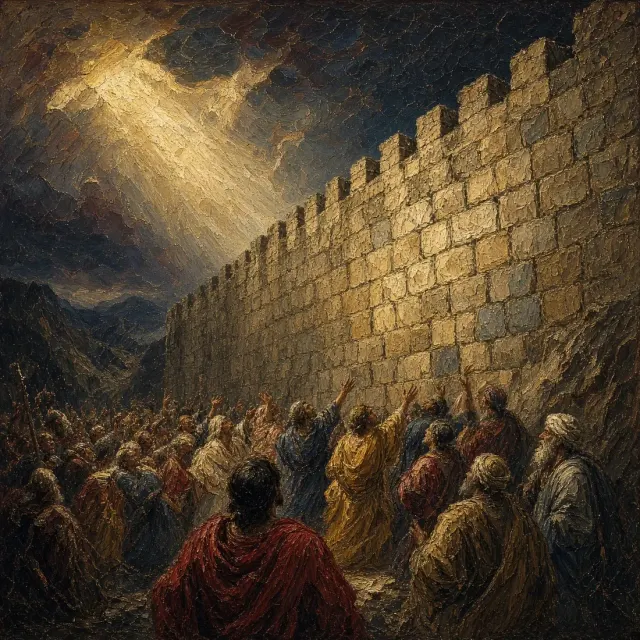
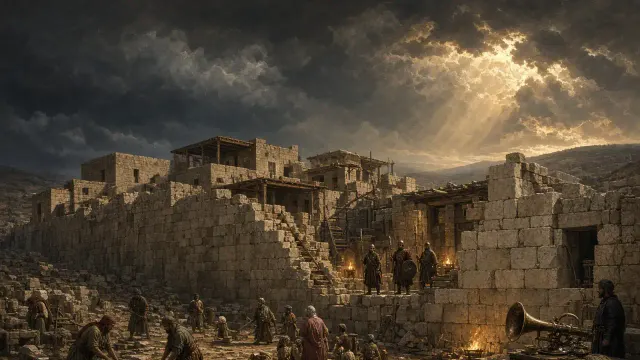
Nehemiah is the king’s cupbearer in Susa when his brother arrives with news from Jerusalem: the wall is broken down and the gates burned. He weeps, mourns, fasts and prays for days, and then waits four months for an opening. When the king notices his face and asks what he wants, he prays before he speaks, and then asks for leave, timber and letters. He inspects the wall at night without telling anyone, and rebuilds it in fifty-two days against constant interruption.

Where he appearsNehemiah 1 to 13

Scroll down to the account
Nehemiah

The movements, in the order the text gives them.

The Account of Nehemiah

  1. 01

    Nehemiah 1:1-11

    I sat down and wept

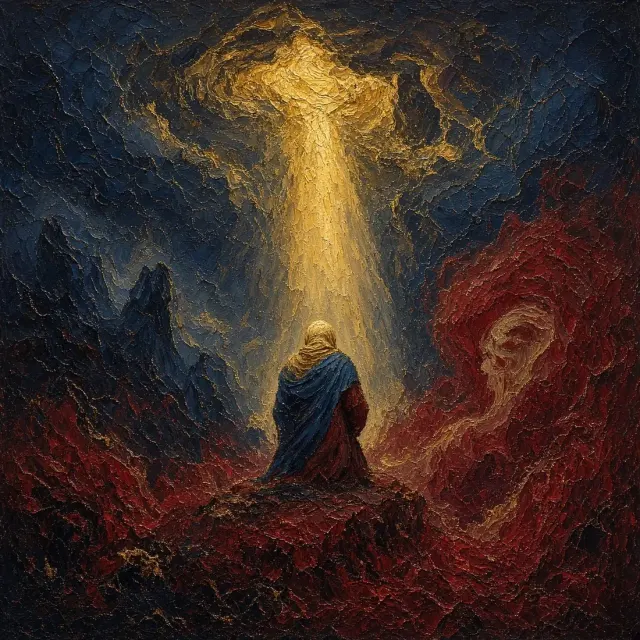
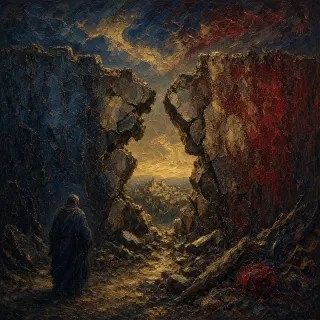
    The news is one sentence: the wall broken down and the gates burned with fire. He mourns certain days, and the prayer that follows confesses his own father’s house before it asks for anything.

    The job title comes last. Only after the tears, the fast, and the long prayer does Nehemiah identify himself as the king's cupbearer. Until then, the important distance is not between a court official and ordinary people. It is between a man inside Shushan's palace and a community whose gates have burned. He asks about them before any assignment sends him there.

    His prayer does not begin by placing blame safely on absent ancestors. Both I and my father's house have sinned. The confession draws him into the people's history, although the damaged walls stand far away. Nor does he ask God to overlook the covenant that explains their scattering. He asks God to remember it, including the promise of gathering those who return. The same word that exposes the breach supplies the grounds of his appeal.

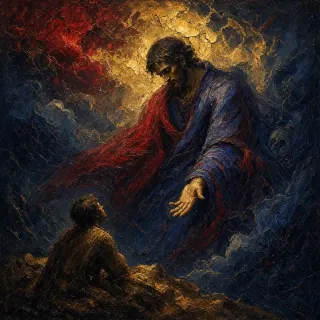
    Then the prayer narrows. From heaven, nations, Moses, and the strong hand of redemption, it comes down to mercy in the sight of this man. That man is the king. Nehemiah's court position explains how such an encounter could happen, but the prayer has already put the emperor in proportion. He holds enormous earthly authority. Before the God of heaven, he is still this man.

    Verse by verse

    1. 1:3

      Reproach means public disgrace, not merely structural damage. The report concerns the condition of the surviving people as well as the city.

    2. 1:5

      Terrible here means awe-inspiring or fearsome. The same description is joined to covenant loyalty and mercy.

    3. 1:11

      Cupbearer identifies a position with direct access to the king. The verse does not describe a formal appointment to rebuild Jerusalem yet.

    Nehemiah 1:1-11: I sat down and wept

    Nehemiah 1:1-11

    King James Version · 11 verses

    1:1The words of Nehemiah the son of Hachaliah. And it came to pass in the month Chisleu, in the twentieth year, as I was in Shushan the palace,

    1:2That Hanani, one of my brethren, came, he and certain men of Judah; and I asked them concerning the Jews that had escaped, which were left of the captivity, and concerning Jerusalem.

    1:3And they said unto me, The remnant that are left of the captivity there in the province are in great affliction and reproach: the wall of Jerusalem also is broken down, and the gates thereof are burned with fire.

    1:4And it came to pass, when I heard these words, that I sat down and wept, and mourned certain days, and fasted, and prayed before the God of heaven,

    1:5And said, I beseech thee, O LORD God of heaven, the great and terrible God, that keepeth covenant and mercy for them that love him and observe his commandments:

    1:6Let thine ear now be attentive, and thine eyes open, that thou mayest hear the prayer of thy servant, which I pray before thee now, day and night, for the children of Israel thy servants, and confess the sins of the children of Israel, which we have sinned against thee: both I and my father’s house have sinned.

    1:7We have dealt very corruptly against thee, and have not kept the commandments, nor the statutes, nor the judgments, which thou commandedst thy servant Moses.

    1:8Remember, I beseech thee, the word that thou commandedst thy servant Moses, saying, If ye transgress, I will scatter you abroad among the nations:

    1:9But if ye turn unto me, and keep my commandments, and do them; though there were of you cast out unto the uttermost part of the heaven, yet will I gather them from thence, and will bring them unto the place that I have chosen to set my name there.

    1:10Now these are thy servants and thy people, whom thou hast redeemed by thy great power, and by thy strong hand.

    1:11O Lord, I beseech thee, let now thine ear be attentive to the prayer of thy servant, and to the prayer of thy servants, who desire to fear thy name: and prosper, I pray thee, thy servant this day, and grant him mercy in the sight of this man. For I was the king’s cupbearer.

  2. 02

    Nehemiah 2:1-8

    So I prayed to the God of heaven

    Four months later the king notices his sadness. Sore afraid, he prays between the question and his reply, and then asks for a date, letters for the governors and timber from the king’s forest.

    A prayer fits between the king's question and Nehemiah's answer. Chapter 1 gave the long petition; this verse records the sudden one without preserving its words. The two are not competing forms of devotion. The man who has prayed through days of grief also prays inside a conversation he cannot control.

    His fear is explicit. Very sore afraid is not the portrait of a courtier strolling casually into an easy request. He speaks first of ancestral graves and burned gates, giving his sorrow a particular place. When permission becomes possible, however, his answers are remarkably practical. He can supply a time. He requests letters for passage and another letter for timber. Gates require beams, and royal approval will need documents when it reaches a provincial official.

    The queen's presence is recorded without an explanation of her influence. The text does not need an invented conversation behind the throne. Its stated explanation comes at the end: the king granted the requests according to the good hand of God upon Nehemiah. That does not erase the letters, the named keeper of the forest, or the planning. The divine hand works through an actual royal decision with actual materials attached. Nehemiah has not merely secured permission to feel concerned. He has asked to go and build.

    Verse by verse

    1. 2:2

      The passage states Nehemiah's fear but gives no decree prescribing death for looking sad. Such a rule should not be invented to intensify the scene.

    2. 2:4

      The words of this brief prayer are not supplied. Its position between question and answer is the detail the account preserves.

    3. 2:8

      Asaph is identified by his responsibility for the king's forest. The timber request includes gates, the city wall, and Nehemiah's accommodation.

    Nehemiah 2:1-8

    King James Version · 8 verses

    2:1And it came to pass in the month Nisan, in the twentieth year of Artaxerxes the king, that wine was before him: and I took up the wine, and gave it unto the king. Now I had not been beforetime sad in his presence.

    2:2Wherefore the king said unto me, Why is thy countenance sad, seeing thou art not sick? this is nothing else but sorrow of heart. Then I was very sore afraid,

    2:3And said unto the king, Let the king live for ever: why should not my countenance be sad, when the city, the place of my fathers’ sepulchres, lieth waste, and the gates thereof are consumed with fire?

    2:4Then the king said unto me, For what dost thou make request? So I prayed to the God of heaven.

    2:5And I said unto the king, If it please the king, and if thy servant have found favour in thy sight, that thou wouldest send me unto Judah, unto the city of my fathers’ sepulchres, that I may build it.

    2:6And the king said unto me, (the queen also sitting by him,) For how long shall thy journey be? and when wilt thou return? So it pleased the king to send me; and I set him a time.

    2:7Moreover I said unto the king, If it please the king, let letters be given me to the governors beyond the river, that they may convey me over till I come into Judah;

    2:8And a letter unto Asaph the keeper of the king’s forest, that he may give me timber to make beams for the gates of the palace which appertained to the house, and for the wall of the city, and for the house that I shall enter into. And the king granted me, according to the good hand of my God upon me.

  3. 03

    Nehemiah 2:11-18

    The night inspection

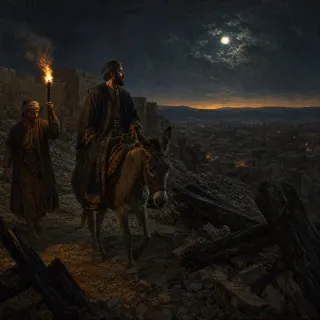
    He tells nobody what God has put in his heart and rides out by night to view the walls, until the beast cannot pass. Only afterwards does he say, come, let us build.

    There is a point at which the animal cannot get through. That small obstruction gives the ruined city more substance than a grand description of devastation would. Nehemiah has royal letters and a purpose he attributes to God, but neither makes the broken ground passable. The work is going to have to deal with the rubble that is actually there.

    His silence is carefully qualified. He has not yet told the leaders what God has put in his heart. This is an inspection before a public proposal, not an ideal of permanent secrecy. A few men accompany him; the account gives no private speech to explain what they think. It records gates, a well, a pool, a brook, and the route back. The city is being examined, not merely admired from a safe viewpoint.

    When Nehemiah finally speaks, the emphasis changes from what he alone has inspected to the distress shared by the whole community. He brings two forms of evidence: God's good hand upon him and the actual words of the king. The people's response then turns the hand language outward. They strengthened their hands for this good work. A burden carried in one heart has become labor accepted by many hands. The walls still need rebuilding, but the work is no longer his alone.

    Verse by verse

    1. 2:12

      The animal is not identified as a horse, donkey, or mule. Only Nehemiah's mount accompanies this small group.

    2. 2:13

      Dragon well is a place-name in the route. The verse does not describe an encounter with a dragon.

    3. 2:16-18

      Not as yet marks temporary withholding of the plan. It is followed by an open appeal and a shared commitment to build.

    Nehemiah 2:11-18

    King James Version · 8 verses

    2:11So I came to Jerusalem, and was there three days.

    2:12And I arose in the night, I and some few men with me; neither told I any man what my God had put in my heart to do at Jerusalem: neither was there any beast with me, save the beast that I rode upon.

    2:13And I went out by night by the gate of the valley, even before the dragon well, and to the dung port, and viewed the walls of Jerusalem, which were broken down, and the gates thereof were consumed with fire.

    2:14Then I went on to the gate of the fountain, and to the king’s pool: but there was no place for the beast that was under me to pass.

    2:15Then went I up in the night by the brook, and viewed the wall, and turned back, and entered by the gate of the valley, and so returned.

    2:16And the rulers knew not whither I went, or what I did; neither had I as yet told it to the Jews, nor to the priests, nor to the nobles, nor to the rulers, nor to the rest that did the work.

    2:17Then said I unto them, Ye see the distress that we are in, how Jerusalem lieth waste, and the gates thereof are burned with fire: come, and let us build up the wall of Jerusalem, that we be no more a reproach.

    2:18Then I told them of the hand of my God which was good upon me; as also the king’s words that he had spoken unto me. And they said, Let us rise up and build. So they strengthened their hands for this good work.

  4. 04

    Nehemiah 4:6-23

    A trowel and a sword

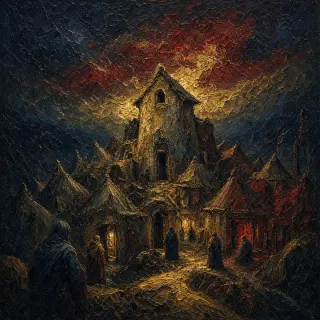
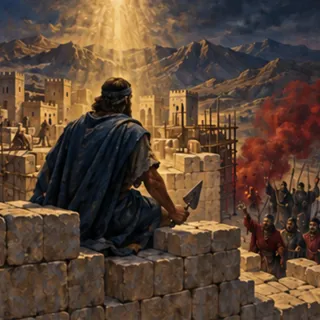
    Half work and half hold spears from the rising of the morning till the stars appear. Every builder has his sword girded by his side, and the trumpeter stays beside Nehemiah.

    The prayer and the watch occupy the same sentence. Nehemiah does not describe one as the respectable alternative to the other. The threat is a planned attack, the laborers are exhausted, and the rubble has not become lighter because the work is worthy. The people can have a mind to work and still have failing strength.

    The defensive arrangements are precise. Families stand together at exposed positions. Half of Nehemiah's servants work while the other half hold weapons and armor. The account pictures hands divided between labor and defense, then specifies that the builders wear swords at their sides. It need not be forced into a painting in which every mason somehow builds permanently with one hand. The point is readiness without abandoning the wall.

    The trumpet answers a different danger: distance. The workers are spread out, one far from another, so a threatened section needs the rest to know where to gather. Nehemiah's declaration that God will fight for them is attached to that assembly signal, not offered instead of it. Even the sleeping arrangements change; men lodge inside Jerusalem to guard by night and labor by day. The chapter ends with clothes kept on, not a victory parade. Its energy is the costly persistence of people who remain at their posts.

    Verse by verse

    1. 4:10

      The complaint names physical exhaustion and accumulated debris. The text does not reduce both to a lack of faith.

    2. 4:16-18

      Habergeons are pieces of body armor. Verse 18 specifies that the builders have swords fastened at their sides.

    3. 4:19-22

      The trumpet is a rallying signal for separated workers. Keeping men inside the city supplies guards at night as well as workers by day.

    Nehemiah 4:6-23: A trowel and a sword

    Nehemiah 4:6-23

    King James Version · 18 verses

    4:6So built we the wall; and all the wall was joined together unto the half thereof: for the people had a mind to work.

    4:7But it came to pass, that when Sanballat, and Tobiah, and the Arabians, and the Ammonites, and the Ashdodites, heard that the walls of Jerusalem were made up, and that the breaches began to be stopped, then they were very wroth,

    4:8And conspired all of them together to come and to fight against Jerusalem, and to hinder it.

    4:9Nevertheless we made our prayer unto our God, and set a watch against them day and night, because of them.

    4:10And Judah said, The strength of the bearers of burdens is decayed, and there is much rubbish; so that we are not able to build the wall.

    4:11And our adversaries said, They shall not know, neither see, till we come in the midst among them, and slay them, and cause the work to cease.

    4:12And it came to pass, that when the Jews which dwelt by them came, they said unto us ten times, From all places whence ye shall return unto us they will be upon you.

    4:13Therefore set I in the lower places behind the wall, and on the higher places, I even set the people after their families with their swords, their spears, and their bows.

    4:14And I looked, and rose up, and said unto the nobles, and to the rulers, and to the rest of the people, Be not ye afraid of them: remember the Lord, which is great and terrible, and fight for your brethren, your sons, and your daughters, your wives, and your houses.

    4:15And it came to pass, when our enemies heard that it was known unto us, and God had brought their counsel to nought, that we returned all of us to the wall, every one unto his work.

    4:16And it came to pass from that time forth, that the half of my servants wrought in the work, and the other half of them held both the spears, the shields, and the bows, and the habergeons; and the rulers were behind all the house of Judah.

    4:17They which builded on the wall, and they that bare burdens, with those that laded, every one with one of his hands wrought in the work, and with the other hand held a weapon.

    4:18For the builders, every one had his sword girded by his side, and so builded. And he that sounded the trumpet was by me.

    4:19And I said unto the nobles, and to the rulers, and to the rest of the people, The work is great and large, and we are separated upon the wall, one far from another.

    4:20In what place therefore ye hear the sound of the trumpet, resort ye thither unto us: our God shall fight for us.

    4:21So we laboured in the work: and half of them held the spears from the rising of the morning till the stars appeared.

    4:22Likewise at the same time said I unto the people, Let every one with his servant lodge within Jerusalem, that in the night they may be a guard to us, and labour on the day.

    4:23So neither I, nor my brethren, nor my servants, nor the men of the guard which followed me, none of us put off our clothes, saving that every one put them off for washing.


  5. 05

    Nehemiah 5:1-13

    Restore to them this day

    The crisis is internal: mortgaged fields and children sold into slavery among their own people. He is angry, calls an assembly, and gives back his own loans first.

    The cry now comes from inside the wall. The enemy does not have to climb it to reach these families; creditors already hold their fields, and some daughters have already entered bondage. The repeated word brethren makes the accusation unbearable. People being defended as one community are being consumed through their debts to one another.

    The complaints are distinct. Some lack grain, some have mortgaged property during scarcity, and some have borrowed to pay the king's tribute. By the time children become the remaining resource, the loss of land has also removed their families' means of buying them back. Nehemiah does not answer hunger with a speech about finishing the building schedule. He becomes very angry, then consults with himself before confronting the nobles publicly. The pause does not cool the charge into politeness. It gives it direction.

    His appeal exposes the reversal: Jews have been redeemed from foreign bondage only to be sold by fellow Jews. He includes his own lending circle in the call to stop the exaction. Then comes the decisive word: restore. The demand names fields, houses, produce, and money, with this day attached. An oath before priests turns the promise into an accountable obligation; shaking out his garment makes the threatened consequence visible. The last sentence matters as much as the public Amen. The people actually do what they promised.

    Verse by verse

    1. 5:3-5

      Dearth means scarcity or famine. The passage distinguishes loans for food from loans to meet the royal tax.

    2. 5:11

      The hundredth part is a specified charge on money and produce. The verse does not state its payment interval, so an annual rate cannot be read directly from it.

    3. 5:12-13

      The promise is confirmed by an oath in the presence of priests and a public symbolic curse. The final clause records performance, not merely agreement.

    Nehemiah 5:1-13

    King James Version · 13 verses

    5:1And there was a great cry of the people and of their wives against their brethren the Jews.

    5:2For there were that said, We, our sons, and our daughters, are many: therefore we take up corn for them, that we may eat, and live.

    5:3Some also there were that said, We have mortgaged our lands, vineyards, and houses, that we might buy corn, because of the dearth.

    5:4There were also that said, We have borrowed money for the king’s tribute, and that upon our lands and vineyards.

    5:5Yet now our flesh is as the flesh of our brethren, our children as their children: and, lo, we bring into bondage our sons and our daughters to be servants, and some of our daughters are brought unto bondage already: neither is it in our power to redeem them; for other men have our lands and vineyards.

    5:6And I was very angry when I heard their cry and these words.

    5:7Then I consulted with myself, and I rebuked the nobles, and the rulers, and said unto them, Ye exact usury, every one of his brother. And I set a great assembly against them.

    5:8And I said unto them, We after our ability have redeemed our brethren the Jews, which were sold unto the heathen; and will ye even sell your brethren? or shall they be sold unto us? Then held they their peace, and found nothing to answer.

    5:9Also I said, It is not good that ye do: ought ye not to walk in the fear of our God because of the reproach of the heathen our enemies?

    5:10I likewise, and my brethren, and my servants, might exact of them money and corn: I pray you, let us leave off this usury.

    5:11Restore, I pray you, to them, even this day, their lands, their vineyards, their oliveyards, and their houses, also the hundredth part of the money, and of the corn, the wine, and the oil, that ye exact of them.

    5:12Then said they, We will restore them, and will require nothing of them; so will we do as thou sayest. Then I called the priests, and took an oath of them, that they should do according to this promise.

    5:13Also I shook my lap, and said, So God shake out every man from his house, and from his labour, that performeth not this promise, even thus be he shaken out, and emptied. And all the congregation said, Amen, and praised the LORD. And the people did according to this promise.

  6. 06

    Nehemiah 6:1-16

    I am doing a great work

    Four invitations to the plain of Ono, then an open letter alleging rebellion, then a hired prophet suggesting he hide in the temple. The wall is finished in fifty-two days.

    Four invitations receive the same answer. Nehemiah does not confuse repetition with a better reason to leave the wall. The account identifies the proposed meeting as a plan to harm him, so his refusal is not a general suspicion of conversation. It is a response to this particular attempt to remove him from the work.

    The fifth approach changes the instrument, not the purpose. An open letter gives the charge of rebellion room to circulate, then offers a meeting as the apparent remedy. The accusation claims that Nehemiah wants a crown and has hired prophets to announce it. His reply refuses the premise. The charge is fabricated, and the desired effect is weakened hands. His prayer asks for the opposite: strengthen my hands. He does not need to become what the letter says in order to answer it.

    Shemaiah's proposal is more dangerous because it wears the language of protection and prophecy. A refuge inside the temple would turn fear into a sinful act and provide the damaging report the opponents need. Nehemiah identifies payment behind the prophecy, and the chapter names other prophetic voices in the intimidation. Religious language is not treated as its own certificate of divine commission. At the end, fifty-two days marks the completed wall, not the disappearance of opposition. The enemies recognize God's work; the following verses still contain their letters.

    Verse by verse

    1. 6:5-8

      The letter's accusation is explicitly denied as an invention. Gashmu is a form of the name Geshem, already mentioned among the opponents.

    2. 6:10-13

      The proposed entry is into the temple building, not merely its public surroundings. Nehemiah says compliance would be sin; Numbers 18:7 supplies the background of restricted priestly access.

    3. 6:15-16

      Fifty-two days dates the wall-building effort, not the whole restoration of Jerusalem. The text attributes the achievement to God while retaining the human labor.

    Nehemiah 6:1-16: I am doing a great work

    Nehemiah 6:1-16

    King James Version · 16 verses

    6:1Now it came to pass, when Sanballat, and Tobiah, and Geshem the Arabian, and the rest of our enemies, heard that I had builded the wall, and that there was no breach left therein; (though at that time I had not set up the doors upon the gates;)

    6:2That Sanballat and Geshem sent unto me, saying, Come, let us meet together in some one of the villages in the plain of Ono. But they thought to do me mischief.

    6:3And I sent messengers unto them, saying, I am doing a great work, so that I cannot come down: why should the work cease, whilst I leave it, and come down to you?

    6:4Yet they sent unto me four times after this sort; and I answered them after the same manner.

    6:5Then sent Sanballat his servant unto me in like manner the fifth time with an open letter in his hand;

    6:6Wherein was written, It is reported among the heathen, and Gashmu saith it, that thou and the Jews think to rebel: for which cause thou buildest the wall, that thou mayest be their king, according to these words.

    6:7And thou hast also appointed prophets to preach of thee at Jerusalem, saying, There is a king in Judah: and now shall it be reported to the king according to these words. Come now therefore, and let us take counsel together.

    6:8Then I sent unto him, saying, There are no such things done as thou sayest, but thou feignest them out of thine own heart.

    6:9For they all made us afraid, saying, Their hands shall be weakened from the work, that it be not done. Now therefore, O God, strengthen my hands.

    6:10Afterward I came unto the house of Shemaiah the son of Delaiah the son of Mehetabeel, who was shut up; and he said, Let us meet together in the house of God, within the temple, and let us shut the doors of the temple: for they will come to slay thee; yea, in the night will they come to slay thee.

    6:11And I said, Should such a man as I flee? and who is there, that, being as I am, would go into the temple to save his life? I will not go in.

    6:12And, lo, I perceived that God had not sent him; but that he pronounced this prophecy against me: for Tobiah and Sanballat had hired him.

    6:13Therefore was he hired, that I should be afraid, and do so, and sin, and that they might have matter for an evil report, that they might reproach me.

    6:14My God, think thou upon Tobiah and Sanballat according to these their works, and on the prophetess Noadiah, and the rest of the prophets, that would have put me in fear.

    6:15So the wall was finished in the twenty and fifth day of the month Elul, in fifty and two days.

    6:16And it came to pass, that when all our enemies heard thereof, and all the heathen that were about us saw these things, they were much cast down in their own eyes: for they perceived that this work was wrought of our God.

Why it matters

Nehemiah is the most practical book in the Old Testament and the most quotable on getting a thing finished. Every household repairs the section in front of its own house. Half the men hold weapons while half build, and every builder has a sword at his side. Asked four times to come down and meet, he sends the same answer: I am doing a great work, so that I cannot come down, why should the work cease while I leave it and come down to you.

17 songs

The music

Every song in the catalogue whose passage falls inside these chapters.

  1. Nehemiah 1:1-13:31

    Nehemiah, Rebuild the Walls

  2. Nehemiah 1:1-11

    The Wall Is Broken Down

  3. Nehemiah 1-12

    The Wall Was Finished

  4. Nehemiah 2:1-20

    Come, Let Us Build the Wall

  5. Nehemiah 2:11-20

    Rise and Build

    Play here
    Open song pageRead lyrics
  6. Nehemiah 3:1-32

    Every Man over against His House

  7. Nehemiah 4:1-23

    A Trowel and a Sword

  8. Nehemiah 5:1-19

    Restore unto Them This Day

  9. Nehemiah 6:1-19

    I Am Doing a Great Work

  10. Nehemiah 7:1-73

    Let Not the Gates Be Opened until the Sun Be Hot

  11. Nehemiah 8:1-12

    The Joy of the LORD Is Your Strength

  12. Nehemiah 8:13-18

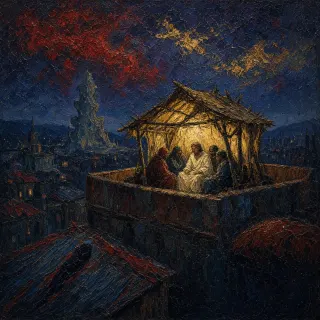
    They Made Booths upon the Roofs

  13. Nehemiah 9:1-38

    Thou Art a God Ready to Pardon

  14. Nehemiah 10:1-39

    We Will Not Forsake the House of Our God

  15. Nehemiah 11:1-12:26

    The Holy City Was Filled Again

  16. Nehemiah 12:27-47

    The Joy of Jerusalem Was Heard Afar Off

  17. Nehemiah 13:1-31

    Remember Me, O My God

Nearby

All the people

Report an error on this page