The big picture
Nehemiah 8 moves the center of action from wall and register to a public reading. The people themselves ask Ezra to bring the law of Moses. Men, women, and all able to understand listen from morning until midday while Ezra stands on a prepared platform and the Levites help make the reading clear. The first response is tears, but the leaders insist that this holy day is to be marked by food, sweet drink, shared portions, and joy. Understanding produces both grief and celebration without making either response permanent. Further study the next day uncovers the command to dwell in booths during the seventh-month feast. Soon roofs, courts, streets, and temple spaces are covered with temporary shelters inside the newly strengthened city. Scripture continues to be read throughout the feast, so the chapter ends with celebration still tied to sustained hearing and understanding.
Central truth
Nehemiah 8 centers the restored community on public hearing and understanding of the law, moving from tears to commanded joy and then into a newly attentive observance of the Feast of Booths.
The study notes have a page of their own
The movement by movement analysis, the words to trace, the verse by verse notes and where readers differ are written for someone studying alone. They are on the Deep Personal Reflections page for this chapter. This page is the lesson.
A chapter-specific teaching brief
These anchors come from this chapter itself. They help a teacher use the Level 1 overview, the Level 2 study, and the Scripture text as one lesson.
Open with the chapter’s first image
Nehemiah 8:1: “And all the people gathered themselves together as one man into the street that was before the water gate; and they spake unto Ezra the scribe to bring the…”
Slow down at the turning point
Nehemiah 8:10: “Then he said unto them, Go your way, eat the fat, and drink the sweet, and send portions unto them for whom nothing is prepared: for this day is holy unto…”
Keep this word trail visible
people, Ezra, LORD, book, booths, branches
What to explain, in order
Teach the passage in this order. Each step names the verses it rests on, so every point can be shown in the text before it is applied.
Nehemiah 8:1-3
The people ask for the book
Begin with who takes the initiative. The people gather "as one man" in the open square by the water gate and ask Ezra to bring the law. Explain that Ezra is both priest and scribe, a man trained in the law (Ezra 7:6, 10). Note the date: the first day of the seventh month, the day of blowing trumpets in Leviticus 23:24. Then read 8:2-3 and stress who listens: men and women and all who can understand, from morning until midday. Teach this first so that learners see a hungry people, not a reluctant audience.
Nehemiah 8:4-6
Standing, Amen and faces to the ground
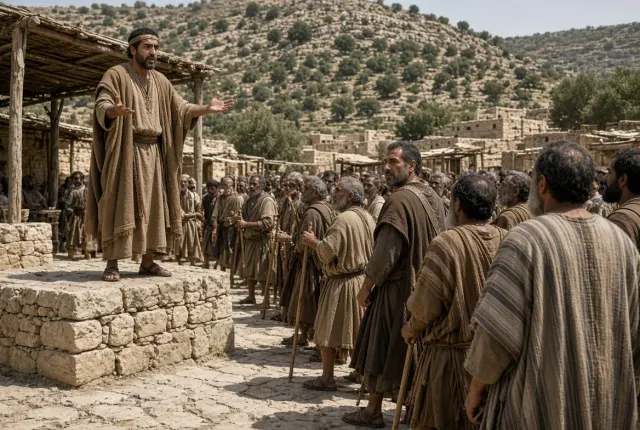
Describe the scene: Ezra on a wooden platform made for the purpose, thirteen men beside him, the book opened in sight of everyone. Explain pulpit here as a raised platform. When he opens it, the people stand. When he blesses the LORD, they answer "Amen, Amen" with lifted hands and then bow to the ground. Help the class see that the posture of the body expresses reverence for God's word. Teach this step here because it shows how the reading was received: as worship, not as a lecture.
Nehemiah 8:7-8
Read distinctly and give the sense
Now name the Levites and their task: they "caused the people to understand the law". Read 8:8 and take its three parts one at a time. Read distinctly, clearly and section by section. Give the sense, explain the meaning. Cause them to understand. Mention that some see translation from Hebrew into Aramaic here and others see explanation; the text makes understanding the point. Teach this carefully, because this verse describes what the teacher in the room is doing, and it shows that understanding is part of hearing.
Nehemiah 8:9-12
Holy joy instead of tears
Explain why the people weep: they hear the law and see how far they have fallen short. The leaders do not tell them their tears are wrong; they tell them what this day is for. Read 8:10 slowly, with its feast, its portions for those with nothing, and its reason, "the joy of the LORD is your strength". Explain the fat and the sweet as rich food and sweet drink. Then 8:12: they rejoice "because they had understood". Teach this as the heart of the chapter: understanding God's word leads through sorrow to joy.
Nehemiah 8:13-18
Booths on every roof
On the second day the leaders study more closely and find the command of Leviticus 23:39-43 to live in booths during the feast. Explain booths as shelters of branches recalling the wilderness journey. Read the list of branches and places in 8:15-16: rooftops, courtyards, temple courts and streets. Then 8:17: nothing like it since the days of Joshua, and "very great gladness". Explain that this probably describes the extent and manner of the keeping, since the feast is mentioned in Ezra 3:4. End with 8:18: reading every day for seven days, then a solemn assembly.
Where learners get stuck
The misreadings this passage tends to produce, and how to answer each from the text.
"The joy of the Lord is your strength means Christians should always feel happy."
The verse is spoken to people who are weeping (8:9), on a holy day set apart for feasting. It does not deny their sorrow; it gives them a reason for joy greater than it, and a practical form for it: eating, drinking and sending "portions unto them for whom nothing is prepared" (8:10). Chapter 9 will bring them back to mourning and confession in its right time. Joy here is a gift rooted in God, not a demand to hide grief, and the teacher should say that plainly.
"Only scholars and leaders need to understand the Bible; ordinary people just listen."
The chapter says the opposite. The people ask for the book (8:1), women and men and all who can understand hear it (8:2-3), and the Levites work so that the people "understand the reading" (8:8). The people rejoice "because they had understood the words that were declared unto them" (8:12). Understanding is expected of everyone, and teachers exist to serve it. The heads of families then study more closely (8:13), but in order to teach the rest.
"Verse 17 means no one had kept the Feast of Booths for nearly a thousand years."
The verse says that since the days of Joshua "had not the children of Israel done so", but Ezra 3:4 records the returned exiles keeping the feast of tabernacles, and 2 Chronicles 8:13 mentions it under Solomon. So most readers take 8:17 to mean the feast had not been kept in this manner, with the whole community living in booths throughout the city with such joy. The text does not explain more. Teach the gladness as the point, not a gap in the record.
"If the people were weeping, they must have been doing something wrong."
Their tears are a response to hearing the law: "For all the people wept, when they heard the words of the law" (8:9). That is not wrong; it shows they understood. The leaders redirect them because of the day, "This day is holy unto the LORD your God", and chapter 9 later gives a full day to fasting and confession. The Book of Nehemiah has a time for both. Let learners who have wept at Scripture hear that it can be a sign of hearing well.
Learning objectives
- Describe who gathers at the Water Gate and who asks Ezra to bring the law.
- Identify the repeated emphasis on hearing and understanding.
- Explain the people’s physical responses when Ezra opens, blesses, and reads the book.
- State why Nehemiah, Ezra, and the Levites tell the people not to mourn that day.
- Trace how the leaders’ second-day study leads to the making of booths.
- Explain what the chapter claims about the feast without overstating what earlier generations had never done.
Teacher preparation
- Explain the seventh month: the reading begins on its first day and the Feast of Booths comes later that month.
- Note that the people initiate the request in verse 1 rather than Ezra imposing the reading.
- Flag KJV 'gave the sense' in verse 8. Understanding is certain; translation into Aramaic is debated.
- Read Leviticus 23:33 to 43 for the feast and booths behind verses 14 to 18.
- Treat verse 17 as an extraordinary manner of observance, not proof that no booth feast occurred for centuries.
Evidence and interpretation checks
Explicit
Verses 1 to 8 emphasize hearing and understanding; verses 9 to 12 command celebration; verses 13 to 18 describe study and booth-making.
Scripture-supported
Leviticus 23:39 to 43 commands the feast and dwelling in booths, matching the law discovered in Nehemiah 8:14.
Strong inference
The people’s weeping likely reflects conviction under the law, but the passage does not state the thought behind every tear.
Possible or traditional reading
Some take verse 8 to include Aramaic translation; others see explanation or clear reading. Comprehension is the firm point.
Limit
Verse 17 need not mean no Israelites observed the feast since Joshua; other biblical texts report later observance.
Discussion with answer guidance
1. Who asks Ezra to bring the law?
What a good answer contains
The people do. The text says "all the people gathered themselves together as one man" at the water gate, "and they spake unto Ezra the scribe to bring the book of the law of Moses" (8:1). Ezra does not summon them; they ask for the book. A good answer notices "as one man" and the setting in a public street rather than the temple courts. A strong answer connects it with 7:73, the seventh month and the people settled in their towns. A weak answer says Nehemiah ordered everyone to come and listen.
Show teacher guidance
Verse 1 says all the people gathered as one and told Ezra to bring it.
2. Who is included in the audience?
What a good answer contains
Ezra reads before "the congregation both of men and women, and all that could hear with understanding" (8:2). Verse 3 repeats it: "before the men and the women, and those that could understand". The audience includes everyone old enough to follow, which would take in older children. A good answer notices the repeated stress on understanding and on women as well as men. A strong answer sees that the hearing goes on "from the morning until midday", hours of attention. A weak answer pictures only priests and leaders present.
Show teacher guidance
Verse 2 includes men, women, and all who could hear with understanding.
3. What happens when Ezra opens the book?
What a good answer contains
When Ezra opens the book, "all the people stood up" (8:5). Then "Ezra blessed the LORD, the great God. And all the people answered, Amen, Amen, with lifting up their hands: and they bowed their heads, and worshipped the LORD with their faces to the ground" (8:6). A good answer lists the actions in order: standing, the double Amen, lifted hands, bowed heads, faces to the ground. A strong answer notices that the people respond to God, not to Ezra, and that the reading is treated as worship. A weak answer thinks they stood up only to see better.
Show teacher guidance
The people stand, answer 'Amen, Amen,' lift their hands, bow, and worship.
4. What do the Levites contribute?
What a good answer contains
They "caused the people to understand the law" (8:7). Verse 8 explains how: "So they read in the book in the law of God distinctly, and gave the sense, and caused them to understand the reading." Reading clearly, explaining the meaning, and making sure it was understood. A good answer names all three. A strong answer notes that some think "distinctly" includes translation into Aramaic, the everyday language of many, while others take it as clear reading in sections; understanding is certain either way. A weak answer says the Levites only kept order.
Show teacher guidance
They help the people understand while the reading is made distinctly and the sense is given.
5. Why are the people told not to mourn?
What a good answer contains
"This day is holy unto the LORD your God; mourn not, nor weep" (8:9). The people are weeping at what they hear, but a holy day of the seventh month is for feasting. Nehemiah sends them to "eat the fat, and drink the sweet, and send portions unto them for whom nothing is prepared", and gives the reason, "for the joy of the LORD is your strength" (8:10). A good answer sees that the tears are not mocked but redirected. A strong answer ends with 8:12: they rejoice "because they had understood the words".
Show teacher guidance
The day is holy, and they are directed toward food, drink, shared portions, and joy.
6. What changes on the second day?
What a good answer contains
On the second day the heads of families, priests and Levites gather to Ezra "even to understand the words of the law" (8:13), a smaller group studying closely. They find the command to dwell in booths at the feast of the seventh month (8:14), proclaim it, and the people gather branches and build booths everywhere (8:15-16). A good answer follows the chain: study, discovery, proclamation, obedience. A strong answer notices how quickly the people act on what they learned. A weak answer skips from the reading to the feast.
Show teacher guidance
Leaders return to understand the law, discover the booth command, proclaim it, and the people act.
Responsible application
Heart and habits
Put understanding beside reading. The chapter treats comprehension as part of faithful hearing.
Relationships and community
Notice the command to send portions to those for whom nothing is prepared.
From text to booth
Trace verses 13 to 16: study, discovery, proclamation, branches, and building.
Session plans
Two timings of the same lesson. The shorter keeps the reading, the central discussion and one response; the longer gives the confusions and the application their own time.
45 minutes
The people ask
Read 8:1-3. Ask questions one and two and take confusion two.
Standing and Amen
Read 8:4-6 and ask question three. Have the class stand for the reading of 8:6.
Giving the sense
Read 8:7-8 and ask question four.
Tears and joy
Read 8:9-12. Ask question five and take confusions one and four.
Booths
Read 8:13-18 and ask question six. Take confusion three.
Handout
Read the key verse together, give out the handout and pray.
90 minutes
Hearing well
Ask the class to describe a time they truly understood something read to them and what made the difference.
The people ask
Read 8:1-3 with 7:73 and Leviticus 23:24. Ask questions one and two.
Standing and Amen
Read 8:4-6 and ask question three. Take confusion two.
Giving the sense
Read 8:7-8 and ask question four. Have pairs explain one verse of the chapter to each other in their own words.
Tears and joy
Read 8:9-12. Ask question five and take confusions one and four.
Booths on every roof
Read Leviticus 23:39-43 and Nehemiah 8:13-17. Ask question six and take confusion three.
Portions for those with nothing
Read 8:10 and 8:12 again and use the application on sending portions. Plan one real act of sharing.
Response and handout
Read 8:18 and the key verse together, give out the handout and pray.
Adapting the lesson
Children
Build a small booth with sticks, a sheet or branches, and sit in it while you read 8:14-17. Explain that God's people remembered how he cared for them in the wilderness. Practise standing when the Bible is opened and saying Amen. Read 8:10 and plan to share a snack with someone. Keep the weeping simple: they were sorry when they heard God's words, and then God gave them joy.
Youth
Ask how long they could listen to someone reading, then point out the people listened from morning until midday (8:3). Look at what the Levites did in 8:8 and ask what helps them understand the Bible. Read 8:9-10 and talk about how sorrow and joy can both be right responses to God's word. Invite them to explain one verse to a friend.
Adults
Spend time on 8:8 as a description of good teaching, and ask how the group could read Scripture more distinctly and with more understanding. Discuss the movement from tears to joy without pressing anyone to feel either. Give time to 8:10 and the portions sent to those with nothing; some in the room may be the ones for whom nothing is prepared, so speak with care.
One to one
Read 8:1-12 together, slowly. Ask the person what happens in them when they read God's word: nothing, guilt, comfort, confusion. Then work together on one verse, reading it carefully and putting its sense into plain words, the way the Levites did. If they are weighed down with guilt, read 8:10 and let it speak.
Song and video learning lab
A song or video may interpret, compress, or dramatize the text. Its value becomes clearer when its choices are compared with Scripture.
- Before the media: the exact passage and its central movement.
- During the media: the words, people, events, and emotions the artist emphasizes.
- After the media: what it clarifies, what it leaves out, and what belongs back in the biblical text.
Handout
One page for learners to take home. The print button prints this section alone.
Nehemiah 8:1–18
The passage in brief
In the seventh month the people gathered in Jerusalem and asked Ezra to bring the book of God's law. He read it from morning until midday to men, women and all who could understand, while the Levites explained it. The people worshipped and wept. Nehemiah and Ezra told them not to mourn on this holy day, but to feast and share with those who had nothing, because the joy of the Lord was their strength. Then they built booths and celebrated the feast with great joy.
A verse to keep
So they read in the book in the law of God distinctly, and gave the sense, and caused them to understand the reading.
Nehemiah 8:8 · King James Version
Questions to take home
Who asked for the book of the law in 8:1?
What three things did the Levites do in 8:8?
Why were the people told not to weep in 8:9-10?
This week
This week, read one passage of the Bible slowly until you can explain it, then share something with a person who has less.
Music and video connected to the passage
Related media appears when its Scripture reference overlaps this study. Music and video can illuminate a theme while the biblical text remains the foundation.