
The big picture
The wall and its gates are finally in place, but Nehemiah 7 immediately exposes what stone cannot supply. Jerusalem needs trustworthy oversight, disciplined watches, inhabited houses, and enough people to make a large city live. Nehemiah appoints Hanani and Hananiah, restricts the opening of the gates, and places residents on watch near their homes. Then he confronts the city's thin population and turns to genealogy. An earlier register of returnees brings families, towns, priests, Levites, singers, gatekeepers, temple servants, uncertain ancestry, transport animals, and contributions into view. The list is not a detour from restoration. It shows what the wall exists to contain and serve. A defended capital without a rooted population remains unfinished. By the close, Israel is settled in its cities as the seventh month approaches, preparing the public gathering that will dominate chapter 8.
Central truth
Nehemiah 7 moves from rebuilding a wall to securing and repopulating a city, appointing trustworthy gate leadership and using a recovered genealogy to identify the returned community.

The study notes have a page of their own
The movement by movement analysis, the words to trace, the verse by verse notes and where readers differ are written for someone studying alone. They are on the Deep Personal Reflections page for this chapter. This page is the lesson.
A chapter-specific teaching brief
These anchors come from this chapter itself. They help a teacher use the Level 1 overview, the Level 2 study, and the Scripture text as one lesson.
Open with the chapter’s first image
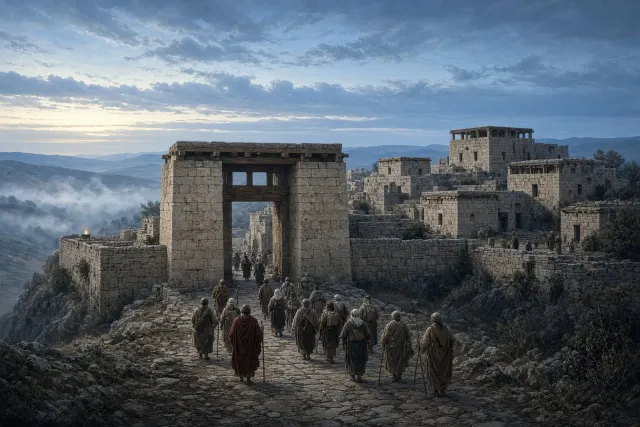
Nehemiah 7:1: “Now it came to pass, when the wall was built, and I had set up the doors, and the porters and the singers and the Levites were appointed,”
Slow down at the turning point
Nehemiah 7:4: “Now the city was large and great: but the people were few therein, and the houses were not builded.”
Keep this word trail visible
children, twenty, forty, seven, eight, five
What to explain, in order
Teach the passage in this order. Each step names the verses it rests on, so every point can be shown in the text before it is applied.
Nehemiah 7:1-3
Doors, guards and trustworthy men
Begin with what changes now that the wall is built: doors are hung and people appointed to the gates. Explain porters as gatekeepers. Nehemiah gives charge of Jerusalem to Hanani and to Hananiah, and the reason is character, "a faithful man, and feared God above many". Some readers take the two names as one man; most take them as two. Then read the gate rules in 7:3 and explain each. Teach this first because it shows that a finished wall needs faithful people to keep it, which is the concern of the rest of the book.
Nehemiah 7:4-5
A large city with few people
Read 7:4 slowly and let the class picture it: a big walled space with empty plots and few houses. That is the problem the register serves. Then 7:5: "my God put into mine heart". Notice that Nehemiah treats a practical idea, a census, as God's prompting, just as the rebuilding was in 2:12. He finds the old register of the first return. Explain genealogy here as the record of family descent that tied people to their towns, their land and, for priests, their office. Teach this step before the list so learners know why it is there.
Nehemiah 7:6-38
Families and towns of the first return
Read the heading in 7:6-7 and a sample of the entries, not all of them. The list records the leaders who came with Zerubbabel and then families by ancestor, "The children of Parosh", and groups by town, Bethlehem, Anathoth, Jericho and others. Tell the class that the same register appears in Ezra 2 with some differences in numbers and names. Do not stop to reconcile every figure. The point to teach is continuity: the people now in Judah are the same community that came back about ninety years earlier, still known by family and place.
Nehemiah 7:39-60
Priests, Levites, singers and servants
Now read the groups who serve in worship: priests of four families, the seventy four Levites, the singers of Asaph, the porters, the Nethinims or temple servants, and the children of Solomon's servants. Ask the class to compare the four thousand priests with the seventy four Levites. Explain that these groups had distinct duties, and that 7:1 has just appointed porters, singers and Levites for the gates. Teach this here because the list prepares for chapters 8 to 12, where these very groups will read, teach, sing and keep the gates.
Nehemiah 7:61-65
Those who could not prove descent
Slow down for the hardest part of the list. One group cannot prove they are of Israel, yet they are counted. A priestly group cannot find their register and are kept from priestly service and the most holy food until a priest can consult Urim and Thummim. Explain Tirshatha as the governor's title, and Urim and Thummim as the priestly means of seeking God's decision (Exodus 28:30). Teach that the ruling is provisional and about service, not about worth. The Book of Nehemiah guards holy things without casting these people out.
Nehemiah 7:66-73
The whole company and the seventh month
Read the total, 42,360, the servants and the 245 singers counted beside it, and the animals. Then the gifts of 7:70-72: the governor, the heads of families and the rest of the people all give to the work. Close with 7:73: everyone in their cities, and "when the seventh month came". Explain that this line leads directly into chapter 8, which opens in the seventh month. End here so the class sees the register give way to an assembly: the people have been counted, and next they will be gathered to hear the law.
Where learners get stuck
The misreadings this passage tends to produce, and how to answer each from the text.
"Nehemiah 7 is just Ezra 2 again, so we can skip it."
The Book of Nehemiah uses the same register for a new purpose. In Ezra 2 it records who came back; here it is recovered because "the city was large and great: but the people were few therein" (7:4), and God has put it in Nehemiah's heart to gather the people (7:5). The list answers a present need, and it leads into the great assembly of chapter 8. Read a sample rather than skipping it, and tell the class why it stands here.
"The numbers in Nehemiah 7 and Ezra 2 don't match, so the Bible is unreliable."
Some figures differ, and both lists give the same total, 42,360 (7:66, Ezra 2:64), while their entries add to less. Name that honestly. Readers explain it in more than one way: errors in copying numerals, which are easily confused, records updated at different times, or people counted in the total but not itemised. The text itself does not say. Do not pretend there is no difference, and do not build a lesson on it; the shape of the community is the same in both.
"The priests without records were thrown out because they were sinful."
The word polluted in 7:64 refers to ritual qualification for priestly office, not to moral filth. They "sought their register" and it was not found, so they were kept from priestly service and from "the most holy things" until a priest could ask God with Urim and Thummim (7:65). It is a decision deferred, not a verdict on their character. The families who could not prove they were of Israel were still counted (7:61-62). Teach the care the text takes not to say more than it knows.
"Hananiah was chosen because he was good at the job."
Verse 2 gives a different reason: "he was a faithful man, and feared God above many". Competence matters, and he already held a post as ruler of the fortress, but the Book of Nehemiah records character as the reason for entrusting the city to him. That is worth teaching in a culture that often promotes ability alone. Let learners notice what is said and what is not, without making it a rule that skill never counts.
Learning objectives
- Explain why gatekeepers are appointed immediately after the wall doors are set.
- Identify the qualities attributed to Hananiah in verse 2.
- Describe the unusual gate-opening instructions in verse 3.
- Explain why Nehemiah gathers nobles, rulers, and people by genealogy.
- Identify what happens to priests who cannot locate their family register.
- Distinguish the chapter’s registered population from the chapter’s larger purpose.
Teacher preparation
- Explain that genealogical registers establish family identity and, for priests, eligibility for office.
- Compare the register with Ezra 2. The lists are closely related but contain numerical and naming differences.
- Mark verse 4: Jerusalem is large, the people few, and houses not built.
- Explain KJV 'Tirshatha' as the governor, a Persian-period title.
- Read verses 64 to 65 carefully: priests without a register are excluded pending a decision by Urim and Thummim.
Evidence and interpretation checks
Explicit
Verses 1 to 3 name gate personnel and security rules; verses 5 to 73 reproduce a register of returned families and resources.
Scripture-supported
Ezra 2 preserves a closely parallel return list in the same return-from-exile setting.
Strong inference
Late opening and guarded closing of the gates reflect continuing security concern, though no attack is reported.
Possible or traditional reading
Differences between Nehemiah 7 and Ezra 2 have several proposed explanations; neither passage gives an explicit harmonization.
Limit
The list does not supply biographies for each family, and its totals should not be forced into precision the component figures do not always make simple.
Discussion with answer guidance
1. Why does the city still need organization after the wall is complete?
What a good answer contains
Because a wall does not make a city. The doors are set and porters, singers and Levites appointed (7:1), but the gates still need rules and watchmen (7:3), and above all people: "the city was large and great: but the people were few therein, and the houses were not builded" (7:4). A good answer names both needs, security and population. A strong answer sees that the genealogy of 7:5 is the first step toward filling the city, which 11:1-2 completes. A weak answer thinks the work ended when the last stone was laid.
Show teacher guidance
Expect gate security and the large-city, small-population problem in verses 1 to 4.
2. Why is Hananiah trusted?
What a good answer contains
Verse 2 gives the reason directly: "for he was a faithful man, and feared God above many." Nehemiah does not mention skill, family or popularity, though Hananiah already holds office as "the ruler of the palace", the commander of the fortress by the temple. A good answer notices that faithfulness and the fear of God are the qualities chosen for the city's security. A strong answer links it with 5:15, where Nehemiah himself acted "because of the fear of God". A weak answer guesses he was trusted because he was Nehemiah's relative.
Show teacher guidance
Verse 2 calls him faithful and says he feared God above many.
3. What are the gate instructions?
What a good answer contains
"Let not the gates of Jerusalem be opened until the sun be hot" (7:3), that is, well into the morning, not at first light when an attack could come unseen. The doors are to be shut and barred while the guards still stand by them, and the inhabitants keep watches, "every one in his watch, and every one to be over against his house". A good answer lists all three: late opening, guarded closing, and household watches. A strong answer connects the last with the builders near their houses in chapter 3. A weak answer says only that the gates were locked.
Show teacher guidance
Open after the sun is hot, shut and bar while guards are present, and assign resident watches.
4. What starts the genealogy project?
What a good answer contains
"And my God put into mine heart to gather together the nobles, and the rulers, and the people, that they might be reckoned by genealogy" (7:5). Nehemiah attributes the idea to God, and then he finds an old register "of them which came up at the first". A good answer notices both: God prompts, and an existing document serves the purpose. A strong answer links "put into mine heart" with 2:12, where God had put the rebuilding in his heart. A weak answer says Nehemiah made up a new list of his own.
Show teacher guidance
Verse 5 says God puts it into Nehemiah’s heart to gather the people by genealogy.
5. What problem appears in verses 61 to 65?
What a good answer contains
Some families "could not shew their father's house, nor their seed, whether they were of Israel" (7:61), yet 642 of them are counted (7:62). Priestly families sought their register, "but it was not found: therefore were they, as polluted, put from the priesthood" (7:64). Polluted here means ritually unqualified. The Tirshatha, the governor, rules that they must not eat "of the most holy things, till there stood up a priest with Urim and Thummim" (7:65). A good answer distinguishes the two groups. A weak answer says all of them were expelled.
Show teacher guidance
Some cannot prove descent, including priestly claimants excluded from service pending a decision.
6. Why does verse 4 matter to the list?
What a good answer contains
It tells the reader why Nehemiah is gathering this register now. Jerusalem has walls but few residents and few houses (7:4), so the people must be known, by family and town, before anyone can be asked to move into the city. A good answer reads the list as practical as well as historical: it is a census for a resettlement. A strong answer points to 11:1, where one in ten is chosen by lot to live in Jerusalem. A weak answer treats the list as an old document copied in for no present reason.
Show teacher guidance
The city is large but thinly populated, so registration serves a present civic need.
Responsible application
Heart and habits
Notice the move from dramatic building to patient administration: gates, rosters, records, and appointments.
Relationships and community
Ask what makes Hananiah noteworthy. The text names faithfulness and fear of God, not charisma.
Read the register as evidence
Sample five lines and classify each as family, town, office, disputed descent, servants, animals, or gifts.
Session plans
Two timings of the same lesson. The shorter keeps the reading, the central discussion and one response; the longer gives the confusions and the application their own time.
45 minutes
Doors and guards
Read 7:1-3 and ask questions two and three. Take confusion four.
Large and empty
Read 7:4-5 and ask questions one, four and six.
Families and towns
Read 7:6-12 and 7:25-33 as a sample. Take confusion one.
Those who serve
Read 7:39-45 and compare the priests and Levites.
Missing records
Read 7:61-65 and ask question five. Take confusion three.
Numbers and gifts
Read 7:66-73 and take confusion two briefly.
Handout
Read the key verse together and give out the handout.
90 minutes
After the build
Ask the class what still needs doing when a new house is finished. List answers, then read 7:1.
Faithful men at the gates
Read 7:1-3. Ask questions two and three and take confusion four.
A city without people
Read 7:4-5 with 2:12. Ask questions one, four and six, and point ahead to 11:1-2.
Families and towns
Read selected entries from 7:6-38 and mark towns on a map of Judah. Take confusion one.
Those who serve
Read 7:39-60 in part. Compare priests and Levites and connect the groups to 7:1.
Missing records
Read 7:61-65 with Exodus 28:30. Ask question five and take confusion three.
Totals, gifts and the seventh month
Read 7:66-73 and set Ezra 2:64-67 beside it. Take confusion two and read 8:1 to show what comes next.
Response and handout
Use the application on patient administration, read the key verse together, give out the handout and pray.
Adapting the lesson
Children
Make a pretend city with blocks and put only a few toy people inside. Ask what is wrong with it. Then read 7:4 and explain that Nehemiah needed to know who everyone was so the city could fill up. Read a few family names and town names aloud and let children repeat them. Keep the priests without records simple: they waited for an answer before they could serve.
Youth
Ask how many records exist about them: school, phone, social media. Then read 7:5 and talk about why a family record mattered so much to people who had come back from exile. Look at Hananiah in 7:2 and ask what being "faithful" and fearing God look like at their age. Keep any discussion of identity documents general and away from current immigration debates.
Adults
Give time to the purpose of the register in 7:4-5, and to the honest handling of the differences with Ezra 2. Discuss what makes a person trustworthy with responsibility, using 7:2. Some adults have lost family records, been adopted or migrated; the passage about those who could not prove descent can touch them, so let 7:61-62 show people counted even without proof.
One to one
Read 7:1-5 and 7:61-66 together. Ask where the person feels they belong and whether that is settled or uncertain for them. If it is painful, show that those without records in 7:61-62 were still counted with the people. Then ask what faithfulness, like Hananiah's, might look like in the responsibility they carry now.
Song and video learning lab
A song or video may interpret, compress, or dramatize the text. Its value becomes clearer when its choices are compared with Scripture.
- Before the media: the exact passage and its central movement.
- During the media: the words, people, events, and emotions the artist emphasizes.
- After the media: what it clarifies, what it leaves out, and what belongs back in the biblical text.
Handout
One page for learners to take home. The print button prints this section alone.
Nehemiah 7:1–73
The passage in brief
When the wall was finished, Nehemiah set guards at the gates and put Jerusalem in the care of two men, one of them chosen because he was faithful and feared God. The city was large but almost empty. God moved Nehemiah to gather the people and record their families, and he found the old list of those who first came back from exile. It names families, towns, priests, Levites, singers and temple servants. Some could not prove their families, but they were still counted.
A verse to keep
That I gave my brother Hanani, and Hananiah the ruler of the palace, charge over Jerusalem: for he was a faithful man, and feared God above many.
Nehemiah 7:2 · King James Version
Questions to take home
Why did Nehemiah trust Hananiah in 7:2?
What problem does 7:4 describe in Jerusalem?
What happened to the priests who could not find their records in 7:64-65?
This week
This week, be faithful in one small, unseen task you have been given, the way a gatekeeper keeps his post.
Music and video connected to the passage
Related media appears when its Scripture reference overlaps this study. Music and video can illuminate a theme while the biblical text remains the foundation.