The big picture
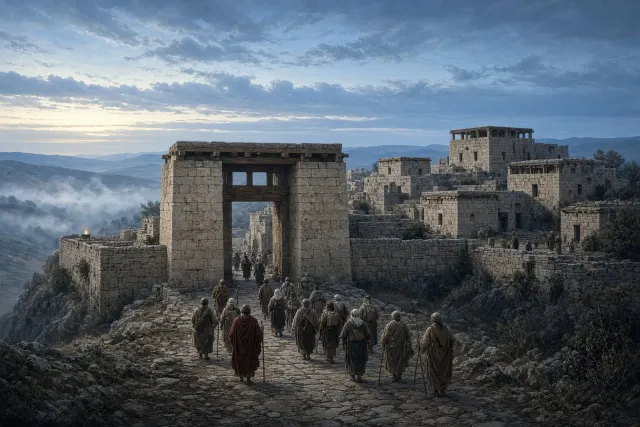
The wall and its gates are finally in place, but Nehemiah 7 immediately exposes what stone cannot supply. Jerusalem needs trustworthy oversight, disciplined watches, inhabited houses, and enough people to make a large city live. Nehemiah appoints Hanani and Hananiah, restricts the opening of the gates, and places residents on watch near their homes. Then he confronts the city's thin population and turns to genealogy. An earlier register of returnees brings families, towns, priests, Levites, singers, gatekeepers, temple servants, uncertain ancestry, transport animals, and contributions into view. The list is not a detour from restoration. It shows what the wall exists to contain and serve. A defended capital without a rooted population remains unfinished. By the close, Israel is settled in its cities as the seventh month approaches, preparing the public gathering that will dominate chapter 8.
In this chapter
- Security Cannot Supply a Population Nehemiah 7:1-5
A finished wall creates a new problem almost immediately: how to run the city it encloses.
- Families and Places Retain Their Names Nehemiah 7:6-38
The register begins by remembering people who were carried away by Nebuchadnezzar and later returned to Jerusalem, Judah, and their own cities.
- Worship Has a Workforce Nehemiah 7:39-60
When the register turns to worship, it does not stop with priests.
- Missing Evidence Limits Priestly Claims Nehemiah 7:61-65
Not every genealogical claim can be verified, and the Book of Nehemiah leaves that uncertainty visible.
- People, Animals, and Contributions Nehemiah 7:66-73
The register ends by putting bodies, transport, and money back around the names.
Scripture beside the summary
Nehemiah · King James Version · 73Nehemiah 7:1-5
Security Cannot Supply a Population
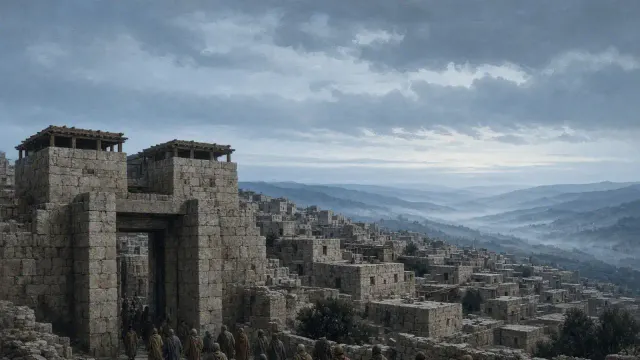
A finished wall creates a new problem almost immediately: how to run the city it encloses. Nehemiah appoints his brother Hanani and Hananiah, a man singled out for faithfulness and unusual fear of God, to responsibility over Jerusalem. Gate opening is delayed until the sun is hot, closing is supervised, and watches are assigned among residents, including positions opposite their own houses. The Book of Nehemiah does not treat completion as permission to relax every precaution. Then comes the more basic difficulty. Jerusalem is "large and great," but the people are few and houses remain unbuilt. Security cannot manufacture a population. Nehemiah's next movement is therefore genealogical rather than architectural. He gathers nobles, rulers, and people and finds an earlier register of returnees. The restoration question has shifted from where the wall stands to who belongs inside the life it protects.
Deep dive
The chapter distinguishes a finished perimeter from an established city. Gates and gatekeepers are in place, yet the people are few and houses remain unbuilt. Nehemiah's instructions delay opening until the sun is hot and require supervised closing and neighborhood watches. This is not the posture of a city that believes masonry has removed every danger.
Hananiah's stated qualifications are faithfulness and an unusual fear of God. His responsibility is described alongside Hanani's, reconnecting the government of Jerusalem to the brother whose report began the book. The next step is genealogical rather than architectural. Nehemiah attributes the impulse to gather the community to God, then finds a register of those who first returned. The historical record becomes a resource for present organization. What follows is therefore not simply a head count of the people currently living inside the wall; it is an earlier return list introduced within the problem of a city needing inhabitants.
Words to trace: Jerusalem, doors, genealogy, people, appoint, appointed
Verse-by-verse path
- Nehemiah 7:1
The doors left unhung in 6:1 are now in place. Porters belong at gates, but singers and Levites were temple staff, and posting them to the city’s gates is unusual; in 13:22 Nehemiah will again set Levites to keep the gates on the sabbath. The house of God lends its people to guard the city.
- Nehemiah 7:2
“The palace” is the birah, the fortress beside the temple for whose beams Nehemiah asked the king in 2:8; its site later held Herod’s Antonia. Hanani is the brother whose report opened the book (1:2), so the man who brought the bad news now keeps the city he described.
- Nehemiah 7:3
Gates normally opened at first light. Waiting until the sun is hot, mid-morning, means no one is let in while the city is half asleep. The phrase rendered “while they stand by” is obscure in the Hebrew; it may mean the gates are shut while the guards are still at their posts. A man watching opposite his own door has every reason to stay awake.
- Nehemiah 7:4
“Large and great” is literally “wide on both hands”, broad in every direction. The houses “not builded” means empty plots and ruins inside the circuit, not a city with no homes at all. The remedy comes in 11:1, when a tenth of the people are chosen by lot to move in.
- Nehemiah 7:5
“My God put into mine heart” is the phrase of 2:12, where Nehemiah kept secret what God had put in his heart for Jerusalem. He finds twice: he finds the register, then finds what is written in it. What follows is a document quoted, almost word for word the list in Ezra 2.
Nehemiah 7:1-5
King James Version1Now it came to pass, when the wall was built, and I had set up the doors, and the porters and the singers and the Levites were appointed,
2That I gave my brother Hanani, and Hananiah the ruler of the palace, charge over Jerusalem: for he was a faithful man, and feared God above many.
3And I said unto them, Let not the gates of Jerusalem be opened until the sun be hot; and while they stand by, let them shut the doors, and bar them: and appoint watches of the inhabitants of Jerusalem, every one in his watch, and every one to be over against his house.
4Now the city was large and great: but the people were few therein, and the houses were not builded.
5And my God put into mine heart to gather together the nobles, and the rulers, and the people, that they might be reckoned by genealogy. And I found a register of the genealogy of them which came up at the first, and found written therein,
Nehemiah 7:6-38
Families and Places Retain Their Names
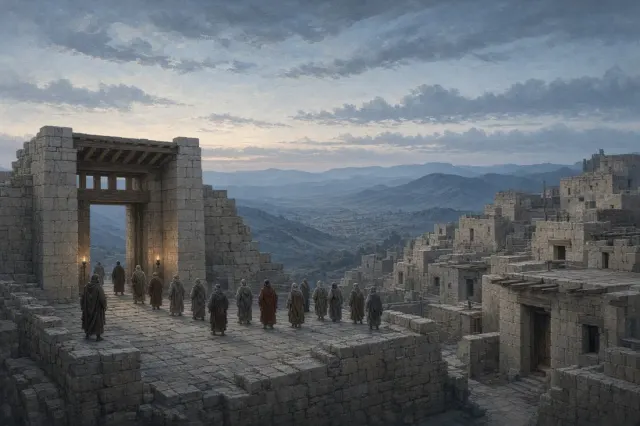
The register begins by remembering people who were carried away by Nebuchadnezzar and later returned to Jerusalem, Judah, and their own cities. Some groups are named by ancestral house, others by town. The mixture matters because exile disrupted both family continuity and place, and the list preserves both forms of memory. Large households sit beside small ones without comment, resisting the temptation to turn "the returnees" into a single anonymous mass. Names such as Nehemiah and Mordecai also require restraint. The register itself does not identify those men with the governor of this book or the Mordecai in Esther, and a shared name cannot do that work alone. What the Book of Nehemiah needs from this older document is not celebrity recognition. It needs a remembered population with identifiable roots in a land whose restored capital still does not have enough residents.
Deep dive
The introductory language joins displacement and resettlement: people taken by Nebuchadnezzar return to their own cities. Some entries identify ancestral houses, others towns and villages. The mixture preserves more than numerical size. It locates the community through both kinship and place, two forms of continuity that exile had disrupted.
The names Nehemiah and Mordecai occur among the earlier leaders, but the register does not identify them with the cupbearer or with the man in Esther. Shared names cannot bear that conclusion by themselves. Nor does the long sequence mean that every group is equally large or similarly situated. Its deliberately particular form resists turning the returning population into an undifferentiated crowd. For the book's present concern, these are people with remembered connections to a land whose capital is still underoccupied.
Words to trace: children, twenty, eight, fifty, forty, seven
Verse-by-verse path
- Nehemiah 7:6
“Children of the province” uses medinah, a Persian administrative district. Judah returns as a province of the empire, not a kingdom, and the list is careful to name Nebuchadnezzar as the one who carried the fathers away. “Every one unto his city” describes families reclaiming their home towns, which is why so many entries that follow are places.
- Nehemiah 7:7
Nehemiah’s copy names twelve leaders where Ezra 2:2 names eleven; Nahamani is the extra name. Twelve returning leaders sound like a deliberate echo of the twelve tribes, as the twelve he goats offered at the temple’s dedication were “according to the number of the tribes” (Ezra 6:17). Several names differ slightly between the two copies, Azariah for Seraiah, Nehum for Rehum.
- Nehemiah 7:8
Parosh means “flea”, the word David uses of himself before Saul (1 Samuel 24:14). It heads the lay families and is among the largest. The family keeps turning up: more of them come with Ezra (Ezra 8:3), Pedaiah son of Parosh repairs the wall (3:25), and Parosh is the first lay name on the covenant in 10:14.
- Nehemiah 7:9
Shephatiah means “the LORD has judged”, and here both copies of the list agree to the last digit. That agreement matters, because it shows the differences elsewhere are not a different census but the same document handed down twice.
- Nehemiah 7:10
Ezra 2:5 counts 775 for Arah, a hundred and twenty three more. The usual explanations for such gaps are copying slips in the numbers, or one list reckoning families at departure and the other at arrival. Arah’s house has already appeared in 6:18, as the family Tobiah married into.
- Nehemiah 7:11
Pahath-moab means “governor of Moab”, an office turned into a family name, perhaps from an ancestor who administered Moab when Israel ruled it under David. At 2,818 it is the largest lay family, split into branches under Jeshua and Joab. Hashub of this house repaired a section of the wall (3:11).
- Nehemiah 7:12
Elam is also the name of the country east of Babylon, but here it is a Judean family. Its 1,254 is the same figure given in verse 34 for “the other Elam”, in both this list and Ezra’s. A coincidence that exact makes many suspect a scribe’s eye picked up the number twice.
- Nehemiah 7:13
Ezra 2:8 gives Zattu 945, exactly a hundred more. A difference of one round hundred is the kind of slip a copyist makes with a single figure. Zattu’s line appears among the covenant signers in 10:14 and among the men with foreign wives in Ezra 10:27.
- Nehemiah 7:14
Zaccai, “pure”, is the Hebrew name that later comes into Greek as Zacchaeus (Luke 19:2). Seven hundred and sixty stands identical in both copies of the register.
- Nehemiah 7:15
Ezra 2:10 calls this family Bani and counts 642. Binnui and Bani are two forms of a name built on banah, to build, which suits a book about building. The same pair of spellings trade places elsewhere in Ezra and Nehemiah, so they probably name the same house.
- Nehemiah 7:16
Five more for Bebai here than in Ezra 2:11. A further twenty eight of Bebai’s house came later with Ezra under Zechariah son of Bebai (Ezra 8:11), and four of the family were among those who had married foreign wives (Ezra 10:28).
- Nehemiah 7:17
Azgad’s 2,322 is the widest gap in the two lists: Ezra 2:12 counts 1,222, eleven hundred fewer. The name probably means “Gad is strong”, Gad being a word for fortune. Another hundred and ten of the house came with Ezra (Ezra 8:12), and Azgad signs the covenant in 10:15.
- Nehemiah 7:18
Adonikam, “my lord has arisen”, counts 667 here and 666 in Ezra 2:13, a single digit apart. Ezra 8:13 calls the later arrivals from this family “the last sons of Adonikam”, as though the house came back in two stages.
- Nehemiah 7:19
Bigvai is a Persian name, carried by one of the twelve leaders of verse 7 as well. A generation after Nehemiah an Aramaic letter from Elephantine in Egypt addresses Bagohi, governor of Judah, a closely related form. That Judean families carried Persian names shows how long they had lived inside the empire.
- Nehemiah 7:20
Ezra 2:15 has 454 for Adin; this copy has 655. Adin means “delicate” or “luxurious”, and the house of Adin sent fifty more men with Ezra (Ezra 8:6) and put its name to the covenant in 10:16.
- Nehemiah 7:21
“Of Hezekiah” marks one branch of Ater, apparently through a Hezekiah, whether the king or a later head of the house. On the covenant in 10:17, Ater and Hizkijah stand side by side. Another Ater appears in verse 45 among the porters, a different line.
- Nehemiah 7:22
Hashum counts 328 here and 223 in Ezra 2:19, and the two lists place it differently in the order. A Hashum is among the men standing at Ezra’s left hand during the reading of the law (8:4), so the house was prominent enough to be at the platform.
- Nehemiah 7:23
Bezai has 324 against Ezra’s 323, the smallest possible difference. The family name appears again on the covenant in 10:18.
- Nehemiah 7:24
Ezra 2:18 has Jorah for this family, with the same 112. Jorah is from yoreh, the early rain, and Hariph may be from choreph, autumn, the season of that rain; two seasonal names for one house, perhaps. Hariph signs the covenant in 10:19.
- Nehemiah 7:25
Ezra 2:20 reads Gibbar, with the same 95. Here the list begins to shift from families to towns, and Gibeon is where the Gibeonites deceived Joshua (Joshua 9). Men of Gibeon worked on the wall beside the men of Mizpah (3:7).
- Nehemiah 7:26
Ezra 2:21–22 counts these two towns separately, 123 and 56, which adds up to 179, not 188. Netophah lay near Bethlehem and was the home of two of David’s thirty mighty men (2 Samuel 23:28–29). Levite singers later lived in “the villages of Netophathi” (12:28).
- Nehemiah 7:27
Anathoth was Jeremiah’s town (Jeremiah 1:1). During the siege he bought a field there and sealed the deed in a jar, saying “houses and fields and vineyards shall be possessed again in this land” (Jeremiah 32:15). Here a hundred and twenty eight of its men come home.
- Nehemiah 7:28
Ezra 2:24 names the town simply Azmaveth; this copy calls it Beth-azmaveth, the house of Azmaveth. It lay a few miles north of Jerusalem near Anathoth, and singers later settled in its fields (12:29).
- Nehemiah 7:29
Three of the four Gibeonite towns of Joshua 9:17 appear together here. Kirjath-jearim held the ark for twenty years after the Philistines returned it (1 Samuel 7:1–2), and Uriah the prophet, killed by Jehoiakim, came from there (Jeremiah 26:20).
- Nehemiah 7:30
Ramah and Geba are border towns of Benjamin. Ramah is where Nebuzaradan found Jeremiah bound in chains among the captives being taken to Babylon and set him free (Jeremiah 40:1). Six hundred and twenty one of its people return along the road that carried their fathers away.
- Nehemiah 7:31
Michmas is where Jonathan and his armourbearer climbed the crag to the Philistine garrison (1 Samuel 13:23–14:14). Isaiah 10:28 imagines an Assyrian army leaving its baggage there on the march to Jerusalem. A hundred and twenty two return, the same in both copies.
- Nehemiah 7:32
Abraham pitched his tent between Bethel and Ai and built an altar there (Genesis 12:8); Ai was the town Joshua took at the second attempt, and Bethel held Jeroboam’s golden calf. Ezra 2:28 counts 223, a hundred more than this copy.
- Nehemiah 7:33
“The other Nebo” distinguishes this Judean town from Mount Nebo in Moab, from which Moses saw the land. Ezra 2:29 has plain Nebo, and then lists Magbish with 156, a town this copy leaves out altogether.
- Nehemiah 7:34
The other Elam repeats verse 12’s 1,254 exactly, as it does in Ezra. “Other” here may separate a town called Elam from the family of that name, since the entries around it are places.
- Nehemiah 7:35
There are two Harims in this register: this lay family of 320, and a priestly house of 1,017 in verse 42. Both names stand on the covenant in chapter 10, the priest in verse 5 and the layman in verse 27.
- Nehemiah 7:36
Jericho, whose rebuilding Joshua cursed (Joshua 6:26) and which Hiel rebuilt at the cost of his sons (1 Kings 16:34), sends 345. Its men built the stretch next to the priests at the Sheep Gate (3:2).
- Nehemiah 7:37
These are the towns of the coastal lowland; Ono is the plain where Sanballat proposed the meeting of 6:2. Lod is the Lydda where Peter healed Aeneas (Acts 9:32–35). Ezra 2:33 counts 725, four more.
- Nehemiah 7:38
At 3,930 Senaah is the largest single group in the whole register, and Ezra 2:35 has 3,630. A town that size would be surprising, so some read the name as “the hated”, a description of a class of poorer returnees rather than a place. The sons of Hassenaah built the Fish Gate (3:3).
Nehemiah 7:6-38
King James Version6These are the children of the province, that went up out of the captivity, of those that had been carried away, whom Nebuchadnezzar the king of Babylon had carried away, and came again to Jerusalem and to Judah, every one unto his city;
7Who came with Zerubbabel, Jeshua, Nehemiah, Azariah, Raamiah, Nahamani, Mordecai, Bilshan, Mispereth, Bigvai, Nehum, Baanah. The number, I say, of the men of the people of Israel was this;
8The children of Parosh, two thousand an hundred seventy and two.
9The children of Shephatiah, three hundred seventy and two.
10The children of Arah, six hundred fifty and two.
11The children of Pahath-moab, of the children of Jeshua and Joab, two thousand and eight hundred and eighteen.
12The children of Elam, a thousand two hundred fifty and four.
13The children of Zattu, eight hundred forty and five.
14The children of Zaccai, seven hundred and threescore.
15The children of Binnui, six hundred forty and eight.
16The children of Bebai, six hundred twenty and eight.
17The children of Azgad, two thousand three hundred twenty and two.
18The children of Adonikam, six hundred threescore and seven.
19The children of Bigvai, two thousand threescore and seven.
20The children of Adin, six hundred fifty and five.
21The children of Ater of Hezekiah, ninety and eight.
22The children of Hashum, three hundred twenty and eight.
23The children of Bezai, three hundred twenty and four.
24The children of Hariph, an hundred and twelve.
25The children of Gibeon, ninety and five.
26The men of Beth-lehem and Netophah, an hundred fourscore and eight.
27The men of Anathoth, an hundred twenty and eight.
28The men of Beth-azmaveth, forty and two.
29The men of Kirjath-jearim, Chephirah, and Beeroth, seven hundred forty and three.
30The men of Ramah and Geba, six hundred twenty and one.
31The men of Michmas, an hundred and twenty and two.
32The men of Beth-el and Ai, an hundred twenty and three.
33The men of the other Nebo, fifty and two.
34The children of the other Elam, a thousand two hundred fifty and four.
35The children of Harim, three hundred and twenty.
36The children of Jericho, three hundred forty and five.
37The children of Lod, Hadid, and Ono, seven hundred twenty and one.
38The children of Senaah, three thousand nine hundred and thirty.
Nehemiah 7:39-60
Worship Has a Workforce
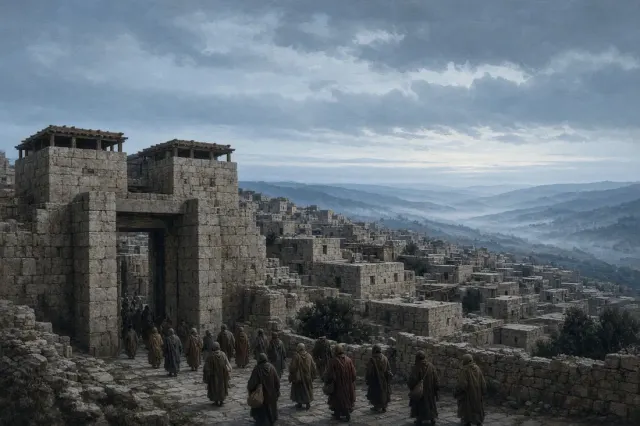
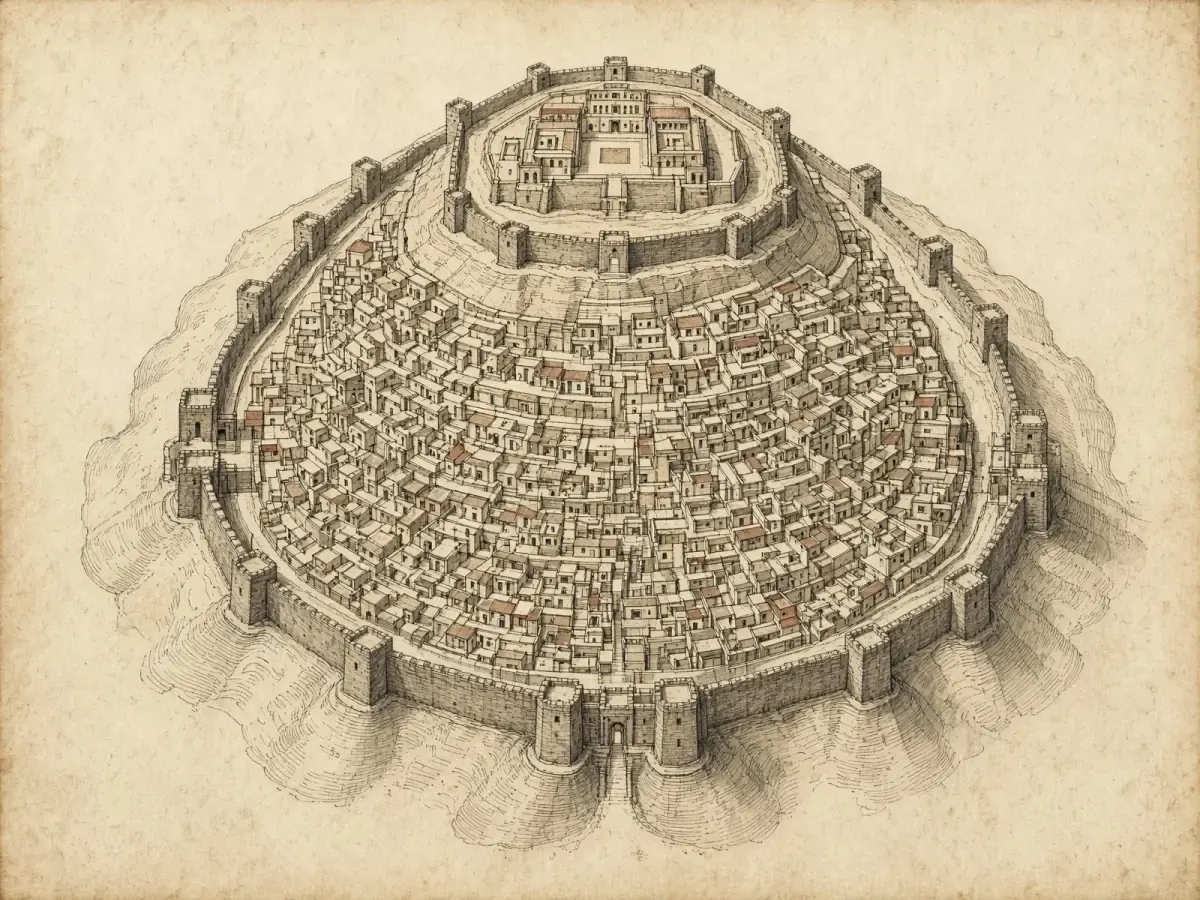
When the register turns to worship, it does not stop with priests. Levites, singers, porters, Nethinims, and descendants of Solomon's servants all receive their own entries. The long sequence makes sacred service look less like a handful of visible leaders and more like an institution with many recurring tasks. Some of those people would be almost invisible if the text simply said "temple staff." The Book of Nehemiah keeps their family names instead. That persistence matters in a book concerned with rebuilding a community, because a sanctuary needs people who teach, sing, guard, carry, prepare, and support its daily functioning. The numbers also differ sharply from group to group, so there is no suggestion of a perfectly balanced workforce. Restoration has personnel problems as surely as it had masonry problems. The register makes those human resources countable without reducing them to numbers alone.
Deep dive
The ordering gives priests a prominent place without making them the whole of the temple community. Levites, singers, gatekeepers, and other service groups each have their own notice. The Nethinims function as temple servants in the book; their many family names are recorded even though their individual duties are not explained here.
This is the institutional side of restoration. A sanctuary needs people who lead its worship, maintain its access, and sustain its daily work. The numerical differences between the groups also prevent an easy assumption that each office had an equally large supply of personnel. The register does not pause to celebrate the famous and discard the obscure. It keeps the names through which recurring service can be traced. The long list's value is precisely that it preserves people who would otherwise disappear behind the phrase temple staff.
Words to trace: children, eight, forty, Giddel, Jeshua, Nethinims
Verse-by-verse path
- Nehemiah 7:39
The priests begin, and their four houses total 4,289, about a tenth of the whole congregation of verse 66. Jedaiah is counted “of the house of Jeshua”, the high priest who returned with Zerubbabel, so this line ran through the leading priestly family.
- Nehemiah 7:40
Immer’s house had a sharp history: Pashur son of Immer beat Jeremiah and put him in the stocks (Jeremiah 20:1–2). In the rebuilding, Zadok son of Immer repaired the wall opposite his own house (3:29).
- Nehemiah 7:41
Pashur is not among the twenty four priestly courses David arranged (1 Chronicles 24), which suggests a house that grew later. At 1,247 it is still large. Six of its priests had married foreign wives and put them away in Ezra’s reform (Ezra 10:22).
- Nehemiah 7:42
Harim held the third of David’s priestly courses (1 Chronicles 24:8). Its 1,017 matches Ezra’s figure exactly, as do all four priestly counts, the steadiest section of the register.
- Nehemiah 7:43
Seventy four Levites against more than four thousand priests. The imbalance is not a copying accident; when Ezra later gathered his caravan at the river Ahava he found no Levites at all and had to send for them (Ezra 8:15–19). Hodevah is spelled Hodaviah in Ezra 2:40.
- Nehemiah 7:44
Only the sons of Asaph are named among the singers; the other two musical families of David’s arrangement, Heman and Jeduthun, are missing. Asaph’s name stands over twelve psalms (50 and 73–83). Ezra 2:41 counts 128, twenty fewer.
- Nehemiah 7:45
Six gatekeeping families, a hundred and thirty eight men, one fewer than Ezra 2:42. Shallum is the name of the chief porter of 1 Chronicles 9:17–19, keeper of the king’s gate on the east side, and Akkub and Talmon appear again as gate wardens in 11:19 and 12:25.
- Nehemiah 7:46
Nethinims means “given ones”, from natan, to give: people given to the sanctuary for its heavy work. Many have linked them with the Gibeonites Joshua made hewers of wood and drawers of water for the altar (Joshua 9:27), an old identification rather than a stated one. Ziha later oversees them on Ophel (11:21).
- Nehemiah 7:47
Siaha in Ezra 2:44 is Sia here, one of many small spelling shifts in the temple servants’ names. Padon comes from padah, to ransom, an apt name in a list of people whose ancestors were bound to service.
- Nehemiah 7:48
Ezra 2:45–46 has Akkub and Hagab in this stretch of the list, names this copy does not carry. Lebana probably means “white”, a poetic word for the moon (Isaiah 24:23). Short gaps like these show a list copied more than once by hand.
- Nehemiah 7:49
Hanan means “gracious”, a name common enough to belong to a covenant signer (10:10) and a storehouse treasurer (13:13) as well. Gahar may mean “ruddy”. The Book of Nehemiah preserves the names of the temple’s lowest servants as carefully as the names of priests.
- Nehemiah 7:50
Rezin is the name of the Aramean king of Damascus who marched on Jerusalem with Pekah (Isaiah 7:1). Nekoda turns up again in verse 62, among the families unable to prove their Israelite descent, so the name crossed between groups.
- Nehemiah 7:51
Gazzam is from gazam, the palmerworm of Joel 1:4, and Hagaba in verse 48 means locust. Insect names fit the pattern of nicknames and bodily descriptions that fills this list. Uzza shares a name with the man struck dead for steadying the ark (2 Samuel 6:6–7).
- Nehemiah 7:52
Meunim are the Meunites, an Arab people Uzziah fought (2 Chronicles 26:7), and Nephishesim recalls Naphish, a son of Ishmael (Genesis 25:15). The names suggest that some temple servant families began as foreign captives or dependants absorbed into Israel’s worship.
- Nehemiah 7:53
Bakbuk is the word for a narrow-necked flask, named for the gurgling sound it makes; Jeremiah smashes a potter’s bakbuk in Jeremiah 19:1. Harhur is related to the fever or “extreme burning” of Deuteronomy 28:22. Names like these read as nicknames that stuck.
- Nehemiah 7:54
Bazlith here is Bazluth in Ezra 2:52, one vowel apart, the sort of variation that comes from a name being heard and written down more than once. Harsha may be from a root meaning craftsman, fitting for a family of temple labourers.
- Nehemiah 7:55
Sisera is the name of the Canaanite general Jael killed with a tent peg (Judges 4:21), here borne by a family of temple servants. Barkos appears to contain the name of Qos, the god of Edom, another sign of foreign origins behind some of these households.
- Nehemiah 7:56
The temple servants end at thirty two families, three fewer than in Ezra. Hatipha is from chataph, to seize, the verb of Judges 21:21 where the men of Benjamin catch wives at the Shiloh dance. Neziah may mean “pre-eminent” or “faithful”.
- Nehemiah 7:57
Solomon’s servants descend from the Canaanites Solomon put to forced labour (1 Kings 9:20–21). Some of their names are titles: Sophereth means “scribe” in a feminine form used for an office, as Pochereth does in verse 59. Ezra 2:55 spells the last name Peruda.
- Nehemiah 7:58
Giddel is also a family among the temple servants in verse 49. Jaala means a mountain goat, the doe of Proverbs 5:19. Two groups of dependants with overlapping names suggest their lines ran close together, and the next verse counts them together.
- Nehemiah 7:59
Pochereth of Zebaim means “gazelle catcher”, a trade become a name. Shephatiah shares its name with the lay family of verse 9, and Amon, where Ezra 2:57 reads Ami, shares his with the Judean king who was murdered by his servants (2 Kings 21:23).
- Nehemiah 7:60
The temple servants and Solomon’s servants are counted as one group, 392 in both copies. Their headquarters was on Ophel, the ridge south of the temple, where 3:26 places them next to the Water Gate on the east.
Nehemiah 7:39-60
King James Version39The priests: the children of Jedaiah, of the house of Jeshua, nine hundred seventy and three.
40The children of Immer, a thousand fifty and two.
41The children of Pashur, a thousand two hundred forty and seven.
42The children of Harim, a thousand and seventeen.
43The Levites: the children of Jeshua, of Kadmiel, and of the children of Hodevah, seventy and four.
44The singers: the children of Asaph, an hundred forty and eight.
45The porters: the children of Shallum, the children of Ater, the children of Talmon, the children of Akkub, the children of Hatita, the children of Shobai, an hundred thirty and eight.
46The Nethinims: the children of Ziha, the children of Hashupha, the children of Tabbaoth,
47The children of Keros, the children of Sia, the children of Padon,
48The children of Lebana, the children of Hagaba, the children of Shalmai,
49The children of Hanan, the children of Giddel, the children of Gahar,
50The children of Reaiah, the children of Rezin, the children of Nekoda,
51The children of Gazzam, the children of Uzza, the children of Phaseah,
52The children of Besai, the children of Meunim, the children of Nephishesim,
53The children of Bakbuk, the children of Hakupha, the children of Harhur,
54The children of Bazlith, the children of Mehida, the children of Harsha,
55The children of Barkos, the children of Sisera, the children of Tamah,
56The children of Neziah, the children of Hatipha.
57The children of Solomon’s servants: the children of Sotai, the children of Sophereth, the children of Perida,
58The children of Jaala, the children of Darkon, the children of Giddel,
59The children of Shephatiah, the children of Hattil, the children of Pochereth of Zebaim, the children of Amon.
60All the Nethinims, and the children of Solomon’s servants, were three hundred ninety and two.
Nehemiah 7:61-65
Missing Evidence Limits Priestly Claims
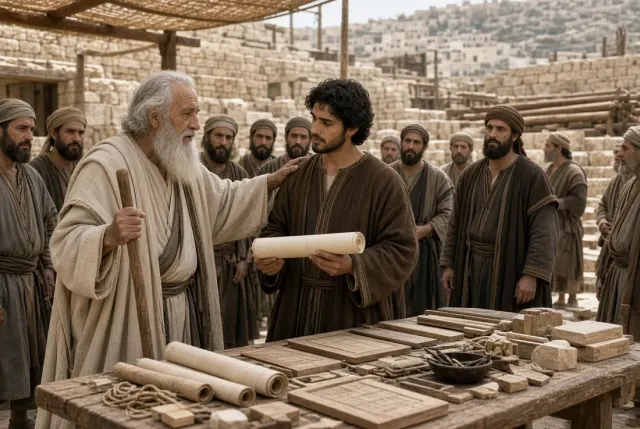
Not every genealogical claim can be verified, and the Book of Nehemiah leaves that uncertainty visible. Some returnees cannot demonstrate their father's house or establish whether their seed belongs to Israel. Certain priestly families face a more specific problem: their names cannot be found in the priestly register. One line even notes a marriage-related change of name, showing how lineage records can become complicated without the passage accusing anyone of fraud. The governor responds by limiting priestly participation in the most holy food until a priest with Urim and Thummim can decide the matter. The anticipated ruling is not reported here. That is important. The book does not invent certainty to make the list cleaner. An unresolved case remains unresolved, and suspension from priestly privileges is not automatically described as exclusion from every other part of communal life.
Deep dive
The uncertain claims are not quietly repaired to make the register look complete. The text differentiates an inability to demonstrate Israelite ancestry from the more specific problem of proving priestly descent. In the priestly case, a marriage-related change of family name is noted, showing how a genealogical claim can become complicated without the book declaring a deliberate fraud.
The Tirshatha, the governor, restricts participation in the most holy food until a priest with Urim and Thummim can make a determination. The passage names a means of sacred decision without describing its operation here or reporting that the anticipated ruling actually occurred. That restraint matters. An unresolved case remains unresolved in the account. Administrative uncertainty is not converted into an invented revelation, and exclusion from priestly functions is not automatically the same as expulsion from every aspect of the community's life.
Words to trace: children, Barzillai, Addon, Cherub, daughters, Delaiah
Verse-by-verse path
- Nehemiah 7:61
Tel means a mound of ruins, and these are places in Babylonia, as Ezekiel lived among the exiles at Tel-abib (Ezekiel 3:15). Tel-melah is “salt mound”. Immer is a place here, though it is also the name of the priestly house of verse 40. Having lived among foreign ruins, these families had lost the proof of who they were.
- Nehemiah 7:62
Ezra 2:60 counts 652, ten more. This Tobiah has nothing to do with the Ammonite of chapter 6; the name was common. What these households lacked was paper, not faith: they are still counted among those who went up.
- Nehemiah 7:63
Barzillai the Gileadite fed David and his men at Mahanaim when Absalom drove him out (2 Samuel 17:27–29). A priest married into that honoured family and took its name, and by doing so seems to have blurred his own line in the priestly records.
- Nehemiah 7:64
The proof they needed was written: “register” is ketav, a writing. “As polluted” is ga’al, to defile, treated as unfit for service at the altar. The priesthood was hereditary, and a gap in the documents meant a gap in the right to serve.
- Nehemiah 7:65
Tirshatha is a Persian title, probably “his excellency”; the Book of Nehemiah later applies it to Nehemiah himself (8:9; 10:1), but in this older document it refers to the earlier governor. Urim and Thummim, the lots carried in the high priest’s breastplate (Exodus 28:30), are last seen being consulted in the days of Saul and David.
Nehemiah 7:61-65
King James Version61And these were they which went up also from Tel-melah, Tel-haresha, Cherub, Addon, and Immer: but they could not shew their father’s house, nor their seed, whether they were of Israel.
62The children of Delaiah, the children of Tobiah, the children of Nekoda, six hundred forty and two.
63And of the priests: the children of Habaiah, the children of Koz, the children of Barzillai, which took one of the daughters of Barzillai the Gileadite to wife, and was called after their name.
64These sought their register among those that were reckoned by genealogy, but it was not found: therefore were they, as polluted, put from the priesthood.
65And the Tirshatha said unto them, that they should not eat of the most holy things, till there stood up a priest with Urim and Thummim.
Nehemiah 7:66-73
People, Animals, and Contributions
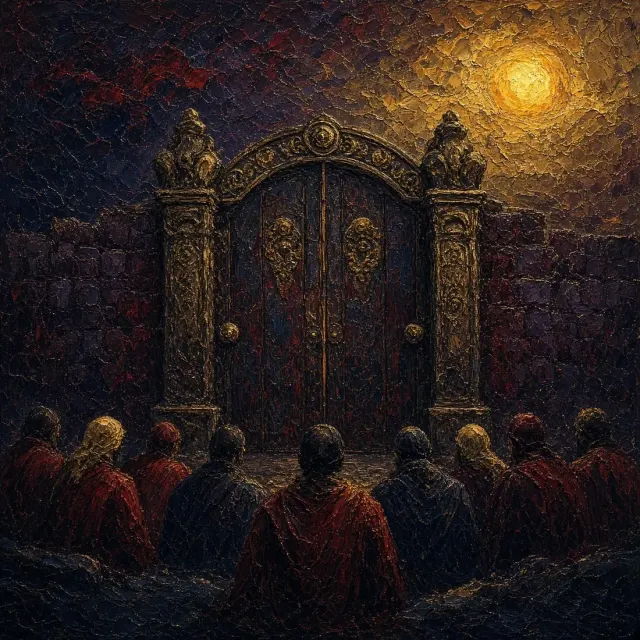
The register ends by putting bodies, transport, and money back around the names. The congregation is counted, then servants and singers are added, followed by horses, mules, camels, and thousands of asses. Return required more than ancestry. It required movement, labor, food, freight, and the ordinary equipment of resettlement. Contributions then come from several levels of the community: the governor, heads of fathers' houses, and the rest of the people. Gold and silver appear beside basins and priestly garments, linking stored wealth to actual service. The Book of Nehemiah finally places priests, Levites, porters, singers, Nethinims, and Israel in their cities as the seventh month arrives. A chapter that began with a city too empty to feel complete ends with a populated regional picture, and the calendar is now ready for the gathering at the Water Gate.
Deep dive
The movement from families to servants, singers, horses, mules, camels, and asses gives return a material dimension. People did not travel as names alone. The transport animals belong to the same account as the persons and resources needed to establish life after displacement. The collective total is followed by additional categories, so it should not be casually described as a count of every person mentioned in the closing inventory.
Contributions also come from more than one level of the community: the governor, family heads, and the rest of the people. Garments and basins appear with gold and silver, connecting wealth to actual worship and service. The final notice places Israel in its cities as the seventh month arrives. The register thus leads back into the book's unfolding time. A long passage that looked away from the wall has prepared for the next major event, a people assembling to hear the law together.
Words to trace: seven, five, gave, thirty, drams, forty
Verse-by-verse path
- Nehemiah 7:66
Both copies of the list give the same total, 42,360, but the entries do not add up to it: this chapter’s figures sum to 31,089 and Ezra’s to 29,818. The difference has been put down to women, to returnees from tribes other than Judah and Benjamin, or to families not itemised. The total is the fixed point.
- Nehemiah 7:67
Seven thousand three hundred and thirty seven slaves, about one for every six free persons. The singing men and women are not the temple singers of verse 44; they are the kind hired for feasts and funerals (2 Chronicles 35:25; Ecclesiastes 2:8). Ezra 2:65 counts 200; this copy’s 245 matches the mules of the next verse, where a scribe’s eye may have slipped.
- Nehemiah 7:68
Most Hebrew manuscripts of Nehemiah lack this verse, and many modern Hebrew Bibles number the chapter one short. The King James includes it, as it stands in Ezra 2:66 and in some manuscripts here. Horses were a rich man’s mount: 736 for more than forty thousand people.
- Nehemiah 7:69
Camels carried loads across the desert road from Babylon, a four month journey when Ezra made it (Ezra 7:9). The 6,720 asses carried everything else, and the old, the sick and the young. The list counts the animals as carefully as the families, because the move was freight as well as people.
- Nehemiah 7:70
“Drams” are darics, the gold coin of the Persian kings; here the governor gives a thousand of them. Ezra 2:69 gives one lump sum, but Nehemiah’s copy breaks the gifts down by giver: governor, heads of houses, and people. The “basons” are the sprinkling bowls used for the blood at the altar.
- Nehemiah 7:71
“Pound” is the maneh, the mina, worth about sixty shekels, so 2,200 of them is a large quantity of silver. The heads of the houses give to “the treasure of the work”, a building fund, the same phrase Ezra 2:69 uses.
- Nehemiah 7:72
The rest of the people match the heads of houses in gold, twenty thousand darics each. Add the three gifts together and Nehemiah’s copy reaches 41,000 darics, 4,200 minas and 597 garments, where Ezra 2:69 has 61,000, 5,000 and 100. Ordinary families gave nearly half the treasure.
- Nehemiah 7:73
The seventh month is Tishri, the month of trumpets, the Day of Atonement and the feast of tabernacles (Leviticus 23:24–36). Ezra 3:1 begins with the same words, and there too the people then gather in Jerusalem. The Book of Nehemiah quotes the list to its end and lets its last line open the next scene.
Nehemiah 7:66-73
King James Version66The whole congregation together was forty and two thousand three hundred and threescore,
67Beside their manservants and their maidservants, of whom there were seven thousand three hundred thirty and seven: and they had two hundred forty and five singing men and singing women.
68Their horses, seven hundred thirty and six: their mules, two hundred forty and five:
69Their camels, four hundred thirty and five: six thousand seven hundred and twenty asses.
70And some of the chief of the fathers gave unto the work. The Tirshatha gave to the treasure a thousand drams of gold, fifty basons, five hundred and thirty priests’ garments.
71And some of the chief of the fathers gave to the treasure of the work twenty thousand drams of gold, and two thousand and two hundred pound of silver.
72And that which the rest of the people gave was twenty thousand drams of gold, and two thousand pound of silver, and threescore and seven priests’ garments.
73So the priests, and the Levites, and the porters, and the singers, and some of the people, and the Nethinims, and all Israel, dwelt in their cities; and when the seventh month came, the children of Israel were in their cities.
Questions to keep in mind while reading
- Track who acts, who speaks, who is affected, and what changes.
- Notice repeated promises, failures, rescues, and consequences.
- Do not assume the account approves every action that is reported.
Text first
Where readers differ
The chapter summary begins with what the passage says and how its parts fit together. It does not assume one denomination has already settled every question. Where a conclusion depends on a tradition, literary theory, or historical reconstruction, that dependence is named openly.
The KJV text is presented first. Interpretive conclusions are labeled, and differences are introduced only when they help a reader understand why serious communities do not always reach the same answer.
Comparative interpretive notes for this chapter are in preparation. Until reviewed notes are ready, this page separates the KJV text from summary and application without claiming that serious readers agree on every question.
Questions beneath the surface
- What account of God, human freedom, responsibility, and the good life emerges from Nehemiah 7?
- Which tension does the chapter refuse to resolve quickly?
- What changes when the chapter is read as part of the whole canon rather than as an isolated moral lesson?
- Where might a sincere reader confuse a familiar tradition with something the text states directly?
Questions for serious personal contemplation
These open-ended questions make room for tension, honest response, prayer, and conclusions that remain accountable to the chapter.
Observe without rushing
What part of Nehemiah 7 makes you stop, feel unsettled, or feel surprised, and why?
Which detail in the passage would be easiest to overlook? How does that detail change your understanding?
Where do you see tension between what happens and this focus: Gatekeepers appointed and returned families registered by genealogy?
What important question does the passage leave open instead of resolving quickly?
Examine your inner life honestly
Which person, response, fear, or desire in the passage feels most like your own life right now?
What assumption about God, other people, or yourself does this text challenge?
Which part would you rather soften, avoid, or explain away too quickly? What might that reaction reveal?
If this Scripture could ask you one direct question, what do you think it would ask?
Respond with wisdom and courage
What do you need to remember, confess, grieve, thank God for, or trust after reading this passage?
How might another faithful person read this situation differently without ignoring the text?
What obedient response would be costly, uncomfortable, or slow, yet still faithful to Scripture?
What question will you carry into prayer this week, and which verses will you keep in front of you?
Music and video connected to the passage
Related media appears when its Scripture reference overlaps this study. Music and video can illuminate a theme while the biblical text remains the foundation.