The big picture
The calendar changes, and so does the community's posture. After the feast, Israel gathers in fasting, sackcloth, confession, and extended reading of the law. The Levites then lead a prayer that refuses to edit either side of Israel's past. God creates, calls Abraham, delivers from Egypt, gives law, food, guidance, land, and repeated mercy. Israel answers repeatedly with pride, forgetfulness, rebellion, and rejection of prophetic warnings. The prayer traces cycles of rescue without turning rescue into proof that disobedience had no consequences. Its final turn is painfully present tense. The returned people are in the land promised to their fathers, yet they call themselves servants there, under kings who take its produce and exercise dominion over bodies and cattle. That unresolved condition, joined to the remembered pattern of failure and mercy, leads directly to a written and sealed commitment.
Central truth
Nehemiah 9 turns confession into a long rehearsal of Israel’s past, contrasting repeated rebellion with God’s repeated mercy before the people acknowledge their present distress and make a written covenant.

The study notes have a page of their own
The movement by movement analysis, the words to trace, the verse by verse notes and where readers differ are written for someone studying alone. They are on the Deep Personal Reflections page for this chapter. This page is the lesson.
A chapter-specific teaching brief
These anchors come from this chapter itself. They help a teacher use the Level 1 overview, the Level 2 study, and the Scripture text as one lesson.
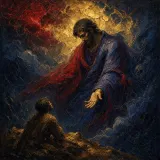
Open with the chapter’s first image
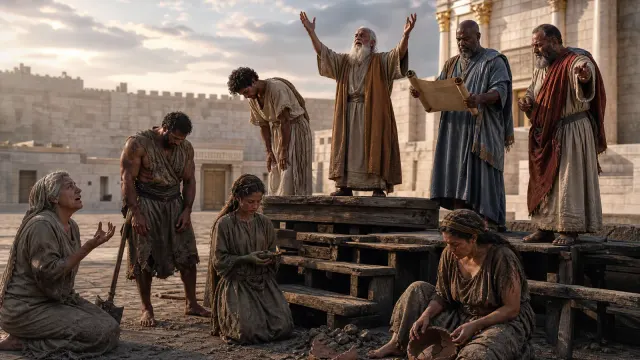
Nehemiah 9:1: “Now in the twenty and fourth day of this month the children of Israel were assembled with fasting, and with sackclothes, and earth upon them.”
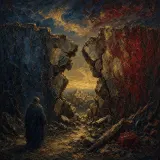
Slow down at the turning point
Nehemiah 9:16: “But they and our fathers dealt proudly, and hardened their necks, and hearkened not to thy commandments,”
Keep this word trail visible
land, gavest, didst, heaven, fathers, LORD
What to explain, in order
Teach the passage in this order. Each step names the verses it rests on, so every point can be shown in the text before it is applied.
Nehemiah 9:1-3
Sackcloth after the feast
Begin with the date: the twenty fourth day of the seventh month, two days after the Feast of Booths has ended. The joy of chapter 8 is followed by fasting, sackcloth and earth on the head, signs of grief and humility. Explain 9:2: the descendants of Israel stand apart from foreigners to confess their own sins and their fathers'. This is a covenant act of a community taking responsibility, not a statement about any people's worth. Then 9:3: three hours of reading, three of confession. Teach this first so the class sees the setting for the prayer.
Nehemiah 9:4-8
The LORD alone, who chose Abram
The Levites stand on the stairs and call the people to bless God. Read 9:5-6 and let the class hear the praise: God's name exalted above all praise, creator and preserver of everything. Then 9:7-8: he chose Abram, brought him from Ur, renamed him, found his heart faithful and made a covenant, "and hast performed thy words; for thou art righteous". Point out that last phrase because the whole prayer rests on it. Teach the prayer's starting point first: God is faithful before anyone confesses anything.
Nehemiah 9:9-21
Exodus, Sinai and the wilderness
Now trace the exodus: affliction seen, sea divided, pursuers thrown "as a stone into the mighty waters" (9:11). Sinai: right judgments, true laws, the holy sabbath. Provision: bread from heaven, water from the rock. Then the turn in 9:16, "But they and our fathers dealt proudly". Read 9:17 slowly, because it quotes the great description of God from Exodus 34:6. Then the calf, and still "thou in thy manifold mercies forsookest them not" (9:19). Teach this long section as a contrast: every gift met by pride, every rebellion met by mercy.
Nehemiah 9:22-31
The land, the judges and the prophets
Read how God gave them kingdoms, children as many as the stars, and the land, with strong cities and houses full of goods. They ate and "delighted themselves in thy great goodness" (9:25). Then 9:26: they cast the law behind their backs and killed the prophets. Explain the cycle in 9:27-28 using the judges. Note 9:24, where the inhabitants of the land were given into Israel's hands; handle it soberly as part of the record. End the step with 9:31: "thou didst not utterly consume them, nor forsake them; for thou art a gracious and merciful God."
Nehemiah 9:32-38
Now therefore, our God
The prayer turns to the present with "Now therefore". The people name God as in 1:5, "who keepest covenant and mercy", and ask that their trouble not seem small to him. Then 9:33: "thou art just in all that is brought upon us; for thou hast done right, but we have done wickedly". Read 9:36-37 and the honest description of their bondage under Persian kings. Explain that the people do not accuse God; they ask him to see. End with 9:38, the written covenant, because the whole confession leads to it.
Where learners get stuck
The misreadings this passage tends to produce, and how to answer each from the text.
"Separating themselves from strangers means God's people should keep away from people of other races."
Read 9:2 in its setting. The people separate in order to confess their own sins and their fathers' sins before God. The concern throughout Nehemiah is covenant faithfulness, worship of the LORD alone, not ancestry; even in Israel's history foreigners who joined themselves to the LORD were received, as Ruth was (Ruth 1:16). Teach the verse as a community humbling itself, and keep it away from any modern racial or ethnic slogan, which the passage does not support.
"This prayer is mostly about how bad Israel was."
It is as much about God's mercy as Israel's sin. Count the times God's goodness is named: he chooses, sees, hears, divides the sea, leads, gives bread and water, gives his good spirit, and "forsookest them not" (9:17, 9:19, 9:31). He is "ready to pardon, gracious and merciful, slow to anger, and of great kindness" (9:17). The sins are named honestly, but the weight of the prayer falls on God's faithfulness. Confession here is a way of praising the God who kept going with them.
"The people blame God for their troubles in verses 36 and 37."
They say the opposite in 9:33: "thou art just in all that is brought upon us; for thou hast done right, but we have done wickedly". Their description of servitude, "we are in great distress" (9:37), is an honest plea, asking God not to let their trouble "seem little before thee" (9:32). They bring their pain to God without accusing him. Laments in the Psalms do the same. Teach that honest complaint and the confession of God's justice can stand side by side.
"God gave Israel the land so they could do whatever they wanted to the people living there."
The phrase in 9:24 is part of a confession that goes on to say Israel itself was then given into the hands of its enemies for its own sin (9:27, 9:30). The prayer is not boasting about conquest; it is admitting that Israel failed to serve God even in the good land (9:35). The conquest was a particular judgment in Israel's history, and readers wrestle with it seriously. Teach it soberly, with care for learners troubled by it, and do not turn it into a principle for any later people.
Learning objectives
- Trace the opening actions of fasting, separation, reading, confession, and worship.
- Outline the major periods of Israel’s past recounted in the prayer.
- Identify repeated descriptions of God’s mercy and patience.
- Contrast Israel’s responses with God’s responses in the wilderness and land.
- Explain how the prayer connects past disobedience with present Persian rule.
- State what the people do after reaching the confession of 'great distress.'
Teacher preparation
- Read the prayer as a timeline: creation, Abraham, Egypt, Sinai, wilderness, conquest, judges, prophets, exile, and present servitude.
- Teach verse 2’s separation language in its covenant setting rather than turning it into a modern ethnic slogan.
- Note verse 3’s time structure: one fourth of the day reading the law and another fourth confessing and worshiping.
- Mark repeated descriptions of God as ready to pardon, gracious, merciful, slow to anger, and of great kindness.
- Read through verse 38. The prayer lands in present foreign rule and a written covenant.
Evidence and interpretation checks
Explicit
Verses 1 to 3 report fasting, separation, reading, confession, and worship; verses 5 to 37 recount Israel’s past; verse 38 records a written covenant.
Scripture-supported
Creation, exodus, Sinai, wilderness, conquest, and prophetic themes echo the Scriptures the community is reading.
Strong inference
The historical recital functions as evidence for confession by placing present distress inside a long covenant pattern.
Possible or traditional reading
The prayer is sometimes called Ezra’s prayer, but chapter 9 names Levites speaking and does not explicitly name Ezra as speaker.
Limit
The chapter summarizes centuries selectively rather than giving a complete chronology.
Discussion with answer guidance
1. What happens before the long prayer?
What a good answer contains
On the twenty fourth day of the month the people gather "with fasting, and with sackclothes, and earth upon them" (9:1). They separate themselves from strangers and "stood and confessed their sins, and the iniquities of their fathers" (9:2). Then a quarter of the day is given to reading the law and another quarter to confession and worship (9:3). A good answer keeps the order: mourning, separation, confession, reading, worship. A strong answer notices that the reading of chapter 8 now leads into confession. A weak answer starts the chapter at the prayer.
Show teacher guidance
Verses 1 to 3 give fasting, sackcloth, earth, separation, confession, law reading, and worship.
2. Where does the prayer begin its history?
What a good answer contains
With creation: "Thou, even thou, art LORD alone; thou hast made heaven, the heaven of heavens, with all their host, the earth, and all things that are therein" (9:6). Then it moves to Abram (9:7-8). A good answer sees that the prayer starts with who God is before it says anything about Israel, and that he preserves all things and is worshipped by the host of heaven. A strong answer notes the claim "LORD alone". A weak answer starts the history at the exodus or at Sinai.
Show teacher guidance
Verse 6 begins with God as creator of heaven, hosts, earth, seas, and all they contain.
3. What follows rebellion in verses 16 to 21?
What a good answer contains
Mercy follows rebellion. The fathers "dealt proudly, and hardened their necks" (9:16), refused to obey and even planned a return to Egypt, and made the molten calf (9:17-18). Yet the prayer answers, "but thou art a God ready to pardon, gracious and merciful, slow to anger, and of great kindness, and forsookest them not" (9:17). The cloud and fire, the good spirit, manna and water, and forty years when "they lacked nothing" follow (9:19-21). A good answer sets each act of rebellion beside God's answer. A weak answer says God abandoned them in the wilderness.
Show teacher guidance
The people act proudly, yet God does not forsake them and continues guidance, provision, and mercy.
4. How does the prayer describe the judges-era cycle?
What a good answer contains
As a repeating cycle. God "deliveredst them into the hand of their enemies"; "when they cried unto thee, thou heardest them from heaven"; he gave "saviours, who saved them" (9:27). "But after they had rest, they did evil again before thee", and the cycle begins again, and "many times didst thou deliver them" (9:28). A good answer names the four parts: sin, oppression, crying out, deliverance. A strong answer connects it to the pattern of the Book of Judges. A weak answer thinks it happened only once.
Show teacher guidance
Verses 27 to 28 move from oppression to crying out, deliverance, renewed evil, and renewed distress.
5. What changes in verses 36 to 37?
What a good answer contains
The prayer reaches the present: "Behold, we are servants this day" (9:36). The land God gave their fathers yields its produce "unto the kings whom thou hast set over us because of our sins", who rule even "over our bodies, and over our cattle, at their pleasure, and we are in great distress" (9:37). A good answer sees the shift from "they" and "our fathers" to "we". A strong answer notices that the people accept God's justice (9:33) while naming their distress honestly. A weak answer thinks the prayer is only about the past.
Show teacher guidance
The speakers say 'this day' and describe present servitude under foreign kings.
6. What follows the confession?
What a good answer contains
A written commitment: "And because of all this we make a sure covenant, and write it; and our princes, Levites, and priests, seal unto it" (9:38). "because of all this" ties it to the whole prayer, both God's mercy and their failure. A good answer sees that confession leads into a concrete promise, which chapter 10 spells out with names and terms. A weak answer ends the chapter with the confession and misses that it was meant to lead somewhere.
Show teacher guidance
Verse 38 says they make a sure covenant, write it, and have leaders seal it.
Responsible application
Heart and habits
Use the timeline to show confession that names both failure and mercy instead of vague regret.
Relationships and community
Notice the repeated 'we' and 'our fathers' language without requiring personal disclosure.
Let history argue
Have groups choose one section and show how its events support the prayer’s claims.
Session plans
Two timings of the same lesson. The shorter keeps the reading, the central discussion and one response; the longer gives the confusions and the application their own time.
45 minutes
Fasting after feasting
Read 9:1-3 and ask question one. Take confusion one.
The LORD alone
Read 9:5-8 and ask question two.
Pride and mercy
Read 9:16-21 and ask question three. Take confusion two.
The cycle
Read 9:26-31 and ask question four.
We are servants this day
Read 9:32-37 and ask question five. Take confusion three.
A sure covenant
Read 9:38, ask question six, read the key verse together and give out the handout.
90 minutes
Remembering well
Ask the class how families remember their history, and whether they tell only the good parts.
Fasting after feasting
Read 9:1-5 with 8:17-18. Ask question one and take confusion one.
The LORD alone, who chose Abram
Read 9:6-15 and ask question two. Mark creation, Abram, Egypt and Sinai on a timeline.
Pride and mercy
Read 9:16-21 beside Exodus 34:6-7. Ask question three and take confusion two.
The land, the judges and the prophets
Read 9:22-31. Ask question four and take confusion four with care.
We are servants this day
Read 9:32-37 and ask question five. Take confusion three.
A sure covenant
Read 9:38 and 10:28-29. Ask question six.
Response and handout
Let each person write one sentence of praise for God's mercy in their own life, read the key verse together and pray.
Adapting the lesson
Children
Draw a long timeline on the floor with tape and walk along it: God makes the world, calls Abram, frees Israel from Egypt, gives bread from heaven, brings them into the land. At each step say together, God did not leave them. Keep the people's sin simple: they forgot God and did wrong, and God was still kind. Leave out the details of battles in 9:24.
Youth
Give small groups a section of the prayer and ask them to find one thing God did and one thing the people did. Put them in order on a wall. Then read 9:17 and ask why it is the centre. Talk about 9:36-37 and how it feels to live with the results of earlier mistakes, theirs or other people's, without blaming God.
Adults
Spend time on the way the prayer reads history, and how a community can confess honestly without despair. Read 9:17 with Exodus 34:6-7. Take 9:2 and 9:24 carefully, because both are easily misused. Adults carrying the consequences of past failures may hear 9:31 as good news; give it room without asking anyone to share their own past.
One to one
Read 9:5-21 and 9:31-33 together. Ask the person to name one way God has been faithful to them, and one way they have turned away from him. Do not press for detail. Then read 9:17 aloud as a description of the God they are speaking to, and pray together using the pattern of praise, confession and honest request.
Song and video learning lab
A song or video may interpret, compress, or dramatize the text. Its value becomes clearer when its choices are compared with Scripture.
- Before the media: the exact passage and its central movement.
- During the media: the words, people, events, and emotions the artist emphasizes.
- After the media: what it clarifies, what it leaves out, and what belongs back in the biblical text.
Handout
One page for learners to take home. The print button prints this section alone.
Nehemiah 9:1–38
The passage in brief
After the feast, the people gathered again, this time fasting and in sackcloth, to confess their sins. They read God's law for a quarter of the day and confessed for another quarter. The Levites led a long prayer that told Israel's history from creation through Abraham, the exodus, the wilderness, the land, the judges and the prophets. Again and again the people rebelled, and again and again God showed mercy. The people admitted that God was just, described their hardship, and made a written covenant.
A verse to keep
And refused to obey, neither were mindful of thy wonders that thou didst among them; but hardened their necks, and in their rebellion appointed a captain to return to their bondage: but thou art a God ready to pardon, gracious and merciful, slow to anger, and of great kindness, and forsookest them not.
Nehemiah 9:17 · King James Version
Questions to take home
Where does the prayer begin in 9:6?
How does 9:17 describe God?
What did the people do in 9:38 because of all they had confessed?
This week
This week, thank God for one specific time he was faithful to you when you were not faithful to him.
Music and video connected to the passage
Related media appears when its Scripture reference overlaps this study. Music and video can illuminate a theme while the biblical text remains the foundation.