
The big picture
Numbers opens with a census that sounds administrative until its limits become clear. Moses and Aaron count by name, household, tribe, age, and military fitness, producing 603,550 men able to go to war. The repeated tribal formula makes everyone comparable without pretending that every tribe is the same size, and Joseph appears through Ephraim and Manasseh while Levi stands outside the military total. That exception is not leisure. The Levites receive the tabernacle, its equipment, its transport, and its protective perimeter. The opening register therefore does two jobs at once: it prepares an army and marks the sanctuary as the center that army does not control. Before anyone marches, Numbers has already distinguished belonging to Israel from being counted for one particular purpose.
Central truth
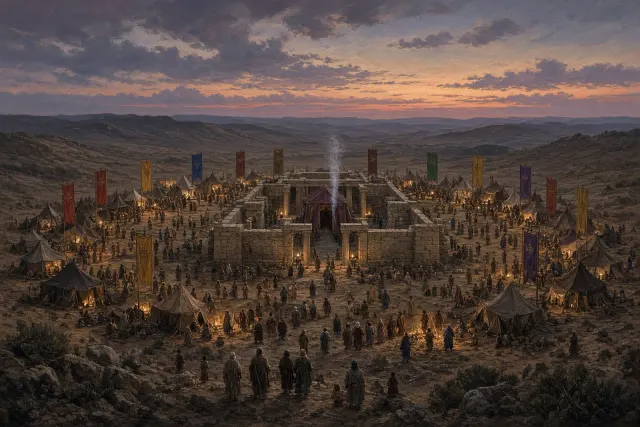
Numbers 1–2 presents Israel as a counted people arranged around the tabernacle, ready to move as an ordered host with the Lord’s dwelling at the center.

The study notes have a page of their own
The movement by movement analysis, the words to trace, the verse by verse notes and where readers differ are written for someone studying alone. They are on the Deep Personal Reflections page for this chapter. This page is the lesson.
A chapter-specific teaching brief
These anchors come from this chapter itself. They help a teacher use the Level 1 overview, the Level 2 study, and the Scripture text as one lesson.
Open with the chapter’s first image
Numbers 1:1: “And the LORD spake unto Moses in the wilderness of Sinai, in the tabernacle of the congregation, on the first day of the second month, in the second year…”
Slow down at the turning point
Numbers 1:47: “But the Levites after the tribe of their fathers were not numbered among them.”
Keep this word trail visible
children, fathers, numbered, house, names, number
What to explain, in order
Teach the passage in this order. Each step names the verses it rests on, so every point can be shown in the text before it is applied.
Numbers 1:1-4
Begin with the date and the purpose
Start with verse 1, because it tells the class where Israel is: still at Sinai, “on the first day of the second month, in the second year”, a month after the tabernacle was set up in Exodus 40:17. Then read verses 2-3 and name the purpose of the count, men “able to go forth to war”. Explain “polls” as heads, a count person by person. Teach this first so the class does not hear the whole chapter as a population survey; the Book of Numbers is preparing an army to march toward a land it must take.
Numbers 1:5-46
Let the names be heard, then the total
Read the twelve princes of 1:5-16 aloud once, without apology, and then summarise the tribal totals rather than reading every one. Verse 18 says the people “declared their pedigrees”, so each man stood in a named family before he stood in a total. Then give the sum in verse 46, 603,550. Explain that teachers differ over how to read such large numbers, and that this lesson does not need to settle it. What it needs is the observation that every soldier was counted by name and by house.
Numbers 1:47-54
Show why Levi stands apart
Read verses 47-53 slowly, since this is where the chapter turns. Levi is not numbered because Levi is given the tabernacle: to bear it, take it down, set it up and camp “round about” it. Explain that “the stranger that cometh nigh shall be put to death” (1:51) means any unauthorised person approaching the holy things, not a foreigner as such. Then show the purpose clause in verse 53, “that there be no wrath upon the congregation”. The Levites stand between the holy dwelling and the people as a guard for the people's sake. Teach it here so chapter 2 has its centre.
Numbers 2:1-31
Build the four sides on the board
Draw a square for the tabernacle, a ring for Levi, and four camps of three tribes: Judah, Issachar and Zebulun east; Reuben, Simeon and Gad south; Ephraim, Manasseh and Benjamin west; Dan, Asher and Naphtali north. Explain “standard” and “ensign” as the banner of a camp and the sign of a family, and admit that the text does not describe what was on them. Note the phrase “far off about the tabernacle” in 2:2: the tribes face the dwelling at a distance, which keeps reverence in the layout itself. Build it in front of the class so the arrangement is seen, not described.
Numbers 2:17
Find the centre on the move
Now read verse 17 and move the diagram. Judah and Reuben go first, the tabernacle with the Levites follows, then Ephraim and Dan. Explain that the dwelling of the Lord is never left at the edge, either at rest or on the march: “as they encamp, so shall they set forward”. This is the theological heart of the two chapters and belongs after the diagram, because the class needs to see the whole camp before it can see what the camp is built around. Hold Numbers 10:11-28 in reserve as the place where this order is first used.
Numbers 2:32-34
Close on obedience
End where the Book of Numbers ends the section, with the total repeated, the Levites again set apart, and the line “so they pitched by their standards, and so they set forward” (2:34). Point back to 1:54, which says the same thing. Two chapters of lists close with a people who did all that was commanded. Teach it last because it is the hinge for the rest of the book: the class should remember this obedient, ordered camp when it reads the complaining at Taberah and the refusal at Kadesh.
Where learners get stuck
The misreadings this passage tends to produce, and how to answer each from the text.
“Six hundred thousand people left Egypt.”
Numbers 1:3 and 1:45 say the count is of men twenty and older able to go to war, and 1:47 excludes the Levites. Women, children, the elderly and Levi are not in the 603,550. Whatever view a teacher takes of the large numbers, the text itself defines what is being counted, so start there. Do not turn the class into a debate on demographics; read the qualifying phrases aloud and let them carry the correction.
“The Levites were left out because they were less important.”
The exclusion in 1:49 is followed at once by an appointment in 1:50: the Levites are set “over the tabernacle of testimony, and over all the vessels thereof”. They camp nearest the holy dwelling and protect the congregation from wrath (1:53). Chapters 3 and 4 then give them their own census and their own tasks. Being left out of the army is being kept for another service, closer to the centre, not further from it.
“These chapters are just lists, so there is nothing to teach.”
The lists are attached to names (1:5-16), families (1:18), positions (2:3, 2:10, 2:18, 2:25), and a marching order (2:9, 2:16, 2:24, 2:31). They end twice with obedience (1:54; 2:34). A people that was a crowd of slaves in Exodus 12:38 is now a named, ordered host with God at its centre. Show the class one tribe from name to place to rank, and the chapter starts to speak.
“The camp layout is a pattern every church should copy.”
Numbers 2 gives instructions for Israel's camp at Sinai and on the road to Canaan. It does not prescribe a seating plan for later worship. What carries forward is what the chapter makes plain: God dwells among his people, his presence is the centre, and order serves that presence. Let learners draw principles carefully, and keep the diagram as Israel's, not as a blueprint for a building.
Learning objectives
- Identify who is counted in the military census and who is excluded.
- State the total fighting-age census given in Numbers 1:46.
- Explain the Levites’ distinct assignment around the tabernacle.
- Map the four camp groupings and their lead tribes.
- Trace how the camp order becomes the marching order.
- Explain why the tabernacle’s central position matters within these chapters.
Teacher preparation
- Sketch the camp before class: Judah east, Reuben south, Ephraim west, Dan north, with Levites and tabernacle in the center.
- Mark Numbers 1:46 and 1:47–53 so the room sees the difference between the military census and the Levite charge.
- Be ready to explain the KJV word “polls” in 1:2 as a count by heads or persons, not an opinion survey.
- Notice the repeated phrase “as the Lord commanded Moses”; let repetition carry the point instead of apologizing for the lists.
- Read Numbers 10:11–28 afterward so you can show that the chapter 2 arrangement becomes actual travel order.
Evidence and interpretation checks
Explicit
Numbers 1:46 gives 603,550 men in the military census, while 1:47–53 explicitly excludes the Levites from that count and assigns them to the tabernacle.
Scripture-supported
Numbers 2:3–31 places the camps of Judah, Reuben, Ephraim, and Dan on the four sides, with associated tribes grouped under each standard.
Strong inference
Because 2:17 places the tabernacle and Levites in the midst when the camp moves, the physical arrangement strongly emphasizes worship and divine presence as Israel’s center.
Possible or traditional reading
Reconstructions differ over the exact visual shape, spacing, and artwork of tribal standards. Teach the named sides and groupings, not an imagined diagram as though Scripture supplied it.
Limit
These chapters do not count every Israelite person, give a modern population census, or explain how far each tribal camp extended from the tabernacle.
Discussion with answer guidance
1. Who is actually counted in Numbers 1:2–3, and what qualification besides age is named?
What a good answer contains
The count is “every male by their polls; From twenty years old and upward, all that are able to go forth to war in Israel” (1:2-3). So it is a muster, not a headcount of the nation: women, children, the old and the Levites are all outside it. The second qualification is fitness for war. A weak answer says everyone was counted and then treats 603,550 as the size of Israel, which the verses never claim.
Show teacher guidance
Expect men twenty and upward who are able to go forth to war.
2. Why are the Levites removed from the military total in 1:47–53?
What a good answer contains
Verse 50 gives the reason: the Levites are appointed “over the tabernacle of testimony, and over all the vessels thereof”. They carry it, take it down, set it up and camp around it, and verse 53 says they do so “that there be no wrath upon the congregation”. A good answer sees that Levi is excluded because it has a different post, not because it matters less. A weak answer reads the exclusion as a demotion.
Show teacher guidance
Point to their charge over the tabernacle, its vessels, its transport, and the protective encampment around it.
3. Which camp sets out first according to 2:3–9?
What a good answer contains
Judah, on the east side “toward the rising of the sun” (2:3), with Issachar and Zebulun camped beside it. Verse 9 adds the decisive line, “These shall first set forth.” A strong answer notices that the order of camping and the order of marching are the same list, and that Judah, not Reuben the firstborn, leads. It may connect this to Genesis 49:10, but the chapter itself gives no reason, so the connection should be offered and not pressed.
Show teacher guidance
Expect Judah’s standard, with Issachar and Zebulun.
4. What occupies the middle position when Israel journeys in 2:17?
What a good answer contains
“Then the tabernacle of the congregation shall set forward with the camp of the Levites in the midst of the camp” (2:17). Two camps march ahead of it and two behind, so the Lord's dwelling is carried in the centre of the moving people. The good answer adds the closing clause, “as they encamp, so shall they set forward”: the arrangement at rest is the arrangement on the road. A weak answer places the tabernacle at the front, leading like a banner.
Show teacher guidance
The tabernacle of the congregation with the camp of the Levites.
5. What does the repeated obedience formula at 1:54 and 2:34 add to two chapters full of names and numbers?
What a good answer contains
Both chapters close with “the children of Israel did according to all that the LORD commanded Moses” (1:54; 2:34). The lists are not a clerk's inventory but an act of obedience, carried out to the letter. A good answer sees that the repetition is the point: a people who will shortly grumble, rebel and refuse the land begin by doing exactly what they were told. That contrast with chapters 11 to 14 is worth naming.
Show teacher guidance
Notice that the lists conclude with Israel doing what the Lord commanded.
6. How does the structure of chapter 2 keep the census from being merely bookkeeping?
What a good answer contains
Chapter 2 attaches every number to a place, a standard, a captain and a rank in the march. Verse 3 gives Judah the east and names Nahshon; verse 9 gives the total and says “These shall first set forth”; verse 16 puts Reuben “in the second rank”. Numbers become positions, and positions become movement. A weak answer treats the totals as the content and the arrangement as decoration, when the chapter is built the other way round.
Show teacher guidance
Connect numbers to positions, standards, leaders, and marching order.
Responsible application
Heart and habits
Ask learners to distinguish between order that serves a real purpose and order that exists only to look impressive.
Relationships and community
Have the group name what each tribe shares with the others and what remains distinct.
A center that governs the edges
Invite learners to diagram any organization with its stated center and actual center.
Session plans
Two timings of the same lesson. The shorter keeps the reading, the central discussion and one response; the longer gives the confusions and the application their own time.
45 minutes
Where and why
Read 1:1-3 aloud. Ask who is being counted and for what, and write the two qualifications on the board. Use question one.
Names before numbers
Read the princes in 1:5-16, then 1:44-46. Deal with confusion one from the qualifying phrases in 1:3 and 1:45.
Levi set apart
Read 1:47-54 and take question two. Use confusion two to show that the exclusion is an appointment.
The camp on the board
Build the four camps from 2:3-31 on a simple diagram. Ask question three, then read 2:17 and ask question four.
Obedience as the ending
Read 1:54 and 2:34 together and take question five. Ask how a list can be an act of obedience.
Response and handout
Choose the application on the centre that governs the edges, read the key verse aloud, and hand out the sheet.
90 minutes
From crowd to company
Read Exodus 12:37-38 and ask what kind of group left Egypt. Then read Numbers 1:1-3 and ask what has changed in thirteen months.
Who counts
Work through 1:2-4 and 1:16-18. Explain polls and pedigrees. Take question one and confusion one, with 1:45-47 read aloud.
The princes and the totals
Assign each learner a tribe from 1:20-43 to find its total. Write them on the board and add them up to 1:46.
Levi and the tabernacle
Read 1:47-54. Take question two and confusion two. Explain the stranger of 1:51 and the purpose clause in 1:53.
Building the camp
In four groups, have each group read one side of the camp in chapter 2 and place its three tribes, captain and total on a shared diagram. Take question three.
The centre on the move
Read 2:17 and then Numbers 10:11-28. Take questions four and six. Move the diagram into marching order.
Lists that obey
Read 1:54 and 2:34 and take question five. Take confusions three and four together.
Application
Use the application on order that serves a purpose. Ask each learner to write one thing that sits at the actual centre of their week.
Handout and prayer
Read the key verse together and pray that the Lord's presence would be the centre of the group's life.
Adapting the lesson
Children
Lay a cloth on the floor as the tabernacle and give twelve children a card each with a tribe's name. Let them find their side of the camp from 2:3-31 and stand there, with a small group in the middle as the Levites. Then march them around the room in the order of 2:9-31. Skip the totals; the point is that everyone had a place and God was in the middle.
Youth
Open with a team roster, then show that Numbers 1 is a roster that becomes a formation in chapter 2. Ask why the Levites have no number on the roster and let them find the answer in 1:50. Have them redraw the camp and argue about why Judah goes first. Keep the large-number debate brief and point them to the qualifying phrases in 1:3.
Adults
Give time to the purpose of the census in 1:3, the meaning of the Levites' protective role in 1:53, and the relation between the camp at rest and on the march in 2:17. Let adults raise the question of the large numbers and acknowledge honestly that readers differ. Then press the application: what sits at the actual centre of a household's or congregation's ordinary week.
One to one
Read 1:1-3, 1:47-54 and 2:17 together rather than all the lists. Draw the camp on a single sheet as you talk. Ask the person where they would have stood and what it might mean to belong to a named family in a named place. If they feel uncounted or overlooked, let 1:18 and its named pedigrees speak, without forcing a lesson onto it.
Song and video learning lab
A song or video may interpret, compress, or dramatize the text. Its value becomes clearer when its choices are compared with Scripture.
- Before the media: the exact passage and its central movement.
- During the media: the words, people, events, and emotions the artist emphasizes.
- After the media: what it clarifies, what it leaves out, and what belongs back in the biblical text.
Handout
One page for learners to take home. The print button prints this section alone.
Numbers 1:1–2:34
The passage in brief
At Sinai, a year after leaving Egypt, the Lord tells Moses to count the men of Israel old enough for war, tribe by tribe and family by family. The Levites are not counted with them; they are given charge of the tabernacle and camp around it. Chapter 2 then arranges the twelve tribes in four camps on the four sides, with the tabernacle and the Levites in the middle. When Israel marches, it keeps the same order. Both chapters end with the people doing all that the Lord commanded.
A verse to keep
Then the tabernacle of the congregation shall set forward with the camp of the Levites in the midst of the camp: as they encamp, so shall they set forward, every man in his place by their standards.
Numbers 2:17 · King James Version
Questions to take home
Who was counted in Numbers 1:3, and who was left out in 1:47?
Draw the camp from chapter 2. What is in the middle?
What do 1:54 and 2:34 both say Israel did?
This week
Look at how you spent this week and ask honestly what sat at its centre, then put one act of worship there tomorrow.
Music and video connected to the passage
Related media appears when its Scripture reference overlaps this study. Music and video can illuminate a theme while the biblical text remains the foundation.