The big picture
Numbers 15 begins in the shadow of the sentence pronounced on the wilderness generation, yet its first words look beyond that sentence to settled life. Grain, oil, wine, and bread all assume that Israel will enter the land and live from its produce. The chapter then turns from future worship to present accountability, carefully separating failure committed in ignorance from defiance that despises the LORD's word. That distinction is followed by the man found gathering sticks on the Sabbath, whose case is held until a ruling is given rather than filled out with motives the text never supplies. The closing command puts remembrance on the edge of ordinary clothing: fringes and a blue cord are meant to catch the eye, turn sight toward the commandments, and resist the wandering of heart and eyes. Promise, atonement, judgment, and memory all meet here. Israel's future remains real, but so does the demand to remember whose people they are.
Central truth
Numbers 15 answers the rebellion crisis by speaking of Israel’s future life in the land, distinguishing unintentional sin from defiant sin, and giving visible tassels to call the people back to remembered obedience.


The study notes have a page of their own
The movement by movement analysis, the words to trace, the verse by verse notes and where readers differ are written for someone studying alone. They are on the Deep Personal Reflections page for this chapter. This page is the lesson.
A chapter-specific teaching brief
These anchors come from this chapter itself. They help a teacher use the Level 1 overview, the Level 2 study, and the Scripture text as one lesson.
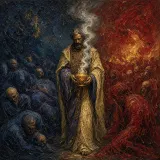
Open with the chapter’s first image
Numbers 15:1: “And the LORD spake unto Moses, saying,”
Slow down at the turning point
Numbers 15:19: “Then it shall be, that, when ye eat of the bread of the land, ye shall offer up an heave offering unto the LORD.”
Keep this word trail visible
LORD, offering, Moses, congregation, children, ignorance
What to explain, in order
Teach the passage in this order. Each step names the verses it rests on, so every point can be shown in the text before it is applied.
Numbers 15:1-2
Hear the timing first
Begin by reading 14:29-35 and then 15:1-2 straight after. The generation has just been told it will die in the wilderness, and the next words of the Lord begin “When ye be come into the land”. Explain that the Book of Numbers places these laws here on purpose: the promise has not been withdrawn, only postponed for a generation. Teach this first because it changes how the whole chapter is heard. Laws about grain, oil and wine in a land not yet reached are a pledge that the land will be reached.
Numbers 15:3-21
Offerings from a settled land
Walk through the scale of grain, oil and wine for a lamb, a ram and a bullock. Explain “tenth deal” as a tenth of an ephah, and “hin” as a liquid measure. Then show that the stranger offers in the same way (15:14-16), and that the first of the dough is offered as a heave offering (15:17-21). Teach the details as signs of a settled life: flour from fields, oil from groves, wine from vineyards. The people who complained about food in 11:5 are promised a land where they will bring food to God.
Numbers 15:22-29
Forgiveness for the unintended
Read the provision for sins of ignorance, first by the whole congregation and then by an individual. Explain “ignorance” as unintended or unwitting sin, not only not knowing the law. Show the offerings and the repeated promise, “it shall be forgiven”. Notice that the stranger is included in 15:26 and 15:29. Teach this before the presumptuous sin so the class sees how wide the provision for failure is. Most of the sins of ordinary life fall here, and the Lord has made a way for them.
Numbers 15:30-31
The high hand
Then read the contrast. The presumptuous soul sins with a high hand, a phrase that pictures a fist raised against God. Explain that this is not a single act but a stance: despising the word of the Lord and breaking his commandment knowingly and defiantly. Such a person “reproacheth the LORD” and is cut off. Tie this back to 14:40-44, where the people “presumed to go up” against the Lord's word. Teach this step carefully so that sensitive learners do not conclude that every failure is defiance.
Numbers 15:32-36
The case at the woodpile
Read the account of the man gathering sticks on the Sabbath. Explain that it illustrates the law of 15:30-31: a deliberate, public breach of the Sabbath sign given in Exodus 31:12-17, which had already named death as the penalty. Note that the people bring him to Moses and wait. Handle the stoning soberly and do not soften it, but do not dwell on it. Explain that this was a judgement given to Israel under the covenant at Sinai, not a pattern for individuals or churches to carry out.
Numbers 15:37-41
Sewn reminders
End with the fringes. Explain them as tassels on the four corners of the outer garment, with a blue cord. Their purpose is in 15:39: to look upon them and remember, rather than follow one's own heart and eyes. Read 15:41 aloud, where the Lord twice says “I am the LORD your God”. Teach this last because the chapter ends not with the threat of 15:30-36 but with a gracious aid to memory. The God who brought them out of Egypt gives them something to see so that they will not forget.
Where learners get stuck
The misreadings this passage tends to produce, and how to answer each from the text.
“After chapter 14 God gave up on Israel.”
The very next words in 15:2 are “When ye be come into the land of your habitations, which I give unto you”, and 15:18 repeats it. The adults of chapter 14 will die in the wilderness, but the promise to their children stands (14:31). Numbers 15 gives instructions for worship in Canaan as a sign that the Lord has not abandoned his purpose. Teach chapter 15 as hope after judgement.
“Any sin I commit on purpose means I am cut off.”
Numbers 15:30-31 describes the soul that acts “presumptuously”, with a raised hand, and “hath despised the word of the LORD”. That is defiant rejection of God, not the weakness and failure of ordinary life. Many sins are known and still committed in weakness, and Psalm 19:12-13 prays for help with both hidden faults and presumptuous sins. Pastors and teachers should reassure anxious learners who fear they have committed an unforgivable sin.
“Strangers could never worship the God of Israel.”
Numbers 15:14-16 says the stranger who offers does as Israel does, and “One law and one manner shall be for you, and for the stranger that sojourneth with you”. The same applies to forgiveness in 15:26 and 15:29. Exodus 12:48-49 had already allowed the stranger to keep the Passover. The stranger who joins Israel's worship comes on the same terms, before the same Lord.
“The fringes were to make the people look religious.”
Numbers 15:39 gives the purpose: “that ye may look upon it, and remember all the commandments of the LORD, and do them”. The fringe is first for the wearer's own eyes, a reminder against following one's own heart. Jesus later criticised those who enlarged their fringes to be seen (Matthew 23:5), which is a misuse of the sign, not its purpose.
Learning objectives
- Explain why “when ye be come into the land” matters after Numbers 14.
- Summarize the grain and drink offerings attached to animal sacrifices.
- Explain the one-law principle for Israelite and resident stranger in this chapter.
- Distinguish unintentional sin from the presumptuous act described in verses 30–31.
- Describe the Sabbath-breaker case without adding motives the text does not state.
- Explain the purpose of the fringes and blue ribbon in verses 37–41.
Teacher preparation
- Read the first two verses after rereading Numbers 14:26–35.
- Clarify KJV “meat offering” as grain offering and “presumptuously” as acting with a high hand or deliberate defiance in context.
- Prepare a small ratio chart for the flour, oil, and wine accompanying lamb, ram, or bullock offerings.
- Treat the man gathering sticks on the Sabbath soberly.
- Bring a simple illustration of a garment corner with fringe and blue cord.
Evidence and interpretation checks
Explicit
Numbers 15:2 says, “When ye be come into the land,” preserving Israel’s future immediately after the wilderness sentence.
Scripture-supported
Numbers 15:14–16 and 15:29 state one ordinance for Israelite and resident stranger in the matters described.
Strong inference
Placed after chapter 14, these future-land commands strongly show that the condemned generation’s failure has not cancelled the Lord’s purpose for Israel.
Possible or traditional reading
Later theology uses different categories for kinds of sin; Numbers 15 itself contrasts unwitting failure with deliberate despising of the Lord’s word.
Limit
The Sabbath case gives the act, custody, ruling, and sentence, but not the man’s motive or private circumstances.
Discussion with answer guidance
1. What is striking about the first words of instruction in 15:2 after the judgment of chapter 14?
What a good answer contains
“When ye be come into the land of your habitations, which I give unto you” (15:2). Straight after the sentence of chapter 14, the Lord speaks as if entry is certain, because for the next generation it is. A good answer sees the grace in the timing: a people who refused the land are told how to worship once they are in it. The same phrase returns in 15:18. A weak answer treats the chapter as an unrelated collection of laws with no connection to Kadesh.
Show teacher guidance
The Lord speaks about Israel entering the land he gives them.
2. How do 15:4–10 vary the accompanying grain, oil, and wine with different animals?
What a good answer contains
With a lamb, “a tenth deal of flour mingled with the fourth part of an hin of oil”, and a fourth of a hin of wine (15:4-5). With a ram, two tenth deals and a third of a hin of oil and wine (15:6-7). With a bullock, three tenth deals and half a hin of oil and wine (15:9-10). A good answer sees the scale: a larger animal brings a larger grain and drink offering. These are products of settled farming, grain, olives and vines, which a wandering people does not yet have. That is part of the promise.
Show teacher guidance
The amounts increase from lamb to ram to bullock.
3. What phrase is repeated about the stranger in 15:14–16?
What a good answer contains
“as ye do, so he shall do” (15:14), and then, “One ordinance shall be both for you of the congregation, and also for the stranger” and “One law and one manner shall be for you, and for the stranger that sojourneth with you” (15:15-16). A good answer notices that the stranger is welcomed into worship on the same terms, “as ye are, so shall the stranger be before the LORD”. The same principle returns in 15:26 and 15:29 for forgiveness. A weak answer assumes outsiders were kept out entirely.
Show teacher guidance
The stranger who offers is to follow the same ordinance; one ordinance and one manner apply in the matter described.
4. How does 15:27–31 distinguish two kinds of wrongdoing?
What a good answer contains
The soul that sins “through ignorance” brings a she goat as a sin offering and “it shall be forgiven him” (15:27-28). But “the soul that doeth ought presumptuously” (15:30), literally with a high hand, “reproacheth the LORD” and is cut off, “Because he hath despised the word of the LORD, and hath broken his commandment” (15:31). A good answer sees that the difference is the posture toward God's word, not the size of the act. A weak answer calls every sin presumptuous or no sin presumptuous.
Show teacher guidance
One is committed ignorantly and receives sacrificial provision; the other is done presumptuously, despises the Lord’s word, and carries cutting off.
5. What do the people do with the man found gathering sticks in 15:32–36 before the sentence is carried out?
What a good answer contains
They “brought him unto Moses and Aaron, and unto all the congregation” (15:33), and “put him in ward, because it was not declared what should be done to him” (15:34). They do not act on their own judgement; they wait for the Lord's word. A good answer notices that the case is placed right after the law on presumptuous sin, which suggests it is an example of it, and that the death is commanded by the Lord (15:35). A weak answer moves straight to the sentence without seeing the restraint.
Show teacher guidance
They bring him to Moses and Aaron and put him in ward because it had not been declared what should be done.
6. What are the fringes and blue ribbon supposed to accomplish in 15:37–41?
What a good answer contains
“that ye may look upon it, and remember all the commandments of the LORD, and do them; and that ye seek not after your own heart and your own eyes” (15:39). The fringe is a reminder sewn into clothing, the blue thread a sign of holiness. A good answer connects this to the spies, who went by their own eyes, and to verse 41, “I am the LORD your God, which brought you out of the land of Egypt”. Remembering the rescuer comes before obeying the commands. A weak answer turns the fringe into a lucky charm.
Show teacher guidance
They are to be seen so Israel remembers and does the commandments rather than following the heart and eyes into unfaithfulness.
Responsible application
Heart and habits
Ask what kinds of physical reminders help a community remember a duty before failure occurs.
Relationships and community
Use the one-law language to discuss equal accountability for people participating in the same covenant practice, while retaining the chapter’s specific Israelite setting.
Promise after failure
Have learners explain why future-land instructions immediately after chapter 14 are weighty.
Session plans
Two timings of the same lesson. The shorter keeps the reading, the central discussion and one response; the longer gives the confusions and the application their own time.
45 minutes
After the sentence
Read 14:29-31 and 15:1-2 back to back. Take question one and confusion one.
Grain, oil and wine
Read 15:3-10 quickly. Take question two.
One law for the stranger
Read 15:14-16 and take question three and confusion three.
Two kinds of sin
Read 15:22-31. Take question four and confusion two, with care for anxious learners.
The woodpile
Read 15:32-36 and take question five. Keep it sober and brief.
Fringes and handout
Read 15:37-41. Take question six, read the key verse and hand out the sheet.
90 minutes
Hope after failure
Ask learners how a family speaks after a serious failure. Read 14:29-31 and 15:1-2. Take question one.
Offerings in the land
Read 15:3-21. Take question two. Show the scale on the board.
The stranger
Read 15:14-16, 15:26, 15:29 and Exodus 12:48-49. Take question three and confusion three.
Ignorance and the high hand
Read 15:22-31 and Psalm 19:12-13. Take question four and confusion two.
The Sabbath case
Read 15:32-36 with Exodus 31:14-15. Take question five.
Fringes
Read 15:37-41 and Matthew 23:5. Take question six and confusion four.
Application
Have learners choose a visible reminder of God's word for the coming week and explain it to a partner.
Handout and prayer
Read the key verse together and pray verse 41 back to God.
Adapting the lesson
Children
Give each child a piece of blue string to tie on their wrist as a reminder. Explain that God told Israel to wear blue threads so they would remember his words when they looked down. Teach that God forgives mistakes we did not mean. Leave out the man who gathered sticks; focus on the promise that the children would one day enter the land.
Youth
Ask what they look at most in a day, and connect it to 15:39 and following one's own eyes. Discuss the difference between failing and defying, and reassure them that the provision of 15:27-28 is wide. Talk about the stranger's equal place in worship. If they ask about the stoning, answer honestly that it was a judgement under Israel's covenant and not a pattern to follow.
Adults
Give time to the timing of the chapter after chapter 14 and its message of hope for the next generation, which may speak to parents. Discuss the theology of unintended and presumptuous sin carefully, including its pastoral use. Discuss the stranger's inclusion. Address the Sabbath case honestly as covenant judgement and draw out the purpose of the fringes.
One to one
Ask whether the person fears they have sinned beyond forgiveness. If so, read 15:27-28 and Psalm 19:12-13 together and talk about the difference between weakness and defiance. If they struggle to remember God in daily life, discuss a practical reminder like the fringe. Read 15:41 as the ground of everything.
Song and video learning lab
A song or video may interpret, compress, or dramatize the text. Its value becomes clearer when its choices are compared with Scripture.
- Before the media: the exact passage and its central movement.
- During the media: the words, people, events, and emotions the artist emphasizes.
- After the media: what it clarifies, what it leaves out, and what belongs back in the biblical text.
Handout
One page for learners to take home. The print button prints this section alone.
Numbers 15:1–41
The passage in brief
After the people refuse the land, the Lord gives laws for when they come into it. Offerings are to be brought with grain, oil and wine, and the stranger who lives among them worships by the same law. Sins committed unintentionally can be forgiven through offerings, but the person who defies the Lord's word with a high hand is cut off. A man is found gathering sticks on the Sabbath and is put to death. Israel is told to wear blue-corded fringes to remember the Lord's commandments.
A verse to keep
And it shall be unto you for a fringe, that ye may look upon it, and remember all the commandments of the LORD, and do them; and that ye seek not after your own heart and your own eyes, after which ye use to go a whoring:
Numbers 15:39 · King James Version
Questions to take home
What do the first words of 15:2 promise after the judgement of chapter 14?
What is the difference between sinning in ignorance (15:27) and presumptuously (15:30)?
What were the fringes for, according to 15:39?
This week
Choose one visible reminder this week and let it call you back to one command of God each time you see it.
Music and video connected to the passage
Related media appears when its Scripture reference overlaps this study. Music and video can illuminate a theme while the biblical text remains the foundation.