The big picture
Psalm 134 closes the Songs of Degrees with only three verses, but it creates a complete exchange. Servants stand in the house of the LORD by night and are called to lift their hands and bless him. The Book of Psalms lets the sanctuary remain active after ordinary daytime movement has ended. Then the direction of blessing reverses. The servants bless the LORD in praise, and the LORD, maker of heaven and earth, is asked to bless the addressed person or community from Zion. The local place and the cosmic title stand together without conflict. Zion is the place from which the blessing is spoken, but the giver is not confined there. After Psalm 120 began among hostile speech and people set on war, the sequence ends with voices in the night directed toward praise and blessing. The ascent concludes in worship that turns outward again.
Central truth
Psalms 133–134 close the Songs of Degrees with unity pictured as consecrating oil and life-giving dew, then with night servants blessing the Lord and receiving blessing from Zion’s Creator.

The study notes have a page of their own
The movement by movement analysis, the words to trace, the verse by verse notes and where readers differ are written for someone studying alone. They are on the Deep Personal Reflections page for this chapter. This page is the lesson.
A chapter-specific teaching brief
These anchors come from this chapter itself. They help a teacher use the Level 1 overview, the Level 2 study, and the Scripture text as one lesson.
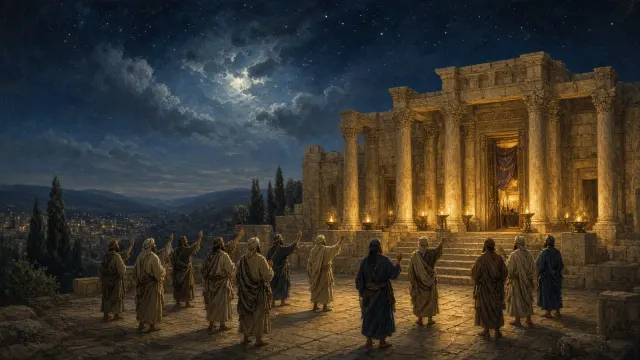
Open with the chapter’s first image
Psalms 134:1: “Behold, bless ye the LORD, all ye servants of the LORD, which by night stand in the house of the LORD.”
Slow down at the turning point
Psalms 134:2: “Lift up your hands in the sanctuary, and bless the LORD.”
Keep this word trail visible
LORD, bless, earth, hands, heaven, house
What to explain, in order
Teach the passage in this order. Each step names the verses it rests on, so every point can be shown in the text before it is applied.
Psalms 133-134
The last of the Songs of Degrees
Begin by explaining that Psalms 120-134 are the Songs of Degrees, or songs of ascents, sung by pilgrims going up to Jerusalem for the feasts. Psalm 120 begins far away among strangers, and by Psalm 134 the pilgrims are in the temple at night. Psalm 133 celebrates the unity of the gathered tribes, and Psalm 134 is a farewell blessing as the pilgrims prepare to leave. Teach this first so that learners hear the two short psalms as the end of a journey and the climax of worship.
Psalm 133:1
Good and pleasant together
Read verse 1. Explain behold as an invitation to look. Explain brethren as the family of God's people, here tribes from all over the land gathered in one place, and dwell together as living in harmony, not merely being near each other. Teach both adjectives, good and pleasant. Ask the class what unity looks like when it is good but not pleasant, and pleasant but not good. Point to Jesus' prayer in John 17:21 that his followers be one. Teach that unity is a gift God gives and a joy to receive.
Psalm 133:2
Oil down Aaron's beard
Now teach the first image. Read Exodus 30:22-33 briefly and explain the holy anointing oil: myrrh, cinnamon, calamus, cassia, olive oil, poured on Aaron's head at his consecration. Explain that it was precious and set apart. Then picture it pouring so freely that it runs down the beard and onto the collar of his robe. Teach that unity among God's people is like this: holy, costly, abundant, and flowing from the head down over the whole body. Christians often connect this with Christ the head and the Spirit given to the church.
Psalm 133:3
Dew from Hermon, life in Zion
Teach the second image. Mount Hermon in the far north is high and snow-capped, and its heavy dew waters the land. Zion is far to the south and drier. The psalm imagines Hermon's dew falling on Zion, refreshment coming from far away. Explain that dew falls quietly and gives life. Then teach the end of the verse: there the LORD commanded the blessing, even life for evermore. Teach that where God's people dwell together in unity, God gives life. Ask the class where they have seen that.
Psalm 134:1-3
Night shift in the sanctuary
Read Psalm 134. Explain the setting: the priests and Levites who kept watch in the temple through the night, guarding the house and tending the lamps. The departing pilgrims, or the priests themselves, call them to bless the LORD and lift their hands. Then teach verse 3, the blessing that returns: the LORD who made heaven and earth bless thee out of Zion. Explain that this is a benediction like Numbers 6:24-26. Close by pronouncing it over the class, so they leave having received what the psalm gives.
Where learners get stuck
The misreadings this passage tends to produce, and how to answer each from the text.
"Unity means everyone has to agree about everything."
Psalm 133 describes brethren dwelling together, tribes with different histories and territories gathered as one family before God. Unity in Scripture is shared life under God, not uniformity of opinion; Romans 14 shows believers who differ on secondary matters accepting one another. The oil in 133:2 is holy and comes from above. Teach unity as a gift to be guarded, as Ephesians 4:3 says, not as an excuse to silence honest differences.
"If my church isn't united, it's not a real church."
Psalm 133:1 calls unity good and pleasant, which implies it is not always present. The churches of the New Testament, in Corinth and Philippi, had divisions that Paul addressed. Disunity is a reason for prayer, repentance and peacemaking, not for despair or leaving at once. Teach the psalm as a vision to pursue together, and pray for the church as it is.
"Blessing God means doing something for him, like giving him a gift."
To bless the LORD in 134:1-2 is to praise him, to speak well of him, with lifted hands. God needs nothing, as Psalm 50:12 says. When God blesses us in 134:3 he gives us good; when we bless him, we honour him. The exchange is not trade but worship and grace. Teach learners to bless God for who he is, especially in the night watches of life.
Learning objectives
- Explain why unity is called both good and pleasant in Psalm 133:1.
- Interpret the oil on Aaron as abundant consecration rather than messiness.
- Explain the dew comparison without requiring literal dew from Hermon to travel to Zion.
- Identify who is addressed in Psalm 134 and when they serve.
- Trace the two directions of blessing in Psalm 134.
- Show how Zion links the two psalms at the close of the ascent collection.
Teacher preparation
- Prepare Aaron’s priestly anointing from Exodus 29 or Leviticus 8 so the oil image reads as holy abundance, not an unfortunate grooming incident.
- Locate Mount Hermon north of Jerusalem and Zion at Jerusalem; treat verse 3 as poetic comparison, not a meteorological claim.
- Explain 'skirts of his garments' in Psalm 133:2 as the edge or collar area of the priestly garments depending on the older English usage; the key point is oil running down abundantly.
- Note that Psalm 134 addresses servants who stand in the Lord’s house by night, likely temple personnel keeping worship through nighttime duty.
- Read all six verses together. They form a compact ending in which gathered people, sanctuary servants, Zion, and the maker of heaven and earth all meet.
Evidence and interpretation checks
Explicit
Psalm 133:1 explicitly calls brothers dwelling together in unity both good and pleasant.
Scripture-supported
Psalm 133:2–3 compares that unity first with precious oil descending on Aaron and then with dew associated with Hermon and Zion, ending with the Lord’s commanded blessing.
Strong inference
Because both images move downward, unity is strongly pictured as bestowed and life-giving rather than merely negotiated by human technique.
Possible or traditional reading
Traditional readings sometimes connect the oil directly with priestly consecration and the dew with extraordinary fertility. Those associations fit the imagery, though the psalm does not explain a full allegory.
Limit
Neither psalm claims that unity means absence of disagreement, nor does Psalm 134 describe the exact schedule or duties of the night servants. The text celebrates their shared worship.
Discussion with answer guidance
1. What two adjectives describe unity before any comparison is given?
What a good answer contains
Good and pleasant: "Behold, how good and how pleasant it is for brethren to dwell together in unity" (133:1). Good speaks of what is right and beneficial; pleasant of what is lovely and delightful. A good answer keeps both, because unity is not only a duty but a joy, and a church can be dutifully united and joyless, or pleasant and unprincipled. Behold invites the class to look and see. A weak answer drops one adjective or turns the verse into a demand for everyone to agree about everything.
Show teacher guidance
Psalm 133:1 says good and pleasant. Let both remain, because the psalm treats unity as morally fitting and genuinely delightful.
2. Why does Aaron matter in the oil comparison?
What a good answer contains
Because the oil is the anointing oil of the high priest. "It is like the precious ointment upon the head, that ran down upon the beard, even Aaron's beard: that went down to the skirts of his garments" (133:2). Exodus 29:7 and 30:22-33 describe the holy oil poured on Aaron's head at his consecration, rich with spices and used for nothing else. A strong answer sees that unity is compared to something holy, costly and abundant, poured so generously that it runs down the beard to the robe. A weak answer stops at the smell or finds the image merely odd.
Show teacher guidance
Aaron is the high-priestly figure. The precious oil evokes consecration and abundance, not merely fragrance.
3. What common movement appears in the oil and dew images?
What a good answer contains
Both come down. The oil "ran down upon the beard" and "went down to the skirts of his garments" (133:2); the dew is "the dew of Hermon, and as the dew that descended upon the mountains of Zion" (133:3). A good answer notices the descent before interpreting it, and then sees that unity in the psalm is a gift that comes from above and flows downward over the whole body, not something produced from below. Hermon was the high, well-watered mountain in the north. A weak answer jumps to meaning without seeing the shared movement.
Show teacher guidance
Both descend. Notice the oil running down and the dew descending before discussing what that movement suggests.
4. Where does Psalm 133 say the Lord commands blessing?
What a good answer contains
In Zion: "for there the LORD commanded the blessing, even life for evermore" (133:3). There refers to the mountains of Zion, the place where God's people gathered as one family to worship. A strong answer sees that the blessing is commanded by the LORD, given with authority, and that it is life for evermore, the fullest blessing in the Old Testament. Unity among worshippers is the setting where God pronounces it. A weak answer misses the word there, or assumes the blessing is the unity itself rather than life from God.
Show teacher guidance
Verse 3 says 'there,' tied to Zion in the comparison, and names the blessing as life for evermore.
5. Who receives the commands in Psalm 134:1–2?
What a good answer contains
"Behold, bless ye the LORD, all ye servants of the LORD, which by night stand in the house of the LORD. Lift up your hands in the sanctuary, and bless the LORD" (134:1-2). The servants are the priests and Levites on the night watch in the temple, as 1 Chronicles 9:33 describes. A good answer sees that the last pilgrim psalm calls those who keep the house at night to worship, not only to guard, and that lifting the hands is a posture of prayer and praise. A weak answer misses the night shift and the setting in the temple.
Show teacher guidance
The servants of the Lord standing in his house by night are told to bless the Lord and lift hands in the sanctuary.
6. What changes in Psalm 134:3?
What a good answer contains
The direction reverses. In verses 1-2 servants bless the LORD; in verse 3 the LORD blesses them: "The LORD that made heaven and earth bless thee out of Zion" (134:3). The thee is singular, a blessing for each person. A strong answer sees the exchange of blessing between God and his people, and notices that the blessing comes from the Creator of everything, out of Zion, which links back to Psalm 133:3. Psalms 120-134 end with this benediction. A weak answer treats verse 3 as repetition.
Show teacher guidance
The direction reverses: after servants bless the Lord, the Lord who made heaven and earth is invoked to bless 'thee' out of Zion.
Responsible application
Treat unity as more than agreement
Use Psalm 133 to evaluate community health by asking whether people can actually dwell together with shared worship and mutual good, not merely sign the same statement.
Honor unseen service
Use Psalm 134:1 to recognize necessary nighttime or behind-the-scenes service without requiring public visibility for the work to count.
Let blessing travel both directions
Use Psalm 134 to structure worship with praise offered to the Lord and a closing blessing that sends people out under the Creator’s care.
Session plans
Two timings of the same lesson. The shorter keeps the reading, the central discussion and one response; the longer gives the confusions and the application their own time.
45 minutes
The end of the road
Explain the Songs of Degrees. Read 120:5 and 134:1 to show the journey from exile to the temple.
Good and pleasant
Read 133:1 and take question one. Address confusion one.
Oil and dew
Read 133:2-3 with Exodus 30:30. Take questions two, three and four.
The night watch
Read 134:1-2 and take question five. Address confusion three.
Blessed from Zion
Read 134:3 and take question six. Address confusion two.
Benediction
Read the key verse together, then pronounce 134:3 over the group with hands lifted.
90 minutes
Songs for the road
Read the first verse of several Songs of Degrees, 120, 121, 122, 125, 130. Explain the pilgrimage.
Good and pleasant
Read 133:1 and John 17:20-23. Take question one and confusion one.
The holy oil
Read Exodus 30:22-33 and Leviticus 8:12. Take question two. If possible, let the group smell a fragrant oil.
Dew and life
Read 133:3 and take questions three and four. Ask where they have seen unity bring life.
Night servants
Read Psalm 134 and 1 Chronicles 9:27, 9:33. Take question five and confusion three.
The blessing returns
Take question six. Address confusion two and pray for your church's unity.
Application
In pairs, name one relationship in the church that needs peacemaking and one practical step toward it.
Handout and benediction
Read the key verse together and close with 134:3 spoken over the group.
Adapting the lesson
Children
Let children hold hands in a circle and read 133:1 together. Bring a small bottle of scented oil and let them smell it, then explain that God's family together is precious like that. Spray a fine mist of water for dew. For Psalm 134, turn the lights low and let them lift hands and say bless the LORD, then speak the blessing of 134:3 over each child by name.
Youth
Start with group divisions: cliques, online arguments, teams. Read 133:1 and ask why unity is both good and pleasant. Explain the oil and dew images and ask what difference it would make if unity were seen as a holy gift. Talk about those who serve unseen, like the night servants of 134:1, and let them speak the blessing of 134:3 over each other.
Adults
Discuss what threatens unity in families and churches and how to pursue it without demanding uniformity. Give time to the priestly oil and its significance. Talk about the night watches of adult life, caring for children, the sick or the dying, and how 134 calls even tired servants to bless the LORD. Close by blessing one another.
One to one
Ask whether there is a relationship in their family or church that needs healing. Read Psalm 133 and pray for it together. If they serve in hidden or exhausting ways, read 134:1-2 and thank God for their service. Speak 134:3 over them as a blessing before you part.
Song and video learning lab
A song or video may interpret, compress, or dramatize the text. Its value becomes clearer when its choices are compared with Scripture.
- Before the media: the exact passage and its central movement.
- During the media: the words, people, events, and emotions the artist emphasizes.
- After the media: what it clarifies, what it leaves out, and what belongs back in the biblical text.
Handout
One page for learners to take home. The print button prints this section alone.
Psalms 133–134
The passage in brief
Psalms 133 and 134 are the last of the Songs of Degrees, sung by pilgrims at the end of their journey to Jerusalem. Psalm 133 celebrates how good and pleasant it is when God's people live together in unity. It is like the holy oil poured on Aaron the high priest, running down his beard, and like the dew of Mount Hermon falling on Zion, where the LORD commands his blessing of life for evermore. Psalm 134 calls the night servants of the temple to bless the LORD, and asks the Creator to bless them from Zion.
A verse to keep
The LORD that made heaven and earth bless thee out of Zion.
Psalms 134:3 · King James Version
Questions to take home
Why do you think the psalm says unity is both good and pleasant?
What do the oil and the dew in Psalm 133 teach about where unity comes from?
How can you bless the LORD in the night watches of your own life?
This week
Take one step this week to make peace with a fellow believer, and pray Psalm 134:3 over them.
Music and video connected to the passage
Related media appears when its Scripture reference overlaps this study. Music and video can illuminate a theme while the biblical text remains the foundation.