
The big picture
Romans 15 completes the food-and-days argument by redefining strength as the ability to carry another person's weakness rather than display personal liberty. Christ's refusal to please himself supplies the pattern, and Scripture supplies patience, comfort, and hope until one divided community can glorify God "with one mind and one mouth." Paul then connects that welcome to the letter's larger Jew-Gentile argument. Christ confirms the promises to the fathers, while Gentiles glorify God for mercy, and a chain of quotations makes both belong inside the same scriptural horizon. The chapter then becomes increasingly personal. Paul explains his Gentile mission, his desire to preach where Christ has not been named, his plan to reach Spain through Rome, and the collection he must first deliver to Jerusalem. The confident itinerary ends in requested prayer for danger and uncertain reception, showing a theology carried through roads, money, communities, and circumstances Paul cannot control.
Central truth
Romans 14:1–15:13 commands believers divided over food and days to stop despising and judging, limit liberty for a brother's sake, pursue peace, and receive one another as Christ received them. Romans 15:14–16:27 closes with Paul's westward mission, Jerusalem service, Phoebe's commendation, and a dense coworker network showing that gospel advance depends on prayer, generosity, hospitality, risk, and mutual recognition.
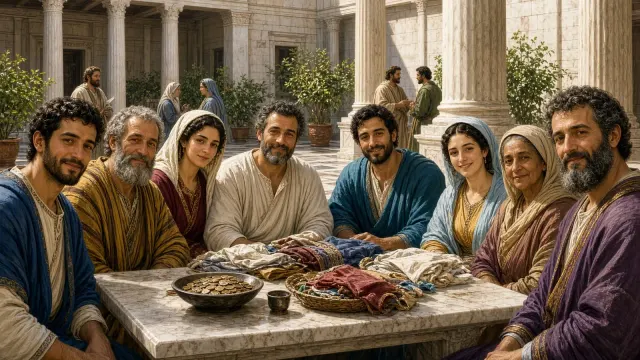

The study notes have a page of their own
The movement by movement analysis, the words to trace, the verse by verse notes and where readers differ are written for someone studying alone. They are on the Deep Personal Reflections page for this chapter. This page is the lesson.
A chapter-specific teaching brief
These anchors come from this chapter itself. They help a teacher use the Level 1 overview, the Level 2 study, and the Scripture text as one lesson.
Open with the chapter’s first image
Romans 15:1: “We then that are strong ought to bear the infirmities of the weak, and not to please ourselves.”
Slow down at the turning point
Romans 15:13: “Now the God of hope fill you with all joy and peace in believing, that ye may abound in hope, through the power of the Holy Ghost.”
Keep this word trail visible
Christ, Gentiles, Jesus, written, gospel, Jerusalem
What to explain, in order
Teach the passage in this order. Each step names the verses it rests on, so every point can be shown in the text before it is applied.
Romans 14:1–15:13
Romans 14:1-4
Receive him, not to argue
Begin with the command and its limit: receive the one who is weak in faith, “but not to doubtful disputations”, that is, not in order to quarrel over his opinions. Explain that “weak” here means a conscience that does not yet feel free about certain practices, not a weak commitment to Christ. Name that readers differ on who the weak were, Jewish believers keeping food laws, those avoiding meat offered to idols, or both. Then stress the reason in verse 3, “God hath received him”, and verse 4, “God is able to make him stand”.
Romans 14:5-12
Unto the Lord, and before his judgment seat
Read verses 5 to 9 and mark every “unto the Lord”. Paul is not saying the questions are unimportant; he is saying both sides can honour Christ in them, and both give thanks. Explain “fully persuaded in his own mind” as each acting from settled conviction. Then read verses 10 to 12 and show why judging is out of place: we will all stand before Christ's judgment seat, and every knee shall bow. Teach these together because the reason for not judging is that Jesus is Lord of both.
Romans 14:13-18
Nothing unclean of itself, yet do not destroy
Notice the play on the word judge in verse 13: stop judging one another, and judge this instead, not to trip a brother. Then let Paul state his own view in verse 14, nothing is unclean of itself, which agrees with Mark 7:19. But he immediately limits freedom by love: if eating grieves a brother so that he is drawn to act against his conscience, the strong are no longer walking in love. Explain “destroy” as ruin. Verse 17 resets the priorities: the kingdom is righteousness, peace and joy.
Romans 14:19-23
Pursue peace and keep faith before God
Read verse 19 as the positive command: follow after what makes for peace and builds up. Then show the balance of verses 20 to 22. All things are clean, yet it is wrong to eat in a way that makes another stumble, and the strong may keep their conviction “to thyself before God” rather than parading it. Explain verse 23 carefully. The one who doubts and eats anyway is condemned because he acted without faith. Conscience is not infallible, but to override it knowingly is sin.
Romans 15:1-7
Christ pleased not himself
Explain that Paul now counts himself among the strong, “We then that are strong”, and lays the burden on them. Read Psalm 69:7-9 so the class hears that Christ bore reproach for God's sake. Then show verse 4: the Scriptures were written for our learning, so that we might have hope. Lead to the prayer of verses 5 and 6, one mind and one mouth, and the command of verse 7. Receiving one another is measured by how Christ received us, which was before we deserved it.
Romans 15:8-13
Gentiles praising God with his people
Read each quotation in turn and ask who is praising: “among the Gentiles”, “ye Gentiles, with his people”, “all ye Gentiles”, and the root of Jesse “in him shall the Gentiles trust”. Show that Christ served Israel to confirm the promises and to bring the nations into praise. This is where the argument of the whole letter has been heading since 1:16, the Jew first and also the Greek. End with the blessing of verse 13, read slowly, as the close of the letter's main body.
Romans 15:14–16:27
Romans 15:14-21
A bold reminder and a priestly mission
Begin with Paul's confidence in the Romans, which is real. He is not correcting a weak church; he is reminding a strong one. Then explain the temple words in verse 16, minister, ministering, offering up, sanctified: Paul pictures his work as a priest presenting the Gentiles to God as an acceptable offering. Show the boundaries of his boasting in verses 17 and 18, only what Christ has done through him. Explain that Illyricum lay on the far side of Greece, roughly the region of the modern western Balkans.
Romans 15:22-29
Jerusalem, Rome, and Spain
Put a map in front of the class with Jerusalem, Corinth, Rome and Spain. Read the plan in order: the collection to Jerusalem, then Rome, then Spain. Read 2 Corinthians 8:1-5 so the class sees how the Macedonian churches gave out of poverty. Explain verse 27: Gentile believers share Israel's spiritual blessings, so it is fitting that they share material ones. Then mention what Acts 21 to 28 records, that Paul was arrested in Jerusalem and reached Rome as a prisoner, and that Romans does not tell us whether he reached Spain.
Romans 15:30-33
Strive together with me in prayer
Explain “strive together” as wrestling alongside, the picture of a shared contest. Paul asks for three things: deliverance from unbelievers in Judaea, acceptance of his service by the saints in Jerusalem, and a joyful arrival in Rome. Show the class that he knew the danger before he went. Then let Acts answer: he was rescued, though in chains, and he did come to Rome. Teach this before the greetings because it shows that the apostle depended on ordinary believers' prayers as much as on his own work.
Romans 16:1-2
Phoebe commended
Explain that Cenchrea was the eastern port of Corinth, where Paul probably wrote the letter. Phoebe is a sister and a “servant” of the church there; the Greek word is diakonos, translated deacon, minister or servant elsewhere, and traditions differ on whether it names an office here. “Succourer” means a helper or patron who used her means for others, including Paul. Show the double request: receive her in the Lord, and assist her in whatever she needs. That she carried the letter to Rome is a strong inference from these verses.
Romans 16:3-16
A church of names
Build a chart with the class: name, how Paul describes them, and what they did. Read Acts 18:1-3 and 18:24-26 for Priscilla and Aquila. Mark the house churches, the risk, the labour, the imprisonment. Name the questions about 16:7: whether Junia is a woman's name, as most ancient readers took it, and whether “of note among the apostles” means well known to the apostles or notable as apostles. Readers differ; show the wording. Note the households of Aristobulus and Narcissus, which likely included slaves and freed people. The church was these people.
Romans 16:17-27
Guarding the network and giving glory
Explain that the warning against those who cause divisions is not about the disagreements of chapter 14; it is about teaching “contrary to the doctrine which ye have learned” and the self-serving smoothness of verse 18. Read verse 20 with Genesis 3:15. Then show the greeting from Tertius, the man who wrote the letter down, and from Gaius and Erastus. End with the doxology and place it beside 1:1-5: the gospel, the prophets, the obedience of faith, all nations. The letter closes where it opened, giving glory to God.
Where learners get stuck
The misreadings this passage tends to produce, and how to answer each from the text.
Romans 14:1–15:13
“Romans 14 means every moral question is just personal opinion.”
The disputes Paul treats are food and days, things he says are not unclean “of itself” (14:14). The same letter names many sins plainly, in 1:29-31 and 13:9, and tells believers to cast off rioting, drunkenness and strife (13:13). Verse 17 says the kingdom is “righteousness, and peace, and joy”. Romans 14 governs disagreements of conscience between believers, not commands God has given; deciding which is which may itself need patience.
“The weak in faith are immature Christians whom the strong should correct.”
Paul does not tell the strong to argue the weak out of their convictions; he forbids receiving them “to doubtful disputations” (14:1). He says “God hath received him” and “God is able to make him stand” (14:3-4). The duty falls on the strong: to “bear the infirmities of the weak, and not to please ourselves” (15:1). Weak describes a conscience about particular practices, not a lesser standing before God.
“Causing someone to stumble means doing anything another believer dislikes.”
Paul's words are stronger than dislike: “destroy” (14:15, 20), “stumbleth, or is offended, or is made weak” (14:21). The danger is leading a brother to act against his own conscience, and so to sin, since “he that doubteth is damned if he eat” (14:23). Paul does not stop stating his own view, “there is nothing unclean of itself” (14:14). Love limits freedom where another's faith is at risk, not wherever someone is annoyed.
“If I am strong, my freedom is what matters most.”
Paul says the strong “ought to bear the infirmities of the weak, and not to please ourselves” (15:1), and grounds it in Christ, who “pleased not himself” (15:3). The brother who might be harmed is one “for whom Christ died” (14:15). Freedom is real, but in this chapter its best use is to be laid aside for someone else, as Christ laid aside his rights for us, so that together believers may “with one mind and one mouth glorify God” (15:6).
Romans 15:14–16:27
“Romans 16 is a list of names we can skip.”
The names show what the gospel of chapters 1 to 15 looks like in actual households. People risked their necks (16:4), hosted churches in their homes (16:5), laboured much (16:6, 12), went to prison (16:7) and mothered an apostle (16:13). Some were Paul's kinsmen, some likely slaves in great households (16:10-11). Skipping the chapter teaches that doctrine floats free of people; Paul ends a letter about grace with the people grace made.
“Paul was a lone hero who did the work by himself.”
Paul asks the Romans to help him on his way to Spain (15:24) and to “strive together with me in your prayers” (15:30). He calls Priscilla and Aquila “my helpers in Christ Jesus” (16:3), Urbane “our helper” (16:9) and Timotheus “my workfellow” (16:21). Tertius wrote the letter down (16:22), Gaius hosted him (16:23), and Phoebe likely carried it (16:1-2). The mission was a network, and Paul says so.
“Romans 16:1 and 16:7 settle every question about women's roles in the church.”
The text honours many women: Phoebe the servant of the church and succourer of many (16:1-2), Priscilla named before her husband (16:3), Mary, Tryphena, Tryphosa and Persis who laboured (16:6, 12), and Junia with Andronicus “of note among the apostles” (16:7). Traditions read servant and the phrase about the apostles differently and reach different conclusions about church office. Let the class see the wording and the honour Paul gives, and do not settle the wider debate from these verses alone.
“Avoiding those who cause divisions means avoiding anyone who disagrees with me.”
Chapter 14 told the church to receive believers who disagree about food and days, so 16:17 cannot mean that. The people to mark are those who cause divisions “contrary to the doctrine which ye have learned” and who “serve not our Lord Jesus Christ, but their own belly” (16:17-18). The warning is about teaching that departs from the gospel and motives that serve the self, not about honest differences of conscience.
Learning objectives
- Identify the food and day disputes Paul addresses.
- Explain why both sides are forbidden to despise or judge.
- Trace Paul's move from liberty to restraint for a brother's sake.
- Explain why God's kingdom is not meat and drink.
- Show how Christ's example governs Romans 15:1–7.
- Connect Romans 15:8–13 with scriptural hope for Jew-Gentile praise.
- Explain why Paul writes boldly to a capable Roman church.
- Trace his ministry from Jerusalem toward Illyricum and unreached regions.
- Map Jerusalem, Rome, and Spain in Paul's travel plans.
- Describe exactly what Romans 16:1–2 says about Phoebe.
- Identify the varied service recognized in Romans 16's greetings.
- Explain how warning and doxology protect the gospel partnership.
Teacher preparation
- Mark receive, judge, despise, eat, day, Lord, brother, stumble, peace, edify, and hope.
- Prepare eater and abstainer columns without labeling either side the better Christian.
- Explain KJV 'doubtful disputations' as quarrels over disputed opinions.
- Review Psalm 69 and the quotation chain in Romans 15:9–12.
- Distinguish conscience-sensitive matters from conduct Romans elsewhere explicitly condemns.
- Underline every place, person, ministry verb, travel intention, request, commendation, and greeting.
- Prepare a map with Jerusalem, Illyricum, Rome, Cenchrea, and Spain.
- Review the Jerusalem collection in 1 Corinthians 16 and 2 Corinthians 8–9.
- Prepare a chart of names and Paul's descriptions in Romans 16.
- Know the interpretive questions around Phoebe and Junia, separating wording from later inference.
Evidence and interpretation checks
Explicit
Romans 14:3 forbids despising and judging because God receives both; Romans 15:7 commands mutual reception after Christ's pattern. Romans 15:24 names Spain and Roman help; 16:1–2 commends Phoebe, servant of Cenchrea, and commands reception and assistance.
Scripture-supported
Romans 14:11 cites Isaiah 45:23; Romans 15:9–12 strings Scripture together around Gentile praise and hope. Romans 15:21 quotes Isaiah 52:15; Romans 16:25–26 says the mystery is made known through prophetic Scriptures.
Strong inference
Food, days, weak, strong, and Gentile praise strongly suggest Jewish-Gentile conscience differences behind much of the conflict. Phoebe's commendation and requested assistance strongly support the traditional inference that she carried or accompanied the letter.
Possible or traditional reading
The exact weak, strong, and disputed days are debated. Keep eating and day-observance 'unto the Lord' as the fixed facts. Romans 16:1 can be read 'servant' or 'deacon'; Romans 16:7 is debated regarding Junia and 'of note among the apostles.'
Limit
Romans 14 does not make every moral issue indifferent; this letter explicitly condemns many behaviors elsewhere. Romans does not say whether Paul reached Spain or supply full biographies for the people in chapter 16.
Discussion with answer guidance
1. What two disputes appear in Romans 14:1–6?
What a good answer contains
The first dispute is food: “one believeth that he may eat all things: another, who is weak, eateth herbs” (14:2). The second is days: “One man esteemeth one day above another: another esteemeth every day alike” (14:5). A good answer pairs each side with its typical fault: “Let not him that eateth despise him that eateth not; and let not him which eateth not judge him that eateth: for God hath received him” (14:3). The strong are tempted to sneer, the weak to condemn. A weak answer names the disputes and misses the attitudes.
Show teacher guidance
Name eating versus abstaining and special days versus every day, then identify despising and judging.
2. What repeated phrase in Romans 14:6–9 reframes both practices?
What a good answer contains
The phrase is “unto the Lord”, or “to the Lord”. “He that regardeth the day, regardeth it unto the Lord”, and “He that eateth, eateth to the Lord, for he giveth God thanks; and he that eateth not, to the Lord he eateth not, and giveth God thanks” (14:6). Then it widens: “whether we live therefore, or die, we are the Lord’s” (14:8). A good answer notices that both sides give thanks to the same Lord, and that Christ died and rose “that he might be Lord both of the dead and living” (14:9).
Show teacher guidance
Trace 'unto the Lord' through eating, abstaining, living, and dying under the same Lord.
3. Why is judging inappropriate in Romans 14:10–12?
What a good answer contains
Because the brother belongs to another master: “Who art thou that judgest another man’s servant?” (14:4). Paul asks, “why dost thou judge thy brother? or why dost thou set at nought thy brother? for we shall all stand before the judgment seat of Christ” (14:10), quoting Isaiah 45:23 in verse 11. “So then every one of us shall give account of himself to God” (14:12). A good answer catches the word himself: each gives account for his own life. A weak answer hears this as a ban on every moral judgment.
Show teacher guidance
Each stands before God's judgment and gives account of himself, not of the other servant.
4. How does Romans 14:13–23 change the liberty question?
What a good answer contains
Paul turns the question from what is allowed to what builds up. He writes, “judge this rather, that no man put a stumblingblock or an occasion to fall in his brother’s way” (14:13). He agrees that “there is nothing unclean of itself” (14:14), yet “Destroy not him with thy meat, for whom Christ died” (14:15). Verse 17 says “the kingdom of God is not meat and drink; but righteousness, and peace, and joy in the Holy Ghost” (14:17). A good answer explains verse 23: acting against conscience is sin, “for whatsoever is not of faith is sin”.
Show teacher guidance
Mark stumblingblock, grief, destroy, peace, edify, offence, and faith; permitted conduct can still harm another.
5. What must the strong do in Romans 15:1–7?
What a good answer contains
“We then that are strong ought to bear the infirmities of the weak, and not to please ourselves” (15:1). Each should please his neighbour “for his good to edification” (15:2). The reason is Christ: “even Christ pleased not himself” (15:3), quoting Psalm 69:9. The goal is to “with one mind and one mouth glorify God” (15:6), and the command is “receive ye one another, as Christ also received us to the glory of God” (15:7). A good answer sees that the strong carry the cost, as Christ did.
Show teacher guidance
Bear the weak, refuse self-pleasing, follow Christ's example, and aim toward one mind and one mouth.
6. Why end with Gentile quotations in Romans 15:8–13?
What a good answer contains
Christ was “a minister of the circumcision for the truth of God, to confirm the promises made unto the fathers: And that the Gentiles might glorify God for his mercy” (15:8-9). Paul then quotes Psalm 18:49, Deuteronomy 32:43, Psalm 117:1 and Isaiah 11:10, all picturing Gentiles praising with Israel. A good answer sees why the section ends here: the disputes over food and days were largely between Jewish and Gentile believers, and God's purpose is one people with one voice, filled by “the God of hope” (15:13).
Show teacher guidance
Trace promises to the fathers into Gentile mercy, praise, rejoicing, and hope in the root of Jesse.
7. Why does Paul write boldly in Romans 15:14–16?
What a good answer contains
He trusts them: “I myself also am persuaded of you, my brethren, that ye also are full of goodness, filled with all knowledge, able also to admonish one another” (15:14). He writes boldly “as putting you in mind, because of the grace that is given to me of God” (15:15), so that he might be “the minister of Jesus Christ to the Gentiles, ministering the gospel of God, that the offering up of the Gentiles might be acceptable” (15:16). A good answer notices the priestly picture: the Gentiles themselves are the offering. A weak answer hears Paul scolding a failing church.
Show teacher guidance
He trusts their goodness and ability, yet reminds them because of grace given for Gentile ministry.
8. What missionary principle appears in Romans 15:19–21?
What a good answer contains
Paul says that “from Jerusalem, and round about unto Illyricum, I have fully preached the gospel of Christ” (15:19). His aim was to preach “not where Christ was named, lest I should build upon another man’s foundation” (15:20), and he quotes Isaiah 52:15, “To whom he was not spoken of, they shall see” (15:21). A good answer also keeps verse 18: he will not dare to speak of anything “which Christ hath not wrought by me”, giving the credit to Christ and to the power of the Spirit of God.
Show teacher guidance
Paul describes work from Jerusalem toward Illyricum and aims where Christ was not already named.
9. What happens at Jerusalem, Rome, and Spain in Paul's plan?
What a good answer contains
At Jerusalem he will “minister unto the saints” (15:25), bringing “a certain contribution for the poor saints which are at Jerusalem” from Macedonia and Achaia (15:26). In Rome he hopes for a visit and to “be brought on my way thitherward by you” (15:24). Spain is the further mission (15:24, 28). A good answer sees that Rome is a base and a partner, not the final destination, and adds verse 27: the Gentiles owe material help to those whose spiritual things they share.
Show teacher guidance
Jerusalem receives service, Rome receives a hoped-for visit and offers help, Spain is further mission.
10. What does Romans 16:1–2 explicitly say about Phoebe?
What a good answer contains
Paul calls her “Phebe our sister, which is a servant of the church which is at Cenchrea” (16:1). He asks “That ye receive her in the Lord, as becometh saints, and that ye assist her in whatsoever business she hath need of you: for she hath been a succourer of many, and of myself also” (16:2). A good answer lists sister, servant, received, assisted, succourer, and notes that “servant” translates the word also rendered deacon, read in different ways. That she carried the letter is a strong inference, not a statement.
Show teacher guidance
She is sister, servant of Cenchrea, worthy of reception and assistance, and a succourer of many.
11. What kinds of service appear in Romans 16:3–16?
What a good answer contains
The service is varied. Priscilla and Aquila “have for my life laid down their own necks” and host “the church that is in their house” (16:4-5). Mary “bestowed much labour on us” (16:6). Andronicus and Junia are “my kinsmen, and my fellowprisoners” (16:7). Tryphena and Tryphosa “labour in the Lord” (16:12), and Rufus's mother has been a mother to Paul (16:13). A good answer notices men and women, households, Jews and Gentiles, and the repeated words labour, beloved and in the Lord.
Show teacher guidance
Mark risk, house churches, labor, kinship, imprisonment, approval, affection, and repeated work in the Lord.
12. How do Romans 16:17–27 guard the network?
What a good answer contains
Paul warns, “mark them which cause divisions and offences contrary to the doctrine which ye have learned; and avoid them” (16:17), since they “by good words and fair speeches deceive the hearts of the simple” (16:18). He wants them “wise unto that which is good, and simple concerning evil” (16:19), and promises that “the God of peace shall bruise Satan under your feet shortly” (16:20). The doxology rests their stability on God, “to stablish you according to my gospel” (16:25), with Christ, the prophets and all nations in view.
Show teacher guidance
Division is warned against; establishment rests in gospel, Jesus Christ, prophetic Scripture, all nations, and God's wisdom.
Responsible application
Do not weaponize liberty
Use Romans 14:13–21 to ask whether permitted conduct builds peace or places a needless stumblingblock.
Make both sides answer to the Lord
Return permissive and restrictive consciences alike to Romans 14:6–12 and the same Master.
Aim beyond tolerance
Use Romans 15:5–7 to move from mere coexistence toward mutual reception and shared worship.
Teach the names as ministry
Do not race through Romans 16; connect several names with the exact work or relationship Paul names.
Put partnership on the map
Use Romans 15:22–32 to include prayer, money, travel help, service, refreshment, and mission in partnership.
Separate evidence from tradition
Label what Romans states, what it strongly suggests, and what remains inference regarding Phoebe, Junia, and Spain.
Session plans
Two timings of the same lesson. The shorter keeps the reading, the central discussion and one response; the longer gives the confusions and the application their own time.
Romans 14:1–15:13
45 minutes
Receive him
Read 14:1-4. Take question one and confusion two.
Unto the Lord
Read 14:5-9 and mark every unto the Lord. Take question two.
Before the judgment seat
Read 14:10-12. Take question three.
Do not destroy
Read 14:13-23. Take question four and confusions one and three.
Christ pleased not himself
Read 15:1-7. Take question five and confusion four.
One voice of praise
Read 15:8-13, a different reader for each quotation. Take question six.
Handout and prayer
Read the key verse together and pray the blessing of 15:13 over the group.
90 minutes
Two plates
Set out two plates, one with meat and one with vegetables, and ask how the group would feel if a church split over them.
God hath received him
Read 14:1-4. Take question one and confusion two.
Unto the Lord
Read 14:5-9. Take question two, and ask the group to name matters of conscience believers disagree on today.
Give account
Read Isaiah 45:22-23, then Romans 14:10-12. Take question three.
Nothing unclean, yet do not destroy
Read Mark 7:18-19, then Romans 14:13-23. Take question four and confusions one and three.
Christ pleased not himself
Read Psalm 69:7-9, then Romans 15:1-7. Take question five and confusion four.
Gentiles with his people
Read 15:8-13 and look up each quotation in its psalm or prophet. Take question six.
Handout and prayer
Read the key verse together, point to the take-home line, and pray 15:13.
Romans 15:14–16:27
45 minutes
A bold reminder
Read 15:14-21. Take questions one and two.
Three cities
Read 15:22-33 with the map. Take question three and confusion two.
Phoebe
Read 16:1-2. Take question four and confusion three.
A church of names
Read 16:3-16 and fill in the chart together. Take question five and confusion one.
Guard and glory
Read 16:17-27. Take question six and confusion four.
The letter's two ends
Read 1:1-5 beside 16:25-27 and list what they share.
Handout and prayer
Read the key verse together and pray for one person on the group's own list of helpers.
90 minutes
Where Christ was not named
Show the map and read 15:14-16. Take question one.
From Jerusalem to Illyricum
Read Isaiah 52:13-15, then Romans 15:17-21. Take question two.
Jerusalem, Rome, Spain
Read 2 Corinthians 8:1-5, then Romans 15:22-29. Take question three.
Strive together in prayer
Read 15:30-33, then Acts 28:14-16 to show how Paul actually arrived. Take confusion two.
Phoebe
Read 16:1-2 and take question four and confusion three.
A church of names
Read Acts 18:1-3 and 18:24-26, then Romans 16:3-16, filling in the chart. Take question five and confusion one.
Mark them, and avoid them
Read 16:17-20 with Genesis 3:15. Begin question six and take confusion four.
To God only wise
Read 16:21-27, then 1:1-5. Finish question six and compare the letter's two ends.
Handout and prayer
Read the key verse together, point to the take-home line, and pray for the people the group named.
Adapting the lesson
Romans 14:1–15:13
Children
Bring two lunchboxes with different food and ask what would happen if one child laughed at the other's lunch or told them it was wrong. Read 14:3 and 14:6 simply: both children can thank God for their food. Then play a welcome game where each child greets another by name, and read 15:7. Leave the debate about who the weak and strong were for older learners.
Youth
They know disputes about music, clothes, screens and entertainment, and they know the sneer and the judgement of 14:3. Help them sort which questions are matters of conscience and which are plain commands, using 13:13 and 14:14. Then ask how contempt or judgement shows up online. Close on 15:7: whom would Christ have them welcome.
Adults
Name that readers differ on who the weak and the strong were in Rome. Then discuss the disagreements of conscience in this congregation, without naming people or labelling groups as weak. Give time to 14:23 and how to treat a sensitive conscience. Ask the strong what liberty they might lay down for a season, and whether anyone has quietly been made to feel unwelcome.
One to one
Ask whether they more often feel judged by other believers or tempted to look down on them. If judged, read 14:4 and let them hear that they stand before their own Master. If tempted to despise, read 15:1-3. Ask whether there is anything they are doing against their own conscience, and talk honestly about 14:23 before praying.
Romans 15:14–16:27
Children
Make name tags from Romans 16, Phoebe, Priscilla, Aquila, Mary, Rufus, Tertius, and let each child wear one and say one thing Paul said about that person. Seal a pretend letter in an envelope and let one child, as Phoebe, carry it across the room to the others, who welcome her. Explain that Paul had many helpers and thanked them. Leave the debates about deacon and Junia for adults.
Youth
Paul's list shows how much he valued people. Read 16:3-4 and ask who has taken risks for their faith or for them. Show them 15:20, Paul's ambition to go where Christ was not yet known, and ask where that might be in their world. Then read 16:19 and talk about being wise in what is good and innocent about evil, especially online.
Adults
Use the map and the collection to show how money, travel and hospitality served the gospel. Present the readings of servant in 16:1 and of Junia in 16:7 fairly, without settling the wider debate on church office in this lesson. Ask what the congregation's own Romans 16 would look like, and who serves without being named. Give time to 15:30 and pray for those sent out.
One to one
Ask who would be on their own list like Romans 16: the people who helped them come to faith, taught them, took risks for them, or opened a home to them. Encourage them to write one of those people a note of thanks this week. Close by reading 16:25-27 together, and pray that God would establish them according to the gospel.
Song and video learning lab
A song or video may interpret, compress, or dramatize the text. Its value becomes clearer when its choices are compared with Scripture.
- Before the media: the exact passage and its central movement.
- During the media: the words, people, events, and emotions the artist emphasizes.
- After the media: what it clarifies, what it leaves out, and what belongs back in the biblical text.
Handout
One page for learners to take home. The print button prints this section alone.
Romans 14:1–15:13
The passage in brief
Believers in Rome disagreed about food and special days. Paul tells those who ate anything not to look down on those who did not, and those who did not not to condemn those who did, because God has welcomed both. Each one lives for the Lord and will give account to him. The kingdom of God is about righteousness, peace and joy, not food, so believers should not hurt one another over such things. Christ did not please himself, so the strong should help the weak, and all should welcome one another and praise God together.
A verse to keep
Wherefore receive ye one another, as Christ also received us to the glory of God.
Romans 15:7 · King James Version
Questions to take home
What two disagreements does Paul describe in 14:2-5?
Why should we not judge or look down on another believer, according to 14:10-12?
How did Christ set the pattern for us in 15:3 and 15:7?
This week
Welcome one believer who does things differently from you this week with a meal, a message or a kind word.
Romans 15:14–16:27
The passage in brief
Paul closes his letter by explaining his plans. He has preached from Jerusalem to Illyricum and wants to go on to Spain, visiting Rome on the way, but first he is taking a gift from Gentile churches to the poor believers in Jerusalem, and he asks the Romans to pray with him. He commends Phoebe, who has helped many, and greets a long list of friends, men and women who worked hard and took risks for the Lord. He warns against those who divide the church and ends by giving glory to God.
A verse to keep
For your obedience is come abroad unto all men. I am glad therefore on your behalf: but yet I would have you wise unto that which is good, and simple concerning evil.
Romans 16:19 · King James Version
Questions to take home
Where did Paul plan to go in 15:24-28, and why was he going to Jerusalem first?
What does Paul say about Phoebe in 16:1-2?
Choose one person from 16:3-16. What had they done?
This week
Write a note of thanks this week to someone who has helped you in your faith.
Music and video connected to the passage
Related media appears when its Scripture reference overlaps this study. Music and video can illuminate a theme while the biblical text remains the foundation.