Objects of the Bible

The bowls

The trumpets struck a third of everything. These are the same targets again, with the fraction removed.

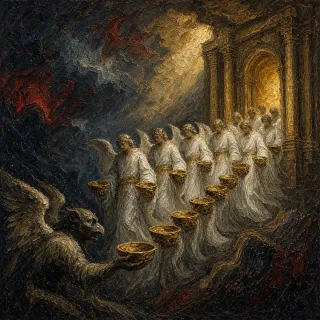
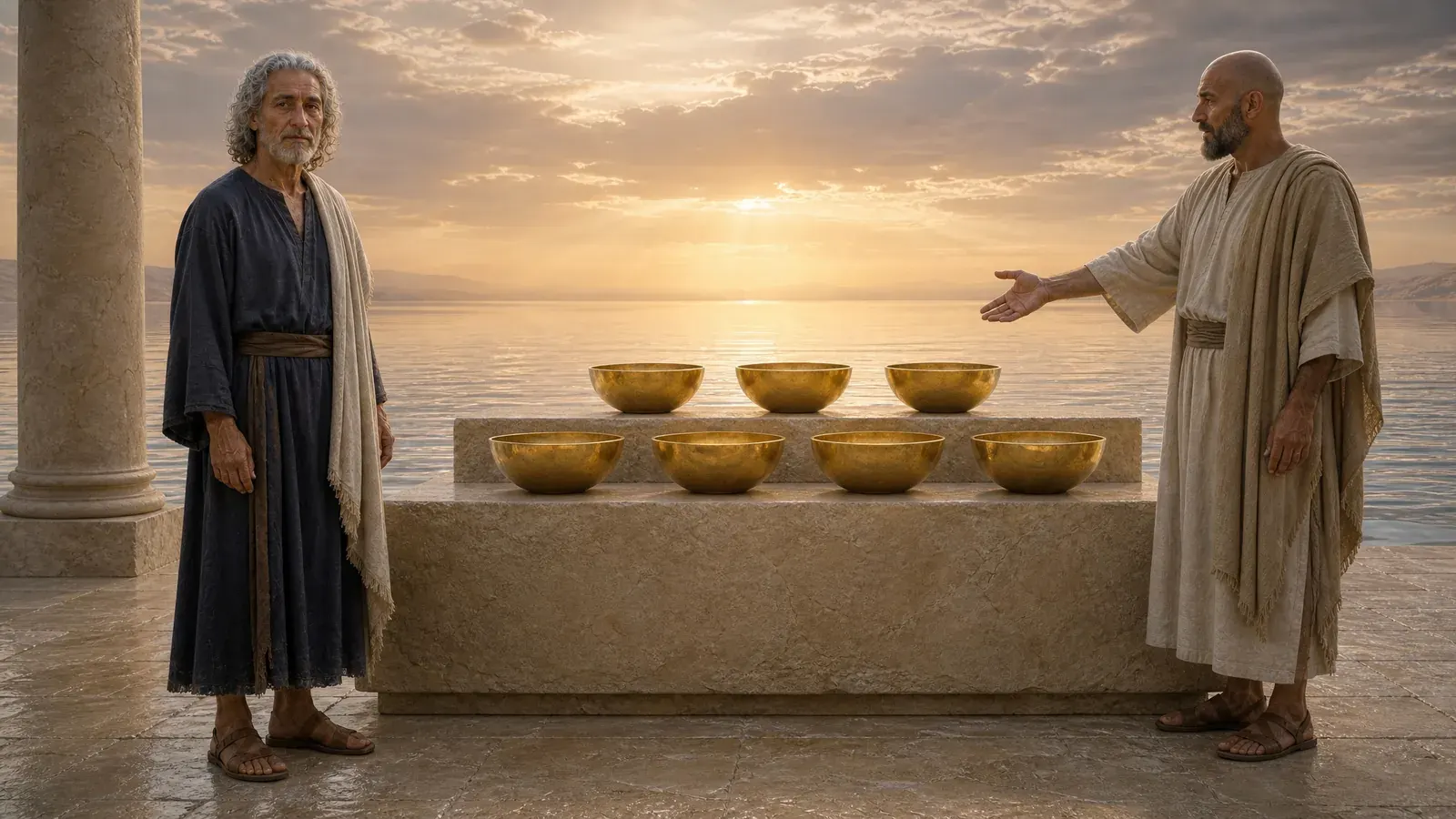
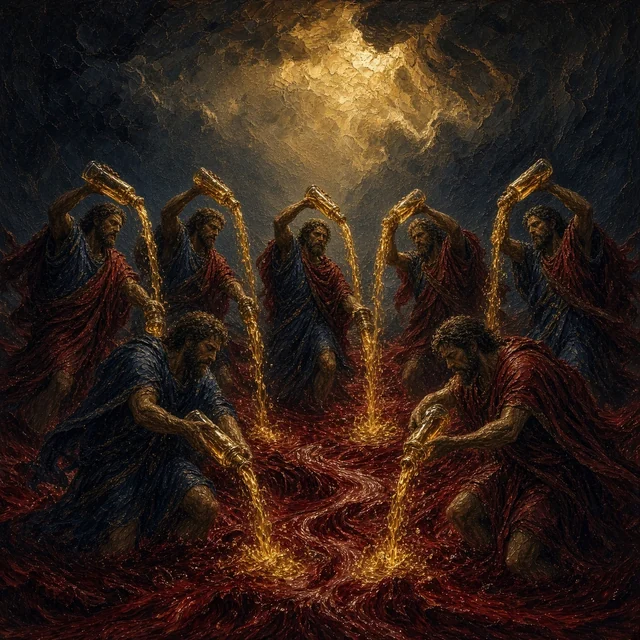
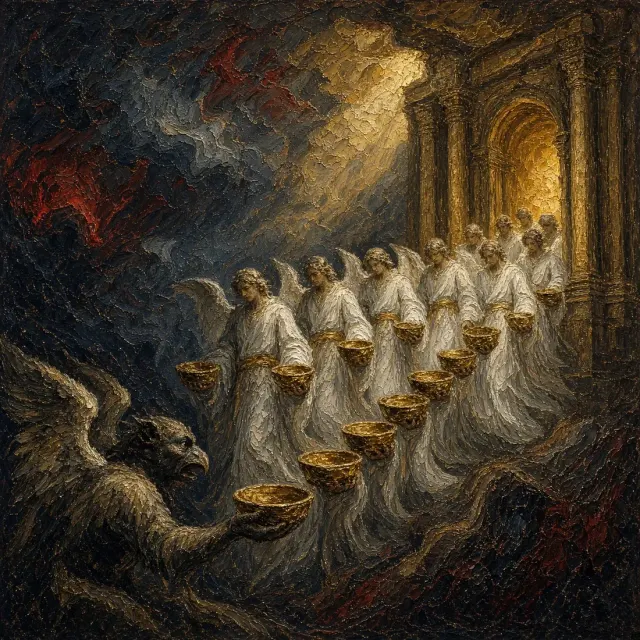
Seven golden vials full of the wrath of God, handed to seven angels by one of the four beasts. The sequence deliberately repeats the trumpets: earth, sea, rivers, sun, the seat of the beast, the Euphrates, the air. What changes is the arithmetic. Where the second trumpet struck the third part of the sea, the second vial makes it as the blood of a dead man: and every living soul died in the sea. The fraction has gone, and with it the room the fraction was leaving.

Where it appearsRevelation 15 to 16

Scroll down to the account
The bowls

The movements, in the order the text gives them.

The Account of The bowls

  1. 01

    Revelation 15:2-3

    The song of Moses, and the song of the Lamb

    The only other singing of this song is at the Red Sea, which frames everything that follows as a deliverance.

    The victors sing about God's works, not their own. The passage carefully lists what they have overcome, the beast, his image, his mark, his number, and then their song turns entirely toward the one whose ways are just and true. The victory procession does not become a recital of personal achievements.

    Moses and the Lamb stand together in the song's designation. Exodus 15 places rescued Israel beside the sea, singing after deliverance from Pharaoh. Here another delivered company stands at a sea and sings in the presence of the God who judges their oppressor. The earlier rescue supplies the pattern without requiring the later scene to be an exact replay.

    The word victory also deserves the Book of Revelation's own definition. In 13:7 the beast is allowed to overcome the saints; in 15:2 the faithful have overcome the beast. Those statements expose two different measures of winning. Coercion can kill without securing worship. The singers' presence before God overturns the beast's claim to a complete victory, and their song gives the credit somewhere else.

    Verse by verse

    1. 15:2

      The repeated over lists the beast's different claims upon human allegiance. Revelation 13:15-17 explains the coercion associated with the image and mark.

    2. 15:3

      Moses is called God's servant, while the Lamb names the other side of the song's designation. The passage unites their associations without making them identical figures.

    3. 15:3

      Just and true describe God's ways before the bowls are poured. The song supplies the moral frame in which the coming judgments are presented.
    Revelation 15:2-3

    King James Version · 2 verses

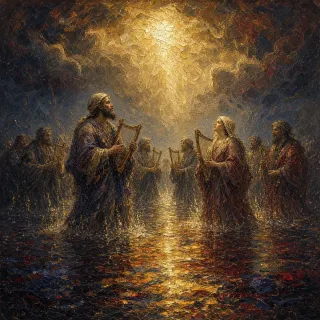
    15:2And I saw as it were a sea of glass mingled with fire: and them that had gotten the victory over the beast, and over his image, and over his mark, and over the number of his name, stand on the sea of glass, having the harps of God.

    15:3And they sing the song of Moses the servant of God, and the song of the Lamb, saying, Great and marvellous are thy works, Lord God Almighty; just and true are thy ways, thou King of saints.

    Revelation 15:2-3: The song of Moses, and the song of the Lamb
  2. 02

    Revelation 15:8

    No man was able to enter into the temple

    The smoke closes the building for the duration, and the account states plainly that access is suspended until it is finished.

    The temple has just been opened in verse 5, and now no one can enter. The apparent contradiction disappears once the cause is named: smoke from the glory of God, and from his power. This is not an abandoned sanctuary. Access is blocked by the intensity of the presence within it.

    That detail puts the seven plagues inside a familiar biblical pattern. Moses could not enter the newly completed tabernacle when the glory filled it, and the priests could not continue ministering when the cloud filled Solomon's temple. Here the same overwhelming holiness attends judgment rather than the inauguration of a building. The smoke belongs to God, not to damage inflicted upon his dwelling.

    Till gives the exclusion its stated boundary: the completion of the seven plagues. The verse does not explain every consequence for prayer or intercession, and it should not be made to supply a timetable it never gives. What it does establish is formidable enough. The judgments proceed from a sanctuary filled with divine glory, and no creature simply walks in to take charge of the proceedings.

    Verse by verse

    1. 15:8

      The smoke is expressly from God's glory and power. It is not described as smoke from the destruction of the heavenly temple.

    2. 15:8

      The restriction lasts until the plagues are fulfilled. Claims that this verse independently defines the exact end of all opportunity for repentance go beyond its stated information.

    Revelation 15:8

    King James Version · 1 verse

    15:8And the temple was filled with smoke from the glory of God, and from his power; and no man was able to enter into the temple, till the seven plagues of the seven angels were fulfilled.

    Revelation 15:8: No man was able to enter into the temple
  3. 03

    Revelation 16:3

    Every living soul died in the sea

    The second trumpet killed a third. The second vial leaves nothing, and the difference is the whole point of the repetition.

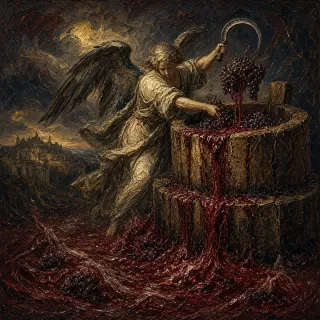
    The fraction has disappeared. At the second trumpet, a third of the sea became blood and a third of its living creatures died. At the second bowl, the corresponding sea judgment ends with every living soul. The repeated target makes the escalation unmistakable without requiring an elaborate chart.

    As the blood of a dead man makes the image more terrible than a change of color. The comparison is with blood belonging to death, and the resulting sea can no longer sustain its life. The verse gives no leisurely description of floating bodies or ruined shores. It spends its final words on the loss itself.

    Living soul here belongs to the creatures in the sea, not merely to human passengers. The judgment reaches the teeming life of the waters. The following verses continue to rivers and springs, then explicitly connect the blood judgment with the blood shed by the persecutors of saints and prophets. The image is therefore both ecological devastation and judicial reckoning within the vision. It should be allowed its full severity without being extended into a claim that every living being everywhere dies in this one verse.

    Verse by verse

    1. 16:3

      Vial translates the Greek phiale, a bowl. The modern image of a small, narrow glass bottle is not the vessel indicated by that term.

    2. 16:3

      Every living soul refers to sea life in the stated setting. It is not a declaration that only humans possess life in the biblical vocabulary.

    3. 16:3

      The scope is the sea in this vision. The verse gives neither a modern location nor a date for the judgment.

    Revelation 16:3

    King James Version · 1 verse

    16:3And the second angel poured out his vial upon the sea; and it became as the blood of a dead man: and every living soul died in the sea.

    Revelation 16:3: Every living soul died in the sea
  4. 04

    Revelation 16:9-11

    They repented not to give him glory

    The refusal is reported three separate times, which makes it the only constant across the sequence.

    They know whose name to curse, but will not give him glory. The passage does not describe a simple failure to recognize power. It names God as the one with authority over the plagues, then places blasphemy where repentance might have stood. Recognition and submission are not the same response.

    The fifth bowl strikes the seat of the beast. The Greek word is throne, the same ordinary word used for the heavenly throne throughout the book. The contrast is exact: one throne issues judgment; the rival throne cannot keep its own kingdom illuminated. The power that demanded worship cannot protect its worshippers from darkness.

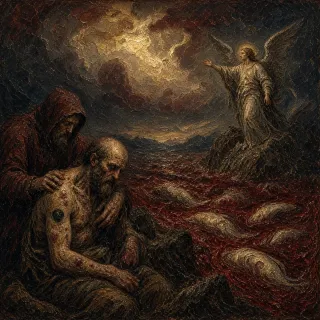
    The physical language allows no comfortable distance. They gnaw their tongues for pain, then those same mouths blaspheme. Verse 11 returns to their deeds, so the issue is not merely that suffering people cry out. The account specifically joins hostile speech to continued wrongdoing. Heat gives way to darkness, but the refusal remains. The setting changes more readily than the allegiance of its inhabitants.

    Verse by verse

    1. 16:9

      The failure to give glory is explicitly tied to lack of repentance. The text describes these people's response, not a general rule that every cry of anguish is blasphemy.

    2. 16:10

      Seat renders thronos, throne. Revelation 13:2 says the dragon gave the beast that throne and authority.

    3. 16:11

      Pains and sores point back to afflictions already present. The closing phrase makes their continuing deeds, not pain alone, part of the charge.

    Revelation 16:9-11

    King James Version · 3 verses

    16:9And men were scorched with great heat, and blasphemed the name of God, which hath power over these plagues: and they repented not to give him glory.

    16:10And the fifth angel poured out his vial upon the seat of the beast; and his kingdom was full of darkness; and they gnawed their tongues for pain,

    16:11And blasphemed the God of heaven because of their pains and their sores, and repented not of their deeds.

    Revelation 16:9-11: They repented not to give him glory
  5. 05

    Revelation 16:17

    It is done

    The seventh vial is poured into the air and a voice from the throne declares the sequence closed in three words.

    The final bowl receives a final declaration. It is done comes from the temple and, more precisely, from the throne. The location does the work of identifying authority: the angel pours, but the throne pronounces completion. The messenger does not certify his own performance.

    The announcement answers the framing of chapter 15. There the seven plagues are called the last, and entry into the sanctuary is withheld until they are fulfilled. Here the seventh bowl reaches its appointed point. The short sentence is not small because it is short. After the sequence's repeated acts, the verdict needs no ornament.

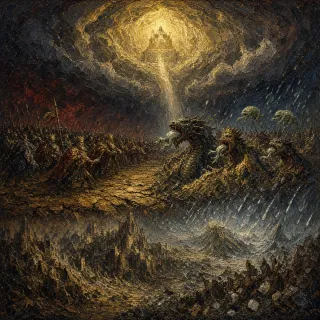
    Nor does it mean that the Book of Revelation has run out of events. Thunder, earthquake, and Babylon's judgment immediately follow, and later chapters unfold what judgment and renewal entail. The declaration marks the completion announced for this sequence rather than providing a license to force every vision into a single undisputed timetable. Its centre is not a calculation but a voice. The throne that ordered the pouring also declares its accomplishment.

    Verse by verse

    1. 16:17

      The bowl is poured into the air, while the voice comes from the throne in the temple. The text keeps the angel's action distinct from the source of the declaration.

    2. 16:17

      The immediate literary frame is Revelation 15:1,8 and the seven last plagues. Larger chronological schemes remain interpretive constructions rather than details supplied by this one sentence.

    Revelation 16:17

    King James Version · 1 verse

    16:17And the seventh angel poured out his vial into the air; and there came a great voice out of the temple of heaven, from the throne, saying, It is done.

    Revelation 16:17: It is done

Why it matters

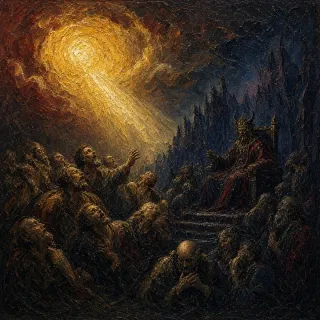
Before any of it is poured out the account stops for a song, sung by people standing on a sea of glass mingled with fire, and the song is the song of Moses the servant of God, and the song of the Lamb. The only other time Israel sings the song of Moses is on the far side of the Red Sea, which places the whole sequence as an exodus rather than as a demolition. The refrain running through the pouring is not triumph either: they repented not to give him glory, said three times, and men blasphemed God because of the plague.

6 songs

The music

Every song in the catalogue whose passage falls inside these chapters.

  1. Revelation 15:1-4

    The Song of Moses and the Lamb

  2. Revelation 15:5-8

    The Temple Filled with Smoke

  3. Revelation 15:1–16:21

    The Vials of Wrath

  4. Revelation 16:12-21

    Armageddon: It Is Done

  5. Revelation 16:1-7

    Blood upon Earth, Sea, and Rivers

  6. Revelation 16:8-11

    The Scorching Sun and the Darkened Kingdom

Nearby

All the objects

Report an error on this page