Objects of the Bible

The scroll and the seven seals

A document nobody was qualified to open, and the only man who wept in Revelation wept about paperwork.

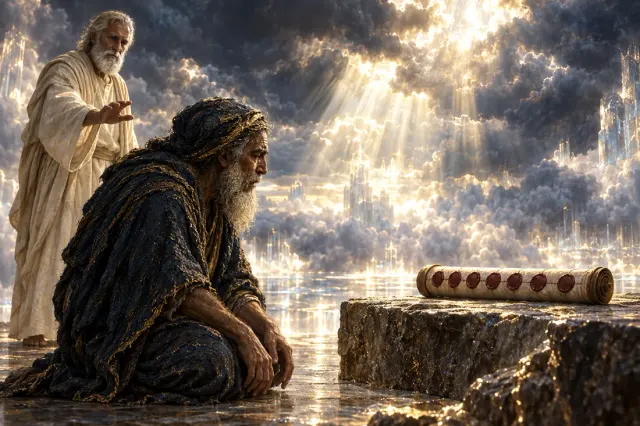
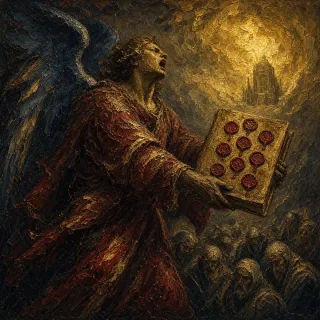
A book written within and on the backside, sealed with seven seals. Roman wills were sealed by seven witnesses and could only be opened by an authorised party, which is the legal picture the image is working from. A strong angel asks the question as a proclamation: who is worthy to open the book, and to loose the seals thereof. Nobody answers, in heaven, in earth or under the earth, and John’s reaction is the most human sentence in the book: I wept much.

Where it appearsRevelation 5 to 6

Scroll down to the account
The scroll and the seven seals

The movements, in the order the text gives them.

The Account of The scroll and the seven seals

  1. 01

    Revelation 5:2-4

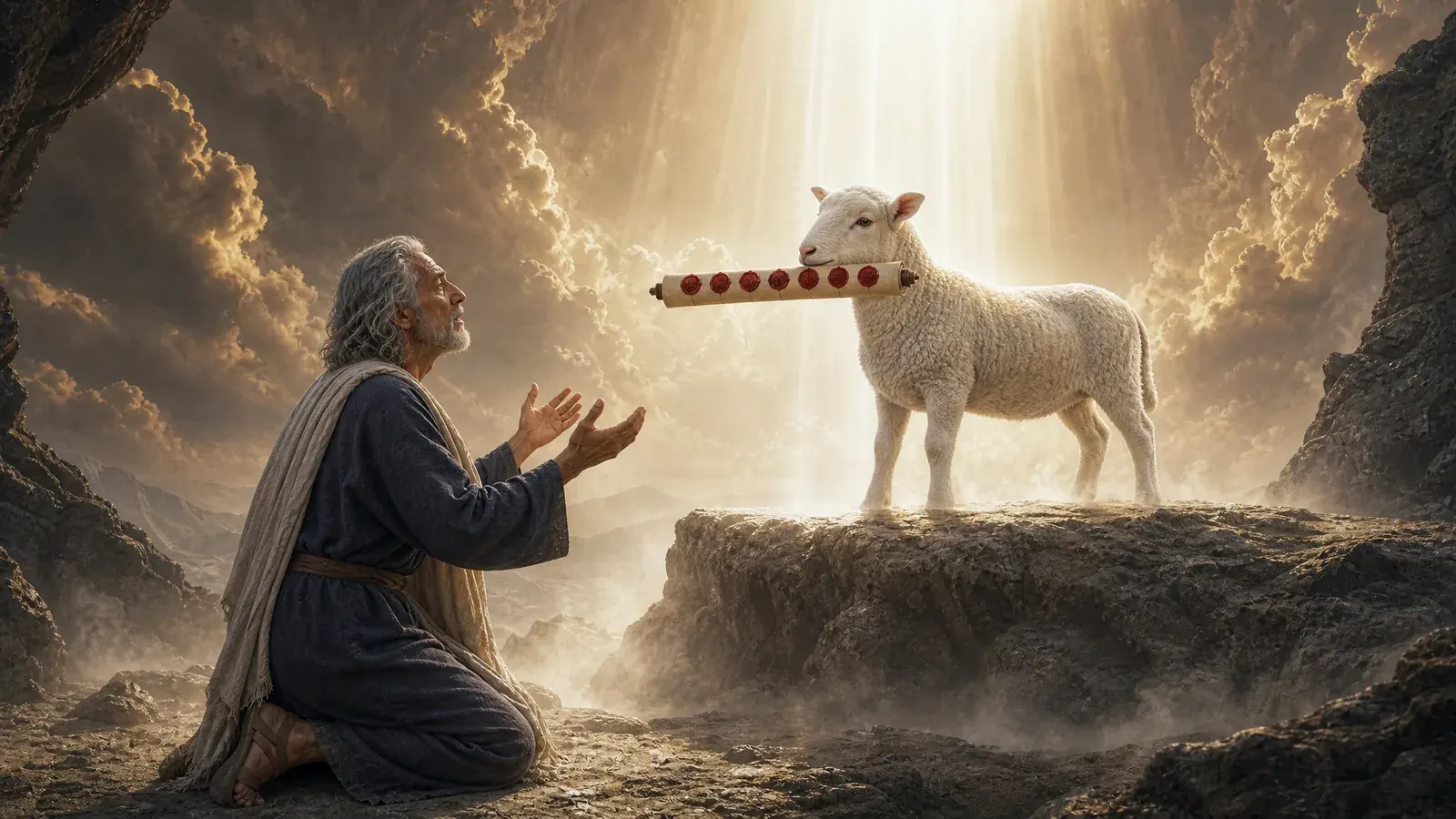
    I wept much, because no man was found worthy

    The one recorded weeping in the book is over an unopened document, which tells you what the document is worth.

    The angel is strong, and the announcement is loud. Neither quality gets the book open. The question is not who can break a seal but who is worthy to do it, and the search empties heaven, earth, and the world beneath of possible candidates. Power is present in the room. Qualification is missing.

    That distinction gives John's tears their weight. The book is already in God's hand in verse 1, so nothing has escaped divine possession. Yet possession and opening are different things. The sealed document remains beyond every creature's authority, and the opening of its seals will bring judgments into view, not merely satisfy curiosity. John is not grieving over a difficult reading assignment.

    The chapter supplies its own explanation of worthiness in verse 9: the Lamb was slain and redeemed people to God by his blood. That answer should govern the question. No amount of created strength substitutes for the act of redemption. Heaven does not need a stronger angel. It needs the one whose sacrifice entitles him to take the book.

    Verse by verse

    1. 5:2

      Worthy concerns the right to open the book, not merely the physical ability to break its seals. Revelation 5:9 grounds that right in the Lamb's redemptive death.

    2. 5:3

      The Greek oudeis means no one; the search extends beyond human beings through the three named regions.

    3. 5:4

      The passage does not identify the document as a will or title deed. Those are interpretations of its imagery, not names supplied by the text.

    Revelation 5:2-4

    King James Version · 3 verses

    5:2And I saw a strong angel proclaiming with a loud voice, Who is worthy to open the book, and to loose the seals thereof?

    5:3And no man in heaven, nor in earth, neither under the earth, was able to open the book, neither to look thereon.

    5:4And I wept much, because no man was found worthy to open and to read the book, neither to look thereon.

    Revelation 5:2-4: I wept much, because no man was found worthy
  2. 02

    Revelation 5:5-6

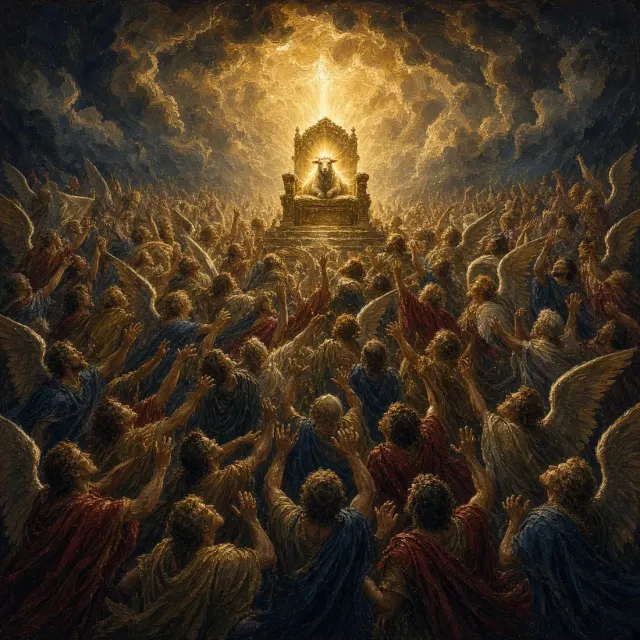
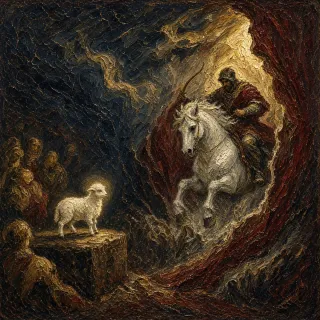
    A Lamb as it had been slain

    He is told to look for a lion and sees a lamb with the marks of slaughter, and the account does not reconcile the two.

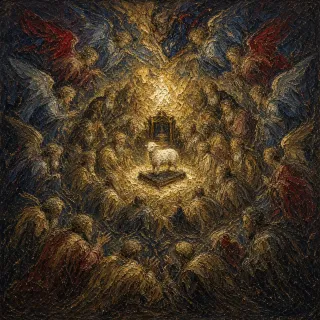
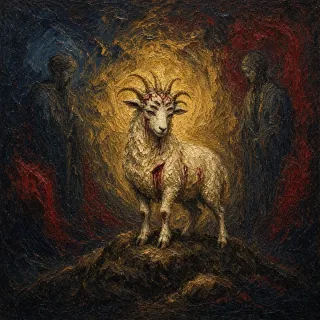
    John hears Lion and sees Lamb. The elder has not announced the wrong arrival. The change from what is heard to what is seen explains the victory: the royal conqueror is the one who was slain. Judah and David supply the language of kingship; the Lamb supplies its astonishing form.

    Stood matters as much as slain. Death has happened, but the victim is standing at the centre of heaven's throne scene. The marks of slaughter are not concealed so that he can look suitably victorious. In verse 9, the slaughter is precisely why he is worthy. The Book of Revelation puts the wound where an ordinary victory portrait would put the trophy.

    The seven horns prevent the image from becoming mere helplessness, while the seven eyes are expressly identified with the seven Spirits sent through the earth. This Lamb possesses power and worldwide reach. Yet neither attribute replaces the sacrificial identity. Lion, Root, and Lamb belong together, and the book passes into the hands of a conqueror whose death has already accomplished something that the strong angel could not.

    Verse by verse

    1. 5:5

      Judah's lion recalls Genesis 49:9; the Davidic root recalls Isaiah 11:1,10. The elder combines royal promises before John sees the Lamb.

    2. 5:6

      The Greek verb sphazo, to slaughter, appears both here and of the slain witnesses in Revelation 6:9. The shared wording connects the Lamb and his persecuted people.

    3. 5:6

      The four beasts here are zoa, living creatures. The Greek term differs from therion, used for the hostile beast in Revelation 13.

    Revelation 5:5-6

    King James Version · 2 verses

    5:5And one of the elders saith unto me, Weep not: behold, the Lion of the tribe of Juda, the Root of David, hath prevailed to open the book, and to loose the seven seals thereof.

    5:6And I beheld, and, lo, in the midst of the throne and of the four beasts, and in the midst of the elders, stood a Lamb as it had been slain, having seven horns and seven eyes, which are the seven Spirits of God sent forth into all the earth.

    Revelation 5:5-6: A Lamb as it had been slain
  3. 03

    Revelation 6:1-8

    Come and see

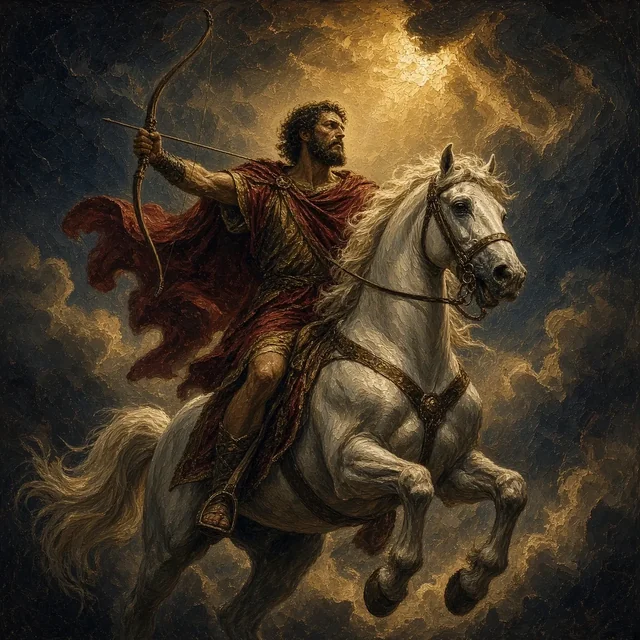
    Four seals release four riders, and the summons is issued each time by one of the living creatures rather than by the Lamb.

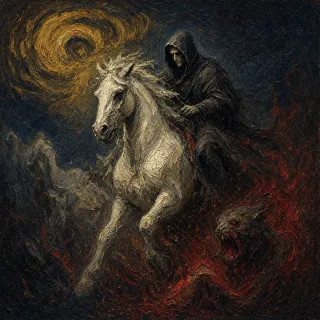
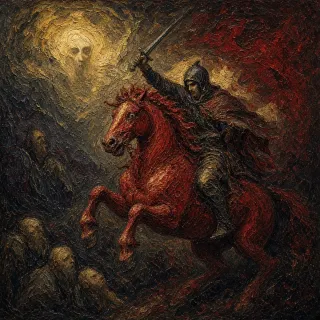
    Was given keeps interrupting the terrible procession. A crown is given, a sword is given, authority is given. The riders are dreadful, but they are not the highest authority in the chapter. The Lamb opens the seals; the living creatures issue the summons; the agents of devastation operate within assigned limits.

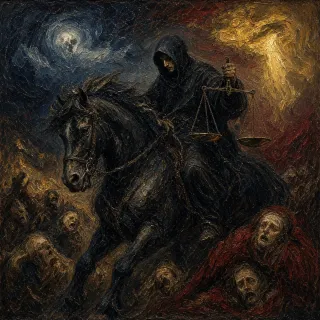
    The black horse makes the destruction painfully ordinary. Its rider carries balances, and the voice announces prices. A penny is a denarius, the day's wage named in Matthew 20:2. Here that coin buys one measure of wheat or three of barley. War has reached the food counter. Oil and wine remain protected, which makes the damage selective rather than uniform; the passage does not explain why those products are spared. There is no need to invent an economic system to feel the pressure of the announced exchange.

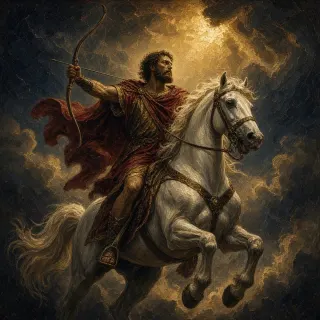
    Only the last rider is actually named: Death. The identity of the first has long divided readers, with interpretations ranging from Christ's conquest to military or deceptive conquest. His white horse alone cannot settle the matter. What the sequence makes unmistakable is the spreading loss of peace, food security, and life. Even Death receives a jurisdiction, the fourth part of the earth. Catastrophe is not being presented as self-governing, and the permission granted is not permission without boundaries.

    Verse by verse

    1. 6:1

      The KJV follows Greek wording that includes and see; some Greek editions have only Come. The shorter form leaves the summons more readily understood as addressed to the rider.

    2. 6:2

      The rider is unnamed here. Revelation 19:11-16 identifies its white-horse rider much more explicitly, so the shared color does not by itself prove identical riders.

    3. 6:6

      A penny translates denarius, also used for a day's pay in Matthew 20:2. The text gives prices but no numerical statement of the increase over normal prices.

    4. 6:8

      Hell here renders Hades, the realm of the dead. Revelation 20:14 distinguishes Death and Hades from the lake of fire into which they are cast.

    Revelation 6:1-8

    King James Version · 8 verses

    6:1And I saw when the Lamb opened one of the seals, and I heard, as it were the noise of thunder, one of the four beasts saying, Come and see.

    6:2And I saw, and behold a white horse: and he that sat on him had a bow; and a crown was given unto him: and he went forth conquering, and to conquer.

    6:3And when he had opened the second seal, I heard the second beast say, Come and see.

    6:4And there went out another horse that was red: and power was given to him that sat thereon to take peace from the earth, and that they should kill one another: and there was given unto him a great sword.

    6:5And when he had opened the third seal, I heard the third beast say, Come and see. And I beheld, and lo a black horse; and he that sat on him had a pair of balances in his hand.

    6:6And I heard a voice in the midst of the four beasts say, A measure of wheat for a penny, and three measures of barley for a penny; and see thou hurt not the oil and the wine.

    6:7And when he had opened the fourth seal, I heard the voice of the fourth beast say, Come and see.

    6:8And I looked, and behold a pale horse: and his name that sat on him was Death, and Hell followed with him. And power was given unto them over the fourth part of the earth, to kill with sword, and with hunger, and with death, and with the beasts of the earth.


    Revelation 6:1-8: Come and see
  4. 04

    Revelation 6:9-11

    How long, O Lord, holy and true

    The fifth seal produces voices rather than horsemen, and the answer given is a delay with a reason attached.

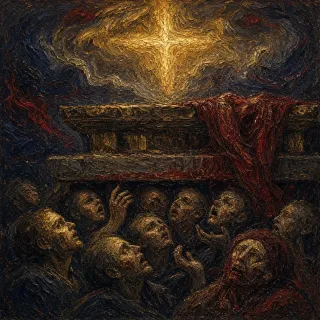
    The fifth seal gives the victims a voice. After horses, weapons, prices, and death, the vision looks beneath the altar and hears from those killed for their testimony. Their deaths have not made their testimony disappear. Heaven contains the people whom earthly violence tried to silence.

    Their appeal is sharp: judge and avenge our blood. The Book of Revelation does not soften that into a general wish for improved circumstances. They ask the holy and true Lord to answer actual bloodshed with justice. Yet the appeal goes to the judge; it is not an instruction for their fellow believers to take up the killers' weapons.

    The reply separates recognition from resolution. White robes are given to every one of them, but final vindication is not immediate. Rest yet for a little season is followed by the blunt statement that more fellow servants will be killed. No explanation makes that sentence painless. The robes establish their standing before God without pretending that the violence below has already ended. They are honored now, and still they wait.

    Verse by verse

    1. 6:9

      Their stated cause of death is the word of God and the testimony they maintained. The text does not identify their killers by a particular modern name.

    2. 6:10

      Holy and true make the demand for judgment an appeal to the Lord's own character. The question concerns its delay, not whether murder matters.

    3. 6:11

      Every one receives a robe, while the waiting is shared. The little season supplies no date or calculable length.

    Revelation 6:9-11

    King James Version · 3 verses

    6:9And when he had opened the fifth seal, I saw under the altar the souls of them that were slain for the word of God, and for the testimony which they held:

    6:10And they cried with a loud voice, saying, How long, O Lord, holy and true, dost thou not judge and avenge our blood on them that dwell on the earth?

    6:11And white robes were given unto every one of them; and it was said unto them, that they should rest yet for a little season, until their fellowservants also and their brethren, that should be killed as they were, should be fulfilled.

    Revelation 6:9-11: How long, O Lord, holy and true
  5. 05

    Revelation 8:1

    Silence in heaven about the space of half an hour

    The seventh seal opens onto nothing at all, and the pause is measured, which makes it the loudest verse in the book.

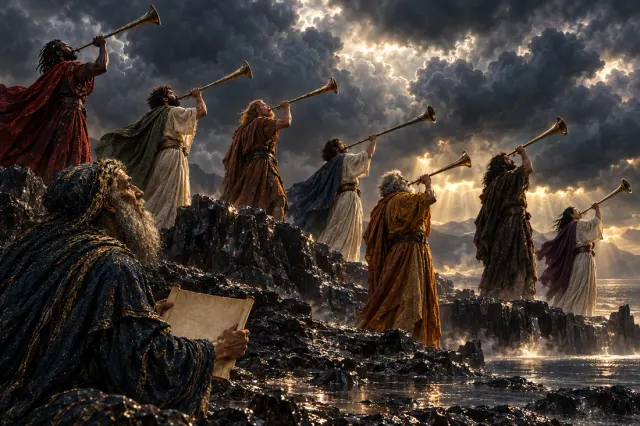
    The seventh seal opens, and heaven becomes quiet. After the living creatures' praise, the elders' worship, and the great multitude's cry, the absence of sound is an event in its own right. The climax begins by withholding the noise that has filled the throne room.

    About the space of half an hour keeps the observation modest and concrete. John reports an approximate duration, not a formula for turning minutes into centuries. The sixth seal's question about who can stand has already been followed by chapter 7's vision of the sealed servants and the multitude before the throne. This silence therefore comes after a substantial interruption, not as the next beat in an uninterrupted disaster sequence.

    Immediately afterward, the vision gives room to incense and the prayers of the saints before altar fire reaches the earth. That sequence connects the hush with solemn worship and judgment. It does not say that God required silence in order to hear. The arresting point needs no such addition: the heaven that has been full of praise also knows how to fall silent.

    Verse by verse

    1. 8:1

      About qualifies the half hour. The verse itself gives no rule for converting that duration into a prophetic timetable.

    2. 8:1

      The prayers and incense follow in Revelation 8:3-4. A relationship between the silence and prayer is suggested by the sequence, but the reason for the silence is not explicitly stated.

    Revelation 8:1

    King James Version · 1 verse

    8:1And when he had opened the seventh seal, there was silence in heaven about the space of half an hour.

    Revelation 8:1: Silence in heaven about the space of half an hour

Why it matters

The answer is announced as one thing and appears as another. He is told behold, the Lion of the tribe of Juda hath prevailed, and when he looks he sees a Lamb as it had been slain. The substitution is not explained. Then the seals come off in order, and the first four release riders, the fifth releases a question rather than a horseman, how long, O Lord, and the sixth undoes the sky. The seventh is followed by silence in heaven about the space of half an hour, which is the only pause of its kind in the book.

12 songs

The music

Every song in the catalogue whose passage falls inside these chapters.

  1. Revelation 4-5

    Worthy Is the Lamb

  2. Revelation 5:6-10

    A Lamb as It Had Been Slain

  3. Revelation 5:1-5

    Who Is Worthy to Open the Book?

  4. Revelation 6:9-11

    How Long, O Lord?

  5. Revelation 6:5-6

    The Black Horse

  6. Revelation 6:12-17

    The Great Day of His Wrath

  7. Revelation 6:7-8

    The Pale Horse

  8. Revelation 6:3-4

    The Red Horse

  9. Revelation 6:1–17

    The Seals Are Opened

  10. Revelation 6-7

    The Seals Were Opened

  11. Revelation 6:1-2

    The White Horse

  12. Revelation 6:1-17

    Who Shall Be Able to Stand

Nearby

All the objects

Report an error on this page