Objects of the Bible

The bronze sea

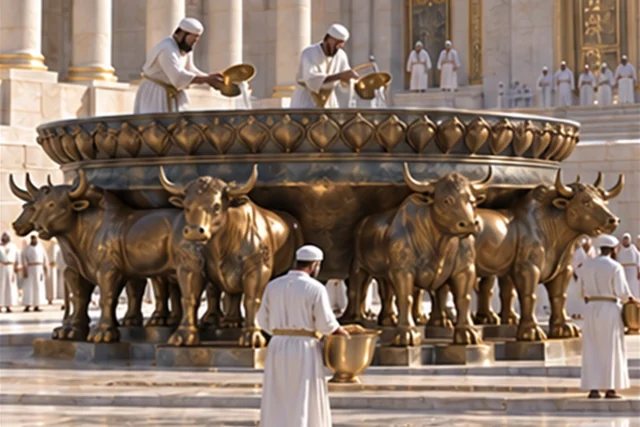
A washbasin the size of a swimming pool, standing on twelve metal oxen facing out in four directions.

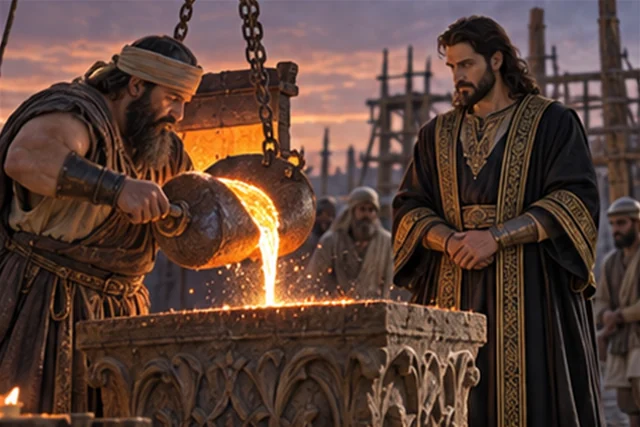
Ten cubits across, five high, thirty round, a handbreadth thick, with a brim wrought like the brim of a cup, with flowers of lilies. It held two thousand baths, which is somewhere near eleven thousand gallons. The tabernacle had a laver; this replaces it at a scale nobody needed. It stood on twelve oxen, three looking north, three west, three south and three east, and all their hinder parts were inward. Chronicles adds what it was for: the priests washed in it.

Where it appears1 Kings 7 · 2 Chronicles 4 · 2 Kings 16

Scroll down to the account
The bronze sea

The movements, in the order the text gives them.

The Account of The bronze sea

  1. 01

    1 Kings 7:23-26

    A molten sea, ten cubits from the one brim to the other

    The dimensions come with a decorative detail. The rim is shaped like a cup and worked with lilies, on a vessel meant for washing.

    The vessel is large enough to be called a sea, but its rim is shaped like a cup. That movement between enormous scale and delicate finish is part of the description's pleasure. Ten cubits across, five high, walls a handbreadth thick, and then lilies at the lip. Hiram's work does not become plain simply because it becomes large.

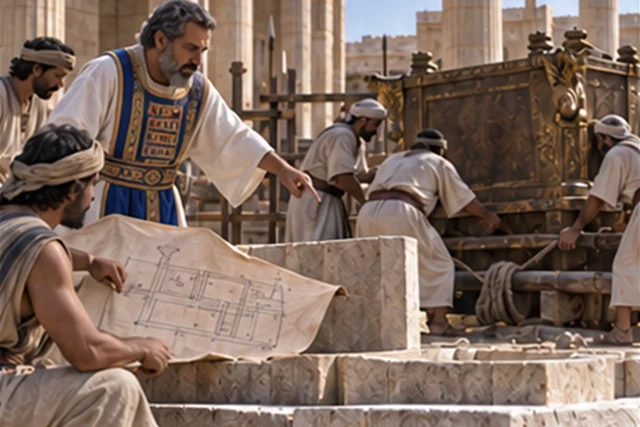
    The two rows of knops belong to the casting itself. They were not loose decorations added later; the text takes care to say they were cast when it was cast. Below, twelve oxen turn the support into a sculpture visible from four directions. The basin, ornament, and animal figures form an ordered whole rather than a large container set on whatever could hold it.

    Sea is the ordinary Hebrew word yam, applied here to the great vessel. It remains a manufactured basin, with measurable sides and a stated capacity. The Book of First Kings lets a practical object carry a grand name without losing its physical particulars. Even this sea has a carefully finished edge.

    Verse by verse

    1. 7:23

      Molten describes metal cast in a mold; sea is the Hebrew yam.

    2. 7:24

      Knops are rounded decorative forms; their exact botanical identification is not specified in this verse.

    3. 7:26

      Second Chronicles 4:5 gives three thousand baths rather than two thousand; the passages do not explicitly distinguish normal filling from maximum capacity.
    1 Kings 7:23-26

    King James Version · 4 verses

    7:23And he made a molten sea, ten cubits from the one brim to the other: it was round all about, and his height was five cubits: and a line of thirty cubits did compass it round about.

    7:24And under the brim of it round about there were knops compassing it, ten in a cubit, compassing the sea round about: the knops were cast in two rows, when it was cast.

    7:25It stood upon twelve oxen, three looking toward the north, and three looking toward the west, and three looking toward the south, and three looking toward the east: and the sea was set above upon them, and all their hinder parts were inward.

    7:26And it was an hand breadth thick, and the brim thereof was wrought like the brim of a cup, with flowers of lilies: it contained two thousand baths.

    1 Kings 7:23-26: A molten sea, ten cubits from the one brim to the other
  2. 02

    1 Kings 7:25

    All their hinder parts were inward

    Twelve oxen face out in four directions and the account notices which way round they stand, which is the kind of thing an eyewitness notices.

    Every side of this basin has faces looking out. The oxen are not arranged in a procession, with one following another. Three face each direction, and their backs converge beneath the sea. The last clause is not an awkward extra detail; it completes the shape that the four compass points have begun.

    The repetition gives the design its steadiness. Three north, three west, three south, three east. None of the four directions receives a larger group, and no single front gets all the ornament. The great bowl has a deliberately distributed base. All their hinder parts were inward supplies the practical reverse of the outward-facing heads.

    Twelve naturally invites comparison with Israel's tribal arrangement, but this verse does not label the oxen as tribes or assign a tribal name to any animal. What it unmistakably gives is order, outward orientation, and a common burden. The metal cattle do not graze, pull a cart, or go anywhere. They hold the sea in place.

    Verse by verse

    1. 7:25

      The order of directions is north, west, south, east; each receives three oxen.

    2. 7:25

      Hinder parts means the rear portions of the animal figures, turned toward the center.

    3. 7:25

      Second Chronicles 4:4 repeats this outward-facing arrangement, including the inward-facing rear parts.

    1 Kings 7:25

    King James Version · 1 verse

    7:25It stood upon twelve oxen, three looking toward the north, and three looking toward the west, and three looking toward the south, and three looking toward the east: and the sea was set above upon them, and all their hinder parts were inward.

    1 Kings 7:25: All their hinder parts were inward
  3. 03

    2 Chronicles 4:6

    The sea was for the priests to wash in

    The Chronicler supplies the purpose Kings leaves out, and distinguishes it from the ten lavers used for rinsing the offerings.

    The largest water vessel is for the people doing the work, not for the offerings they handle. The contrast is explicit. Ten lavers serve the washing of what belongs to the burnt offering; the sea serves the priests. Both uses belong to the same sanctuary, but they are not interchangeable.

    That distinction rescues the sea from becoming nothing more than a spectacular piece of sculpture. The lilies and oxen surround a working provision for priestly washing. Exodus 30:18-21 had already placed a bronze laver between the tabernacle and the altar, requiring Aaron and his sons to wash their hands and feet before service. The temple enlarges the setting without making that preparation unnecessary.

    The verse does not describe priests swimming in the great basin, nor does it explain exactly how the water was drawn or delivered. Its concern is allocation, not plumbing. Five lavers on one side, five on the other, and the sea for the priests. Behind the grandeur is an exact distinction between washing the offering and washing the hands that bring it.

    Verse by verse

    1. 4:6

      Lavers are basins used for washing, not altars.

    2. 4:6

      The verse expressly distinguishes the offerings washed in the lavers from the priests who use the sea.

    3. 4:6

      Exodus 30:19-21 specifies priestly washing of hands and feet; this verse does not give a mechanical description of the sea's use.

    2 Chronicles 4:6

    King James Version · 1 verse

    4:6He made also ten lavers, and put five on the right hand, and five on the left, to wash in them: such things as they offered for the burnt offering they washed in them; but the sea was for the priests to wash in.

    2 Chronicles 4:6: The sea was for the priests to wash in
  4. 04

    2 Kings 16:17

    He took down the sea from off the brasen oxen

    The dismantling is described in the same inventory style as the making, which is what makes the verse land.

    The sea survives, but its arrangement does not. Ahaz lowers it from the twelve oxen and puts it on stone paving. The basin has not yet been shattered by a foreign army. A king of Judah is taking apart the setting that the construction account described with such care.

    The actions extend beyond the sea. The borders of the movable bases are cut away, and the laver is removed from them. The chapter has already described an altar copied from Damascus and the displacement of the older bronze altar. These are connected changes within the same working sanctuary, not an isolated adjustment to one piece of furniture.

    The contrast is visual before it is abstract: a sea lifted above outward-facing oxen now rests on stones. The text does not say that the oxen were melted down or sent to Assyria, and their later fate should not be invented to complete the picture. Enough has happened already. The basin remains in the temple's account, separated from the carefully composed structure beneath it.

    Verse by verse

    1. 16:17

      Bases refers to the stands supporting the lavers, not the masonry foundations of the temple.

    2. 16:17

      The sea is placed on a pavement of stones; its destruction is not reported in this verse.

    3. 16:17

      Second Kings 25:13 later reports the Babylonians breaking the bronze sea into pieces.

    2 Kings 16:17

    King James Version · 1 verse

    16:17And king Ahaz cut off the borders of the bases, and removed the laver from off them; and took down the sea from off the brasen oxen that were under it, and put it upon a pavement of stones.

    2 Kings 16:17: He took down the sea from off the brasen oxen
  5. 05

    2 Kings 16:18

    For the king of Assyria

    The reason is given in four words at the end of a list of alterations, with no judgment attached and none needed.

    The final explanation reaches beyond Jerusalem: for the king of Assyria. This verse concerns the Sabbath structure and the royal entrance, not another alteration to the sea itself. Placed immediately after the basin's dismantled supports, however, it shows the wider setting in which the temple is being changed.

    Earlier in the chapter, Ahaz called himself the Assyrian king's servant and son, sent him silver and gold from the temple and palace, and visited him at Damascus. The objects and entrances of the sanctuary now belong to that same account of dependence. The foreign connection is stated, not guessed from the architecture.

    The exact form of the covert for the sabbath is uncertain, as is the precise demand or concern behind the alteration. The passage does not supply an Assyrian order to remove twelve oxen. What it does preserve is the reason attached to these changes in access: the king of Assyria. A description of the LORD's house ends by naming another king's influence upon it.

    Verse by verse

    1. 16:18

      Covert denotes a covered structure associated with the Sabbath; its exact architectural form is uncertain.

    2. 16:18

      The Hebrew phrase behind for the king of Assyria has the sense on account of that king.

    3. 16:18

      The sea appears in 16:17, not in this verse; 16:18 continues the description of alterations to the temple complex.

    2 Kings 16:18

    King James Version · 1 verse

    16:18And the covert for the sabbath that they had built in the house, and the king’s entry without, turned he from the house of the LORD for the king of Assyria.

    2 Kings 16:18: For the king of Assyria

Why it matters

The interesting part of its history is the end. Ahaz, wanting to pay tribute to Assyria and rearrange the court to suit a visiting king, cut down the borders of the bases, and removed the laver from off them, and took down the sea from off the brasen oxen that were under it, and put it upon a pavement of stones. The verse gives the reason without comment: for the king of Assyria. An object built to say that washing matters was taken off its feet to make a political point, and Kings records the act as plainly as it records the making.

3 songs

The music

Every song in the catalogue whose passage falls inside these chapters.

  1. 1 Kings 5:1-7:51

    A House for the Name

  2. 2 Chronicles 3:1-4:22

    Upon Mount Moriah

  3. 2 Kings 14:1-16:20

    The Shadow from the North

Nearby

All the objects

Report an error on this page