Objects of the Bible

Solomon’s temple

Seven years to build, and the prayer at the opening spends most of its length on what to do when it fails.

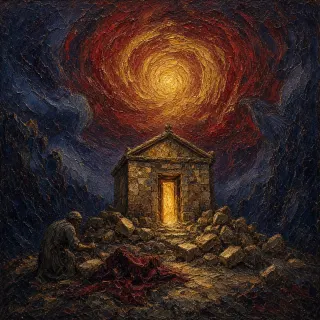
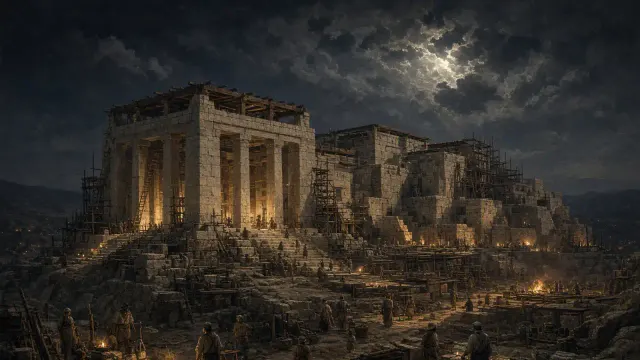
The measurements are given first and they are modest: threescore cubits long, twenty broad, thirty high, which is about ninety feet by thirty. It is not a large building. What is large is the fitting out, and the account keeps count of it: cedar within, carved with knops and open flowers, and overlaid with gold. There was no stone seen. The famous detail about the construction is a negative one. There was neither hammer nor axe nor any tool of iron heard in the house, while it was in building, because the stones were finished at the quarry.

Where it appears1 Kings 6 · 1 Kings 8 · 2 Chronicles 3 · 2 Chronicles 7

Scroll down to the account
Solomon’s temple

The movements, in the order the text gives them.

The Account of Solomon’s temple

  1. 01

    1 Kings 6:7

    There was neither hammer nor axe nor any tool of iron heard

    The one construction detail everyone remembers is about silence. The work was done elsewhere and arrived ready.

    The silence has been paid for elsewhere. These stones have already been made ready before their arrival, so the place where the house rises does not ring with the iron tools that prepared its materials. Nothing here suggests a building without labor. The labor has been arranged so that cutting and fitting are not the same event.

    That is a striking detail to preserve in a chapter concerned with measurements, side chambers, beams, and stairs. The Book of First Kings makes room for what could not be heard. Hammer, axe, any tool of iron: the sentence removes the workshop noises one by one. Even before the cedar and gold appear, the manner of building distinguishes this house.

    The silence is specific, not magical. The verse does not declare the whole city silent or forbid every iron tool used anywhere on the project. Its attention stays inside the house. The stone arrives ready for its place, and the account gives the absent hammer almost as much attention as the walls.

    Verse by verse

    1. 6:7

      Made ready describes prepared stone, not naturally unworked blocks.

    2. 6:7

      The restriction concerns iron tools heard in the house during construction; it does not say that no iron tools were used elsewhere.

    3. 6:7

      First Kings 6:38 gives the building period as seven years.
    1 Kings 6:7

    King James Version · 1 verse

    6:7And the house, when it was in building, was built of stone made ready before it was brought thither: so that there was neither hammer nor axe nor any tool of iron heard in the house, while it was in building.

    1 Kings 6:7: There was neither hammer nor axe nor any tool of iron heard
  2. 02

    1 Kings 8:9

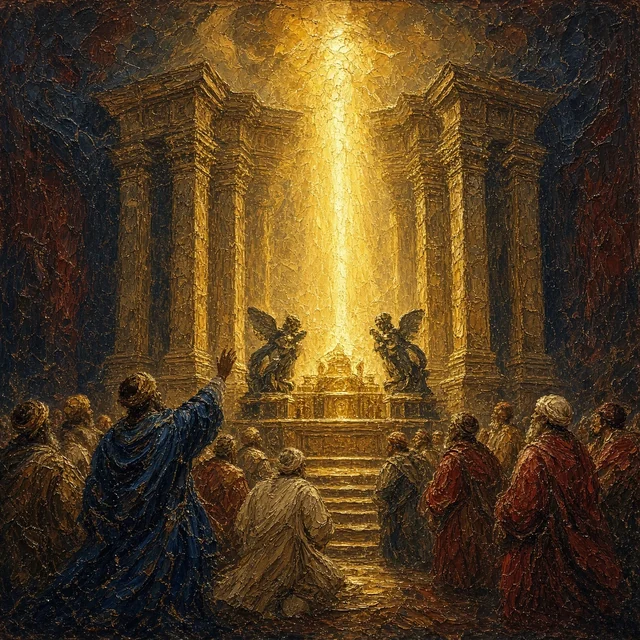
    There was nothing in the ark save the two tables of stone

    At the centre of the most expensive building in the nation is a box holding two slabs and nothing else.

    At the center of all this new gold are two old pieces of stone. The ark has entered a royal building of extraordinary richness, but its contents are not a new constitution issued by Solomon. Moses put the tablets there. The covenant predates the king, his capital, and every cedar panel surrounding it.

    There was nothing in the ark save the two tables of stone. That spare inventory matters. The preceding verses describe the great cherubim sheltering the ark and the position of its carrying poles. Then the description passes through the gold-covered exterior to the covenant within. The innermost object points back to an agreement made when Israel came out of Egypt, not to the achievement of the man opening the temple.

    Hebrews 9:4 also names the manna jar and Aaron's rod in its description of the tabernacle's ark. First Kings gives a different inventory at this dedication. Neither passage supplies a transport log explaining the difference. Here the emphasis is wonderfully plain: the new house receives an older covenant.

    Verse by verse

    1. 8:9

      Tables means tablets, not pieces of furniture.

    2. 8:9

      The reference to Moses and the departure from Egypt identifies the ark with the covenant rather than with Solomon personally.

    3. 8:9

      Hebrews 9:4 names additional contents in its tabernacle description; neither text explains when or how the inventory changed.

    1 Kings 8:9

    King James Version · 1 verse

    8:9There was nothing in the ark save the two tables of stone, which Moses put there at Horeb, when the LORD made a covenant with the children of Israel, when they came out of the land of Egypt.

    1 Kings 8:9: There was nothing in the ark save the two tables of stone
  3. 03

    1 Kings 8:10-11

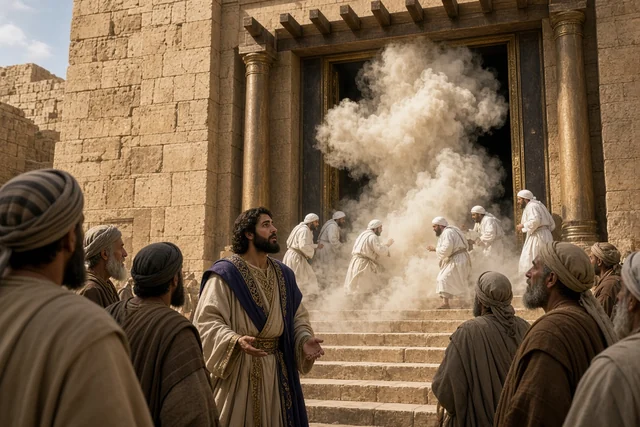
    The priests could not stand to minister

    The staff are put out of work by the arrival of the one they work for, and the account reports it as a fact rather than as a wonder.

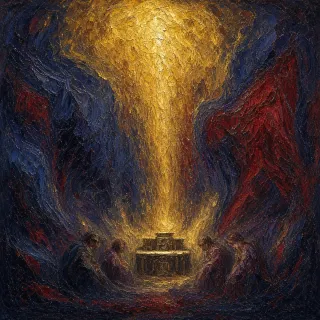
    The opening ceremony reaches the point where its ministers cannot continue. This is not the embarrassment of an empty sanctuary. The difficulty is the opposite: the glory of the LORD has filled it. The priests have brought in the ark and come out, but their completed task does not leave the service under their control.

    Filled the house appears twice in two verses. First the cloud fills it; then the account identifies that cloud with the LORD's glory. The repetition gives the interruption its weight. The building has received more than furnishings, and its consecration is not merely a royal announcement that the premises are ready.

    Exodus 40:34-35 provides the great echo. When the tabernacle was finished, the cloud covered it, the glory filled it, and even Moses could not enter. Now the same pattern marks the temple. Different building, different generation, the same overwhelming presence. The priests are not described as fainting or falling unconscious. They simply cannot stand to carry on the ministry. The ceremony cannot proceed as though nothing has happened.

    Verse by verse

    1. 8:10

      The priests have already come out of the holy place when the cloud fills the house.

    2. 8:11

      Could not stand to minister describes an inability to continue their service, not an explicitly reported collapse.

    3. 8:11

      Exodus 40:34-35 connects the completion of the tabernacle with the same cloud, filling glory, and impeded access.

    1 Kings 8:10-11

    King James Version · 2 verses

    8:10And it came to pass, when the priests were come out of the holy place, that the cloud filled the house of the LORD,

    8:11So that the priests could not stand to minister because of the cloud: for the glory of the LORD had filled the house of the LORD.

    1 Kings 8:10-11: The priests could not stand to minister
  4. 04

    1 Kings 8:27

    The heaven and heaven of heavens cannot contain thee

    Halfway through dedicating the building he says out loud that it cannot do what a temple is for.

    The builder himself refuses to mistake his building for a container. Solomon has just celebrated the fulfillment of the promise concerning this house, and he will direct prayer toward it. Yet heaven and the heaven of heavens cannot contain God. The finest room in Jerusalem is not going to solve that difficulty.

    This is no dismissal of the temple. It is a precise account of what the temple can and cannot mean. In the following verses, the house is the place associated with God's name, the place toward which petitions are directed, while God hears in heaven. A chosen meeting place does not establish the outer limits of its owner's existence.

    That distinction remains important when Stephen speaks in Acts 7:47-50. He acknowledges that Solomon built a house, then insists that the Most High does not dwell in temples made with hands. The qualification was already present at the dedication. Solomon's prayer holds magnificence and limitation together without embarrassment. The house matters enormously. God is not house-sized.

    Verse by verse

    1. 8:27

      Contain is the decisive verb: the question concerns enclosure, not whether God can make his presence known on earth.

    2. 8:27

      First Kings 8:29-30 distinguishes prayer directed toward the house from the hearing of God in heaven.

    3. 8:27

      Acts 7:47-50 joins the building of Solomon with a warning against confining the Most High to handmade sanctuaries.

    1 Kings 8:27

    King James Version · 1 verse

    8:27But will God indeed dwell on the earth? behold, the heaven and heaven of heavens cannot contain thee; how much less this house that I have builded?

    1 Kings 8:27: The heaven and heaven of heavens cannot contain thee
  5. 05

    1 Kings 8:46-50

    If they sin against thee, for there is no man that sinneth not

    The longest section of the prayer is written for a nation already in exile, which is where the readers of Kings were sitting.

    The dedication prayer has room for deportation. Before this new house has acquired a long history, Solomon imagines the people far from it, defeated and carried into an enemy's country. That is an extraordinary subject for an opening ceremony. The parenthesis removes any pretense that the building's splendor has solved the human problem: there is no man that sinneth not.

    The imagined confession has three clauses, and none offers an excuse. Sin, perversity, wickedness. Yet the prayer does not end with a catalogue of guilt. It pictures a return that can begin while the captives are still in foreign territory. Their hearts and souls turn toward God before their bodies can come home. Land, city, house: the direction of prayer narrows through those three places, locating the absent worshipers in relation to a home they cannot presently reach. Daniel 6:10 later shows Daniel praying with his windows open toward Jerusalem.

    Solomon asks God to hear in heaven, maintain their cause, forgive, and give them compassion before their captors. That last request is painfully practical. Forgiveness is sought alongside mercy from the people who control the prisoners' daily lives. The prayer does not call captivity harmless, nor does it promise an immediate journey home. It asks that distance and defeat not make petition impossible. The temple's opening includes words for people who will be unable to enter it.

    Verse by verse

    1. 8:46

      The parenthesis makes sin a universal human reality rather than an exceptional possibility confined to a few future captives.

    2. 8:47

      Bethink themselves means reconsider or come to their senses; the Hebrew describes bringing the matter back to the heart.

    3. 8:48

      Land, city, and house form a progressively narrower direction for prayer from abroad.

    4. 8:50

      The request for compassion concerns the captors themselves, not only the captives being forgiven by God.

    1 Kings 8:46-50

    King James Version · 5 verses

    8:46If they sin against thee, (for there is no man that sinneth not,) and thou be angry with them, and deliver them to the enemy, so that they carry them away captives unto the land of the enemy, far or near;

    8:47Yet if they shall bethink themselves in the land whither they were carried captives, and repent, and make supplication unto thee in the land of them that carried them captives, saying, We have sinned, and have done perversely, we have committed wickedness;

    8:48And so return unto thee with all their heart, and with all their soul, in the land of their enemies, which led them away captive, and pray unto thee toward their land, which thou gavest unto their fathers, the city which thou hast chosen, and the house which I have built for thy name:

    8:49Then hear thou their prayer and their supplication in heaven thy dwelling place, and maintain their cause,

    8:50And forgive thy people that have sinned against thee, and all their transgressions wherein they have transgressed against thee, and give them compassion before them who carried them captive, that they may have compassion on them:

    1 Kings 8:46-50: If they sin against thee, for there is no man that sinneth not

Why it matters

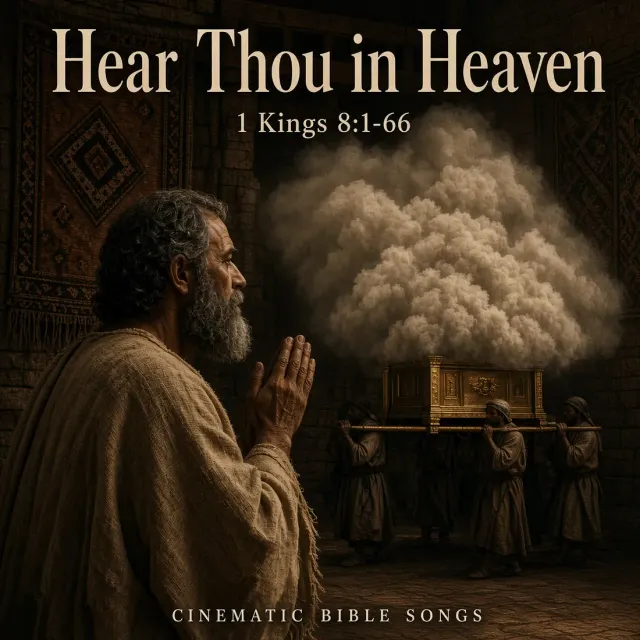
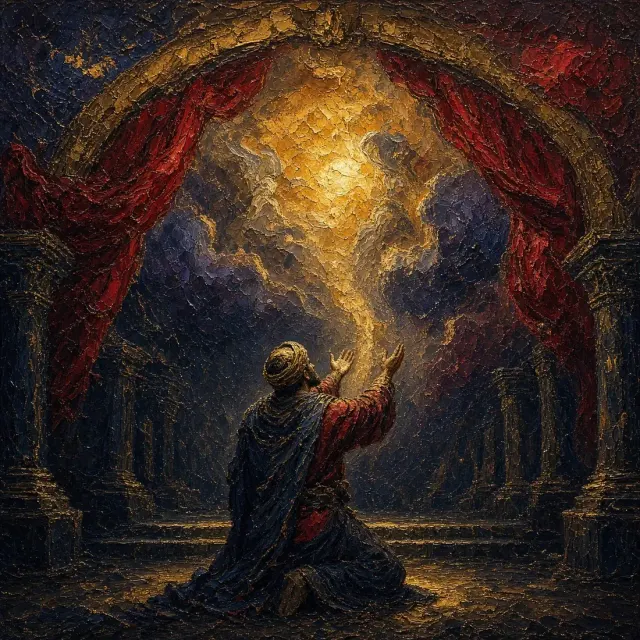
Then the ark is brought in, and the account notes that there was nothing in it save the two tables of stone. The cloud fills the house so the priests cannot stand to minister. And then Solomon prays, and the prayer is the strangest part of the whole thing, because a dedication speech for a new building should be about the building. Most of this one is about failure: when they sin against thee, when the heaven is shut up, when they be carried away captive. Seven times he asks for the same thing, which is that a prayer made towards this place be heard somewhere else.

6 songs

The music

Every song in the catalogue whose passage falls inside these chapters.

  1. 1 Kings 5:1-7:51

    A House for the Name

  2. 1 Kings 5-8

    The House of the Name

  3. 1 Kings 8:1-66

    Hear Thou in Heaven

  4. 2 Chronicles 3:1-4:22

    Upon Mount Moriah

  5. 2 Chronicles 5:1-7:22

    The Glory Filled the House

  6. 2 Chronicles 5:1-7:22

    When the Glory Filled the House

Nearby

All the objects

Report an error on this page