Objects of the Bible

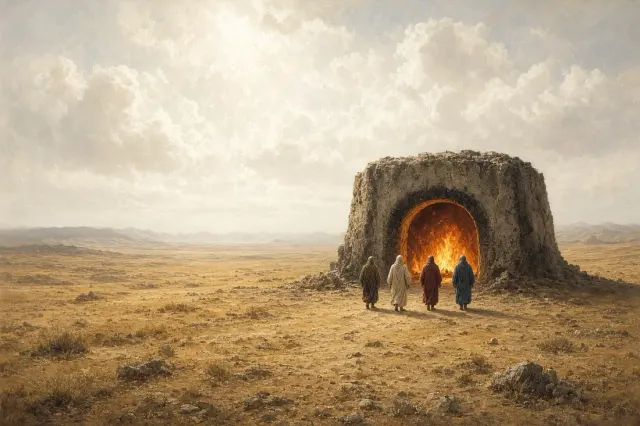
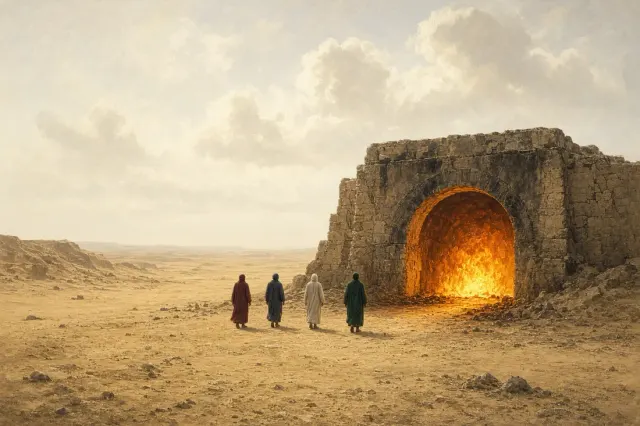
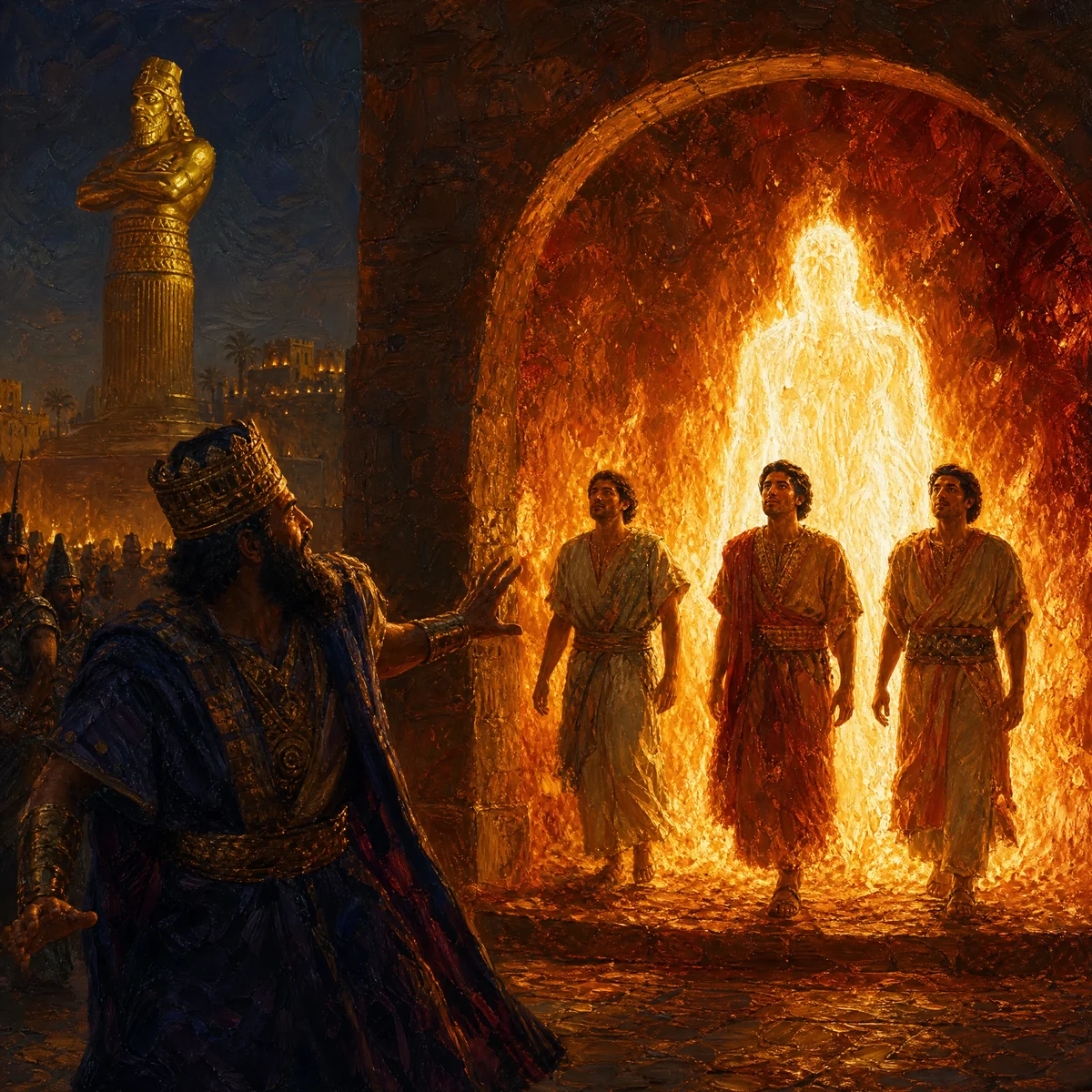
The fiery furnace

The answer given before the fire is the part worth reading, and it contains the words but if not.

The king gives them a second chance, which is not mercy so much as impatience, and finishes with a question: who is that God that shall deliver you out of my hands. The reply is short and it is the centre of the chapter. Our God whom we serve is able to deliver us, and he will deliver us out of thine hand, O king. But if not, be it known unto thee, O king, that we will not serve thy gods, nor worship the golden image which thou hast set up.

Where it appearsDaniel 3

Scroll down to the account
The fiery furnace

The movements, in the order the text gives them.

The Account of The fiery furnace

  1. 01

    Daniel 3:16-18

    But if not

    The confidence and the refusal are stated separately, so that the refusal does not depend on the rescue.

    But if not is spoken before anybody comes out of the fire. That placement gives the reply its weight. The three men affirm God's ability to deliver them, then refuse to make worship of the image the alternative if deliverance does not come. The answer is not a bargain with a favorable result written into the terms.

    Not careful does not mean that the matter is unimportant. The Aramaic wording concerns needing to answer: they do not need to construct a defense that makes their refusal negotiable. Their reply is brief, and it addresses the king's actual challenge. He has asked what god can rescue them from his hand. They name the God they serve without granting the king ownership of their worship.

    The passage supplies their words, not a measurement of their fear. Adding effortless calm would weaken the seriousness of the choice rather than explain it. Their bodies are exposed to a real sentence of death. Their allegiance is already stated. Whatever precise force is assigned to the conditional wording in verse 17, verse 18 will not permit the conclusion that obedience depends on surviving. The outcome is not their condition.

    Verse by verse

    1. 3:16

      The Aramaic verb behind careful concerns need or necessity; the statement is not an admission of carelessness.

    2. 3:17

      The men explicitly affirm that God is able to deliver them. The conditional wording is interpreted in more than one way, but it does not deny that ability.

    3. 3:18

      But if not leaves their refusal to worship intact even without rescue from the threatened punishment.
    Daniel 3:16-18

    King James Version · 3 verses

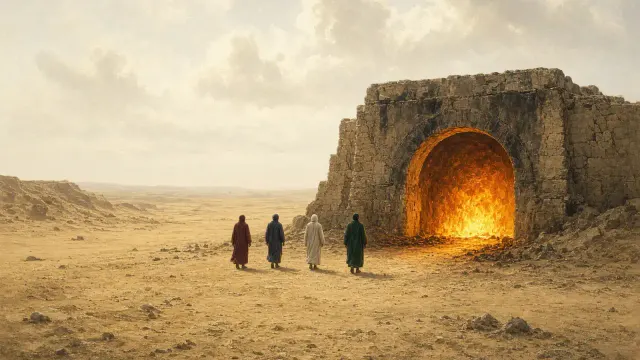
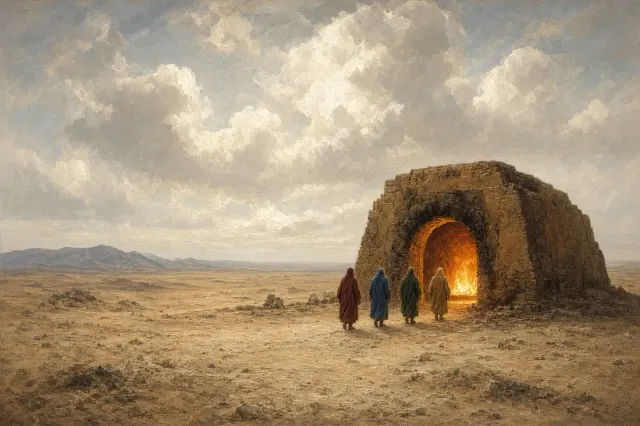
    3:16Shadrach, Meshach, and Abed-nego, answered and said to the king, O Nebuchadnezzar, we are not careful to answer thee in this matter.

    3:17If it be so, our God whom we serve is able to deliver us from the burning fiery furnace, and he will deliver us out of thine hand, O king.

    3:18But if not, be it known unto thee, O king, that we will not serve thy gods, nor worship the golden image which thou hast set up.

    Daniel 3:16-18: But if not
  2. 02

    Daniel 3:19-22

    Seven times more than it was wont to be heated

    The order is made in a rage and the account notes the result: the flame killed the men that took up the three.

    The first people killed by the heightened fire are the men obeying the king. That is the grim result of the urgency the passage carefully records. Nebuchadnezzar selects some of his strongest soldiers, but strength offers no protection from the furnace to which his order sends them. The command reaches its own servants with lethal force.

    The changed face and the increased heat belong together. Fury is not an emotion supplied by an imaginative retelling; the verse names it and makes its effect visible. Seven times expresses the extraordinary escalation ordered by the king. It supplies no measured starting temperature from which a modern calculation could be made.

    The clothing receives almost as much attention as the bindings: coats, hosen, hats, other garments. The three are thrown in dressed and tied, not equipped with some described protection against fire. These details establish the bodily circumstances of the execution, while the soldiers' deaths establish that the danger is real. Nothing in this passage makes the furnace harmless. The king has intensified his chosen punishment so much that carrying it out is itself fatal.

    Verse by verse

    1. 3:19

      Wont means accustomed. The sevenfold order intensifies the heating, but the text supplies no numerical temperature.

    2. 3:20

      Most mighty describes the soldiers selected to carry out the execution, not the three condemned men.

    3. 3:21

      Hosen is an older English term for leg garments; the precise identification of the underlying ancient clothing terms is debated.

    4. 3:22

      The passage attributes the soldiers' deaths to the urgent command and the extreme heat; it does not say the three prisoners died with them.

    Daniel 3:19-22

    King James Version · 4 verses

    3:19Then was Nebuchadnezzar full of fury, and the form of his visage was changed against Shadrach, Meshach, and Abed-nego: therefore he spake, and commanded that they should heat the furnace one seven times more than it was wont to be heated.

    3:20And he commanded the most mighty men that were in his army to bind Shadrach, Meshach, and Abed-nego, and to cast them into the burning fiery furnace.

    3:21Then these men were bound in their coats, their hosen, and their hats, and their other garments, and were cast into the midst of the burning fiery furnace.

    3:22Therefore because the king’s commandment was urgent, and the furnace exceeding hot, the flame of the fire slew those men that took up Shadrach, Meshach, and Abed-nego.

    Daniel 3:19-22: Seven times more than it was wont to be heated
  3. 03

    Daniel 3:24-25

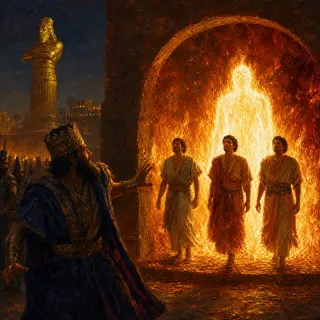
    Lo, I see four men loose

    The king counts, and the arithmetic is what convinces him. The detail that lands is not the fourth figure but the word loose.

    The king has to check the count. Three men went in bound; four are walking free. His counsellors can confirm what was ordered, but their confirmation only sharpens the difference between the execution and what he now sees. The arithmetic is simple. The event is not.

    Loose matters as much as four. The men are not merely alive somewhere in the furnace, still immobilized and awaiting extraction. They are moving within it, and the king says they have no hurt. The text does not describe the process by which the bonds ceased to hold them. A claim that only the ropes burned goes beyond the detail actually given.

    The fourth figure is described through the king's comparison, like the Son of God in the KJV. The Aramaic bar elahin can be expressed as a son of the gods, and verse 28 calls the deliverer God's angel. This leaves room for distinguishing the king's recognition of a heavenly being from a specific Christian identification of Christ. The fourth receives no personal name in the scene. What the king recognizes beyond dispute is a presence he did not put there, keeping alive the men he condemned.

    Verse by verse

    1. 3:24

      The king asks his counsellors to confirm the original number and the prisoners' bound condition.

    2. 3:25

      Loose means unbound; the verse does not explicitly state how the bindings were removed.

    3. 3:25

      Bar elahin contains a plural word for gods or divine beings. The KJV wording is preserved here, while the linguistic and Christian interpretive questions remain distinct.

    Daniel 3:24-25

    King James Version · 2 verses

    3:24Then Nebuchadnezzar the king was astonied, and rose up in haste, and spake, and said unto his counsellors, Did not we cast three men bound into the midst of the fire? They answered and said unto the king, True, O king.

    3:25He answered and said, Lo, I see four men loose, walking in the midst of the fire, and they have no hurt; and the form of the fourth is like the Son of God.

    Daniel 3:24-25: Lo, I see four men loose
  4. 04

    Daniel 3:26-27

    Nor was an hair of their head singed

    The inspection is a list: bodies, hair, coats, smell. The fire consumed exactly one thing, and it was the thing binding them.

    Not even the smell of fire. After a royal decree, an execution detail and a fourth figure in the flames, the chapter ends its inspection with something as ordinary as odor. The smallness of that observation makes the completeness of the deliverance tangible. The men have not merely escaped with their lives.

    The inspection moves across bodies, hair and clothing before reaching smell. It is conducted in the presence of assembled officials, not left as a private claim by the three men. The coats mentioned at the casting into the furnace are specifically examined afterward. The description gives the outcome a physical continuity: the people sent in are the people standing outside, with even their garments unchanged.

    The king comes near the mouth of the furnace and calls them servants of the most high God. That title changes the terms under which he addresses them. They had been accused of disregarding his authority; now he names the service they refused to abandon. He does not rescue them by making the fire safe or by taking them out himself. He calls to men already unharmed. His voice summons their exit, not their preservation.

    Verse by verse

    1. 3:26

      The king approaches the furnace's mouth; the verse does not place him inside it.

    2. 3:27

      The officials inspect the survivors themselves. Their observation includes bodies, hair, garments and smell.

    3. 3:27

      The fire had killed the soldiers in 3:22. Its inability to harm these three is not presented as a general failure of the furnace to burn.

    Daniel 3:26-27

    King James Version · 2 verses

    3:26Then Nebuchadnezzar came near to the mouth of the burning fiery furnace, and spake, and said, Shadrach, Meshach, and Abed-nego, ye servants of the most high God, come forth, and come hither. Then Shadrach, Meshach, and Abed-nego, came forth of the midst of the fire.

    3:27And the princes, governors, and captains, and the king’s counsellors, being gathered together, saw these men, upon whose bodies the fire had no power, nor was an hair of their head singed, neither were their coats changed, nor the smell of fire had passed on them.

    Daniel 3:26-27: Nor was an hair of their head singed
  5. 05

    Daniel 3:28-30

    They have changed the king’s word

    The decree that follows praises them for disobedience, and the men who would not take a promotion’s terms are promoted.

    Changed the king's word is a remarkable description for an act of refusal. The three men have not issued a rival decree or taken command of the province. They have yielded their bodies rather than worship another god, and the king now acknowledges that his command has been defeated. He praises the very trust his sentence was meant to punish.

    The wording keeps human refusal and divine rescue distinct. They trusted and surrendered their bodies; God sent his angel and delivered them. Their decision was made without making survival its price. Nebuchadnezzar's own explanation preserves that sequence instead of turning their obedience into a technique for escaping danger.

    His new decree also deserves to be read all the way through. Praise is followed by threats of dismemberment and ruined houses against anyone who speaks amiss of their God. The object of royal protection has changed, but the method still includes severe punishment. This is not a declaration of general freedom of worship. The chapter closes with promotion in Babylon, not departure from it. Their place in the province changes because the worship they refused to change has been publicly vindicated.

    Verse by verse

    1. 3:28

      The king calls the deliverer his angel, meaning the angel sent by the God of the three men.

    2. 3:28

      Yielded their bodies describes their acceptance of bodily danger rather than the worship demanded of them.

    3. 3:29

      The decree forbids speaking amiss against this God; it does not announce unrestricted religious liberty.

    4. 3:30

      The promotion takes place within the province of Babylon. The men are not said to return to Judah here.

    Daniel 3:28-30

    King James Version · 3 verses

    3:28Then Nebuchadnezzar spake, and said, Blessed be the God of Shadrach, Meshach, and Abed-nego, who hath sent his angel, and delivered his servants that trusted in him, and have changed the king’s word, and yielded their bodies, that they might not serve nor worship any god, except their own God.

    3:29Therefore I make a decree, That every people, nation, and language, which speak any thing amiss against the God of Shadrach, Meshach, and Abed-nego, shall be cut in pieces, and their houses shall be made a dunghill: because there is no other God that can deliver after this sort.

    3:30Then the king promoted Shadrach, Meshach, and Abed-nego, in the province of Babylon.

Why it matters

Everything after that is almost comic in its excess. The furnace is heated seven times more than usual, which makes it worse at killing them and fatal to the soldiers carrying them. They go in bound, in their coats, their hosen and their hats. The king looks in and starts counting out loud: did not we cast three men bound into the midst of the fire, lo, I see four men loose, walking in the midst of the fire, and they have no hurt. When they come out the account inspects them item by item, and the last item on the list is the smell.

4 songs

The music

Every song in the catalogue whose passage falls inside these chapters.

  1. Daniel 3:16-30

    Gold in the Fire

    Play here
    Open song pageRead lyrics
  2. Daniel 3:1-30

    In the Midst of the Fire

    Play here
    Open song pageRead lyrics
  3. Daniel 3

    Through the Fire

  4. Daniel 3:1-30

    We Will Not Serve Thy Gods

Nearby

All the objects

Report an error on this page