New · FreePlay The Witnesses The in-depth puzzle battle quest through Bible history

Objects of the Bible

The table of the bread of the Presence

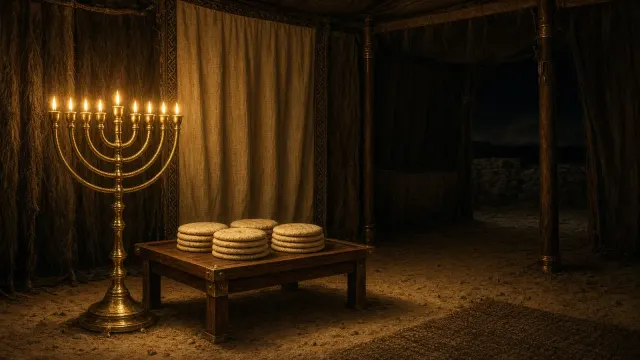
Twelve loaves replaced every sabbath, set out in front of a God who does not eat.

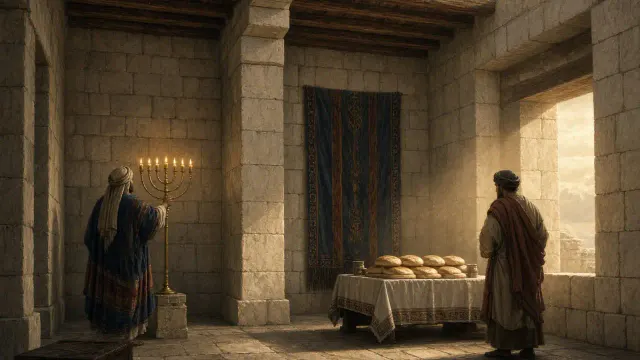
The table is shittim wood overlaid with pure gold, with a border of an handbreadth round about and a golden crown to the border, and rings and staves like everything else. On it go twelve cakes of fine flour, two tenth deals in each, set in two rows of six with pure frankincense on each row. The name is literal: bread of faces, set in continual order before the LORD.

Where it appearsExodus 25 · Leviticus 24 · 1 Samuel 21

Scroll down to the account
The table of the bread of the Presence

The movements, in the order the text gives them.

The Account of The table of the bread of the Presence

  1. 01

    Exodus 25:23-30

    Shewbread before me alway

    The table is described in the same terms as the ark, gold and rings and staves, and the instruction ends with a word about continuity.

    Seven verses build and equip the table; the last tells what makes it a sanctuary furnishing. Bread is to remain before God continually. Gold alone does not give the object its purpose. This is a table laid in the divine presence, with its own dishes and utensils, inside a dwelling that also contains light and incense.

    The household resemblance is real, but it must not be mistaken for a claim that God depends on Israel's catering. Psalm 50:12-13 explicitly rejects the notion that divine hunger is supplied by human offerings. Leviticus 24:9 identifies the actual eaters of this bread as Aaron and his sons. The table expresses continuing presentation before God; it does not solve a shortage in God's pantry.

    Its carrying poles matter as much as its gold. The bread belongs before God while the people remain a traveling people, and Numbers 4:7 specifically includes the continual bread when the table is prepared for transport. This is not a banquet arranged only after the journey has ended. The sanctuary carries its table through the wilderness. The covenant setting is sustained in a place where settling down is not yet an option.

    Verse by verse

    1. 25:24-25

      Crown denotes a surrounding gold molding or rim, not a wearable royal crown.

    2. 25:29

      Several utensil names are difficult to identify precisely; the passage should not be treated as a complete modern place-setting diagram.

    3. 25:30

      Hebrews 9:2 places the table and shewbread in the first compartment of the sanctuary, outside the inner veil.
    Exodus 25:23-30

    King James Version · 8 verses

    25:23Thou shalt also make a table of shittim wood: two cubits shall be the length thereof, and a cubit the breadth thereof, and a cubit and a half the height thereof.

    25:24And thou shalt overlay it with pure gold, and make thereto a crown of gold round about.

    25:25And thou shalt make unto it a border of an hand breadth round about, and thou shalt make a golden crown to the border thereof round about.

    25:26And thou shalt make for it four rings of gold, and put the rings in the four corners that are on the four feet thereof.

    25:27Over against the border shall the rings be for places of the staves to bear the table.

    25:28And thou shalt make the staves of shittim wood, and overlay them with gold, that the table may be borne with them.

    25:29And thou shalt make the dishes thereof, and spoons thereof, and covers thereof, and bowls thereof, to cover withal: of pure gold shalt thou make them.

    25:30And thou shalt set upon the table shewbread before me alway.

    Exodus 25:23-30: Shewbread before me alway
  2. 02

    Leviticus 24:5-9

    Two rows, six on a row

    The arrangement is specified down to the flour, the rows and the frankincense, and the bread is called most holy.

    The table is set for twelve, though twelve diners never sit around it. The number naturally recalls Israel's twelve tribes, and verse 8 expressly associates the bread with the children of Israel and an everlasting covenant. No verse assigns a named tribe to a particular loaf. The representation is corporate before it becomes a diagram.

    Each cake receives the same stated measure of fine flour. The arrangement gives no tribe a larger place at the table. The bread is renewed every sabbath, making the sacred week visible in the sanctuary's provisions. Continually does not mean that one ancient batch remains untouched indefinitely. Continuity is maintained by replacement.

    The frankincense serves as the memorial offering by fire, while the bread becomes the priests' food in a holy place. That division matters. The twelve loaves are not all burned away on the altar, nor are they merely props removed when the ceremony ends. Presentation, memorial, and priestly eating are joined within one command. The bread is offered before God and then actually eaten. The ritual has not forgotten what bread is for.

    Verse by verse

    1. 24:5

      Two tenth deals means two-tenths of an ephah of flour for each cake, not the final weight of the baked loaf.

    2. 24:7

      The frankincense is the memorial associated with the offering by fire; verse 9 reserves the bread itself for priestly eating.

    3. 24:8

      The sabbath renewal explains how the bread remains continually before the LORD without the same loaves remaining permanently.

    Leviticus 24:5-9

    King James Version · 5 verses

    24:5And thou shalt take fine flour, and bake twelve cakes thereof: two tenth deals shall be in one cake.

    24:6And thou shalt set them in two rows, six on a row, upon the pure table before the LORD.

    24:7And thou shalt put pure frankincense upon each row, that it may be on the bread for a memorial, even an offering made by fire unto the LORD.

    24:8Every sabbath he shall set it in order before the LORD continually, being taken from the children of Israel by an everlasting covenant.

    24:9And it shall be Aaron’s and his sons’; and they shall eat it in the holy place: for it is most holy unto him of the offerings of the LORD made by fire by a perpetual statute.

    Leviticus 24:5-9: Two rows, six on a row
  3. 03

    Leviticus 24:8-9

    It shall be Aaron’s and his sons’

    The bread set before God is eaten by the men who set it there. Nothing is wasted and the eating is part of the rite.

    The priests eat the bread because it is holy, not after it stops being holy. Verse 9 calls it most holy in the same sentence that assigns it to Aaron and his sons. Its movement from presentation to consumption is prescribed service, not the disposal of something whose religious usefulness has expired.

    That is why the place of eating is specified. The bread is not simply priestly wages available for any use in any location. It comes from Israel, stands before the LORD, and is eaten under the conditions of a perpetual statute. The priests receive it, but do not invent the terms of receiving it. The food sustains their bodies while its handling remains part of the sanctuary's order.

    The distinction sharpens the later episode at Nob. When Ahimelech says that no common bread is available, he is not making a fussy distinction between yesterday's ceremonial label and today's ordinary leftovers. Leviticus has preserved the bread's special status through its final use. The law provides nourishment and maintains a boundary at once. Bread can be given to human beings without ceasing to belong to a holy arrangement.

    Verse by verse

    1. 24:8

      The bread comes from the children of Israel; it is not presented as a private gift supplied solely by the priestly household.

    2. 24:9

      Most holy is a legal designation carrying restrictions on handling and consumption, not merely an expression of admiration.

    3. 24:9

      The authorized eating occurs in a holy place, not at any table the priests might choose.

    Leviticus 24:8-9

    King James Version · 2 verses

    24:8Every sabbath he shall set it in order before the LORD continually, being taken from the children of Israel by an everlasting covenant.

    24:9And it shall be Aaron’s and his sons’; and they shall eat it in the holy place: for it is most holy unto him of the offerings of the LORD made by fire by a perpetual statute.

    Leviticus 24:8-9: It shall be Aaron’s and his sons’
  4. 04

    1 Samuel 21:1-6

    There is no common bread under mine hand

    David arrives at Nob hungry and the priest has only the holy bread, taken from before the LORD to put hot bread in its place.

    The priest has bread, but not the category of bread being requested. No common bread under mine hand is a real problem under Leviticus 24:9, which reserves the holy loaves for Aaron's sons. David does not become a priest by arriving hungry. The passage has brought human need directly against the prescribed use of a sacred provision.

    Ahimelech does not respond as though every distinction has disappeared. He asks about the men's ritual condition, and David gives an answer intended to meet that concern. At the same time, David's claim of secret royal business is not a reliable account of his situation: verse 10 explicitly calls his journey flight from Saul. The priest is making his decision with information David has distorted. Mercy in the scene does not require treating the conversation as wholly truthful.

    The bread has been removed from before the LORD to make room for fresh bread. It is therefore the portion due for priestly eating, not bread David has seized from the table himself. That distinction keeps the action concrete. A priest hands over an authorized food portion to someone outside its ordinary class of recipients. The gift feeds David without making the legal tension vanish.

    Verse by verse

    1. 21:1

      The priest named here is Ahimelech. His son Abiathar appears as a survivor in 1 Samuel 22:20.

    2. 21:5

      Vessels may refer to the men's equipment or, in an extended sense, their bodies; the compressed wording is difficult and should not bear an elaborate certainty.

    3. 21:6

      The text records David requesting five loaves in verse 3, but does not separately state the final number handed over.

    1 Samuel 21:1-6

    King James Version · 6 verses

    21:1Then came David to Nob to Ahimelech the priest: and Ahimelech was afraid at the meeting of David, and said unto him, Why art thou alone, and no man with thee?

    21:2And David said unto Ahimelech the priest, The king hath commanded me a business, and hath said unto me, Let no man know any thing of the business whereabout I send thee, and what I have commanded thee: and I have appointed my servants to such and such a place.

    21:3Now therefore what is under thine hand? give me five loaves of bread in mine hand, or what there is present.

    21:4And the priest answered David, and said, There is no common bread under mine hand, but there is hallowed bread; if the young men have kept themselves at least from women.

    21:5And David answered the priest, and said unto him, Of a truth women have been kept from us about these three days, since I came out, and the vessels of the young men are holy, and the bread is in a manner common, yea, though it were sanctified this day in the vessel.

    21:6So the priest gave him hallowed bread: for there was no bread there but the shewbread, that was taken from before the LORD, to put hot bread in the day when it was taken away.

    1 Samuel 21:1-6: There is no common bread under mine hand
  5. 05

    Matthew 12:3-8

    Have ye not read what David did

    The episode is used as a precedent about sabbath and hunger, and the argument ends with a line from Hosea about mercy.

    Jesus does not solve the dispute by pretending the bread was ordinary. He explicitly calls it unlawful for David and his companions to eat, except for the priests. The force of the example depends on the restriction being real. A defense that quietly removes the law would remove the point of citing David.

    Then comes a second example from the law itself: priests perform their temple duties on the sabbath and remain blameless. Sacred service requires actions that a flat rule against every kind of work would misclassify. The bread table already supplies a particularly apt connection, since Leviticus 24:8 commands its renewal on that very day. Scripture contains the distinctions needed to challenge the accusation.

    The argument does not end with an exception for hungry travelers. Jesus speaks of one greater than the temple, quotes Hosea's demand for mercy rather than sacrifice, and identifies the Son of man as Lord of the sabbath. The disciples' case is therefore joined to his authority and to the meaning of the law, not merely to the intensity of their appetite. An old loaf at Nob has become evidence in a dispute about the one standing in the grainfield.

    Verse by verse

    1. 12:4

      The priestly restriction is stated, not denied. Jesus builds his argument with the difficult feature of David's case intact.

    2. 12:5

      The priests' sabbath duties are commanded by the law; blameless distinguishes authorized service from culpable violation.

    3. 12:7

      The quotation comes from Hosea 6:6, where covenant faithfulness and knowledge of God are contrasted with sacrifice without those realities.

    4. 12:8

      Lord of the sabbath is a claim about the Son of man's authority, not a claim that the disciples themselves determine the law.

    Matthew 12:3-8

    King James Version · 6 verses

    12:3But he said unto them, Have ye not read what David did, when he was an hungred, and they that were with him;

    12:4How he entered into the house of God, and did eat the shewbread, which was not lawful for him to eat, neither for them which were with him, but only for the priests?

    12:5Or have ye not read in the law, how that on the sabbath days the priests in the temple profane the sabbath, and are blameless?

    12:6But I say unto you, That in this place is one greater than the temple.

    12:7But if ye had known what this meaneth, I will have mercy, and not sacrifice, ye would not have condemned the guiltless.

    12:8For the Son of man is Lord even of the sabbath day.

    Matthew 12:3-8: Have ye not read what David did

Why it matters

Every sabbath the loaves are replaced and the old ones go to Aaron and his sons, and they shall eat it in the holy place, for it is most holy unto him. It is an offering that ends as a meal. Twelve loaves for twelve tribes, kept in the presence week after week by people who never see them being looked at. Centuries later David, running with nothing, asks a priest at Nob for bread and is given the shewbread, and that transaction is quoted by Jesus in an argument about the sabbath.

1 song

The music

Every song in the catalogue whose passage falls inside these chapters.

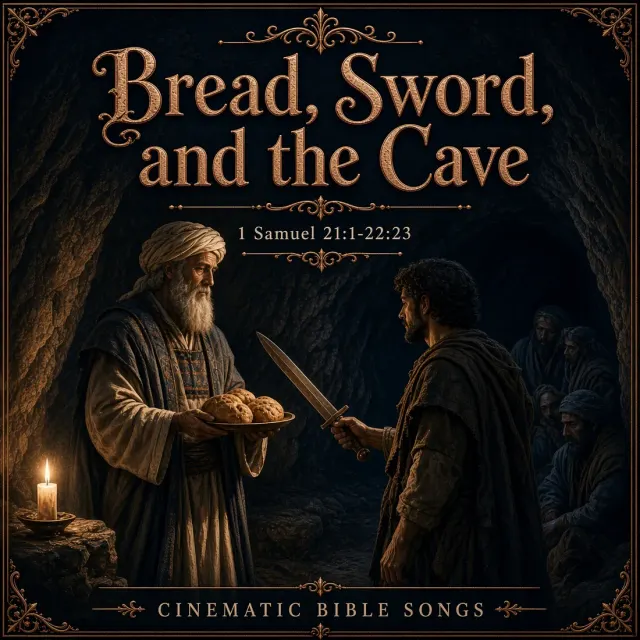
  1. 1 Samuel 21:1-22:23

    Bread, Sword, and the Cave

Nearby

All the objects

Report an error on this page