New · FreePlay The Witnesses The in-depth puzzle battle quest through Bible history

People of the Bible

Gabriel

Appears four times in the whole Bible, always to explain something, and twice to tell a family they are having a child.

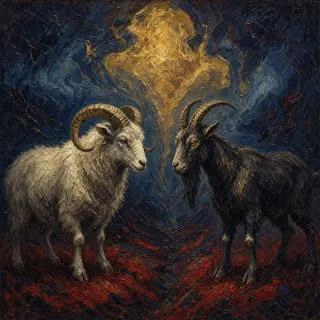
He is one of only two angels named in Scripture, and the name means man of God or strength of God. Every appearance is an errand of interpretation. Daniel has seen a ram and a goat and does not understand, and a voice tells Gabriel to make this man understand the vision. Later, while Daniel is still praying, he comes again, being caused to fly swiftly, and touches him about the time of the evening oblation.

Where he appearsDaniel 8 · Daniel 9 · Luke 1

Scroll down to the account
Gabriel

The movements, in the order the text gives them.

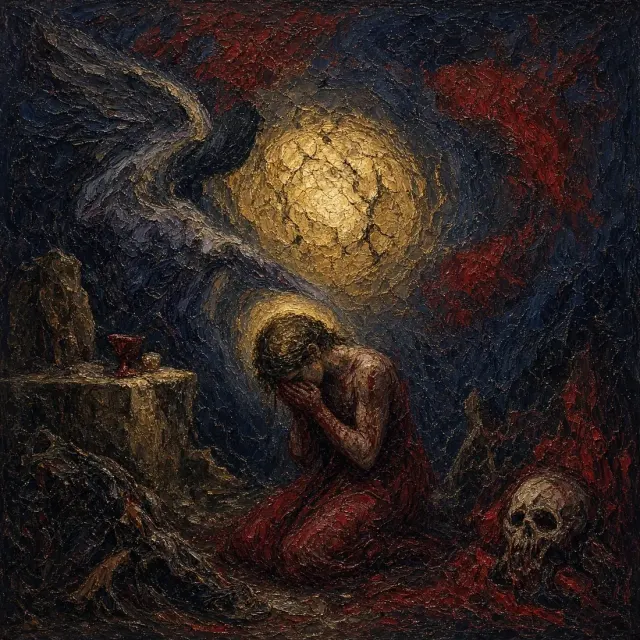
The Account of Gabriel

  1. 01

    Daniel 8:15-19

    Make this man to understand the vision

    A voice between the banks of the river gives him the instruction. Daniel is afraid and falls on his face, and is set upright before anything is explained.

    Gabriel's first recorded assignment is not to make the vision more spectacular. It is to make it understood. Daniel has already seen extraordinary things, yet seeing has not supplied their meaning. A voice names the messenger and gives him a task aimed directly at that gap.

    The encounter does not leave Daniel elegantly taking notes. Gabriel approaches; Daniel falls on his face. While the explanation begins, the prophet lies in a deep sleep with his face toward the ground, until a touch raises him upright. The messenger who brings the interpretation also restores the hearer to a position in which he can receive it. Neither the vision nor its explanation is presented as a display Daniel controls.

    Time is the other repeated concern: the time of the end, the last end of the indignation, the time appointed. The disturbing violence in the vision has a boundary; it is not an endless succession of horns doing whatever they please. The following verses identify the ram with Media and Persia and the goat with Greece, giving the symbols historical reference rather than leaving them available for any convenient guess. Readers differ about the full reach of the final horizon. Gabriel's stated work remains clear: revelation is being accompanied by interpretation, not simply by more astonishment.

    Verse by verse

    1. 8:16

      The voice gives Gabriel his commission. The passage does not explicitly identify the speaker whose voice comes from between the banks of Ulai.

    2. 8:17

      Son of man here addresses Daniel as a human being. It is not a claim that Daniel is the messianic figure of Daniel 7:13.

    3. 8:19

      The end is appointed in relation to the vision and its indignation. Interpretations differ over how the historical events identified in verses 20-22 relate to a further final fulfillment.

    Daniel 8:15-19

    King James Version · 5 verses

    8:15And it came to pass, when I, even I Daniel, had seen the vision, and sought for the meaning, then, behold, there stood before me as the appearance of a man.

    8:16And I heard a man’s voice between the banks of Ulai, which called, and said, Gabriel, make this man to understand the vision.

    8:17So he came near where I stood: and when he came, I was afraid, and fell upon my face: but he said unto me, Understand, O son of man: for at the time of the end shall be the vision.

    8:18Now as he was speaking with me, I was in a deep sleep on my face toward the ground: but he touched me, and set me upright.

    8:19And he said, Behold, I will make thee know what shall be in the last end of the indignation: for at the time appointed the end shall be.

    Daniel 8:15-19: Make this man to understand the vision
  2. 02

    Daniel 9:20-23

    At the beginning of thy supplications

    He arrives during the prayer rather than after it, and says the commandment came forth at the beginning of it. Thou art greatly beloved is the message he carries first.

    Gabriel arrives before Daniel has finished praying. The timing is stated twice, then explained from the other end: the command went out at the beginning of the supplications. Daniel's words are still being spoken when the response touches him. The passage records this particular answer; it does not offer a stopwatch for every prayer.

    What Gabriel interrupts is confession. Daniel names my sin as well as the sin of his people, and has already refused to present their righteousness as the ground of his appeal in verse 18. Greatly beloved therefore does not arrive as a certificate that Daniel has separated himself from the guilty nation. He is addressed with affection while identifying himself with it. The answer includes understanding, not merely reassurance that his concern has been noticed.

    The evening oblation is the quiet detail that fixes the whole scene. Daniel has just prayed over a desolate sanctuary, yet still tells time by the offering associated with it. Exile has not removed Jerusalem from his hours. Nor is the returning messenger anonymous: Daniel recognizes the man Gabriel from the earlier vision. The same figure who had raised him from the ground now speaks into a prayer shaped by the ruined city. A familiar messenger, an absent altar, and an explanation still centered on the holy mountain.

    Verse by verse

    1. 9:20

      Daniel explicitly includes his own sin in the confession. The distinction between him and Israel is not that he prays as a person who has never needed forgiveness.

    2. 9:21

      Evening oblation refers to the evening offering. Verse 17 identifies the sanctuary as desolate, making this a remembered worship time rather than proof that the temple is functioning.

    3. 9:23

      The message proceeds in verse 24 to seventy weeks. Readers differ over their chronology, but the stated subjects include the people, the holy city, sin, and restoration.

    Daniel 9:20-23

    King James Version · 4 verses

    9:20And whiles I was speaking, and praying, and confessing my sin and the sin of my people Israel, and presenting my supplication before the LORD my God for the holy mountain of my God;

    9:21Yea, whiles I was speaking in prayer, even the man Gabriel, whom I had seen in the vision at the beginning, being caused to fly swiftly, touched me about the time of the evening oblation.

    9:22And he informed me, and talked with me, and said, O Daniel, I am now come forth to give thee skill and understanding.

    9:23At the beginning of thy supplications the commandment came forth, and I am come to shew thee; for thou art greatly beloved: therefore understand the matter, and consider the vision.

    Daniel 9:20-23: At the beginning of thy supplications
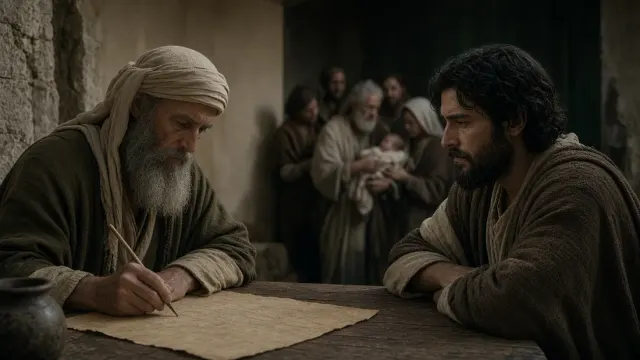
  3. 03

    Luke 1:11-20

    I am Gabriel, that stand in the presence of God

    Zechariah asks for evidence and is given a name instead, and then nine months of silence. The credential is stated only because it was doubted.

    Zacharias offers his age as evidence. Gabriel answers with where he stands. The contrast is precise: an old man measures the announcement against his household's circumstances; the messenger identifies the presence from which he has been sent. I am Gabriel is not a demand for admiration. It establishes whose announcement the priest is questioning.

    Luke has already called Zacharias and Elisabeth righteous. Their childlessness is not introduced as a hidden stain on that verdict, and the priest's fear at the appearance is not itself condemned. The stated fault comes later: he does not believe the words. The response fits the dispute with a severe exactness. His speech stops, but the promised word does not. The announcement will be fulfilled in its season whether he can repeat it aloud or not.

    Nor is the promised child merely a private answer to an elderly couple's longing. Joy extends to many, and John's work concerns Israel's return to the Lord. The description in the spirit and power of Elias gives that work a prophetic identity without saying that Elijah is being born again. Gabriel moves from one family's childlessness to a people prepared for the Lord. The scene remains beside the incense altar, but the announcement is already larger than the household that receives it.

    Verse by verse

    1. 1:15

      Abstention from wine and strong drink is specified. The passage does not give John the title Nazirite or describe every feature of that vow.

    2. 1:17

      Elias is the King James form of Elijah here. Spirit and power describe the character of John's prophetic work, not reincarnation.

    3. 1:19

      Gabriel is named twice in Daniel and twice in Luke. Scripture calls him an angel, but does not explicitly give him the title archangel.

    4. 1:20

      Dumb means unable to speak. It is not a description of intelligence, and the verse explains the silence as temporary.

    Luke 1:11-20

    King James Version · 10 verses

    1:11And there appeared unto him an angel of the Lord standing on the right side of the altar of incense.

    1:12And when Zacharias saw him, he was troubled, and fear fell upon him.

    1:13But the angel said unto him, Fear not, Zacharias: for thy prayer is heard; and thy wife Elisabeth shall bear thee a son, and thou shalt call his name John.

    1:14And thou shalt have joy and gladness; and many shall rejoice at his birth.

    1:15For he shall be great in the sight of the Lord, and shall drink neither wine nor strong drink; and he shall be filled with the Holy Ghost, even from his mother’s womb.

    1:16And many of the children of Israel shall he turn to the Lord their God.

    1:17And he shall go before him in the spirit and power of Elias, to turn the hearts of the fathers to the children, and the disobedient to the wisdom of the just; to make ready a people prepared for the Lord.

    1:18And Zacharias said unto the angel, Whereby shall I know this? for I am an old man, and my wife well stricken in years.

    1:19And the angel answering said unto him, I am Gabriel, that stand in the presence of God; and am sent to speak unto thee, and to shew thee these glad tidings.

    1:20And, behold, thou shalt be dumb, and not able to speak, until the day that these things shall be performed, because thou believest not my words, which shall be fulfilled in their season.

    Luke 1:11-20: I am Gabriel, that stand in the presence of God
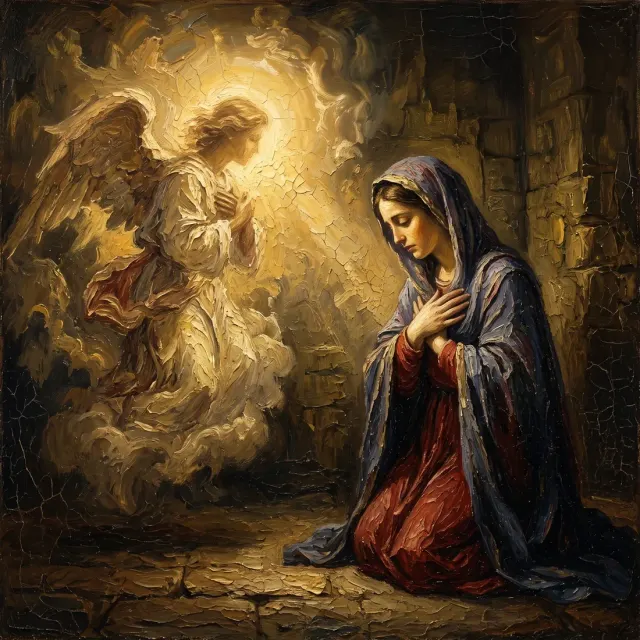
  4. 04

    Luke 1:26-38

    Hail, thou that art highly favoured

    The same messenger, a village instead of a temple, and a question answered rather than punished. With God nothing shall be impossible.

    No palace is named in this announcement. David's throne is. Gabriel has moved from the temple in Jerusalem to Nazareth, and the woman addressed is identified by name, virginity, and betrothal rather than by an office at the sanctuary. Yet the promise concerns a kingdom without an end. The distance between the setting and the announcement is part of its force.

    The promised son is not simply another remarkable child alongside John. John prepares a people for the Lord; Jesus receives David's throne, reigns over the house of Jacob, and is called the Son of the Highest. The enduring throne recalls the promise to David in 2 Samuel 7:12-16, while Gabriel's explanation of the conception goes beyond an account of royal descent. The Holy Ghost and the power of the Highest, not a human father, are named in the answer to Mary's question. The angel announces the conception; he is not its agent as a father.

    Mary's question is answered rather than punished. Luke explicitly identifies unbelief in Zacharias's response, but records Mary's acceptance here and Elisabeth's recognition of her belief in verse 45. That contrast rests on the text, not on a rule that questions are automatically faithless. Elisabeth's pregnancy is given as a confirming sign, not as an identical kind of conception. Mary then calls herself the Lord's handmaid and accepts the word. The last movement belongs to Gabriel: he departs. His message has placed the emphasis where it belongs, on the son to be born rather than on the messenger who came.

    Verse by verse

    1. 1:26

      The sixth month is explained in verse 36 as the sixth month of Elisabeth's pregnancy. It is not a reference to June.

    2. 1:27

      Luke gives no age for Mary in this passage. Espoused identifies her betrothal to Joseph, not an already consummated marriage.

    3. 1:32-33

      David, Jacob, and an enduring throne root the announcement in Israel's covenant history. The kingdom is not introduced as a disconnected new subject.

    4. 1:36

      Cousin represents a Greek kinship term broad enough to mean relative. This verse does not establish the precise degree of relationship between Mary and Elisabeth.

    Luke 1:26-38

    King James Version · 13 verses

    1:26And in the sixth month the angel Gabriel was sent from God unto a city of Galilee, named Nazareth,

    1:27To a virgin espoused to a man whose name was Joseph, of the house of David; and the virgin’s name was Mary.

    1:28And the angel came in unto her, and said, Hail, thou that art highly favoured, the Lord is with thee: blessed art thou among women.

    1:29And when she saw him, she was troubled at his saying, and cast in her mind what manner of salutation this should be.

    1:30And the angel said unto her, Fear not, Mary: for thou hast found favour with God.

    1:31And, behold, thou shalt conceive in thy womb, and bring forth a son, and shalt call his name JESUS.

    1:32He shall be great, and shall be called the Son of the Highest: and the Lord God shall give unto him the throne of his father David:

    1:33And he shall reign over the house of Jacob for ever; and of his kingdom there shall be no end.

    1:34Then said Mary unto the angel, How shall this be, seeing I know not a man?

    1:35And the angel answered and said unto her, The Holy Ghost shall come upon thee, and the power of the Highest shall overshadow thee: therefore also that holy thing which shall be born of thee shall be called the Son of God.

    1:36And, behold, thy cousin Elisabeth, she hath also conceived a son in her old age: and this is the sixth month with her, who was called barren.

    1:37For with God nothing shall be impossible.

    1:38And Mary said, Behold the handmaid of the Lord; be it unto me according to thy word. And the angel departed from her.


    Luke 1:26-38: Hail, thou that art highly favoured

Why it matters

Five hundred years later he is in the temple at the hour of incense standing on the right side of the altar, and an old priest is struck silent for asking how he can be sure. Six months after that he is in Nazareth with a greeting that troubles a young woman before he has said anything else. What he brings each time is not a command but information, and he gives his credentials once only, to Zechariah: I am Gabriel, that stand in the presence of God.

5 songs

The music

Every song in the catalogue whose passage falls inside these chapters.

  1. Daniel 8:1-27

    The Ram and the He-Goat

  2. Daniel 9:1-27

    We Have Sinned and Done Wickedly

  3. Luke 1:5-25

    A Son Named John

    Play here
    Open song pageRead lyrics
  4. Luke 1

    Be It Unto Me

  5. Luke 1:26-38

    The Annunciation

    Play here
    Open song pageRead lyrics

Nearby

All the people

Report an error on this page