
New · FreePlay The Witnesses The in-depth puzzle battle quest through Bible history

People of the Bible

Michael

Called one of the chief princes, and the only one who fights, and he will not pick an argument he is not given.

Where Gabriel explains, Michael stands. Daniel is told that a messenger was withstood twenty-one days by the prince of the kingdom of Persia until Michael, one of the chief princes, came to help. The same chapter calls him your prince, meaning Israel’s, and the phrase is repeated. He is never described. No wings, no face, no height, nothing that would let a painter start. What the text gives instead is a function and a side.

Where he appearsDaniel 10 · Daniel 12 · Jude 1 · Revelation 12

Scroll down to the account
Michael

The movements, in the order the text gives them.

The Account of Michael

  1. 01

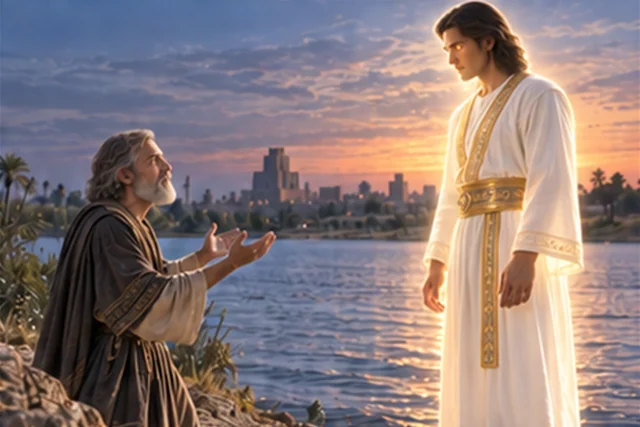
    Daniel 10:12-14

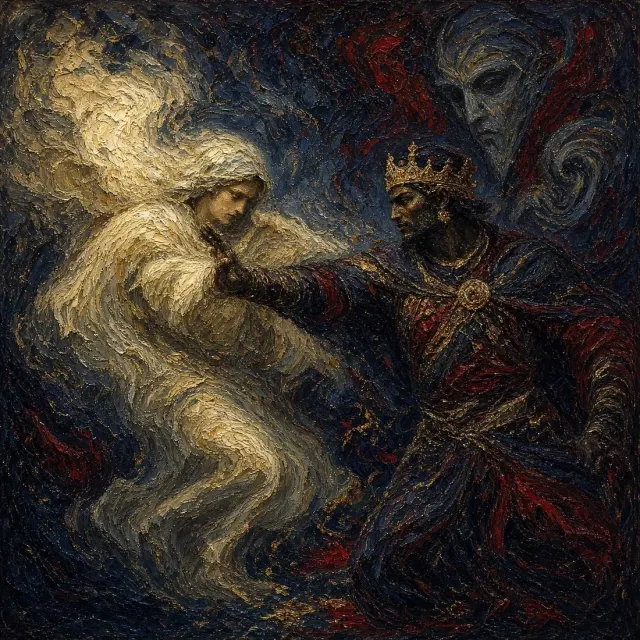
    The prince of the kingdom of Persia withstood me

    The delay is twenty-one days and the prayer was heard on the first. The explanation given is not silence but resistance, and Michael is the help sent.

    The first day and the twenty-one days belong in the same reading. Daniel's words were heard when he began to seek understanding, yet the messenger describes a prolonged resistance before arriving. Delay in this account is not presented as evidence that the prayer failed to reach God. The chapter distinguishes a heard petition from an immediately visible answer.

    Michael enters with an action rather than a speech: he came to help. The unnamed speaker has been opposed by the prince of Persia, and one of the chief princes joins him. The title places Michael within an order of heavenly authority; it does not supply an entire diagram of that order. The conflict is real within the vision, but its weapons, maneuvers, and full organization are not described. Elaborate accounts of those details go beyond the passage.

    The destination of this assistance is equally important. The messenger comes to make Daniel understand what will happen to his people. Michael's intervention serves the delivery of that explanation, not a separate exhibition of angelic prowess. Daniel has spent the opening of the chapter mourning and denying himself ordinary comforts. Behind those visible days, the account places an unseen struggle. Its first named defender is introduced in three plain words: came to help.

    Verse by verse

    1. 10:12

      The statement that the words were heard concerns the first day. The delay described in verse 13 is not a delay in divine hearing.

    2. 10:13

      Twenty-one days matches the three full weeks of mourning in verses 2-3. The account places the earthly waiting beside the heavenly opposition.

    3. 10:14

      The speaker in this chapter is not explicitly named Gabriel. His mission resembles Gabriel's work of explanation without that resemblance establishing his identity.
    Daniel 10:12-14

    King James Version · 3 verses

    10:12Then said he unto me, Fear not, Daniel: for from the first day that thou didst set thine heart to understand, and to chasten thyself before thy God, thy words were heard, and I am come for thy words.

    10:13But the prince of the kingdom of Persia withstood me one and twenty days: but, lo, Michael, one of the chief princes, came to help me; and I remained there with the kings of Persia.

    10:14Now I am come to make thee understand what shall befall thy people in the latter days: for yet the vision is for many days.

    Daniel 10:12-14: The prince of the kingdom of Persia withstood me
  2. 02

    Daniel 10:21

    Michael your prince

    The messenger says none holds with me in these things but Michael. The relationship is stated as an alliance rather than a hierarchy.

    The final description changes the scale of Michael's introduction. He is not merely a powerful figure who happened to help. He is the prince associated with Daniel's people. The conflict involving Persia and Greece is therefore not detached from the exiled community whose future Daniel wants to understand.

    The scripture of truth places another limit around the scene. The messenger is not improvising an outcome as heavenly opponents contend; he announces something described as already inscribed. The writing and the struggle stand together. The passage does not treat resistance as imaginary because the purpose is known, or the purpose as uncertain because resistance exists.

    Michael's solidarity is expressed in muscular language. Holdeth with me translates a form of the Hebrew verb for strengthening: this is active support, not sympathetic observation from a safe distance. Yet the phrase in these things matters too. The statement concerns the conflict just described; it is not a complete census of every faithful being in heaven. The chapter closes by joining a truthful message to a particular defender. Daniel's people are not merely the subject of a prediction. Their prince is involved.

    Verse by verse

    1. 10:21

      Holdeth comes from the Hebrew root chazaq, associated with strength and strengthening. In context it describes standing firmly alongside the speaker.

    2. 10:21

      The scripture of truth is the writing from which the coming disclosure is announced. The phrase is not a title for a completed biblical collection already in Daniel's hands.

    3. 10:21

      Michael's Hebrew name asks who is like God. The name draws attention to God rather than serving as a claim that Michael possesses independent divine authority.

    Daniel 10:21

    King James Version · 1 verse

    10:21But I will shew thee that which is noted in the scripture of truth: and there is none that holdeth with me in these things, but Michael your prince.

    Daniel 10:21: Michael your prince
  3. 03

    Daniel 12:1

    At that time shall Michael stand up

    He is the great prince which stands for the children of thy people, and his standing up coincides with a time of trouble such as never was.

    The previous verse ends with a ruler who comes to his end and has nobody to help him. This verse begins with Michael standing for Daniel's people. The contrast crosses the chapter division: an apparently overwhelming ruler reaches abandonment, while a threatened people have a defender. The division between chapters should not hide that turn.

    Michael's presence does not mean there will be no trouble. The trouble is described in terms of unmatched severity, in the very sentence that promises deliverance. The text is not offering two competing versions of the future, one frightening and one reassuring. The defense belongs within the crisis rather than replacing it with an easier account.

    The book at the end of the verse gives the promise precision. Those delivered are identified as those found written in it; the description is not left as an undefined statement about every individual bearing a national label. Immediately afterward, the horizon opens onto the awakening of the dead, some to everlasting life and some to shame. Deliverance therefore belongs beside resurrection and judgment, not merely beside the survival of a political order. Michael stands for the people, but their final future is framed by a record and an awakening beyond the reach of their oppressors.

    Verse by verse

    1. 12:1

      At that time connects the verse with the preceding revelation. Interpreters differ over the relationship between its historical crises and its final horizon.

    2. 12:1

      The great prince is explicitly associated with the children of Daniel's people. The verse does not name every heavenly protector or define every angelic rank.

    3. 12:1

      The following verse describes resurrection to different outcomes. That immediate context gives the promise of deliverance a scope beyond escape from a present danger.

    Daniel 12:1

    King James Version · 1 verse

    12:1And at that time shall Michael stand up, the great prince which standeth for the children of thy people: and there shall be a time of trouble, such as never was since there was a nation even to that same time: and at that time thy people shall be delivered, every one that shall be found written in the book.

    Daniel 12:1: At that time shall Michael stand up
  4. 04

    Jude 1:9

    The Lord rebuke thee

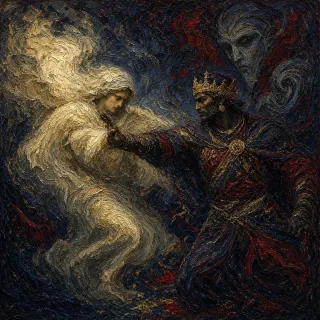
    In a dispute about the body of Moses he brings no railing accusation. The archangel is quoted as an example of what not to say rather than of power.

    Michael contends, but does not rail. That distinction is why Jude introduces him between descriptions of people who despise authority and speak evil of what they do not understand. The contrast is not between a timid angel and bold opponents. Michael is already disputing with the devil. His restraint operates inside the confrontation, not instead of it.

    The body of Moses invites more questions than Jude answers. Deuteronomy 34 records Moses's death and burial, with the location of his grave unknown, but does not describe this dispute. Jude supplies its participants and subject, not the devil's detailed claim or Michael's whole argument. Accounts of exactly what either party intended to do with the body add information absent from the verse.

    The Lord rebuke thee places the decisive judgment with the Lord. Durst not does not turn Michael into an admirer of his opponent or imply that abusive language would have been a stronger weapon. Jude's point depends on the opposite contrast: a figure bearing the title archangel does not assume the freedom of speech claimed by people who lack his standing. The highest title assigned to a named angel in the New Testament is paired here with a refusal to overstep. Authority does not become permission to say anything.

    Verse by verse

    1. 1:9

      Archangel comes from Greek archangelos, meaning chief angel. Michael is the only named figure explicitly given this title in the New Testament.

    2. 1:9

      Railing describes reviling or abusive accusation. The verse distinguishes such speech from the dispute in which Michael actually participates.

    3. 1:9

      The verse does not state the outcome concerning Moses's body. Deuteronomy 34:6 supplies the burial notice, not an explanation of every detail in Jude's reference.

    Jude 1:9

    King James Version · 1 verse

    1:9Yet Michael the archangel, when contending with the devil he disputed about the body of Moses, durst not bring against him a railing accusation, but said, The Lord rebuke thee.

    Jude 1:9: The Lord rebuke thee
  5. 05

    Revelation 12:7-9

    There was war in heaven

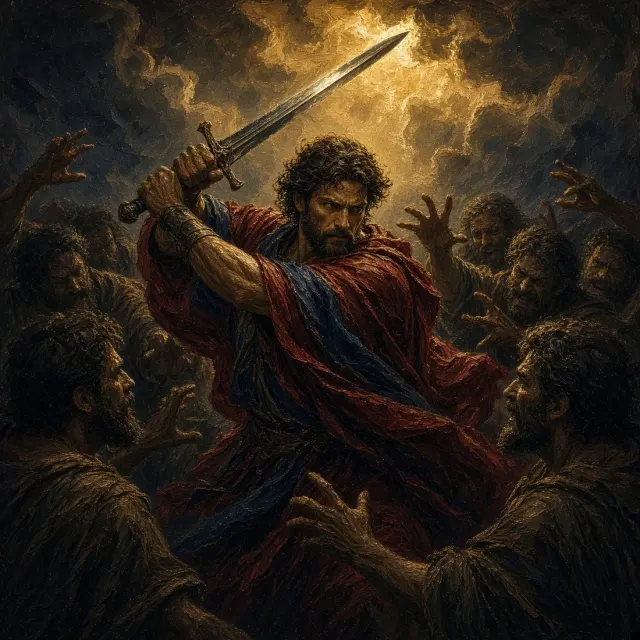
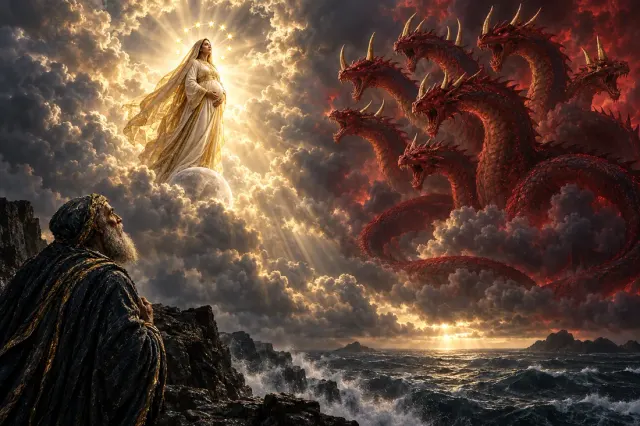
    Michael and his angels fought against the dragon, and the dragon prevailed not. The one cast out is named four ways in a single verse.

    The dragon loses more than a battle. He loses his place. Neither was their place found any more in heaven makes the outcome an expulsion, and the next verse states that expulsion three times. The account spends fewer words describing the combat than identifying who is removed and where he goes.

    The identification prevents the dragon from remaining a vague emblem of whatever danger a reader happens to imagine. He is the old serpent, the Devil, and Satan, the deceiver of the whole world. Michael and his angels oppose a specified adversary. Yet their victory does not mean that the earth is instantly free of danger. The following proclamation combines heaven's rejoicing with a warning for the earth, where the defeated enemy continues his aggression. Cast down is not the same as harmless.

    The song after the battle also refuses to make Michael the center of salvation. It announces God's kingdom and Christ's authority, then speaks of victory through the Lamb's blood and the witnesses' testimony. Michael's fighting belongs within that larger triumph. The Book of Revelation can describe real heavenly conflict without making military spectacle its final explanation. The defender named in Daniel now leads angels against the accuser; the meaning of the victory is supplied by the proclamation that follows, not by an invented description of his sword.

    Verse by verse

    1. 12:7

      Readers relate this conflict variously to Christ's exaltation, a final crisis, or the wider conflict of the Church. The vision does not supply a calendar date for the battle.

    2. 12:7

      Some Christian interpreters identify Michael with Christ; others distinguish the archangel from him. The passage names Michael, while the following proclamation names Christ and the Lamb.

    3. 12:8-9

      The loss of a place in heaven is followed by expulsion to earth. Verse 12 explicitly describes continued danger there, not the enemy's annihilation.

    Revelation 12:7-9

    King James Version · 3 verses

    12:7And there was war in heaven: Michael and his angels fought against the dragon; and the dragon fought and his angels,

    12:8And prevailed not; neither was their place found any more in heaven.

    12:9And the great dragon was cast out, that old serpent, called the Devil, and Satan, which deceiveth the whole world: he was cast out into the earth, and his angels were cast out with him.

    Revelation 12:7-9: There was war in heaven

Why it matters

Jude records the one scene where he refuses to use his rank. Disputing with the devil about the body of Moses, he durst not bring against him a railing accusation, but said the Lord rebuke thee. The restraint is the point of the citation. Then Revelation gives him the war: Michael and his angels fought against the dragon, and the dragon and his angels fought and prevailed not, and the great dragon was cast out, that old serpent, called the Devil and Satan.

4 songs

The music

Every song in the catalogue whose passage falls inside these chapters.

  1. Daniel 10:12-13

    Delayed, but Not Denied

    Play here
    Open song pageRead lyrics
  2. Daniel 10:1-21

    The Prince of Persia Withstood Me

  3. Daniel 11:1-12:13

    Many Shall Awake

  4. Revelation 12:1–17

    War in Heaven

Nearby

All the people

Report an error on this page