
The big picture
The road ahead leads Paul toward Jerusalem, the chief Jewish city. He travels as a messenger of Jesus. Jesus is the risen Lord for whom he is ready to suffer. Along the coast, believers warn him about danger and plead with him to stop. He still goes. Leaders in Jerusalem welcome his report but ask him to answer rumours through a public religious act. That attempt at peace does not prevent a false charge. A crowd attacks him, and Roman soldiers take him into custody.
In this chapter
- Prayer on the Shore at Tyre Acts 21:1-6
The travellers sail through coastal stops and board a ship bound for Phenicia, a coastal region.
- A Bound Belt Foreshadows Arrest Acts 21:7-14
At Cæsarea, a coastal city, the group stays with Philip, a preacher and one of the seven appointed for service.
- A Glad Welcome and a Full Report Acts 21:15-19
The travellers gather their baggage and go up to Jerusalem.
- A Public Act to Answer Rumours Acts 21:20-26
The leaders praise God, then explain a concern among Jewish believers devoted to the law.
- An Assumption Becomes a Violent Charge Acts 21:27-36
Near the end of the seven days, opponents from Asia, a distant region, see Paul in the temple.
- Paul Asks to Address the Crowd Acts 21:37-40
As soldiers bring Paul toward the barracks, he asks the commander for permission to speak.
Central truth
Paul goes to Jerusalem despite warnings, tries to reassure fellow believers, and is seized after an unproved charge stirs a violent crowd.
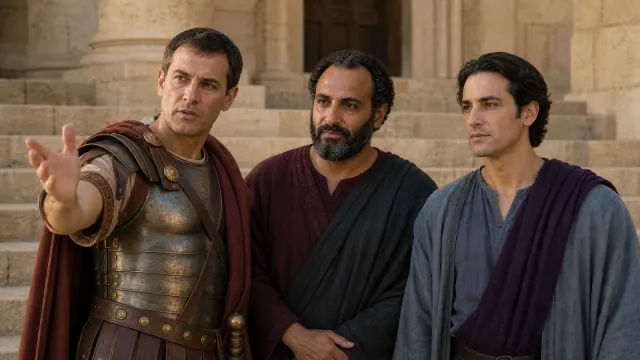

Scripture beside the summary
Acts · King James Version · 40Acts 21:1-6
Prayer on the Shore at Tyre
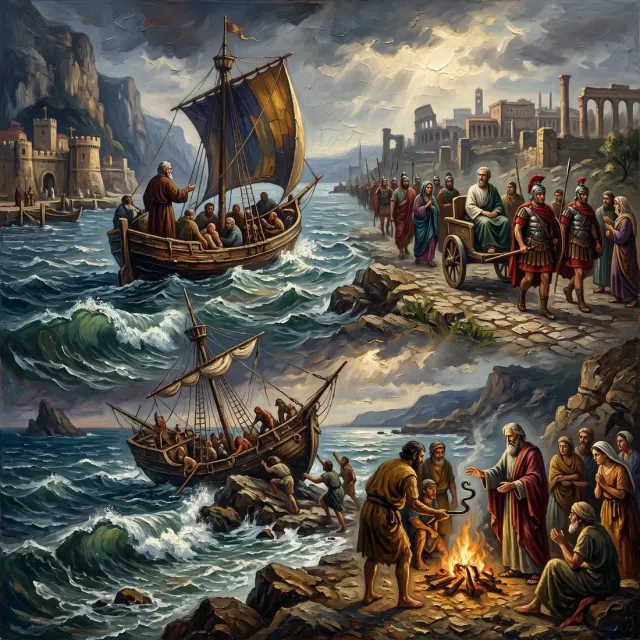
The travellers sail through coastal stops and board a ship bound for Phenicia, a coastal region. They pass Cyprus, an island, and land at Tyre, a port where cargo is unloaded. They find believers and stay seven days. Through the Spirit, those believers tell Paul not to go to Jerusalem. Readers differ on whether this is a direct prohibition or a warning interpreted as a plea. At departure, the whole group, including wives and children, walks them outside the city. They kneel on the beach to pray, then part as the travellers board.
In everyday life
An island passenger pauses on the quay while friends urge him to reconsider a dangerous assignment inland. The warning has not settled the decision, but they gather around him before he boards. Their care remains visible even when they do not agree about his next step. The believers speak through the Spirit and pray over Paul's departure.
Notice
Acts 21:5 Wives and children join the farewell on the shore. The concern for Paul belongs to whole households, not only to a few recognised leaders.
Acts 21:1-6
King James Version1And it came to pass, that after we were gotten from them, and had launched, we came with a straight course unto Coos, and the day following unto Rhodes, and from thence unto Patara:
2And finding a ship sailing over unto Phenicia, we went aboard, and set forth.
3Now when we had discovered Cyprus, we left it on the left hand, and sailed into Syria, and landed at Tyre: for there the ship was to unlade her burden.
4And finding disciples, we tarried there seven days: who said to Paul through the Spirit, that he should not go up to Jerusalem.
5And when we had accomplished those days, we departed and went our way; and they all brought us on our way, with wives and children, till we were out of the city: and we kneeled down on the shore, and prayed.
6And when we had taken our leave one of another, we took ship; and they returned home again.
Acts 21:7-14
A Bound Belt Foreshadows Arrest
At Cæsarea, a coastal city, the group stays with Philip, a preacher and one of the seven appointed for service. His four unmarried daughters speak messages from God. Agabus, another prophet, arrives and binds his own hands and feet with Paul's belt. He says the Spirit foretells Paul's binding in Jerusalem and delivery to Gentiles, non-Jewish authorities. Companions and local believers plead with Paul not to go. He says their tears pain him, but he is ready for imprisonment and death for Jesus. Unable to persuade him, they entrust the outcome to the Lord's will.
In everyday life
A helicopter pilot shows a map of the threats around the airstrip where a colleague plans to land. The crew plead with him to turn back, but he remains committed to reaching those waiting there. Their fear and his resolve meet without an agreed route. Agabus gives a prophetic sign of Paul's actual binding, not a risk estimate.
Notice
Acts 21:13 Paul does not dismiss their affection; he says their tears break his heart. His resolve to go exists alongside the pain their concern causes him.
Acts 21:7-14
King James Version7And when we had finished our course from Tyre, we came to Ptolemais, and saluted the brethren, and abode with them one day.
8And the next day we that were of Paul’s company departed, and came unto Cæsarea: and we entered into the house of Philip the evangelist, which was one of the seven; and abode with him.
9And the same man had four daughters, virgins, which did prophesy.
10And as we tarried there many days, there came down from Judæa a certain prophet, named Agabus.
11And when he was come unto us, he took Paul’s girdle, and bound his own hands and feet, and said, Thus saith the Holy Ghost, So shall the Jews at Jerusalem bind the man that owneth this girdle, and shall deliver him into the hands of the Gentiles.
12And when we heard these things, both we, and they of that place, besought him not to go up to Jerusalem.
13Then Paul answered, What mean ye to weep and to break mine heart? for I am ready not to be bound only, but also to die at Jerusalem for the name of the Lord Jesus.
14And when he would not be persuaded, we ceased, saying, The will of the Lord be done.
Acts 21:15-19
A Glad Welcome and a Full Report
The travellers gather their baggage and go up to Jerusalem. Some believers from Cæsarea accompany them and arrange lodging with Mnason, a long-standing follower from Cyprus. The Jerusalem believers receive the group gladly. Next day Paul meets James, a church leader, with all the elders present. He gives a detailed report of what God has done among Gentiles through his service. His arrival is not first met by rejection within the church. Hospitality and a careful hearing come before the concern about rumours that the leaders will raise.
In everyday life
A village outreach worker reaches the home of a long-time supporter after weeks away. Next morning, the local team gathers to hear which families received help and what changed. The report names each place rather than reducing the work to a total. Welcome makes room for a careful account. Paul reports God's work among Gentiles through his ministry.
Notice
Acts 21:19 Paul describes the events in detail while crediting God with the work. The leaders hear more than a broad claim of success or a list of numbers.
Acts 21:15-19
King James Version15And after those days we took up our carriages, and went up to Jerusalem.
16There went with us also certain of the disciples of Cæsarea, and brought with them one Mnason of Cyprus, an old disciple, with whom we should lodge.
17And when we were come to Jerusalem, the brethren received us gladly.
18And the day following Paul went in with us unto James; and all the elders were present.
19And when he had saluted them, he declared particularly what things God had wrought among the Gentiles by his ministry.
Acts 21:20-26
A Public Act to Answer Rumours
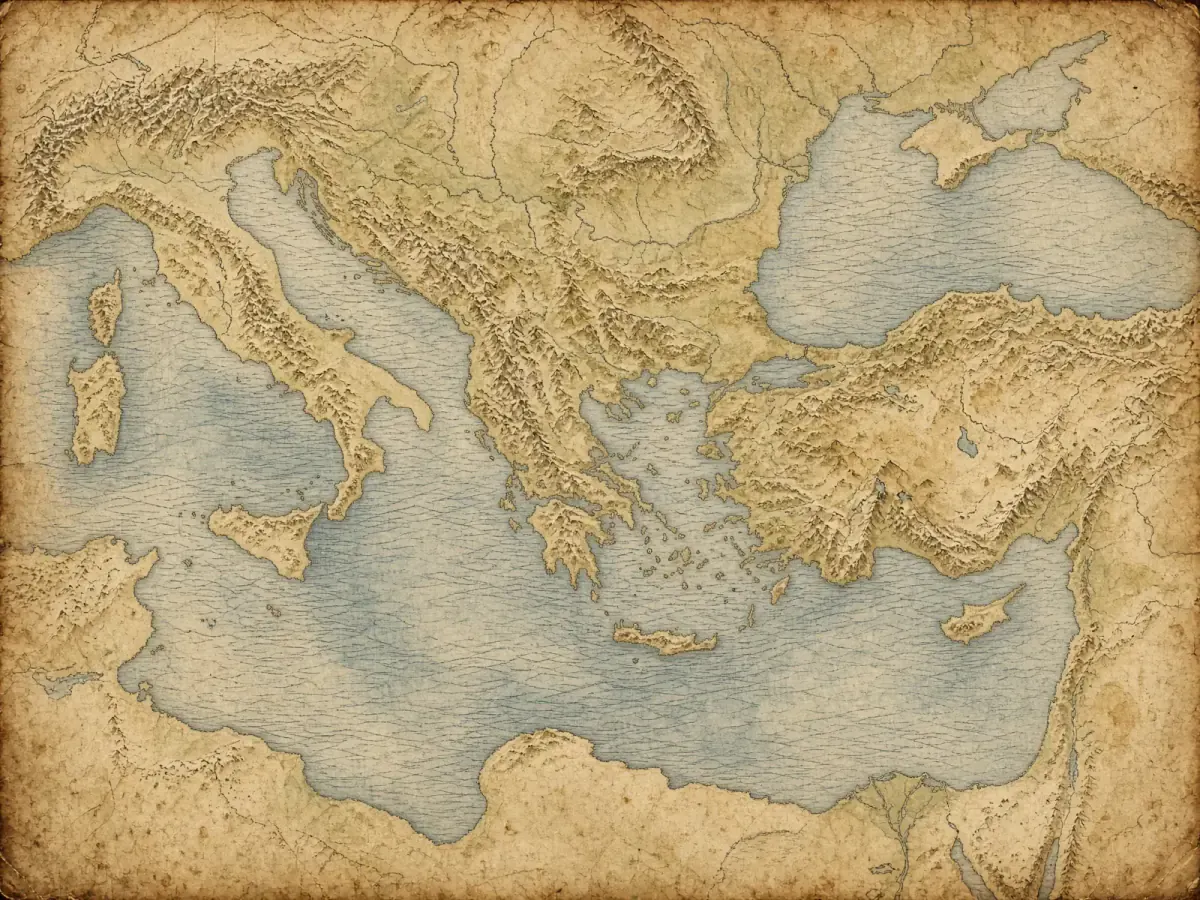
The leaders praise God, then explain a concern among Jewish believers devoted to the law. They have heard a troubling report about Paul. He is said to teach Jews abroad to abandon Moses, the giver of their law, and their customs. The leaders propose that he join four men completing a vow and pay their costs. This will show his own respect for the law. They repeat that Gentile believers remain under the earlier limited instructions about idols, blood, strangled food, and sexual immorality. Paul agrees, undergoes ritual cleansing, and enters the temple, the main worship place, to arrange the offerings.
In everyday life
A guild instructor hears that returning apprentices think she has banned every old workshop practice. The elders ask her to join a scheduled craft ceremony and cover the learners' materials. She agrees to give visible evidence against the rumour. New members still keep the separately agreed rules. Paul's act concerns Jewish law and temple purification, not a guild tradition.
Notice
Acts 21:25 The leaders repeat the Gentile decision while proposing Paul's action. They do not use this plan to impose the whole Jewish law on non-Jewish believers.
Acts 21:20-26
King James Version20And when they heard it, they glorified the Lord, and said unto him, Thou seest, brother, how many thousands of Jews there are which believe; and they are all zealous of the law:
21And they are informed of thee, that thou teachest all the Jews which are among the Gentiles to forsake Moses, saying that they ought not to circumcise their children, neither to walk after the customs.
22What is it therefore? the multitude must needs come together: for they will hear that thou art come.
23Do therefore this that we say to thee: We have four men which have a vow on them;
24Them take, and purify thyself with them, and be at charges with them, that they may shave their heads: and all may know that those things, whereof they were informed concerning thee, are nothing; but that thou thyself also walkest orderly, and keepest the law.
25As touching the Gentiles which believe, we have written and concluded that they observe no such thing, save only that they keep themselves from things offered to idols, and from blood, and from strangled, and from fornication.
26Then Paul took the men, and the next day purifying himself with them entered into the temple, to signify the accomplishment of the days of purification, until that an offering should be offered for every one of them.
Acts 21:27-36
An Assumption Becomes a Violent Charge
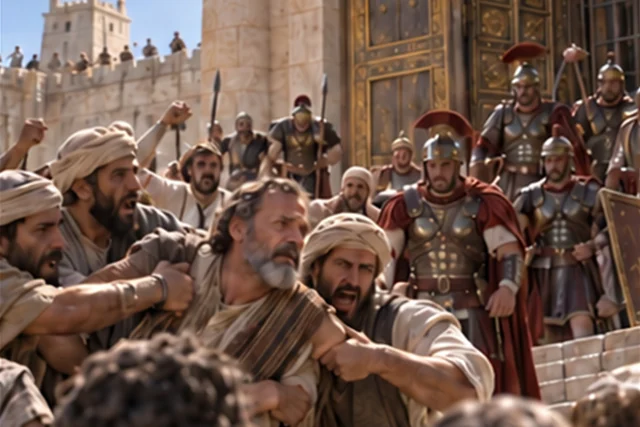
Near the end of the seven days, opponents from Asia, a distant region, see Paul in the temple. They accuse him of attacking the people, law, and sacred place. They also claim he brought Greeks inside unlawfully. They had seen Trophimus, a believer from Ephesus, a city in Asia, with Paul elsewhere and assumed he entered too. The crowd drags Paul out and tries to kill him. Soldiers rush in, stop the beating, and chain him. Conflicting shouts prevent a clear answer about the charge. Soldiers carry him toward their barracks to shield him from the crowd.
In everyday life
An evidence investigator compares a violent complaint with the only photograph offered as proof. It shows two people together in a public street, not inside the restricted building named in the charge. An assumption filled the gap before anyone checked it. Her report separates what was seen from what was claimed. Paul is attacked before that distinction receives a hearing.
Notice
Acts 21:29 Acts explicitly identifies an assumption behind the temple charge. Seeing Trophimus with Paul in the city did not prove that Paul brought him into the sacred area.
Acts 21:27-36
King James Version27And when the seven days were almost ended, the Jews which were of Asia, when they saw him in the temple, stirred up all the people, and laid hands on him,
28Crying out, Men of Israel, help: This is the man, that teacheth all men every where against the people, and the law, and this place: and further brought Greeks also into the temple, and hath polluted this holy place.
29(For they had seen before with him in the city Trophimus an Ephesian, whom they supposed that Paul had brought into the temple.)
30And all the city was moved, and the people ran together: and they took Paul, and drew him out of the temple: and forthwith the doors were shut.
31And as they went about to kill him, tidings came unto the chief captain of the band, that all Jerusalem was in an uproar.
32Who immediately took soldiers and centurions, and ran down unto them: and when they saw the chief captain and the soldiers, they left beating of Paul.
33Then the chief captain came near, and took him, and commanded him to be bound with two chains; and demanded who he was, and what he had done.
34And some cried one thing, some another, among the multitude: and when he could not know the certainty for the tumult, he commanded him to be carried into the castle.
35And when he came upon the stairs, so it was, that he was borne of the soldiers for the violence of the people.
36For the multitude of the people followed after, crying, Away with him.
Acts 21:37-40
Paul Asks to Address the Crowd
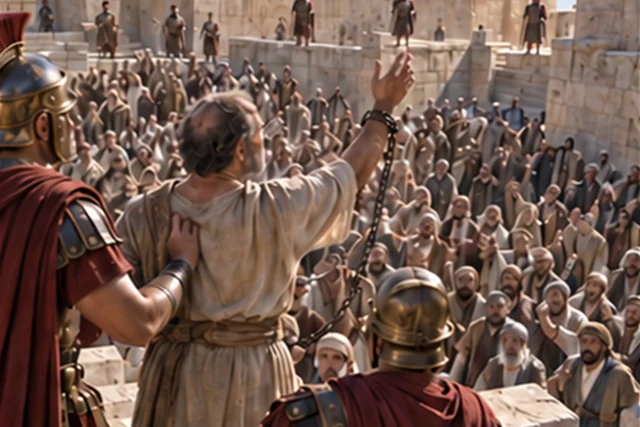
As soldiers bring Paul toward the barracks, he asks the commander for permission to speak. Hearing Greek, the officer questions his identity. He had thought Paul was an Egyptian rebel who led thousands of violent men into the wilderness. Paul corrects him: he is a Jew from Tarsus, an important city in Cilicia, a region to the north. He asks to speak to the people. The commander agrees. From the steps, Paul gestures until the crowd becomes quiet, then addresses them in their Hebrew language. A chance to answer replaces mistaken identity.
In everyday life
A station guard stops a traveller after mistaking him for a wanted organiser. The traveller speaks calmly, gives his home address, and asks to explain himself to those gathered around. The guard's first picture of him changes before the account begins. Paul's correction wins permission to address a crowd that has tried to kill him.
Notice
Acts 21:39 Paul answers the commander's mistaken identity with his actual origin and citizenship. Clear personal facts open space for speech amid the crowd's confused accusations.
Acts 21:37-40
King James Version37And as Paul was to be led into the castle, he said unto the chief captain, May I speak unto thee? Who said, Canst thou speak Greek?
38Art not thou that Egyptian, which before these days madest an uproar, and leddest out into the wilderness four thousand men that were murderers?
39But Paul said, I am a man which am a Jew of Tarsus, a city in Cilicia, a citizen of no mean city: and, I beseech thee, suffer me to speak unto the people.
40And when he had given him licence, Paul stood on the stairs, and beckoned with the hand unto the people. And when there was made a great silence, he spake unto them in the Hebrew tongue, saying,
Details worth noticing
The opening image
Acts 21:1 begins with “And it came to pass, that after we were gotten from them, and had launched, we came with a straight course unto Coos, and the day following unto Rhodes…”
Where the chapter turns
Acts 21:22 forms a natural hinge: “What is it therefore? the multitude must needs come together: for they will hear that thou art come.”
The final note
Acts 21:40 leaves the reader with “And when he had given him licence, Paul stood on the stairs, and beckoned with the hand unto the people. And when there was made a great silence, he spake…”
A word trail through the chapter
The words Paul, days, Jerusalem, people, took, city help reveal the chapter’s repeated concerns.
KJV words made clear
- carriages
- Baggage or belongings carried while travelling, not wheeled vehicles here.
- girdle
- A belt or cloth band worn around the waist.
- be at charges
- Pay the expenses required for another person's action.
Music and video connected to the passage
Related media appears when its Scripture reference overlaps this study. Music and video can illuminate a theme while the biblical text remains the foundation.