The big picture
One follower asks Jesus, the teacher and healer, to teach them to pray. His answer joins trust in the Father with daily need, forgiveness, and protection from evil. A healing then provokes accusations about the source of his power. Jesus challenges the refusal to receive what God is doing. At a meal he also exposes religious care for appearances that hides greed and neglect. Jesus teaches people to ask God for good gifts. He also confronts those whose teaching blocks the way to God.
In this chapter
- Jesus Teaches Trusting and Persistent Prayer Luke 11:1-13
A follower asks for teaching on prayer as John, the earlier preacher, gave his followers.
- Freedom Shows God’s Kingdom at Work Luke 11:14-26
Jesus expels a devil that prevents a man from speaking.
- Hearing Matters More Than Demanding Signs Luke 11:27-32
A woman praises the mother who bore and nursed Jesus.
- The Inner Eye Must Receive Light Luke 11:33-36
Jesus pictures a lamp set where entrants can see rather than hidden away.
- Clean Vessels Hide Greed and Pride Luke 11:37-44
A Pharisee, a member of a group strict about religious law, invites Jesus to dine and notices his lack of ritual washing.
- Law Experts Block the Way They Teach Luke 11:45-54
One lawyer objects that Jesus has insulted his group too.
Central truth
Jesus teaches trust in God's goodness while exposing hearts that mistake outward devotion for obedience and reject the light before them.


Scripture beside the summary
Luke · King James Version · 54Luke 11:1-13
Jesus Teaches Trusting and Persistent Prayer
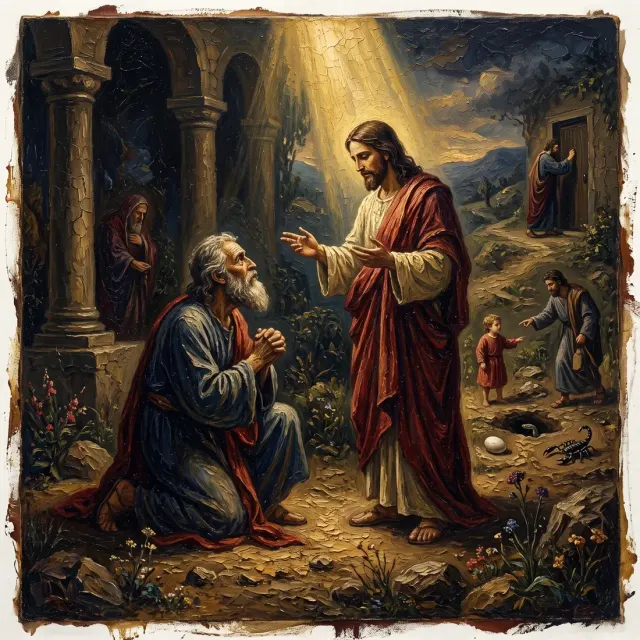
A follower asks for teaching on prayer as John, the earlier preacher, gave his followers. Jesus teaches them to address God as Father, honour his name, and seek his kingdom and will. They ask for daily food, forgiveness as they forgive, and rescue from temptation and evil. Jesus then pictures a host asking a friend for bread at midnight. Persistent asking overcomes the friend's reluctance to rise. He urges asking, seeking, and knocking. Even flawed human parents give food rather than dangerous substitutes to hungry children. The heavenly Father is more generous still, giving the Holy Spirit, God's own Spirit, to those who ask.
In everyday life
A recently arrived flatmate knocks on the next door late at night after an unexpected guest arrives hungry. Embarrassed but persistent, she explains the need until her neighbour brings bread. Their ordinary friendship survives the inconvenient request. Jesus uses such persistence to encourage prayer to a Father whose goodness exceeds a sleepy neighbour's willingness.
Notice
Luke 11:13 The final gift named is the Holy Spirit, not only bread or another material need. Jesus directs confidence toward the Father's own presence and help.
Luke 11:1-13
King James Version1And it came to pass, that, as he was praying in a certain place, when he ceased, one of his disciples said unto him, Lord, teach us to pray, as John also taught his disciples.
2And he said unto them, When ye pray, say, Our Father which art in heaven, Hallowed be thy name. Thy kingdom come. Thy will be done, as in heaven, so in earth.
3Give us day by day our daily bread.
4And forgive us our sins; for we also forgive every one that is indebted to us. And lead us not into temptation; but deliver us from evil.
5And he said unto them, Which of you shall have a friend, and shall go unto him at midnight, and say unto him, Friend, lend me three loaves;
6For a friend of mine in his journey is come to me, and I have nothing to set before him?
7And he from within shall answer and say, Trouble me not: the door is now shut, and my children are with me in bed; I cannot rise and give thee.
8I say unto you, Though he will not rise and give him, because he is his friend, yet because of his importunity he will rise and give him as many as he needeth.
9And I say unto you, Ask, and it shall be given you; seek, and ye shall find; knock, and it shall be opened unto you.
10For every one that asketh receiveth; and he that seeketh findeth; and to him that knocketh it shall be opened.
11If a son shall ask bread of any of you that is a father, will he give him a stone? or if he ask a fish, will he for a fish give him a serpent?
12Or if he shall ask an egg, will he offer him a scorpion?
13If ye then, being evil, know how to give good gifts unto your children: how much more shall your heavenly Father give the Holy Spirit to them that ask him?
Luke 11:14-26
Freedom Shows God’s Kingdom at Work
Jesus expels a devil that prevents a man from speaking. Some claim Beelzebub, the ruler of devils, empowers him; others demand a heavenly sign. Jesus says Satan, God's enemy, would ruin his own rule by fighting himself. If God's power drives out devils, God's kingdom has reached them. He compares it to a stronger man overcoming an armed guard and taking his goods. There is no safe middle ground. Failing to gather with him scatters. Jesus also pictures a spirit returning to a swept but unguarded home with seven worse spirits. A clean-looking life still needs a new master. Without one, the return of evil makes things worse.
In everyday life
A locksmith changes a damaged door lock after a break-in, then finds the owner has left the new key hanging outside. A cleaner room and fresh paint cannot secure a house that remains open to the same threat. The repair needs a changed use of the door. Jesus addresses spiritual allegiance and returning evil, not burglary prevention.
Notice
Luke 11:20 Jesus treats the release of people from devils as evidence that God's kingdom has arrived. The accusation against him reverses the meaning of that freedom.
Luke 11:14-26
King James Version14And he was casting out a devil, and it was dumb. And it came to pass, when the devil was gone out, the dumb spake; and the people wondered.
15But some of them said, He casteth out devils through Beelzebub the chief of the devils.
16And others, tempting him, sought of him a sign from heaven.
17But he, knowing their thoughts, said unto them, Every kingdom divided against itself is brought to desolation; and a house divided against a house falleth.
18If Satan also be divided against himself, how shall his kingdom stand? because ye say that I cast out devils through Beelzebub.
19And if I by Beelzebub cast out devils, by whom do your sons cast them out? therefore shall they be your judges.
20But if I with the finger of God cast out devils, no doubt the kingdom of God is come upon you.
21When a strong man armed keepeth his palace, his goods are in peace:
22But when a stronger than he shall come upon him, and overcome him, he taketh from him all his armour wherein he trusted, and divideth his spoils.
23He that is not with me is against me: and he that gathereth not with me scattereth.
24When the unclean spirit is gone out of a man, he walketh through dry places, seeking rest; and finding none, he saith, I will return unto my house whence I came out.
25And when he cometh, he findeth it swept and garnished.
26Then goeth he, and taketh to him seven other spirits more wicked than himself; and they enter in, and dwell there: and the last state of that man is worse than the first.
Luke 11:27-32
Hearing Matters More Than Demanding Signs
A woman praises the mother who bore and nursed Jesus. He directs attention to the blessing of hearing God's word and keeping it. As the crowd grows, he refuses its demand for another sign except the sign of Jonas. Jonas was a prophet whose preaching moved Nineve, a foreign city, to turn from evil. Jesus, who calls himself the Son of man, is greater than Jonas. He also recalls the queen from the south who travelled to hear Solomon, an earlier king famed for wisdom. Those outsiders responded to less than this crowd receives. Their response will condemn the crowd's refusal at judgement.
In everyday life
A visiting astronomer answers careful questions from a traveller who crossed the county to learn. A local attendee refuses to listen unless she first stages another dazzling demonstration. Access to better teaching has not produced a better response. Jesus claims to be greater than past prophets and kings, not only a speaker whose work deserves attention.
Notice
Luke 11:32 The people of Nineve turned at Jonas' preaching. Jesus contrasts their response with a generation that asks for more evidence while resisting someone greater.
Luke 11:27-32
King James Version27And it came to pass, as he spake these things, a certain woman of the company lifted up her voice, and said unto him, Blessed is the womb that bare thee, and the paps which thou hast sucked.
28But he said, Yea rather, blessed are they that hear the word of God, and keep it.
29And when the people were gathered thick together, he began to say, This is an evil generation: they seek a sign; and there shall no sign be given it, but the sign of Jonas the prophet.
30For as Jonas was a sign unto the Ninevites, so shall also the Son of man be to this generation.
31The queen of the south shall rise up in the judgment with the men of this generation, and condemn them: for she came from the utmost parts of the earth to hear the wisdom of Solomon; and, behold, a greater than Solomon is here.
32The men of Nineve shall rise up in the judgment with this generation, and shall condemn it: for they repented at the preaching of Jonas; and, behold, a greater than Jonas is here.
Luke 11:33-36
The Inner Eye Must Receive Light
Jesus pictures a lamp set where entrants can see rather than hidden away. He then speaks of the eye as the body's lamp. A sound eye lets light fill the person, while an evil eye leaves darkness. He warns that what seems to be inner light can actually be darkness. This image asks how people respond to what they see. It does not blame those born blind. When a person's response is clear, the whole life can be lit. Jesus has already faced people calling God's freeing work evil; now he warns about distorted sight that mistakes darkness for truth.
In everyday life
A stained-glass cleaner steps inside after washing one panel and sees how much brighter the room becomes. The light outside has not changed; the barrier through which it enters has. She checks the remaining panes rather than blaming the sun. Jesus describes a moral response to God's light, not the effect of dust on windows.
Notice
Luke 11:35 The warning allows that someone can mistake darkness for light. Confidence in one's own judgement is not proof that the judgement has received truth.
Luke 11:33-36
King James Version33No man, when he hath lighted a candle, putteth it in a secret place, neither under a bushel, but on a candlestick, that they which come in may see the light.
34The light of the body is the eye: therefore when thine eye is single, thy whole body also is full of light; but when thine eye is evil, thy body also is full of darkness.
35Take heed therefore that the light which is in thee be not darkness.
36If thy whole body therefore be full of light, having no part dark, the whole shall be full of light, as when the bright shining of a candle doth give thee light.
Luke 11:37-44
Clean Vessels Hide Greed and Pride
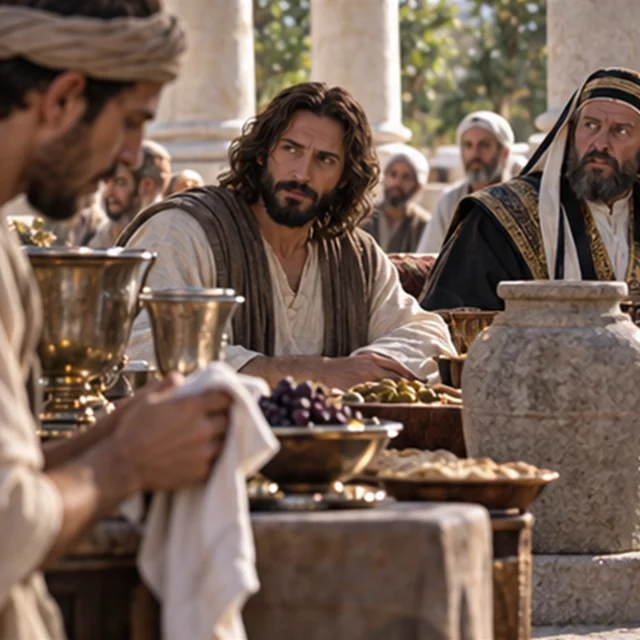
A Pharisee, a member of a group strict about religious law, invites Jesus to dine and notices his lack of ritual washing. Jesus answers that clean cups do not cleanse greed and evil within. God made both outside and inside. He calls for giving to people in need, then condemns tiny herb tithes, gifts of a tenth, that coexist with neglected justice and love for God. Both should be kept. He also condemns love of prominent seats and public greetings. Such leaders resemble hidden graves that people cross unknowingly, becoming ritually unclean without warning. Their show of holiness hides harm. It does not guide people safely.
In everyday life
A restaurant owner polishes award plaques while underpaying the dishwasher who cleans the dining room. Customers see spotless surfaces and prizes, but the worker's missing wages reveal another reality. A public image of care cannot make exploitation clean. Jesus speaks of inner defilement before God and distorted worship, not only unfair employment.
Notice
Luke 11:42 Small acts still matter, Jesus says. They must not replace justice and love. The fault is the exchange of greater duties for visible details.
Luke 11:37-44
King James Version37And as he spake, a certain Pharisee besought him to dine with him: and he went in, and sat down to meat.
38And when the Pharisee saw it, he marvelled that he had not first washed before dinner.
39And the Lord said unto him, Now do ye Pharisees make clean the outside of the cup and the platter; but your inward part is full of ravening and wickedness.
40Ye fools, did not he that made that which is without make that which is within also?
41But rather give alms of such things as ye have; and, behold, all things are clean unto you.
42But woe unto you, Pharisees! for ye tithe mint and rue and all manner of herbs, and pass over judgment and the love of God: these ought ye to have done, and not to leave the other undone.
43Woe unto you, Pharisees! for ye love the uppermost seats in the synagogues, and greetings in the markets.
44Woe unto you, scribes and Pharisees, hypocrites! for ye are as graves which appear not, and the men that walk over them are not aware of them.
Luke 11:45-54
Law Experts Block the Way They Teach
One lawyer objects that Jesus has insulted his group too. These men are experts in God's law. Jesus says they load others with hard burdens but offer no help. They honour prophets' tombs while continuing the rejection that killed God's messengers. He names Abel, an early innocent victim, and Zacharias, killed near the temple altar, as part of a long record of bloodshed. This generation will answer for its part. He also accuses the experts of removing the key to knowledge: refusing entry themselves and obstructing others. The scribes and Pharisees respond by pressing him with questions, seeking words they can use as a charge.

In everyday life
A qualification adviser withholds the handbook needed by new apprentices, then faults them for failing rules she refuses to explain. A review of complaints shows that she has become a barrier to the work she claims to support. Her title conceals obstruction. Jesus also names murdered messengers and divine judgement, not only abuse of an advisory role.
Notice
Luke 11:52 The key image describes responsibility for access to knowledge. The experts are charged with blocking others as well as refusing to enter themselves.
Luke 11:45-54
King James Version45Then answered one of the lawyers, and said unto him, Master, thus saying thou reproachest us also.
46And he said, Woe unto you also, ye lawyers! for ye lade men with burdens grievous to be borne, and ye yourselves touch not the burdens with one of your fingers.
47Woe unto you! for ye build the sepulchres of the prophets, and your fathers killed them.
48Truly ye bear witness that ye allow the deeds of your fathers: for they indeed killed them, and ye build their sepulchres.
49Therefore also said the wisdom of God, I will send them prophets and apostles, and some of them they shall slay and persecute:
50That the blood of all the prophets, which was shed from the foundation of the world, may be required of this generation;
51From the blood of Abel unto the blood of Zacharias, which perished between the altar and the temple: verily I say unto you, It shall be required of this generation.
52Woe unto you, lawyers! for ye have taken away the key of knowledge: ye entered not in yourselves, and them that were entering in ye hindered.
53And as he said these things unto them, the scribes and the Pharisees began to urge him vehemently, and to provoke him to speak of many things:
54Laying wait for him, and seeking to catch something out of his mouth, that they might accuse him.
Details worth noticing
The opening image
Luke 11:1 begins with “And it came to pass, that, as he was praying in a certain place, when he ceased, one of his disciples said unto him, Lord, teach us to pray, as John also…”
Where the chapter turns
Luke 11:27 forms a natural hinge: “And it came to pass, as he spake these things, a certain woman of the company lifted up her voice, and said unto him, Blessed is the womb that bare thee…”
The final note
Luke 11:54 leaves the reader with “Laying wait for him, and seeking to catch something out of his mouth, that they might accuse him.”
A word trail through the chapter
The words light, generation, devils, full, Pharisees, rise help reveal the chapter’s repeated concerns.
KJV words made clear
- importunity
- Bold persistence that continues asking despite an initial refusal.
- alms
- Gifts of money or goods given to people in need.
- ravening
- Greedy taking that harms others to satisfy selfish desires.
Music and video connected to the passage
Related media appears when its Scripture reference overlaps this study. Music and video can illuminate a theme while the biblical text remains the foundation.