The big picture
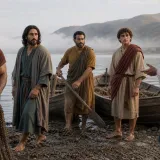
Jesus, the travelling teacher and healer, returns to his home area with his followers. Familiar people resist him, while villages elsewhere receive help through the twelve men he sends. News reaches Herod, the regional ruler, whose guilt over John the Baptist's death colours what he hears. Crowds then follow Jesus into a lonely place. Later his followers face a night of hard rowing. Through rejection, hunger, and fear, they see acts whose meaning they have still not fully grasped.
In this chapter
- Familiarity Turns Into Unbelief Mark 6:1-6
On the sabbath, the weekly holy rest day, Jesus teaches in his home synagogue, a place for worship and Scripture.
- The Twelve Travel with Little Mark 6:7-13
Jesus sends the twelve out in pairs and gives them authority over unclean spirits.
- Herod’s Fear Recalls John’s Death Mark 6:14-29
Herod hears of Jesus and fears that John the Baptist, the preacher he executed, has risen.
- A Small Meal Feeds a Vast Crowd Mark 6:30-44
The twelve return and report their work.
- Jesus Reaches the Struggling Boat Mark 6:45-52
Jesus sends his followers by boat toward Bethsaida, a town near the lake, while he dismisses the crowd.
- People Bring the Sick from Everywhere Mark 6:53-56
The boat reaches Gennesaret, a fertile district beside the lake.
Central truth
Jesus meets rejection and human need with continued teaching and care, while his followers struggle to understand the authority they witness.

Scripture beside the summary
Mark · King James Version · 56Mark 6:1-6
Familiarity Turns Into Unbelief
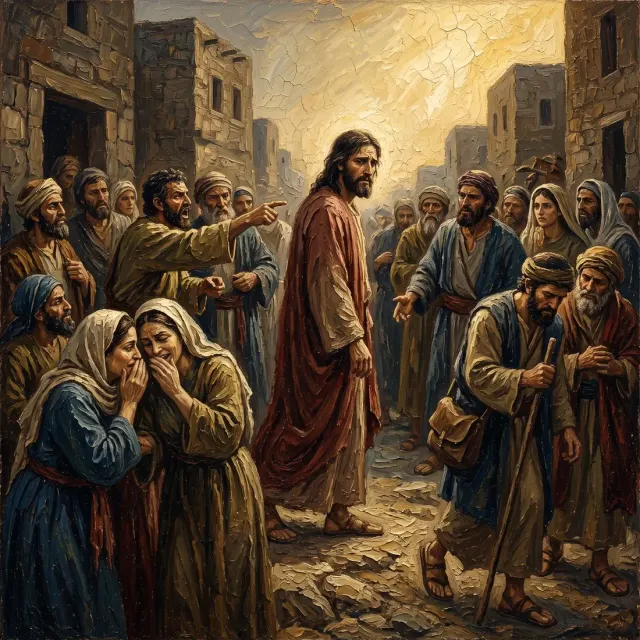
On the sabbath, the weekly holy rest day, Jesus teaches in his home synagogue, a place for worship and Scripture. His neighbours wonder where his wisdom and deeds come from. They know him as the carpenter, the son of Mary, and name his brothers and sisters among them. That familiarity becomes a reason to reject him. Jesus says a prophet, God's messenger, often lacks honour among his own people and relatives. Mark says he can do no great work there except healing a few sick people by touch. Their unbelief amazes him. He continues teaching in nearby villages rather than forcing his home town to welcome him.
In everyday life
A returning apprentice carpenter brings a tested repair plan to the workshop where he first swept floors. Older workers laugh because they remember his early mistakes and refuse to examine the plan. Their old picture of him blocks a fair hearing. Jesus' neighbours reject a prophet's authority, not merely a former apprentice's new skill.
Notice
Mark 6:3 The neighbours do not deny hearing wisdom or knowing of mighty deeds. They use Jesus' familiar family and trade to resist what those things imply.
Mark 6:1-6
King James Version1And he went out from thence, and came into his own country; and his disciples follow him.
2And when the sabbath day was come, he began to teach in the synagogue: and many hearing him were astonished, saying, From whence hath this man these things? and what wisdom is this which is given unto him, that even such mighty works are wrought by his hands?
3Is not this the carpenter, the son of Mary, the brother of James, and Joses, and of Juda, and Simon? and are not his sisters here with us? And they were offended at him.
4But Jesus said unto them, A prophet is not without honour, but in his own country, and among his own kin, and in his own house.
5And he could there do no mighty work, save that he laid his hands upon a few sick folk, and healed them.
6And he marvelled because of their unbelief. And he went round about the villages, teaching.
Mark 6:7-13
The Twelve Travel with Little
Jesus sends the twelve out in pairs and gives them authority over unclean spirits. They may carry a staff and wear sandals, but take no food, money, travel bag, or spare coat. They must depend on welcome. They should stay in the first receiving household rather than shop for better hosts. A place that refuses their message receives a warning. They must shake its dust from their feet when leaving. Jesus compares that refusal with Sodom and Gomorrha, ancient cities judged for grave evil. The twelve call people to turn from sin, drive out devils, and use oil as they heal sick people.
In everyday life
A footpath surveyor sets out with a partner and the basic tools their hosts have agreed to support. They accept the first arranged lodging instead of searching for a richer household. Their light packs make the welcome of others essential. Jesus gives spiritual authority and warns of judgement; the surveyors only carry out a practical survey.
Notice
Mark 6:10 Staying in one house keeps the mission from becoming a search for better food or lodging. The messengers depend on welcome without using it to climb in comfort.
Mark 6:7-13
King James Version7And he called unto him the twelve, and began to send them forth by two and two; and gave them power over unclean spirits;
8And commanded them that they should take nothing for their journey, save a staff only; no scrip, no bread, no money in their purse:
9But be shod with sandals; and not put on two coats.
10And he said unto them, In what place soever ye enter into an house, there abide till ye depart from that place.
11And whosoever shall not receive you, nor hear you, when ye depart thence, shake off the dust under your feet for a testimony against them. Verily I say unto you, It shall be more tolerable for Sodom and Gomorrha in the day of judgment, than for that city.
12And they went out, and preached that men should repent.
13And they cast out many devils, and anointed with oil many that were sick, and healed them.
Mark 6:14-29
Herod’s Fear Recalls John’s Death
Herod hears of Jesus and fears that John the Baptist, the preacher he executed, has risen. Others suggest Elias, an earlier prophet, or another messenger from God. Mark recalls why John died. John opposed Herod's marriage to Herodias, his brother Philip's wife. She wanted John killed, while Herod feared his holiness and listened to him. At a birthday feast, Herod promises her dancing daughter a lavish reward. Prompted by her mother, she demands John's head. Herod feels grief but values his oath and guests' opinion above John's life. He orders the beheading, and the head is brought on a platter. John's followers bury his body.
In everyday life
A victim's relative listens as a witness describes officials choosing their public image over a life they had power to protect. She grips the burial papers and asks that each decision be recorded in order. Regret spoken later cannot undo the loss. John's death follows a ruler's oath and a demanded execution, not merely a failure of paperwork.
Notice
Mark 6:26 Herod's sorrow does not stop his command. Mark shows how concern for an oath and watching guests outweighs his own knowledge that John is holy.
Mark 6:14-29
King James Version14And king Herod heard of him; (for his name was spread abroad:) and he said, That John the Baptist was risen from the dead, and therefore mighty works do shew forth themselves in him.
15Others said, That it is Elias. And others said, That it is a prophet, or as one of the prophets.
16But when Herod heard thereof, he said, It is John, whom I beheaded: he is risen from the dead.
17For Herod himself had sent forth and laid hold upon John, and bound him in prison for Herodias’ sake, his brother Philip’s wife: for he had married her.
18For John had said unto Herod, It is not lawful for thee to have thy brother’s wife.
19Therefore Herodias had a quarrel against him, and would have killed him; but she could not:
20For Herod feared John, knowing that he was a just man and an holy, and observed him; and when he heard him, he did many things, and heard him gladly.
21And when a convenient day was come, that Herod on his birthday made a supper to his lords, high captains, and chief estates of Galilee;
22And when the daughter of the said Herodias came in, and danced, and pleased Herod and them that sat with him, the king said unto the damsel, Ask of me whatsoever thou wilt, and I will give it thee.
23And he sware unto her, Whatsoever thou shalt ask of me, I will give it thee, unto the half of my kingdom.
24And she went forth, and said unto her mother, What shall I ask? And she said, The head of John the Baptist.
25And she came in straightway with haste unto the king, and asked, saying, I will that thou give me by and by in a charger the head of John the Baptist.
26And the king was exceeding sorry; yet for his oath’s sake, and for their sakes which sat with him, he would not reject her.
27And immediately the king sent an executioner, and commanded his head to be brought: and he went and beheaded him in the prison,
28And brought his head in a charger, and gave it to the damsel: and the damsel gave it to her mother.
29And when his disciples heard of it, they came and took up his corpse, and laid it in a tomb.
Mark 6:30-44
A Small Meal Feeds a Vast Crowd
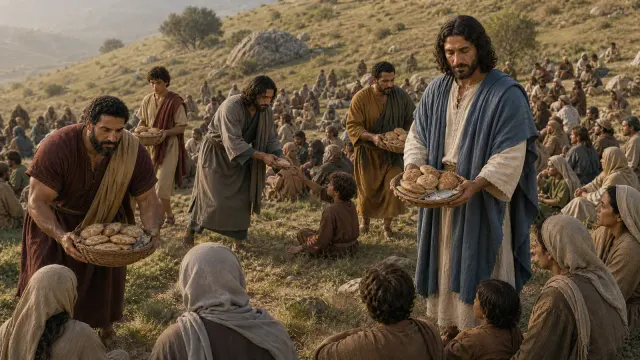
The twelve return and report their work. Jesus invites them away to rest because crowds leave no time even to eat. People see their boat and reach the lonely place first. Jesus feels compassion for them as for sheep lacking a shepherd and teaches them. Late in the day, the followers suggest sending the crowd to buy food. Jesus tells them to feed it. They find five loaves and two fish. He seats the people in groups on the grass, gives thanks, and hands food to his followers to distribute. About five thousand men eat enough, and twelve baskets of leftovers remain.
In everyday life
A relief-kitchen volunteer looks at a long queue and starts counting the bread already on the table. The cook seats families in groups and asks her to carry trays rather than stand defeated by the total. Order turns concern into service. Jesus makes the small supply feed everyone; a relief kitchen still needs enough food delivered.
Notice
Mark 6:41 Jesus gives the food through the followers who thought the task impossible. They take part in feeding the crowd without being its source of supply.
Mark 6:30-44
King James Version30And the apostles gathered themselves together unto Jesus, and told him all things, both what they had done, and what they had taught.
31And he said unto them, Come ye yourselves apart into a desert place, and rest a while: for there were many coming and going, and they had no leisure so much as to eat.
32And they departed into a desert place by ship privately.
33And the people saw them departing, and many knew him, and ran afoot thither out of all cities, and outwent them, and came together unto him.
34And Jesus, when he came out, saw much people, and was moved with compassion toward them, because they were as sheep not having a shepherd: and he began to teach them many things.
35And when the day was now far spent, his disciples came unto him, and said, This is a desert place, and now the time is far passed:
36Send them away, that they may go into the country round about, and into the villages, and buy themselves bread: for they have nothing to eat.
37He answered and said unto them, Give ye them to eat. And they say unto him, Shall we go and buy two hundred pennyworth of bread, and give them to eat?
38He saith unto them, How many loaves have ye? go and see. And when they knew, they say, Five, and two fishes.
39And he commanded them to make all sit down by companies upon the green grass.
40And they sat down in ranks, by hundreds, and by fifties.
41And when he had taken the five loaves and the two fishes, he looked up to heaven, and blessed, and brake the loaves, and gave them to his disciples to set before them; and the two fishes divided he among them all.
42And they did all eat, and were filled.
43And they took up twelve baskets full of the fragments, and of the fishes.
44And they that did eat of the loaves were about five thousand men.
Mark 6:45-52
Jesus Reaches the Struggling Boat
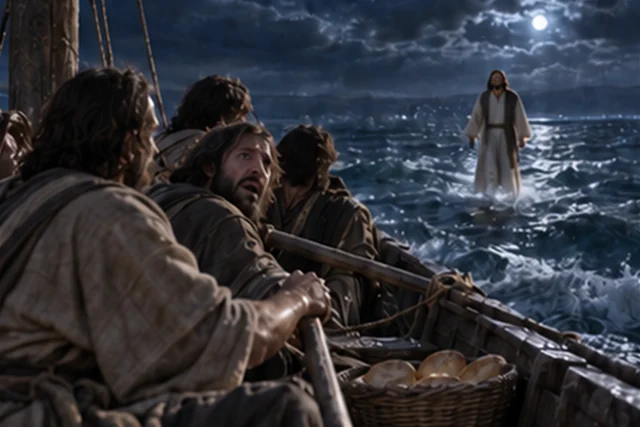
Jesus sends his followers by boat toward Bethsaida, a town near the lake, while he dismisses the crowd. He then goes up a mountain to pray. During the night he sees them straining against the wind. Near dawn he comes toward them on the water and is about to pass them. They think they see a spirit and cry out. He identifies himself, tells them not to fear, and joins them in the boat. The wind stops. They are utterly amazed. Mark says they had failed to understand the loaves because their hearts were still hard. Seeing wonders has not yet become clear understanding.
In everyday life
A snowplough driver sees stranded road workers struggling to reach a shelter and turns toward them. Through blowing snow they first mistake his lights for another hazard. His familiar voice on the radio changes fear into relief. Jesus walks on water and stills the wind; the driver reaches people through ordinary machinery.
Notice
Mark 6:52 Mark links the boat's fear with the earlier meal. The followers' failure to understand is not lack of evidence but difficulty taking in what it means.
Mark 6:45-52
King James Version45And straightway he constrained his disciples to get into the ship, and to go to the other side before unto Bethsaida, while he sent away the people.
46And when he had sent them away, he departed into a mountain to pray.
47And when even was come, the ship was in the midst of the sea, and he alone on the land.
48And he saw them toiling in rowing; for the wind was contrary unto them: and about the fourth watch of the night he cometh unto them, walking upon the sea, and would have passed by them.
49But when they saw him walking upon the sea, they supposed it had been a spirit, and cried out:
50For they all saw him, and were troubled. And immediately he talked with them, and saith unto them, Be of good cheer: it is I; be not afraid.
51And he went up unto them into the ship; and the wind ceased: and they were sore amazed in themselves beyond measure, and wondered.
52For they considered not the miracle of the loaves: for their heart was hardened.
Mark 6:53-56
People Bring the Sick from Everywhere
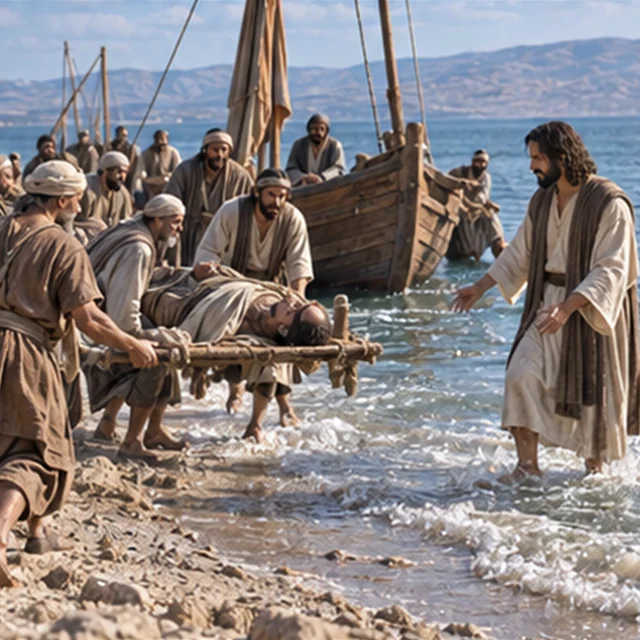
The boat reaches Gennesaret, a fertile district beside the lake. People recognise Jesus as soon as he steps ashore. They run through the area and carry sick people on beds to wherever they hear he is. In towns, villages, and rural places, they lay those needing help in public spaces. They ask to touch even the edge of his clothes. All who touch him are made well. The chapter closes with widespread need meeting healing, without naming individual patients. Recognition spreads into practical action as people carry others who cannot reach Jesus on their own.
In everyday life
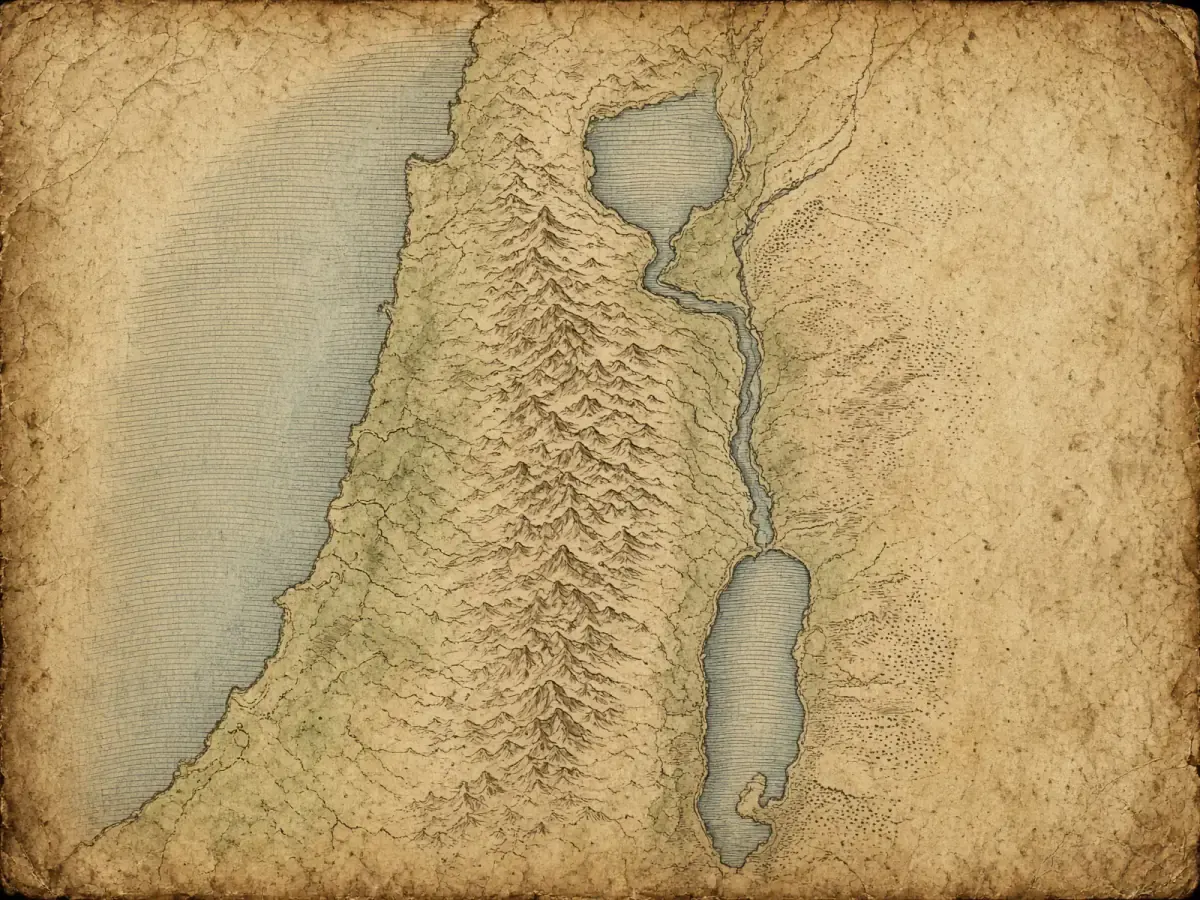
A village transport organiser unfolds a map when a visiting medical team arrives. Neighbours bring stretchers and arrange rides for residents who cannot walk to the hall. News becomes useful because people carry it and carry one another. Jesus heals all who touch him; the medical team can assess and treat only within human limits.
Notice
Mark 6:55 People carry beds toward the places where they hear Jesus is present. Their response involves physical help for others, not only excitement about his arrival.
Mark 6:53-56
King James Version53And when they had passed over, they came into the land of Gennesaret, and drew to the shore.
54And when they were come out of the ship, straightway they knew him,
55And ran through that whole region round about, and began to carry about in beds those that were sick, where they heard he was.
56And whithersoever he entered, into villages, or cities, or country, they laid the sick in the streets, and besought him that they might touch if it were but the border of his garment: and as many as touched him were made whole.
Details worth noticing
The opening image
Mark 6:1 begins with “And he went out from thence, and came into his own country; and his disciples follow him.”
Where the chapter turns
Mark 6:24 forms a natural hinge: “And she went forth, and said unto her mother, What shall I ask? And she said, The head of John the Baptist.”
The final note
Mark 6:56 leaves the reader with “And whithersoever he entered, into villages, or cities, or country, they laid the sick in the streets, and besought him that they might touch if it were…”
A word trail through the chapter
The words Herod, John, disciples, king, loaves, place help reveal the chapter’s repeated concerns.
KJV words made clear
- scrip
- A bag carried for provisions while travelling.
- charger
- A large dish or platter used for serving food.
- apostles
- People sent as messengers with authority from the one sending them.
Music and video connected to the passage
Related media appears when its Scripture reference overlaps this study. Music and video can illuminate a theme while the biblical text remains the foundation.