

The big picture
A challenge reaches Jesus, the teacher and healer. His followers have eaten without a ritual washing. He answers by exposing a custom that lets people neglect their parents, then explains that moral uncleanness comes from the heart. Away from the familiar setting, a Canaanite woman, a member of another people, pleads for her daughter. Her faith receives praise and healing. More crowds find bodily restoration, and Jesus refuses to send hungry people away without food for their return.
In this chapter
- A Religious Custom Cannot Cancel Care for Parents Matthew 15:1-9
Scribes and Pharisees, teachers and members of a strict religious group, come from Jerusalem, the chief city.
- The Heart Is the Source of Defiling Wrong Matthew 15:10-20
Jesus tells the crowd that what enters the mouth does not make a person morally unclean; what comes out does.
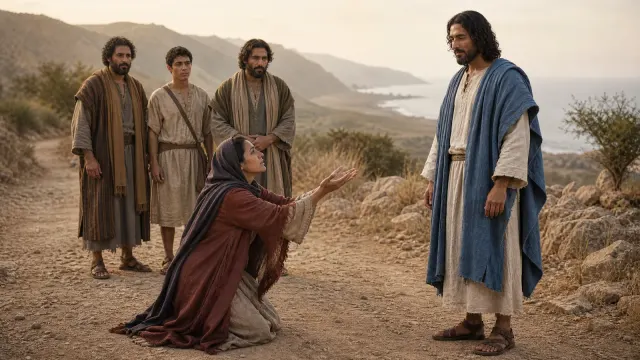
- A Mother Persists and Her Daughter Is Healed Matthew 15:21-28
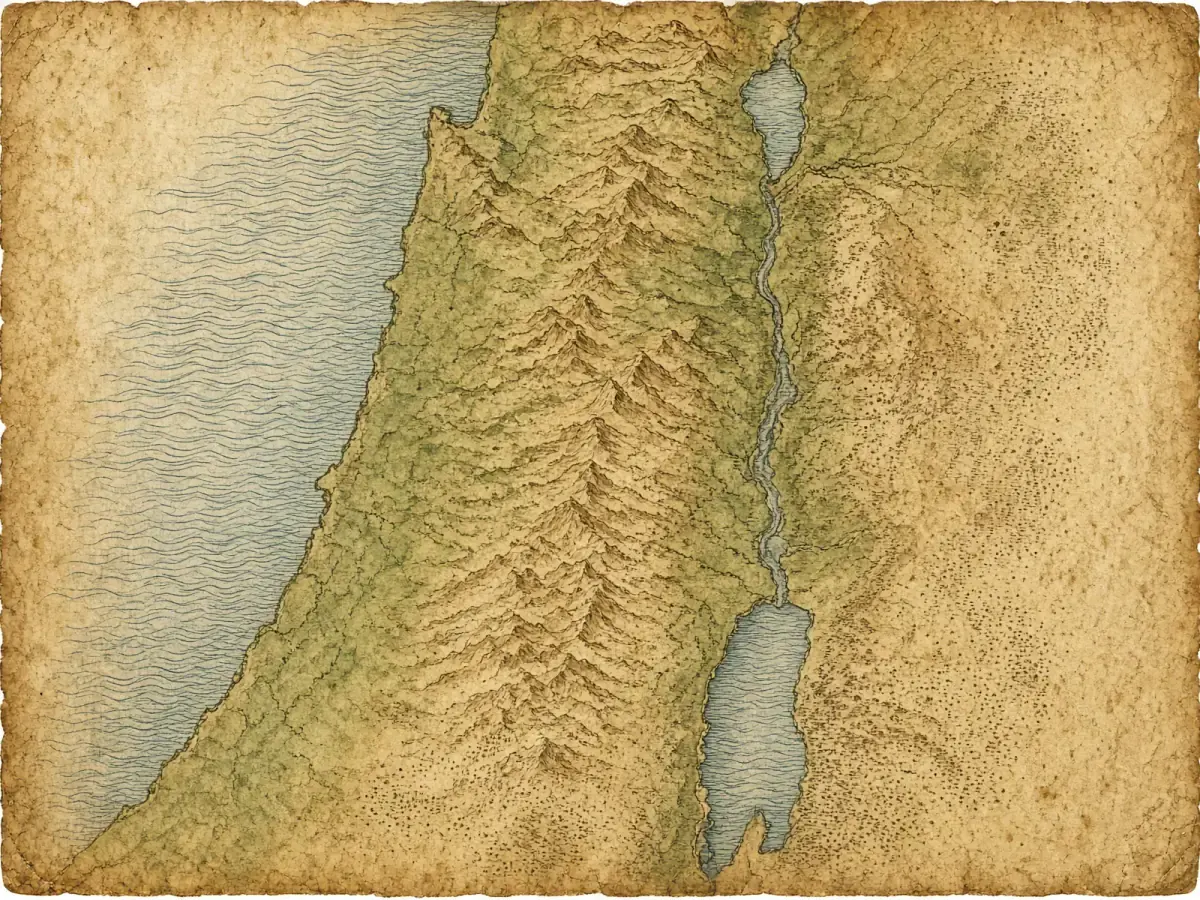
Near Tyre and Sidon, coastal cities outside the usual setting, a Canaanite woman asks Jesus to free her demon-troubled daughter.
- Restored Bodies Lead the Crowd to Praise God Matthew 15:29-31
Jesus returns near the sea of Galilee, the northern lake, and sits on a mountain.
- Compassion Provides Food for the Return Matthew 15:32-39
Jesus says the crowd has stayed three days and has no food.
Central truth
Jesus locates uncleanness in the heart rather than an outward washing, while his mercy answers persistent faith and the concrete needs of the crowds.

Scripture beside the summary
Matthew · King James Version · 39Matthew 15:1-9
A Religious Custom Cannot Cancel Care for Parents
Scribes and Pharisees, teachers and members of a strict religious group, come from Jerusalem, the chief city. They ask why the disciples eat without following an inherited handwashing custom. Jesus asks why their own custom breaks God's command to honour parents. They allow someone to declare resources a gift for God and use that claim to avoid helping father or mother. The command is thus emptied of force by the tradition. Jesus recalls Esaias, an earlier prophet, who described lips offering honour while hearts stay distant. Teaching human rules as God's demands does not make worship true.
In everyday life
A trust administrator notices that a donor has labelled funds charitable while using the label to evade promised support for an elderly parent. The sacred-sounding purpose has become a shield for neglect. She asks what the arrangement actually does. Jesus judges a tradition by God's command, not an administrator applying the terms of a financial trust.
Notice
Matthew 15:6 The declared gift removes help that a parent would otherwise receive. Jesus tests the custom by its effect on the command to honour, not by how religious it sounds.
Matthew 15:1-9
King James Version1Then came to Jesus scribes and Pharisees, which were of Jerusalem, saying,
2Why do thy disciples transgress the tradition of the elders? for they wash not their hands when they eat bread.
3But he answered and said unto them, Why do ye also transgress the commandment of God by your tradition?
4For God commanded, saying, Honour thy father and mother: and, He that curseth father or mother, let him die the death.
5But ye say, Whosoever shall say to his father or his mother, It is a gift, by whatsoever thou mightest be profited by me;
6And honour not his father or his mother, he shall be free. Thus have ye made the commandment of God of none effect by your tradition.
7Ye hypocrites, well did Esaias prophesy of you, saying,
8This people draweth nigh unto me with their mouth, and honoureth me with their lips; but their heart is far from me.
9But in vain they do worship me, teaching for doctrines the commandments of men.
Matthew 15:10-20
The Heart Is the Source of Defiling Wrong
Jesus tells the crowd that what enters the mouth does not make a person morally unclean; what comes out does. The disciples report that the Pharisees are offended. He warns that growth not planted by the Father will be uprooted and that blind guides lead others into a ditch. Peter, one of the disciples, asks for explanation. Jesus contrasts digestion with the heart, from which harmful thoughts, murder, sexual wrong, theft, false testimony, and insults against God arise. These defile a person. Eating without the disputed washing does not. The concern is moral pollution, not advice against ordinary hygiene.
In everyday life
A school counsellor hears a pupil defend cruel messages by pointing to a spotless uniform and careful manners in class. The outward routine has not removed the intent behind the words. She addresses the chosen cruelty rather than the polished appearance. Jesus speaks of moral uncleanness before God, not merely standards of behaviour within a school.
Notice
Matthew 15:19 The list of wrongs begins within the heart before becoming outward acts. Clean hands cannot answer what a person chooses to think, say, and do.
Matthew 15:10-20
King James Version10And he called the multitude, and said unto them, Hear, and understand:
11Not that which goeth into the mouth defileth a man; but that which cometh out of the mouth, this defileth a man.
12Then came his disciples, and said unto him, Knowest thou that the Pharisees were offended, after they heard this saying?
13But he answered and said, Every plant, which my heavenly Father hath not planted, shall be rooted up.
14Let them alone: they be blind leaders of the blind. And if the blind lead the blind, both shall fall into the ditch.
15Then answered Peter and said unto him, Declare unto us this parable.
16And Jesus said, Are ye also yet without understanding?
17Do not ye yet understand, that whatsoever entereth in at the mouth goeth into the belly, and is cast out into the draught?
18But those things which proceed out of the mouth come forth from the heart; and they defile the man.
19For out of the heart proceed evil thoughts, murders, adulteries, fornications, thefts, false witness, blasphemies:
20These are the things which defile a man: but to eat with unwashen hands defileth not a man.
Matthew 15:21-28
A Mother Persists and Her Daughter Is Healed
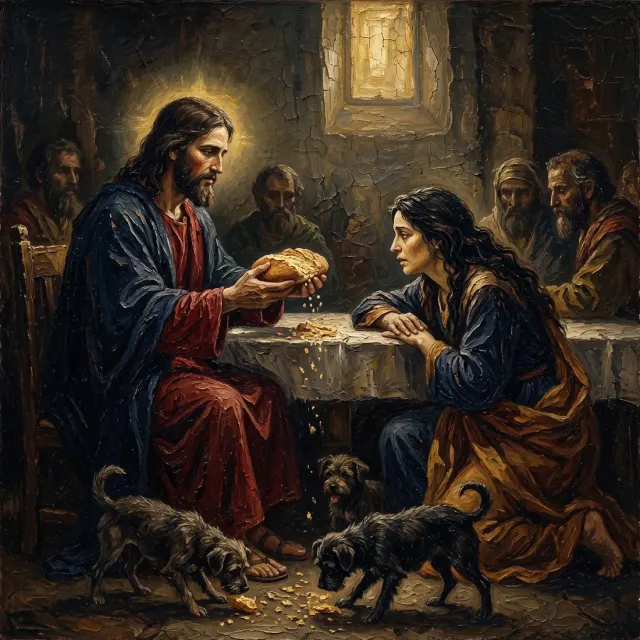
Near Tyre and Sidon, coastal cities outside the usual setting, a Canaanite woman asks Jesus to free her demon-troubled daughter. She calls him Son of David, the promised royal heir. At first he is silent, and the disciples want her sent away. He names his mission to Israel's lost sheep, God's people. She kneels and asks for help. His reply compares giving children's bread to dogs, a sharp image of the boundary. She accepts the image but asks for fallen crumbs. Jesus praises her great faith and grants her request. Her daughter is healed immediately. The account gives no explanation of his initial silence.
In everyday life
A specialist-clinic advocate continues seeking help for a child whose need falls outside the service's usual catchment. She acknowledges the stated priority while asking whether help can still reach this case. Refusal has not silenced the child's need. Jesus heals at once and praises the mother's faith, not an advocate's success in negotiating limited clinical resources.
Notice
Matthew 15:27 The woman answers within Jesus' own image instead of abandoning her plea. She finds room for mercy without claiming that the children's place must first be taken away.
Matthew 15:21-28
King James Version21Then Jesus went thence, and departed into the coasts of Tyre and Sidon.
22And, behold, a woman of Canaan came out of the same coasts, and cried unto him, saying, Have mercy on me, O Lord, thou Son of David; my daughter is grievously vexed with a devil.
23But he answered her not a word. And his disciples came and besought him, saying, Send her away; for she crieth after us.
24But he answered and said, I am not sent but unto the lost sheep of the house of Israel.
25Then came she and worshipped him, saying, Lord, help me.
26But he answered and said, It is not meet to take the children’s bread, and to cast it to dogs.
27And she said, Truth, Lord: yet the dogs eat of the crumbs which fall from their masters’ table.
28Then Jesus answered and said unto her, O woman, great is thy faith: be it unto thee even as thou wilt. And her daughter was made whole from that very hour.
Matthew 15:29-31
Restored Bodies Lead the Crowd to Praise God
Jesus returns near the sea of Galilee, the northern lake, and sits on a mountain. Crowds bring people unable to walk, see, or speak, along with those bearing damaged limbs and other needs. They lay them before him, and he heals them. Witnesses see speech, movement, and sight restored and give glory to the God of Israel, the people to whom the earlier mission was directed. The brief account gathers many kinds of bodily loss into one scene of care. The strongest are not given first claim. People who need help to reach him receive healing too.
In everyday life
An accessible-transport coordinator watches neighbours bring people who cannot manage the steep route to a visiting care service. The gathering exists because others make room for those with limited movement or sight. She keeps access centred on their needs. Matthew describes Jesus fully restoring bodies, not access alone or treatment with uncertain results.
Notice
Matthew 15:30 The sick are brought and placed at Jesus' feet. Others' practical help makes their approach possible, so the crowd includes people who cannot arrive by their own strength.
Matthew 15:29-31
King James Version29And Jesus departed from thence, and came nigh unto the sea of Galilee; and went up into a mountain, and sat down there.
30And great multitudes came unto him, having with them those that were lame, blind, dumb, maimed, and many others, and cast them down at Jesus’ feet; and he healed them:
31Insomuch that the multitude wondered, when they saw the dumb to speak, the maimed to be whole, the lame to walk, and the blind to see: and they glorified the God of Israel.
Matthew 15:32-39
Compassion Provides Food for the Return
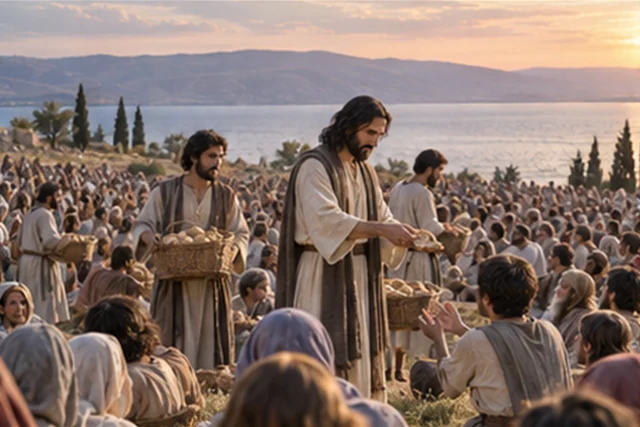
Jesus says the crowd has stayed three days and has no food. He does not want people fainting on the way home. The disciples ask where enough bread can be found in such a remote place. He asks what they have: seven loaves and a few small fish. After seating the crowd, he thanks God, breaks the food, and gives it through the disciples. All eat enough, and seven baskets of pieces remain. Four thousand men are counted, besides women and children. Jesus then dismisses them and sails to Magdala, another lakeside district. Their need for a safe return has been met.
In everyday life
A long-distance coach attendant sees that stranded passengers have missed several meals. She checks the food supply before departure. Reaching the destination is not the only concern; they need strength for the trip. She begins distributing what is available. Jesus feeds thousands from a small supply with baskets left over, not a stock an attendant can stretch by careful rationing.
Notice
Matthew 15:32 Fainting on the way is a risk Jesus names. His concern reaches the people's departure and physical limits, not only the time they spend listening near him.
Matthew 15:32-39
King James Version32Then Jesus called his disciples unto him, and said, I have compassion on the multitude, because they continue with me now three days, and have nothing to eat: and I will not send them away fasting, lest they faint in the way.
33And his disciples say unto him, Whence should we have so much bread in the wilderness, as to fill so great a multitude?
34And Jesus saith unto them, How many loaves have ye? And they said, Seven, and a few little fishes.
35And he commanded the multitude to sit down on the ground.
36And he took the seven loaves and the fishes, and gave thanks, and brake them, and gave to his disciples, and the disciples to the multitude.
37And they did all eat, and were filled: and they took up of the broken meat that was left seven baskets full.
38And they that did eat were four thousand men, beside women and children.
39And he sent away the multitude, and took ship, and came into the coasts of Magdala.
Details worth noticing
The opening image
Matthew 15:1 begins with “Then came to Jesus scribes and Pharisees, which were of Jerusalem, saying,”
Where the chapter turns
Matthew 15:21 forms a natural hinge: “Then Jesus went thence, and departed into the coasts of Tyre and Sidon.”
The final note
Matthew 15:39 leaves the reader with “And he sent away the multitude, and took ship, and came into the coasts of Magdala.”
A word trail through the chapter
The words Jesus, disciples, multitude, blind, father, mouth help reveal the chapter’s repeated concerns.
KJV words made clear
- tradition of the elders
- Inherited religious customs taught by earlier leaders.
- draught
- A place for bodily waste, completing the account of digestion.
- maimed
- Living with injured, damaged, or missing limbs.
Music and video connected to the passage
Related media appears when its Scripture reference overlaps this study. Music and video can illuminate a theme while the biblical text remains the foundation.
 Crumbs from the Master's TableMatthew 15:21-28Listen to related music →A Stone at the DoorMatthew 27:57-66; Mark 15:42-47; Luke 23:50-56; John 19:38-42Listen to related music →
 It Is FinishedMatthew 27:32-56; Mark 15:21-41; Luke 23:26-49; John 19:16-37Listen to related music →
 Behold the ManMatthew 27:1-31; Mark 15:1-20; Luke 22:63-23:25; John 18:28-19:16Listen to related music →