The big picture
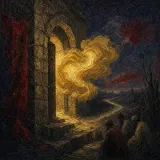
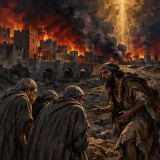
At the eastern gate, Jerusalem's leaders speak as though the city were a secure cooking pot and they the protected contents. The Book of Ezekiel turns their proverb against them: the flesh in the pot is the people they have slain, while the leaders themselves will be brought out for judgment. Pelatiah's death within the vision drives Ezekiel to another plea over the remnant, and the answer redirects hope away from those who claim possession of the land. The exiles dismissed as far from the LORD are promised that God will be "as a little sanctuary" to them. Gathering, removal of abominations, a new heart, and a new spirit follow that promise without erasing accountability for those who persist in idolatry. Finally the glory leaves the city and stands on the mountain to the east. Ezekiel returns in vision to Chaldea and reports everything to the captives.
In this chapter
- A Cooking-Pot Proverb Offered as Reassurance Ezekiel 11:1-4
The east gate holds twenty-five men, including two named leaders, and their proverb turns Jerusalem into cookware.
- The Slain Are the Flesh in the Pot Ezekiel 11:5-13
God does not discard the leaders' cauldron proverb.
- Distance from Jerusalem Is Not Distance from God Ezekiel 11:14-21
Jerusalem's inhabitants have turned geography into theology: the exiles are far from the LORD, while those still holding the land treat possession as proof of divine favor.
- The Vision Returns to Its First Audience Ezekiel 11:22-25
The glory makes one final outward movement, rising from the city and standing on the mountain east of Jerusalem.

Scripture beside the summary
Ezekiel · King James Version · 25Ezekiel 11:1-4
A Cooking-Pot Proverb Offered as Reassurance
The east gate holds twenty-five men, including two named leaders, and their proverb turns Jerusalem into cookware. They speak of the city as a cauldron and themselves as its flesh, an image that appears to make the walls into protection. The Book of Ezekiel does not fully resolve the difficult first clause about whether building houses is near or not near, but it clearly identifies the counsel as wicked and commands Ezekiel to answer it. The location sharpens the irony. These leaders stand at the very gate toward which the glory has moved, yet their confidence takes no account of what the vision has shown. They interpret the city from inside its political assumptions. The coming oracle will reinterpret their own metaphor against them. Security cannot be established merely by naming Jerusalem a protective pot when violence inside the pot has already become part of the charge.
Deep dive
The twenty-five men include Jaazaniah son of Azur and Pelatiah son of Benaiah. The father's name distinguishes this Jaazaniah from the son of Shaphan in chapter 8. The leaders occupy the gate where the glory has just appeared, but their counsel does not arise from the reality disclosed by the vision. The divine address names their activity as devising mischief and giving wicked counsel.
Their saying about houses and the cauldron is difficult in its first clause, and its precise wording has been understood in more than one way. In the KJV it sounds like confident delay: the danger is not near, so building can proceed. The cauldron image appears to treat the city as a protective enclosure and its inhabitants as the contents worth keeping within it. Whatever shade belongs to the proverb, the response will overturn the security it offers. The city's walls cannot establish who is safe when the judgment concerns what its leaders have done inside them.
Words to trace: city, gate, prophesy, Azur, Benaiah, build
Verse-by-verse path
- Ezekiel 11:1
Jaazaniah means the LORD hears, and a man of that name has now appeared in both halves of the vision, among the incense burners of 8:11 and among the princes at the gate. His father Azur shares a name with the father of Hananiah, the prophet who broke Jeremiah’s yoke (Jeremiah 28:1), though no family link is stated.
- Ezekiel 11:2
“Devise mischief” is literally think iniquity, the charge of Micah 2:1: “Woe to them that devise iniquity, and work evil upon their beds!” These men are the counsellors whose counsel 7:26 said would perish from the elders. They are the city’s policy makers.
- Ezekiel 11:3
Jeremiah had seen a “seething pot” tipped from the north as the sign of his call (Jeremiah 1:13), and he had told the exiles, “Build ye houses, and dwell in them” (29:5), because they would be in Babylon a long time. These leaders speak of building houses in Jerusalem, as if no pot were boiling.
- Ezekiel 11:4
The command is doubled, prophesy against them, prophesy, an urgency that stands out even in Ezekiel. He is in a vision, standing at a gate hundreds of miles from his body, and yet the prophesying he does there will have an effect in Jerusalem within ten verses.
Ezekiel 11:1-4
King James Version1Moreover the spirit lifted me up, and brought me unto the east gate of the LORD’s house, which looketh eastward: and behold at the door of the gate five and twenty men; among whom I saw Jaazaniah the son of Azur, and Pelatiah the son of Benaiah, princes of the people.
2Then said he unto me, Son of man, these are the men that devise mischief, and give wicked counsel in this city:
3Which say, It is not near; let us build houses: this city is the caldron, and we be the flesh.
4Therefore prophesy against them, prophesy, O son of man.
Ezekiel 11:5-13
The Slain Are the Flesh in the Pot
God does not discard the leaders' cauldron proverb. He takes it over. The real flesh in the pot, the Book of Ezekiel says, is the multitude of slain people whose bodies fill the city's streets. The leaders who imagined themselves safely contained will instead be brought out and judged. Their own metaphor becomes an accusation constructed from their victims. Fear of the sword does not lead to escape from it, and the city walls do not settle who is secure. Then Pelatiah dies while Ezekiel is prophesying, giving the oracle sudden personal force. The chapter does not separately establish how that death relates in time to events outside the vision, but Ezekiel's response is unmistakable. He falls facedown and cries out over the remnant. Delivering judgment has not made him indifferent to its consequences. The question of whether Israel will survive now presses directly into the vision.
Deep dive
The reply does not discard the cauldron metaphor; it takes possession of it. The flesh in the city is the slain whom the leaders have multiplied, not the secure governing class they imagine themselves to be. The leaders will be removed from the supposed safety of the pot and judged at Israel's border. Their fear of the sword becomes the announced instrument of their sentence. The metaphor they offered as reassurance returns as an accusation built from their victims.
When Pelatiah dies as Ezekiel prophesies, the prophet again pleads against a complete end of the remnant. The event occurs within the vision, and the chapter does not supply a separate report establishing its timing outside that vision. Its place in the encounter is unmistakable: a named leader's death gives sudden immediacy to the oracle. Ezekiel's response also resists the assumption that delivering judgment makes him indifferent to its consequences. The question of a surviving Israel presses through the prophecy itself, and the following answer locates that future somewhere Jerusalem's leaders had dismissed.
Words to trace: LORD, Israel, midst, city, know, slain
Verse-by-verse path
- Ezekiel 11:5
“The things that come into your mind” is literally the steps of your spirit, using ma’alot, the word for stairs and the word in the titles of the Songs of Degrees (Psalms 120–134). God knows every step their thinking climbs. The capital S of “Spirit of the LORD” is the translators’ judgment.
- Ezekiel 11:6
2 Kings 24:4 says Manasseh “filled Jerusalem with innocent blood; which the LORD would not pardon”. The present leaders have added to it. “Your slain” may mean men killed in the streets, or the victims of judicial murder, as when Jehoiakim killed the prophet Urijah (Jeremiah 26:23).
- Ezekiel 11:7
Micah 3:2–3 had described Jerusalem’s rulers as butchers of their own people, who “chop them in pieces, as for the pot, and as flesh within the caldron.” God takes up the leaders’ image of the caldron exactly as Micah had used it: the meat is their victims.
- Ezekiel 11:8
Jeremiah 42:16 uses the same turn against those who fled to Egypt: “the sword, which ye feared, shall overtake you there.” The thing a man takes precautions against is what finds him. Fear of the sword is not the same as avoiding the reasons for it.
- Ezekiel 11:9
“Execute judgments” is the phrase for the punishments God executed on Egypt: “against all the gods of Egypt I will execute judgment” (Exodus 12:12). The leaders will receive the treatment once given to Pharaoh, at the hands of strangers, foreigners with no stake in them.
- Ezekiel 11:10
The fulfilment is recorded in Jeremiah 52:9–10 and 24–27: the princes of Judah were taken to Riblah, far to the north on Israel’s frontier, and put to death there. The oracle names the border, not the town.
- Ezekiel 11:11
Verse 11 undoes the proverb of verse 3 in its own words: not your caldron, not your flesh. Ezekiel often refutes a popular saying by quoting it and turning it round, as he will do with the proverbs of 12:22 and 18:2. The saying is answered with the saying.
- Ezekiel 11:12
Leviticus 18:3 had said, “After the doings of the land of Egypt… and after the doings of the land of Canaan… shall ye not do: neither shall ye walk in their ordinances.” The charge lays the leaders’ conduct against that command: statutes not walked in, judgments not kept, the neighbours’ ways copied instead.
- Ezekiel 11:13
Pelatiah means the LORD rescues, built on the same root as the “escape” and the escaped remnant of 6:8. When a man whose name promises rescue drops dead, Ezekiel hears it as the death of the remnant itself, and asks whether God will make “a full end”.
Ezekiel 11:5-13
King James Version5And the Spirit of the LORD fell upon me, and said unto me, Speak; Thus saith the LORD; Thus have ye said, O house of Israel: for I know the things that come into your mind, every one of them.
6Ye have multiplied your slain in this city, and ye have filled the streets thereof with the slain.
7Therefore thus saith the Lord GOD; Your slain whom ye have laid in the midst of it, they are the flesh, and this city is the caldron: but I will bring you forth out of the midst of it.
8Ye have feared the sword; and I will bring a sword upon you, saith the Lord GOD.
9And I will bring you out of the midst thereof, and deliver you into the hands of strangers, and will execute judgments among you.
10Ye shall fall by the sword; I will judge you in the border of Israel; and ye shall know that I am the LORD.
11This city shall not be your caldron, neither shall ye be the flesh in the midst thereof; but I will judge you in the border of Israel:
12And ye shall know that I am the LORD: for ye have not walked in my statutes, neither executed my judgments, but have done after the manners of the heathen that are round about you.
13And it came to pass, when I prophesied, that Pelatiah the son of Benaiah died. Then fell I down upon my face, and cried with a loud voice, and said, Ah Lord GOD! wilt thou make a full end of the remnant of Israel?
Ezekiel 11:14-21
Distance from Jerusalem Is Not Distance from God
Jerusalem's inhabitants have turned geography into theology: the exiles are far from the LORD, while those still holding the land treat possession as proof of divine favor. The Book of Ezekiel breaks that equation. God acknowledges scattering the people and then promises to be "as a little sanctuary" in the countries where they have gone. The sanctuary is no longer something Jerusalem can monopolize by remaining near one building. The promise moves from presence to gathering, then deeper still to transformation. Detestable things are removed, a new spirit is given, and a stony heart is exchanged for a heart of flesh capable of responsive obedience. Yet the paragraph does not simply reverse Jerusalem's prejudice by making every exile righteous. Those who continue to pursue detestable things remain accountable. Hope is relocated in God's presence and gift, not in the moral superiority of one displaced group over another.

Deep dive
The people remaining in Jerusalem have turned possession of the land into a verdict on the people removed from it. In their account, the exiles are far from the LORD and the land belongs to those still present. The answer separates geographical displacement from abandonment. God acknowledges that he has scattered the people, yet promises to be "as a little sanctuary" where they have gone. The sanctuary can no longer be treated as a building whose location settles every question of divine presence.
The promise includes gathering and the return of the land, but it goes further than relocation. The returning people remove detestable things, and God gives one heart and a new spirit. A heart of flesh contrasts with a heart of stone: the image concerns living responsiveness instead of insensibility, not a contrast between sinful flesh and spiritual goodness. Verse 20 supplies the purpose, walking in God's statutes and renewed belonging between God and his people.
The closing qualification matters. Those whose hearts continue after the abominations are still answerable for their ways. The promise does not simply reverse the Jerusalem residents' prejudice by declaring every exile automatically righteous. It relocates hope in God's presence and transforming gift, while keeping the difference between turning from idols and pursuing them fully visible.
Words to trace: heart, LORD, countries, abominations, brethren, detestable
Verse-by-verse path
- Ezekiel 11:14
The answer to Ezekiel’s question comes as a fresh oracle, introduced by its own formula. God does not argue with the cry of verse 13; he redirects it. The remnant Ezekiel fears for is about to be located somewhere other than where he was looking.
- Ezekiel 11:15
“The men of thy kindred” is literally the men of thy redemption: the kinsmen with the legal right to buy back family land, as Jeremiah did when told “the right of redemption is thine” (Jeremiah 32:7; Leviticus 25:25). The people in Jerusalem claim the land; the law gives the right to redeem it to the exiles.
- Ezekiel 11:16
“A little sanctuary” can mean a sanctuary in small measure or a sanctuary for a little while. The Talmud (Megillah 29a) applied it to the synagogues and houses of study of Babylon, and many trace the synagogue’s beginnings to exactly this setting, worship without a temple.
- Ezekiel 11:17
Deuteronomy 30:3–4 promised that if Israel returned to the LORD in exile, he would “gather thee from all the nations, whither the LORD thy God hath scattered thee”, even from “the outmost parts of heaven”. Ezekiel uses the same two verbs, gather and assemble, and the land is named as a gift again.
- Ezekiel 11:18
In chapter 8 it was the elders who carried the detestable things in. Here it is the returning exiles who take them out. The purging of the land is not done for them by an army or a reforming king; the people who come back do it themselves.
- Ezekiel 11:19
The Greek Old Testament reads “another heart” instead of “one heart”. Jeremiah 32:39 has the same promise, “I will give them one heart, and one way”. Ezekiel repeats this verse almost word for word in 36:26, where the new heart comes with clean water sprinkled on the people.
- Ezekiel 11:20
“They shall be my people, and I will be their God” is the covenant formula, first given in Exodus 6:7 and Leviticus 26:12 and repeated by Jeremiah (24:7; 31:33). Ezekiel uses it again in 14:11. It is the relationship the exiles were told they had lost.
- Ezekiel 11:21
The Hebrew is awkward on purpose: “to the heart of their detestable things their heart walketh”. The idols are given a heart, and the people’s heart follows it. Whatever a person’s heart walks after, it comes to resemble; the phrasing makes the idols the ones leading.
Ezekiel 11:14-21
King James Version14Again the word of the LORD came unto me, saying,
15Son of man, thy brethren, even thy brethren, the men of thy kindred, and all the house of Israel wholly, are they unto whom the inhabitants of Jerusalem have said, Get you far from the LORD: unto us is this land given in possession.
16Therefore say, Thus saith the Lord GOD; Although I have cast them far off among the heathen, and although I have scattered them among the countries, yet will I be to them as a little sanctuary in the countries where they shall come.
17Therefore say, Thus saith the Lord GOD; I will even gather you from the people, and assemble you out of the countries where ye have been scattered, and I will give you the land of Israel.
18And they shall come thither, and they shall take away all the detestable things thereof and all the abominations thereof from thence.
19And I will give them one heart, and I will put a new spirit within you; and I will take the stony heart out of their flesh, and will give them an heart of flesh:
20That they may walk in my statutes, and keep mine ordinances, and do them: and they shall be my people, and I will be their God.
21But as for them whose heart walketh after the heart of their detestable things and their abominations, I will recompense their way upon their own heads, saith the Lord GOD.
Ezekiel 11:22-25
The Vision Returns to Its First Audience
The glory makes one final outward movement, rising from the city and standing on the mountain east of Jerusalem. The Book of Ezekiel does not name that mountain here, because the relational geography is enough: the presence has moved beyond the city whose sanctuary it once filled. Then the vision reverses direction for Ezekiel. The spirit brings him back to Chaldea, where the whole sequence began with Judah's elders sitting before him. That return closes the frame opened in chapter 8. Jerusalem's hidden practices, the judgment, the marking, the moving glory, and the promise of sanctuary in exile are all carried back to the captives as a single revelation. Ezekiel tells them what he has been shown. The place dismissed by Jerusalem as spiritually distant becomes the place where the meaning of Jerusalem's loss is explained and where a promise of divine presence has already been spoken.
Deep dive
The last outward movement takes the glory from the city to the mountain on its eastern side. The chapter supplies the location relationally rather than naming it. The important movement is away from Jerusalem, completing the sequence through threshold and eastern gate. The sanctuary has not protected the city from examination, and the city has not retained the glory by treating it as a possession.
The spirit then brings Ezekiel in the vision back to Chaldea, where he speaks to the captives. This return closes the frame opened when the elders sat before him in chapter 8. What was exposed in Jerusalem is now communicated in exile. The report also includes the promise that God will be a sanctuary to the scattered, so the vision is not merely intelligence about the homeland's coming loss. It challenges the hierarchy in which those still in Jerusalem imagine themselves nearest to God. The place of captivity becomes the place where the meaning of the sanctuary's departure is disclosed.
Words to trace: captivity, city, glory, LORD, spirit, vision
Verse-by-verse path
- Ezekiel 11:22
The cherubim lift their wings for the last time in this vision. The throne on the cherubim will not be seen again until the closing vision of the book, when the same glory returns to a new temple and Ezekiel falls on his face once more (43:2–5).
- Ezekiel 11:23
The mountain on the east of the city is the Mount of Olives, and Zechariah 14:4 pictures God’s feet standing there “in that day”. A rabbinic tradition (Lamentations Rabbah) says the divine presence lingered on that mountain for three and a half years, waiting for Jerusalem to repent.
- Ezekiel 11:24
“The vision… went up from me” uses the same verb as the glory that “went up from the midst of the city” in verse 23. Both leave by rising. Ezekiel never left his house in Babylon; the spirit returns him in the vision to where his body sat among the elders (8:1).
- Ezekiel 11:25
This closes the vision that began in 8:1, with the elders of Judah sitting before him, and it is one of the few places the book reports Ezekiel actually speaking to the exiles. How they took it is not recorded. The next verse addressed to him still calls them “a rebellious house” (12:2).
Ezekiel 11:22-25
King James Version22Then did the cherubims lift up their wings, and the wheels beside them; and the glory of the God of Israel was over them above.
23And the glory of the LORD went up from the midst of the city, and stood upon the mountain which is on the east side of the city.
24Afterwards the spirit took me up, and brought me in a vision by the Spirit of God into Chaldea, to them of the captivity. So the vision that I had seen went up from me.
25Then I spake unto them of the captivity all the things that the LORD had shewed me.
Questions to keep in mind while reading
- Identify the historical crisis, covenant failure, warning, and promised hope.
- Distinguish the prophet’s immediate audience from later biblical connections.
- Do not turn present-day headlines into confident fulfillment claims without textual evidence.
Text first
Where readers differ
The chapter summary begins with what the passage says and how its parts fit together. It does not assume one denomination has already settled every question. Where a conclusion depends on a tradition, literary theory, or historical reconstruction, that dependence is named openly.
The KJV text is presented first. Interpretive conclusions are labeled, and differences are introduced only when they help a reader understand why serious communities do not always reach the same answer.
Comparative interpretive notes for this chapter are in preparation. Until reviewed notes are ready, this page separates the KJV text from summary and application without claiming that serious readers agree on every question.
Questions beneath the surface
- What account of God, human freedom, responsibility, and the good life emerges from Ezekiel 11?
- Which tension does the chapter refuse to resolve quickly?
- What changes when the chapter is read as part of the whole canon rather than as an isolated moral lesson?
- Where might a sincere reader confuse a familiar tradition with something the text states directly?
Questions for serious personal contemplation
These open-ended questions make room for tension, honest response, prayer, and conclusions that remain accountable to the chapter.
Observe without rushing
What part of Ezekiel 11 makes you stop, feel unsettled, or feel surprised, and why?
Which detail in the passage would be easiest to overlook? How does that detail change your understanding?
Where do you see tension between what happens and this focus: Ezekiel 11 develops its own movement around LORD, city, Israel, flesh, heart?
What important question does the passage leave open instead of resolving quickly?
Examine your inner life honestly
Which person, response, fear, or desire in the passage feels most like your own life right now?
What assumption about God, other people, or yourself does this text challenge?
Which part would you rather soften, avoid, or explain away too quickly? What might that reaction reveal?
If this Scripture could ask you one direct question, what do you think it would ask?
Respond with wisdom and courage
What do you need to remember, confess, grieve, thank God for, or trust after reading this passage?
How might another faithful person read this situation differently without ignoring the text?
What obedient response would be costly, uncomfortable, or slow, yet still faithful to Scripture?
What question will you carry into prayer this week, and which verses will you keep in front of you?
Music and video connected to the passage
Related media appears when its Scripture reference overlaps this study. Music and video can illuminate a theme while the biblical text remains the foundation.