The big picture
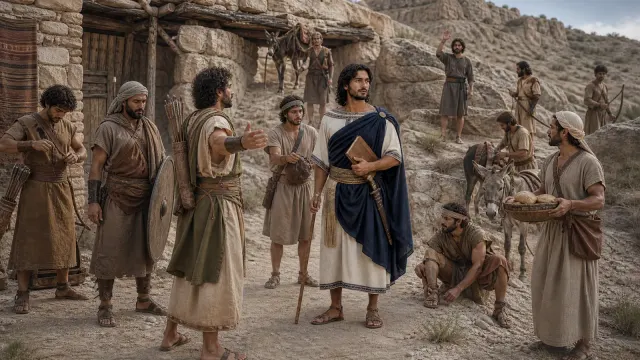
The chapter looks backward to the period when David was still restricted by Saul and shows support gathering before public kingship was secure. Benjaminite warriors, Gadites, men from Judah and Manasseh, and others arrive with distinct skills and varying risks attached to their allegiance. David does not accept every newcomer blindly, and Amasai's declaration of peace answers a genuine fear of betrayal. The scene then broadens to Hebron, where tribal contingents come with different numbers, leaders, weapons, and descriptions. Unity does not require uniformity. Issachar brings discernment about what Israel should do, Zebulun brings disciplined ranks and an undivided heart, and the rest contribute according to their strengths. The final picture is unexpectedly domestic: three days of eating and drinking, abundant provisions, and joy in Israel.
Central truth
David's kingship gathers Israel around the Lord's word through covenant, costly loyalty, varied service, and shared provision rather than presenting the king as a solitary hero.
The study notes have a page of their own
The movement by movement analysis, the words to trace, the verse by verse notes and where readers differ are written for someone studying alone. They are on the Deep Personal Reflections page for this chapter. This page is the lesson.
A chapter-specific teaching brief
These anchors come from this chapter itself. They help a teacher use the Level 1 overview, the Level 2 study, and the Scripture text as one lesson.
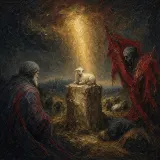
Open with the chapter’s first image
1 Chronicles 12:1: “Now these are they that came to David to Ziklag, while he yet kept himself close because of Saul the son of Kish: and they were among the mighty men…”
Slow down at the turning point
1 Chronicles 12:18: “Then the spirit came upon Amasai, who was chief of the captains, and he said, Thine are we, David, and on thy side, thou son of Jesse: peace, peace be unto…”
Keep this word trail visible
David, captains, children, mighty, Saul, battle
What to explain, in order
Teach the passage in this order. Each step names the verses it rests on, so every point can be shown in the text before it is applied.
1 Chronicles 11:1-3
All Israel comes to Hebron
Begin with the covenant at Hebron. Show that 1 Chronicles moves straight from Saul's death to all Israel coming to David and leaves out the seven years of struggle told in 2 Samuel 2-4. Read the elders' three reasons in 11:1-2 and then 11:3, where David makes a covenant "before the LORD" and they anoint him "according to the word of the LORD by Samuel". Explain feed as shepherd. Teach this first because it defines the king's job: to shepherd God's people under God's word.
1 Chronicles 11:4-9
Jerusalem taken, and the LORD with him
Read the taking of Jebus. The inhabitants say "Thou shalt not come hither", David takes "the castle of Zion", and it becomes "the city of David" (11:5). Joab earns command by going up first. Explain Millo as some kind of fill or terrace; scholars are not sure of its exact form. Then land on 11:9: David grows greater because "the LORD of hosts was with him". Teach this step here because the capital matters to the rest of the book, where the ark and the temple will both come to Jerusalem.
1 Chronicles 11:10-25
The mighty men and the water
Introduce the heroes as people who helped make David king, "according to the word of the LORD" (11:10). Read Eleazar holding a barley field, where "the LORD saved them by a great deliverance" (11:14), and Benaiah's lion and Egyptian (11:22-23). Then spend the most time on 11:15-19, the water from Bethlehem. Explain that pouring out water to the LORD treats it like a drink offering. The point to land is that David will not take the risks of his people lightly.
1 Chronicles 11:26-47
A list with strangers in it
Do not read the whole list. Point to three names: "Uriah the Hittite" (11:41), "Zelek the Ammonite" (11:39) and "Ithmah the Moabite" (11:46). The kingdom's defenders include foreigners. Explain that Uriah's name should be noticed by anyone who knows 2 Samuel 11, though 1 Chronicles does not tell that event. Keep the step short and specific. It belongs here because it widens the picture of who helped David, and it prepares the class for the many tribes of chapter 12.
1 Chronicles 12:1-22
Earlier years at Ziklag and in the hold
Show the time markers: Ziklag in 12:1, the hold in 12:8 and 12:16, and the battle with the Philistines in 12:19, all while Saul lives. These are men who came early and at risk, including Benjamites, Saul's own tribe (12:2). Read 12:17-18 closely. David asks if they come in peace, and the spirit comes on Amasai, who answers "Thine are we, David, and on thy side". Explain that the book is gathering witnesses that God was building the kingdom long before Hebron.
1 Chronicles 12:23-40
The army at Hebron and the feast
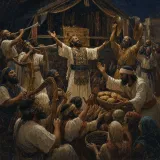
Read the tribal numbers briefly and stop at Issachar and Zebulun (12:32-33). Explain understanding of the times as practical wisdom about what Israel should do then. Explain not of double heart as undivided loyalty. Then read 12:38-40: they came "with a perfect heart", all Israel was "of one heart", and the gathering ends with three days of food "for there was joy in Israel". Close the exposition here, because unity and joy are the result the whole section has been building.
Where learners get stuck
The misreadings this passage tends to produce, and how to answer each from the text.
"David became king because he was the strongest fighter, and the people voted for him."
1 Chronicles 11:2-3 gives the decisive reason as the word of the LORD, spoken by Samuel. The elders do recognise his past leadership, and they make a covenant with him, but the book insists the anointing was according to God's word, and 11:9 credits his growth to the LORD. Leadership in this passage is a calling from God that the people recognise, not a prize for the strongest.
"Pouring out the water was a waste of a brave gift."
David's own words in 11:19 explain it: the water is like the blood of men who risked their lives. To drink it as a refreshment would treat their lives cheaply. He pours it "to the LORD" (11:18), giving it the highest honour he can. The men's courage is honoured, not wasted. Ask learners how a gift that cost someone dearly should be received.
"Issachar's men could predict the future, so Christians should look for people who know the signs of the times."
12:32 explains its own phrase: they had understanding of the times "to know what Israel ought to do". This is practical wisdom for a decision Israel faced, whether to follow David. It is not prediction. Encourage learners to value people who can read a situation wisely and point a community toward faithful action, and gently resist using the verse to label any modern group.
"Everyone in chapter 12 showed up at Hebron on the same day."
The chapter marks different times and places. 12:1 is Ziklag while David hid from Saul, 12:8 and 12:16 are the hold, 12:19 is when David went out with the Philistines, and only 12:23 begins the gathering at Hebron. 12:22 says men came "day by day". Teaching the timeline helps learners see that support for David grew over years.
Learning objectives
- Identify the grounds for David's recognition at Hebron.
- Distinguish chapter 12's earlier gatherings from the coronation.
- Explain David's refusal to drink the Bethlehem water.
- Compare the contributions of three named tribal groups.
- Identify the source of David's growing strength.
- Describe how food provision participates in national unity.
Teacher preparation
- Read 11:1-12:40; mark 12:1, 16, 19, and 23 to prevent one invented simultaneous assembly.
- Locate Hebron, Jerusalem, Bethlehem, Ziklag, and the Jordan; distinguish locations from stages in the account.
- Explain that host means army, hold means stronghold, and a perfect heart in 12:38 describes wholehearted allegiance, not sinlessness.
- Select 11:15-19 for careful reading; the three men risk their lives, but David never orders this expedition in the passage.
- Prepare a contribution chart for Benjamin, Gad, Issachar, Zebulun, and the food-bearing neighbours; resist reducing the whole unit to combat feats.
Evidence and interpretation checks
Explicit
Read 11:1-3: kinship, David's earlier leadership, the Lord's appointment, covenant, and anointing supply the stated grounds for kingship.
Scripture-supported
Compare 11:15-19 with 2 Samuel 23:13-17; both accounts connect the poured-out water with the men's jeopardized lives.
Strong inference
Infer from 12:38-40 that shared allegiance becomes practical hospitality; the food supply is part of the unity pictured, not an unrelated menu.
Possible or traditional reading
Treat Issachar's understanding in 12:32 as discernment about Israel's action here; a claim of a transferable end-times prediction gift goes beyond the verse.
Limit
Do not turn 11:1-12:40 into one day's gathering, or assume that all Israel means every individual participated without exception.
Discussion with answer guidance
1. What reasons do the elders give for accepting David?
What a good answer contains
The elders give three reasons in 11:1-2. Kinship: "we are thy bone and thy flesh". Experience: even under Saul, "thou wast he that leddest out and broughtest in Israel". And God's word: "Thou shalt feed my people Israel, and thou shalt be ruler over my people Israel". Then 11:3 says the anointing was "according to the word of the LORD by Samuel". A good answer ends with the word of the LORD. A weak answer says David was simply popular.
Show teacher guidance
Name kinship, previous leadership, and God's word in 11:1-3; do not settle for popularity alone.
2. Who receives credit for David becoming greater?
What a good answer contains
The LORD does. "So David waxed greater and greater: for the LORD of hosts was with him" (11:9). The next verse adds the mighty men who "strengthened themselves with him in his kingdom" and that too is "according to the word of the LORD concerning Israel" (11:10). A strong answer keeps both: God gives the growth and uses many people to bring it about. A weak answer sets God and the helpers against each other.
Show teacher guidance
Locate 11:9: the Lord of hosts is with him; read the helpers in verse 10 without opposing divine and human action.
3. Why does David pour out water he had wanted?
What a good answer contains
Because the water cost too much. Three men broke through the Philistine lines to bring it, and David says, "shall I drink the blood of these men that have put their lives in jeopardy?" (11:19). He "poured it out to the LORD" (11:18), turning a gift he could not drink into an offering. A good answer sees honour for the men and worship of God together. A weak answer thinks David was ungrateful or wasteful.
Show teacher guidance
Read 11:17-19; focus on the men's endangered lives and the offering to the Lord, not contempt for their effort.
4. Which clues show that chapter 12 revisits earlier years?
What a good answer contains
12:1 names Ziklag, "while he yet kept himself close because of Saul the son of Kish". 12:19 places some men from Manasseh joining him "when he came with the Philistines against Saul to battle". Saul is still alive in both. The numbers that came "to Hebron, to turn the kingdom of Saul to him" start only at 12:23. A good answer sees that chapter 12 gathers support from several years. A weak answer imagines everyone arriving at once.
Show teacher guidance
Use 12:1 and 19, where Saul is still alive; place these before the Hebron gathering in verse 23.
5. How do Issachar and Zebulun contribute differently?
What a good answer contains
Issachar sent men "that had understanding of the times, to know what Israel ought to do" (12:32), two hundred leaders. Zebulun sent fifty thousand "which could keep rank: they were not of double heart" (12:33). One tribe gives wisdom, the other disciplined, single-minded loyalty. A good answer values both. A weak answer turns Issachar into the only tribe worth imitating or reads 12:32 as fortune-telling.
Show teacher guidance
Contrast understanding and leadership in 12:32 with disciplined, undivided readiness in 12:33; do not rank one tribe as unnecessary.
6. Why finish with bread, fruit, animals, and neighbours?
What a good answer contains
Because the kingdom begins with a feast. They stayed with David "three days, eating and drinking: for their brethren had prepared for them" (12:39), and neighbours as far as Issachar, Zebulun and Naphtali brought food on donkeys, camels, mules and oxen, "for there was joy in Israel" (12:40). A good answer sees that a united people shares provision and joy. A weak answer skips the meal as a detail.
Show teacher guidance
Use 12:39-40 to connect preparation, provision, and joy; even mighty men need someone to remember supper.
Responsible application
Heart and habits
Ask how a fictional leader could receive a costly gift without treating other people's risk as personal entitlement; use 11:19.
Relationships and community
Design a shared project with distinct planning, practical, and hospitality roles; explain the analogy to 12:32-40 without copying military organization.
Chronological honesty
Have learners correct an imagined caption that places every listed warrior at David's coronation on the same afternoon.
Session plans
Two timings of the same lesson. The shorter keeps the reading, the central discussion and one response; the longer gives the confusions and the application their own time.
45 minutes
The covenant at Hebron
Read 11:1-3. Take question one and write the three reasons on the board.
Jerusalem and the LORD of hosts
Read 11:4-10. Take question two and confusion one.
Water from Bethlehem
Read 11:15-19. Take question three and confusion two.
Who came when
Read 12:1-2, 12:17-19 and 12:23. Take question four and draw a simple timeline.
Wisdom, loyalty and a feast
Read 12:32-33 and 12:38-40. Take questions five and six, and confusion three.
Handout and prayer
Read the key verse together, give out the handout and pray for unity in your church.
90 minutes
From Gilboa to Hebron
Recall 10:14. Explain that 1 Chronicles moves straight to all Israel coming to David. Read 11:1-3 and take question one.
Zion and the LORD with David
Read 11:4-10. Take question two and confusion one.
The mighty men
Read 11:11-25, then 11:15-19 slowly. Take question three and confusion two.
Strangers in the list
Find Uriah, Zelek and Ithmah in 11:39-46. Ask why the book keeps foreign names among David's defenders.
The early years
Read 12:1-22. Take question four and confusion four, and read Amasai's words in 12:18 together.
Hebron and the feast
Read 12:23-40. Take questions five and six and confusion three.
Application
In pairs, name one gift your church needs from understanding and one from steady loyalty. Share one sentence.
Handout and prayer
Read the key verse, point to the take-home line, and pray with Amasai's words of peace.
Adapting the lesson
Children
Act out the water from Bethlehem: three children carry a cup past cushions that stand for the Philistine camp, and the king pours it out on the ground as an offering to God. Ask why he would not drink it. Then have a pretend feast with paper bread and fruit. Leave out the fighting details of 11:11-23 and keep the focus on brave helpers and joy.
Youth
Ask who they would follow and why. Read 11:1-3 and compare their reasons with the elders'. Spend time on 11:17-19 and talk about respecting people who take risks for us. Use 12:32-33 to talk about two different strengths, wise understanding and steady loyalty, and let them say which one they see in each other.
Adults
Compare 1 Chronicles 11-12 with 2 Samuel 5 and 23 so adults can see what the Book of 1 Chronicles chooses to tell and to leave out. Discuss the place of foreigners in 11:39-46 and of Saul's own tribe in 12:2. Give time to the meaning of a perfect heart in 12:38, and to how churches can be of one heart without everyone having the same role.
One to one
Read 11:1-3, 11:15-19 and 12:38-40 together. Ask the person who has taken risks or made sacrifices for them, and how they honour that. If they feel they have little to offer, show the variety of 12:32-40, from wise leaders to the neighbours who brought raisins, and let them see where they fit.
Song and video learning lab
A song or video may interpret, compress, or dramatize the text. Its value becomes clearer when its choices are compared with Scripture.
- Before the media: the exact passage and its central movement.
- During the media: the words, people, events, and emotions the artist emphasizes.
- After the media: what it clarifies, what it leaves out, and what belongs back in the biblical text.
Handout
One page for learners to take home. The print button prints this section alone.
1 Chronicles 11:1–12:40
The passage in brief
In 1 Chronicles 11 and 12 all Israel comes to David at Hebron and makes him king, as the LORD had said through Samuel. David takes Jerusalem, and he grows greater because the LORD is with him. Brave men help him, and when three of them risk their lives to bring him water, he pours it out to the LORD. Men from every tribe join him over the years, and the gathering at Hebron ends with three days of food and joy.
A verse to keep
So David waxed greater and greater: for the LORD of hosts was with him.
1 Chronicles 11:9 · King James Version
Questions to take home
What three reasons did the elders give for making David king in 11:1-3?
Why did David pour out the water in 11:17-19?
What did the men of Issachar and Zebulun each bring in 12:32-33?
This week
Thank one person this week, by name, for something they gave up to help you.
Music and video connected to the passage
Related media appears when its Scripture reference overlaps this study. Music and video can illuminate a theme while the biblical text remains the foundation.