
The big picture
The Book of 1 Samuel opens far from a battlefield or throne. Hannah cannot eat at the yearly feast, Elkanah cannot solve her grief with affection, and Eli mistakes silent prayer for drunkenness. The chapter keeps placing visible facts beside mistaken conclusions. Hannah's moving lips look suspicious to Eli, but her prayer reaches beyond the priest's hearing. When Samuel is born, the answer does not end in possession. Hannah nurses him, waits until he is weaned, then returns to the place of her humiliation and identifies herself simply as the woman who once stood there praying. The child she asked for is the child she gives to lifelong service. Asking, receiving, nursing, and giving all belong to the same act of faithfulness.
Central truth
The Book of 1 Samuel opens Israel's coming change of leadership with Hannah's silent prayer, the Lord's remembrance, and her costly dedication of Samuel.
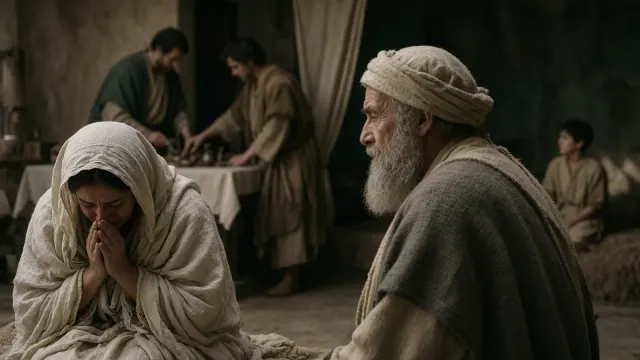

The study notes have a page of their own
The movement by movement analysis, the words to trace, the verse by verse notes and where readers differ are written for someone studying alone. They are on the Deep Personal Reflections page for this chapter. This page is the lesson.
A chapter-specific teaching brief
These anchors come from this chapter itself. They help a teacher use the Level 1 overview, the Level 2 study, and the Scripture text as one lesson.
Open with the chapter’s first image
1 Samuel 1:1: “Now there was a certain man of Ramathaim-zophim, of mount Ephraim, and his name was Elkanah, the son of Jeroham, the son of Elihu, the son of Tohu, the son…”
Slow down at the turning point
1 Samuel 1:14: “And Eli said unto her, How long wilt thou be drunken? put away thy wine from thee.”
Keep this word trail visible
LORD, Hannah, Elkanah, child, handmaid, house
What to explain, in order
Teach the passage in this order. Each step names the verses it rests on, so every point can be shown in the text before it is applied.
1 Samuel 1:1-8
A household with a sorrow in it
Begin with the family before you reach the sanctuary. Elkanah is introduced with a long pedigree, then two wives and one plain fact: "Peninnah had children, but Hannah had no children" (1:2). Explain that "her adversary" in 1:6 is Peninnah, the rival wife, and that "to make her fret" means to provoke her to distress. Notice that the provocation happens at the yearly feast, so the place of worship is where Hannah weeps. Teach this first because the chapter wants you to feel how long the sorrow has lasted before anyone prays about it in public. Keep the household's tension in view without taking sides beyond what the text says.
1 Samuel 1:9-11
Bitterness of soul and a vow
Slow down for Hannah's prayer. She is "in bitterness of soul" and "wept sore" (1:10), and the Book of 1 Samuel does not hurry her out of it. Her vow asks the LORD of hosts to "look", "remember" and "not forget" his handmaid. Explain that "LORD of hosts" names the LORD as commander of armies, heaven's and Israel's, and that the title first appears in Scripture at 1:3. Hannah is the first person in the Bible to address God by it, and she does so as a barren woman with no power at all. Then explain the razor clause by pointing to Numbers 6:5 without claiming every Nazirite rule. Put this before Eli's misjudgment so the class has heard what Eli could not.
1 Samuel 1:12-18
Misjudged at the door
Eli "marked her mouth", that is, watched it, and drew the wrong conclusion. Read his accusation and Hannah's answer side by side. Explain "a daughter of Belial" as a worthless or wicked woman, the same expression the book uses for Eli's own sons in 2:12. That irony is worth naming: the priest sees wickedness in the one praying and misses it in his household. Then show the turn in 1:17-18: Eli blesses her, she eats, and her face is no longer sad. Teach that her peace arrives before her answer, and do not make it a rule for every prayer.
1 Samuel 1:19-23
The LORD remembered her
Read 1:19 as the hinge: "the LORD remembered her". The word "remembered" answers the "remember me" of her vow in 1:11 and does not mean that God had forgotten; it means he acts on her behalf. Explain the name Samuel through her own explanation, "Because I have asked him of the LORD" (1:20), and let the class hear that the child's name is a testimony. Then cover the weaning in 1:22-23. Hannah keeps him at home for the years of nursing, and Elkanah agrees and asks only that "the LORD establish his word". This step shows that the dedication is planned, not impulsive.
1 Samuel 1:24-28
Given back at Shiloh
Finish with the offering. Hannah brings three bullocks, flour, wine and a child who is still young (1:24). Read her speech to Eli in full and explain "lent" from its context: the Hebrew wordplay ties Samuel's name, her asking and her giving together, so "lent" means given over in answer to what was asked. Close by looking ahead to 2:19, where she makes him a little coat every year, so the class sees that dedication did not end her love. Teach this last because it completes the vow of 1:11 and opens the song of chapter 2.
Where learners get stuck
The misreadings this passage tends to produce, and how to answer each from the text.
"God gave Hannah a baby because she prayed hard enough."
The text credits the LORD, not the intensity of the prayer: "the LORD remembered her" (1:19) and "the LORD hath given me my petition" (1:27). Hannah's peace in 1:18 comes before any answer, and the chapter gives no formula or timetable. Many faithful people in Scripture and in your room pray for a child and do not receive one. Say clearly that unanswered prayer is not proof of weak faith, and keep Hannah's history as hers, a particular mercy rather than a promise made to everyone.
"Hannah gave her son away and abandoned him to the priests."
She keeps him through his nursing years (1:22-23), brings him herself, and makes the gift in worship (1:24-28). Then 2:19 records that "his mother made him a little coat, and brought it to him from year to year". The dedication is costly, but it is not desertion. Handle this gently with learners who were adopted, fostered or raised away from a parent. Hannah's act is a vow to the LORD in her setting, not a model for placing children, and the text shows her continued care.
"Eli was a bad priest, so his judgment of Hannah shows he was wicked."
Eli misjudges what he sees, but the text does not make this sin the point. When corrected he blesses her: "Go in peace: and the God of Israel grant thee thy petition" (1:17). His real failure is named later, in 2:29 and 3:13, and it concerns his sons. Use 1:12-17 to teach how easily anyone reads grief wrongly, and how a good response to correction looks. Avoid turning Eli into a cartoon; the Book of 1 Samuel treats him with sorrow as well as judgment.
"Elkanah was cold and did not love Hannah."
The text says the opposite: "unto Hannah he gave a worthy portion; for he loved Hannah" (1:5). His question in 1:8 is clumsy, because it measures her grief against himself, but it comes from affection. Teach the difference between love that is real and comfort that does not reach the wound. That distinction helps learners who have been comforted badly by people who meant well, and those who have tried to comfort and missed.
Learning objectives
- Identify the repeated provocation surrounding Hannah's worship.
- Distinguish Eli's accusation from Hannah's explanation.
- Locate the change in Hannah before conception.
- Explain the lifelong scope of Hannah's vow.
- Trace Samuel's presentation back to Hannah's petition.
- Separate this answered prayer from a universal guarantee.
Teacher preparation
- Read 1:1–28 and 2:18–21; note that dedication does not end Hannah's contact with Samuel.
- Explain Shiloh as the worship location named in 1:3, not Solomon's later Jerusalem temple.
- Gloss 'marked' as observed and 'lent' through 1:28's lifelong wording, not a temporary loan.
- Compare the no-razor vow with Numbers 6:1–8 without importing every Nazirite requirement into Hannah's words.
- Prepare a fictional example of misunderstood grief; never invite accounts of infertility, bereavement, or family rivalry.
Evidence and interpretation checks
Explicit
Read 1:13–18: Hannah prays inaudibly, corrects Eli's accusation, receives his blessing, and eats before the account reports conception.
Scripture-supported
Connect 1:11, 27–28 with 2:19–21: lifelong service and continuing maternal care belong together; dedication is not abandonment.
Strong inference
Infer from 1:18–20 that Hannah's changed bearing precedes visible resolution; do not claim the verse describes every inward feeling.
Possible or traditional reading
Describe Samuel as commonly understood in Nazirite terms because of 1:11; acknowledge that this chapter does not explicitly apply that title or reproduce Numbers 6's full requirements.
Limit
Keep 1:19–20 particular: the Lord answers Hannah here, but 1:1–28 supplies neither a promised timetable nor a childbearing guarantee for every petitioner.
Discussion with answer guidance
1. What keeps happening when Hannah's household visits Shiloh?
What a good answer contains
It happens every year, not once. Elkanah goes up "yearly" (1:3), gives the portions, and "as he did so year by year, when she went up to the house of the LORD, so she provoked her; therefore she wept, and did not eat" (1:7). A good answer names the whole cycle: worship, the portions, Peninnah's provocation, tears and an untouched meal. A weak answer turns it into one bad day and misses that the grief is worn into the household's calendar and into the place of worship itself.
Show teacher guidance
Follow 1:3–7: worship, portions, provocation, tears, and refusal to eat recur. Correct an answer that makes this one unfortunate afternoon.
2. What does Elkanah's question about ten sons address, and what does it leave unanswered?
What a good answer contains
Elkanah addresses Hannah's tears and her refusal to eat with three questions and a fourth that is really about himself: "am not I better to thee than ten sons?" (1:8). He offers love, and 1:5 has already said "he loved Hannah". What he does not answer is her barrenness or Peninnah's taunting, and he gets no reply. A strong answer credits the affection and still sees that it does not reach the grief; a weak one either mocks him or treats his question as the solution.
Show teacher guidance
Use 1:8 to distinguish his offered affection from Hannah's grief. Let the awkward arithmetic register without making her suffering the joke.
3. How does Hannah overturn Eli's reading of her moving lips?
What a good answer contains
Eli sees lips moving with no voice and decides she is drunk: "How long wilt thou be drunken?" (1:14). Hannah answers with respect and precision, "No, my lord", and gives the facts: "I have drunk neither wine nor strong drink, but have poured out my soul before the LORD" (1:15). She asks not to be counted "a daughter of Belial" (1:16). A good answer shows that she corrects the priest with the truth and without bitterness; a weak answer makes Eli a villain or skips the accusation altogether.
Show teacher guidance
Compare 1:13–16. He assumes drunkenness; she explains silent prayer and sorrow. Do not credit Eli with knowledge he lacked.
4. What changes in verse 18 before anything changes in verse 20?
What a good answer contains
In 1:18 nothing outward has changed. Hannah is still childless, yet she "went her way, and did eat, and her countenance was no more sad". Only in 1:19-20 does the LORD remember her and does she conceive and bear a son. A good answer keeps that order: she leaves her petition with the LORD and with Eli's blessing before any answer is visible. A weak answer turns verse 18 into a technique, as though cheerfulness were the price of a granted prayer.
Show teacher guidance
Identify eating and a changed countenance first, conception and birth later. Resist making visible cheerfulness a test of sincere prayer.
5. How long does Hannah intend Samuel's dedication to last?
What a good answer contains
For the whole of his life. The vow in 1:11 says "I will give him unto the LORD all the days of his life", and in 1:22 she plans to bring him "that he may appear before the LORD, and there abide for ever". In 1:28 she says "as long as he liveth he shall be lent to the LORD". A good answer explains that "lent" here carries the sense of something asked for and given over, not borrowed for a season. A weak answer imagines a short loan she means to collect.
Show teacher guidance
Join 1:11 to 1:22–28. Correct the modern assumption that 'lent' means she plans to reclaim him shortly.
6. Why does Hannah remind Eli that she stood praying in this place?
What a good answer contains
Because the child is the answer to that very prayer. "I am the woman that stood by thee here, praying unto the LORD. For this child I prayed; and the LORD hath given me my petition which I asked of him" (1:26-27). The same priest who misjudged her becomes the witness that her prayer was heard, and her words echo Eli's own blessing in 1:17. A good answer links the petition, the gift and the dedication into one line; a weak one treats the reminder as polite small talk.
Show teacher guidance
Read 1:26–28 as testimony linking petition, gift, and dedication. Keep the child's service connected to the Lord's answer.
Responsible application
Heart and habits
Ask learners to draft a private or fictional practice of bringing an unresolved concern to God without attaching Hannah's timetable to it.
Relationships and community
Have pairs rewrite Eli's first response as a listening question, using Hannah's explanation rather than inventing motives.
Costly gratitude
Ask the group to compare verbal thanks with Hannah's enacted commitment in 1:27–28; discuss a hypothetical promise kept when it becomes costly.
Session plans
Two timings of the same lesson. The shorter keeps the reading, the central discussion and one response; the longer gives the confusions and the application their own time.
45 minutes
Year by year
Read 1:1-8 aloud. Ask question one and write the yearly cycle on the board: worship, portions, provocation, tears, no food.
Ten sons
Ask question two. Use confusion four to keep Elkanah's love and his clumsy comfort together.
The prayer Eli misread
Read 1:9-18. Take question three, explain "daughter of Belial", and deal with confusion three.
Remembered, asked, named
Read 1:19-23. Ask question four and keep verse 18 before verse 20. Address confusion one gently, without asking anyone about their own family.
Lent to the LORD
Read 1:24-28 and 2:19. Take questions five and six together and answer confusion two from the little coat.
Handout and prayer
Read the key verse together, give out the handout, and pray for any unspoken burdens in the room without naming them.
90 minutes
What grief looks like
Ask the group how they can tell when someone is carrying a sorrow they do not talk about. List answers briefly, then read 1:1-2.
The yearly wound
Read 1:3-8. Take questions one and two. Explain "adversary" and "to make her fret", and work through confusion four.
Bitterness of soul
Read 1:9-11 slowly. Explain "LORD of hosts" and the razor clause with Numbers 6:5. Ask what Hannah asks God to do, and list look, remember and not forget.
Misjudged and blessed
Read 1:12-18. Take questions three and four. Show the irony of "daughter of Belial" with 2:12, and deal with confusion three.
The LORD remembered
Read 1:19-23. Explain the name Samuel from 1:20 and the weaning plan. Take confusion one with care and leave space for silence.
Given and still loved
Read 1:24-28 and 2:18-19. Take questions five and six and confusion two. Compare Luke 2:22 briefly as a later presentation, without equating the two.
Application
Use the listening application from the lesson plan: in pairs, rewrite Eli's first words as a question that would have let Hannah explain.
Handout and prayer
Read the key verse together, point to the take-home line, and close by thanking the LORD who hears prayers no one else can hear.
Adapting the lesson
Children
Tell this as a true account from the Bible about a mother who prayed. Use simple pictures: a family walking to Shiloh, a woman praying with no sound, a priest watching, a baby, and a little coat. Let children practise praying silently for a moment. Say plainly that God hears quiet prayers. Do not suggest that every child who prays for something will receive it, and avoid any question about their own family's babies or losses.
Youth
Start with how quickly people misread a face or a message, then read Eli's mistake in 1:12-14. Let them notice how Hannah answers: respectful, honest, and without bitterness. Spend time on 1:18, where she leaves peaceful before anything has changed, and ask what that might look like for a request they are still waiting on. Keep it private; offer written reflection instead of sharing, since some will be carrying griefs they will not name.
Adults
Give room to the household dynamics: rivalry, a loving but clumsy husband, and yearly worship that becomes the occasion of pain. Many adults have lived with infertility, miscarriage or longing for children, so speak of Hannah's grief with dignity and never call it a lesson in technique. Discuss the meaning of "lent" and of the dedication, and how promises made to God in distress are to be kept when the distress has passed.
One to one
Read 1:9-18 aloud together and ask which of Hannah's words they would most want to say to God. If the person is grieving, let 1:10 and 1:15 stand as permission to pour out the soul before the LORD without tidying it first. Do not promise them Hannah's outcome. Offer to pray with them, quietly if they prefer, and leave the rest of the chapter for another meeting if needed.
Song and video learning lab
A song or video may interpret, compress, or dramatize the text. Its value becomes clearer when its choices are compared with Scripture.
- Before the media: the exact passage and its central movement.
- During the media: the words, people, events, and emotions the artist emphasizes.
- After the media: what it clarifies, what it leaves out, and what belongs back in the biblical text.
Handout
One page for learners to take home. The print button prints this section alone.
1 Samuel 1:1–28
The passage in brief
Hannah has no children, and every year at Shiloh her rival Peninnah provokes her until she weeps and cannot eat. Hannah prays silently in deep sorrow and vows that if the LORD gives her a son, she will give him back to the LORD for his whole life. The priest Eli thinks she is drunk, but she explains, and he blesses her. She goes away at peace. The LORD remembers her, she bears Samuel, and when he is weaned she brings him to serve at Shiloh.
A verse to keep
For this child I prayed; and the LORD hath given me my petition which I asked of him:
1 Samuel 1:27 · King James Version
Questions to take home
What did Hannah ask the LORD to do in her vow (1:11)?
How did Hannah change in 1:18, before her son was born?
What does the name Samuel remind Hannah of (1:20)?
This week
Bring one burden to God in private prayer this week, and tell him plainly what it is.
Music and video connected to the passage
Related media appears when its Scripture reference overlaps this study. Music and video can illuminate a theme while the biblical text remains the foundation.