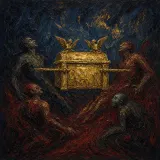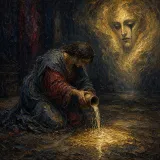
The big picture
Hannah's prayer begins with her own deliverance and expands until it reaches broken bows, hungry people, lifted beggars, a coming king, and the LORD's thunder. The rest of the chapter then begins turning those reversals into household history at Shiloh. Hophni and Phinehas have office but do not know the LORD; Samuel is a child, yet he grows before him. The priests seize meat, abuse worshippers, and refuse correction, while Hannah quietly brings a little coat each year. Eli rebukes his sons but does not restrain them, and an unnamed man of God announces the consequence: the house that has made itself fat from offerings will someday beg for bread. The chapter does not let corruption occupy all of Shiloh. It places faithful service beside institutional failure until the contrast becomes impossible to ignore.
Central truth
Hannah praises the Lord who weighs actions and overturns human strength, while Eli's household abuses holy service and Samuel quietly grows before the Lord.

The study notes have a page of their own
The movement by movement analysis, the words to trace, the verse by verse notes and where readers differ are written for someone studying alone. They are on the Deep Personal Reflections page for this chapter. This page is the lesson.
A chapter-specific teaching brief
These anchors come from this chapter itself. They help a teacher use the Level 1 overview, the Level 2 study, and the Scripture text as one lesson.
Open with the chapter’s first image
1 Samuel 2:1: “And Hannah prayed, and said, My heart rejoiceth in the LORD, mine horn is exalted in the LORD: my mouth is enlarged over mine enemies; because I rejoice in…”
Slow down at the turning point
1 Samuel 2:18: “But Samuel ministered before the LORD, being a child, girded with a linen ephod.”
Keep this word trail visible
LORD, house, sons, Israel, priest, child
What to explain, in order
Teach the passage in this order. Each step names the verses it rests on, so every point can be shown in the text before it is applied.
1 Samuel 2:1-3
A song that starts with God
Open with Hannah's first lines and explain "horn" as strength, the image of an animal's raised horn. Her joy is "in the LORD", and her first claim is about who God is: "There is none holy as the LORD" and no "rock like our God" (2:2). Then show the turn in 2:3 to the arrogant and the reason given: the LORD weighs actions. Teach this first because the whole chapter is going to be weighed by that line, including Eli's house. Point out that this is a prayer, so the class hears that praise and moral seriousness belong together.
1 Samuel 2:4-10
The LORD who reverses
Walk through the pairs: broken bows and girded stumblers, the full hiring themselves out and the hungry satisfied, the barren bearing and the mother of many waxing feeble. Then the LORD "killeth, and maketh alive", makes poor and rich, raises "the poor out of the dust" (2:8). Explain that these are pictures of God's power to overturn, not a promise about every person's finances. Close the step on 2:10, where Hannah speaks of "his king" and "his anointed" before Israel has any king. Note this as a pointer forward to David and, for Christian readers, to Christ, without forcing it.
1 Samuel 2:11-17
Sons of Belial at the altar
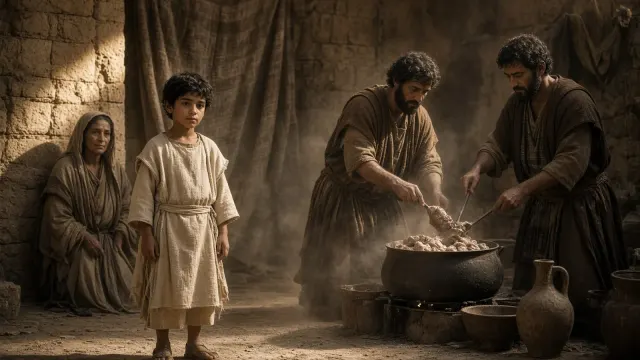
Now turn sharply. The text says "the sons of Eli were sons of Belial; they knew not the LORD" (2:12). Explain "seething" as boiling and walk through the custom: a three-pronged fork into the pot, a demand for raw meat before the fat is burned, and a threat of force. Use Leviticus 3:16 and 7:31-34 to show that the fat belonged to the LORD and the priests already had an allotted share. Teach the sin as contempt for God's worship, which is why 2:17 says the people came to abhor the offering. This step must come after the song so the contrast is heard.
1 Samuel 2:18-21
A linen ephod and a little coat
Read these verses as the chapter's quiet counter-line. Samuel "ministered before the LORD, being a child". Explain the linen ephod as a simple priestly garment worn in service. Then the coat, brought each year, and Eli's blessing on Elkanah and Hannah for "the loan which is lent to the LORD" (2:20). Show that the LORD "visited Hannah" with five more children (2:21), so her gift did not leave her empty. Teach this here because the Book of 1 Samuel deliberately interleaves Samuel's growth with the sons' sin, and the class should see both lines growing at once.
1 Samuel 2:22-26
A father's rebuke that does not restrain
Name the sons' sins in sober words: they "lay with the women that assembled at the door of the tabernacle" (2:22). Do not elaborate. Then read Eli's rebuke and his argument in 2:25: sin against another person has a judge, but sin against the LORD has no one to intercede. The verse ends hard: "they hearkened not unto the voice of their father, because the LORD would slay them". Say that the text holds their refusal and God's judgment together and does not explain how; do not resolve it into a system. Close with 2:26, Samuel growing "in favour both with the LORD, and also with men".
1 Samuel 2:27-36
The man of God and the faithful priest
Finish with the oracle. The LORD recalls his choice of Eli's father's house and their privileges, then asks why they "kick" at his sacrifice. Explain "kick" as scorn, the way an animal kicks against what it should accept. The central line is 2:30, the principle that God honours those who honour him. Then the sign: Hophni and Phinehas will die "in one day" (2:34), fulfilled in 4:11. Treat the "faithful priest" of 2:35 as fulfilled in part in Zadok (1 Kings 2:27, 35), and let Christian learners see a further fulfilment in Christ while keeping the immediate meaning first.
Where learners get stuck
The misreadings this passage tends to produce, and how to answer each from the text.
"Hannah's song means God always makes the poor rich and the rich poor."
The song praises God's power and his justice: he "bringeth low, and lifteth up" (2:7) because "by him actions are weighed" (2:3). It is a confession of who God is, spoken by one woman whose disgrace he turned to joy. It is not a forecast of every person's bank account. Teach it as hope for the humbled and a warning to the proud, and keep it away from promises of prosperity or threats of poverty that the passage does not make.
"Eli's sons were bad, but Eli did everything he could."
The LORD's own verdict disagrees: Eli knew and "restrained them not" (3:13), and the man of God says he honoured his sons above God (2:29). Eli was the high priest as well as their father; he had authority to remove them from service and did not. Teach this carefully, because parents in the room may grieve grown children who have gone astray. The point is not that every parent is to blame for a child's sin, but that a leader who has the power to stop corruption in God's house must use it.
"Verse 25 means God stopped Eli's sons from repenting."
The verse says they "hearkened not unto the voice of their father, because the LORD would slay them". The text affirms both that they refused and that the LORD had resolved on judgment. Readers in different traditions explain how these fit together in different ways, and this lesson does not need to settle it. Keep the plain sense: the sons had long despised the LORD's offering and his people (2:17, 22), and judgment came on persistent, known sin, not on people who were trying to turn back.
"The little coat is just a sweet detail and does not matter."
The Book of 1 Samuel places it between two reports of the sons' wickedness on purpose. In 2:19 a mother keeps a vow with yearly care; in 2:13-16 priests take what is not theirs. Hannah brings something to the sanctuary; the sons take from it. The coat also shows that dedication did not end her love for Samuel. Teach it as part of the chapter's argument: God is raising faithfulness quietly while corruption shouts.
Learning objectives
- Identify three reversals in Hannah's prayer.
- Explain why the priests' meat-taking violates worship.
- Trace the alternating reports about Samuel and Eli's sons.
- Distinguish Eli's rebuke from effective restraint.
- Connect the judgment announcement with Hannah's warning about pride.
- Locate the promise of a faithful priest without overidentifying him.
Teacher preparation
- Read 2:1–36 and 3:11–14; mark every change from Hannah to Samuel or Eli's household.
- Clarify 'horn' as an image of strength in 2:1, 10 and 'seething' as boiling in 2:13.
- Read Leviticus 3:16 and 7:31–34 for the Lord's fat and the allotted priestly portions.
- Prepare non-graphic language for the sexual wrongdoing in 2:22; never stage it or ask learners to describe abuse.
- Compare 2:35 with 1 Kings 2:27, 35 before discussing later priestly fulfillment; label connections rather than erasing the unnamed promise.
Evidence and interpretation checks
Explicit
Read 2:15–17, 22: the sons take meat before the fat is burned, threaten force, and commit sexual wrongdoing at the sanctuary.
Scripture-supported
Join 2:29 with 3:13: Eli's words in 2:23–25 do not amount to the restraint God requires; the indictment includes his honoring sons above God.
Strong inference
Infer from the alternation in 2:17–18 and 2:25–26 that Samuel's faithful growth deliberately contrasts with the priests' corruption.
Possible or traditional reading
Present Zadok as a possible near-term identification of the faithful priest in 2:35, supported by 1 Kings 2:27, 35; distinguish wider Christian fulfillment in Christ from an explicit name here.
Limit
Do not use 2:5 as Hannah's final family count: 2:21 names three additional sons and two daughters, and the prayer's reversals are not a household register.
Discussion with answer guidance
1. What does Hannah say God weighs before she lists reversals?
What a good answer contains
Before any reversal, Hannah warns the proud: "Talk no more so exceeding proudly; let not arrogancy come out of your mouth: for the LORD is a God of knowledge, and by him actions are weighed" (2:3). The reversals that follow in 2:4-8 rest on that verdict. God knows and weighs what people do. A good answer sees that the song is moral before it is dramatic. A weak answer reads it as a celebration that the underdog always wins, which cuts the reversals loose from God's judgment.
Show teacher guidance
Find actions in 2:3. Keep the prayer from becoming a celebration of status reversal detached from moral judgment.
2. Why is the three-pronged fork not merely an unusual kitchen utensil?
What a good answer contains
Because of what it is used for. The custom in 2:13-14 has the servant plunge "a fleshhook of three teeth" into the pot and take "all that the fleshhook brought up" for the priest. Then 2:15-16 goes further: he demands raw meat "before they burnt the fat", the LORD's portion, and threatens, "if not, I will take it by force". The result is stated in 2:17: "men abhorred the offering of the LORD". A good answer names greed, wrong timing and force; a weak one stops at the odd tool.
Show teacher guidance
Follow 2:13–17 to unauthorized taking, timing, and force. The fork serves appetite at the expense of worship.
3. What does Hannah's little coat contribute beside the priests' misconduct?
What a good answer contains
It shows faithfulness carrying on quietly while the priesthood rots. Between the sins of the sons stand verses like 2:18, "But Samuel ministered before the LORD, being a child, girded with a linen ephod", and 2:19, where "his mother made him a little coat, and brought it to him from year to year". Then 2:21 adds that the LORD gave Hannah three sons and two daughters. A good answer reads the coat as a mother's continuing love and a sign that God is raising something new. A weak answer treats it as a pleasant pause with no purpose.
Show teacher guidance
Use 2:18–21 to notice continuing care and ordinary faithfulness. Do not reduce it to a sentimental interruption.
4. Why does Eli remain accountable after telling his sons they are wrong?
What a good answer contains
Because his words did not become action. Eli asks, "Why do ye such things?" and warns them (2:23-25), but the man of God charges him, "honourest thy sons above me" (2:29), and the LORD later says "his sons made themselves vile, and he restrained them not" (3:13). He also shared in the fat portions, "to make yourselves fat" (2:29). A good answer distinguishes a rebuke from restraint and sees Eli's authority as a priest and father. A weak answer says he did his part by speaking.
Show teacher guidance
Compare 2:23–25, 29 and 3:13. Correct the claim that verbal disapproval exhausts responsible leadership.
5. How does the warning about pride in Hannah's prayer reach Eli's house?
What a good answer contains
Hannah sang that the LORD weighs actions and brings low the proud (2:3, 7). The man of God then applies that weighing to the priestly house: God chose Eli's father's house and gave them the offerings (2:27-28), but "them that honour me I will honour, and they that despise me shall be lightly esteemed" (2:30). A good answer sees the song's principle landing on the most privileged family in Israel's worship. A weak answer keeps the song about distant enemies and misses that it also judges the house of God.
Show teacher guidance
Connect weighed actions in 2:3 with privileged office abused in 2:28–30; inherited position does not cancel accountability.
6. What contrast closes the chapter around food and service?
What a good answer contains
The chapter begins with priests grabbing meat from the pot (2:13-16) and ends with their descendants begging: "Put me, I pray thee, into one of the priests' offices, that I may eat a piece of bread" (2:36). Those who took by force will ask for a morsel. A good answer connects the two scenes and sees the reversal Hannah sang about in 2:5, "They that were full have hired out themselves for bread". A weak answer reads 2:36 as a random detail of poverty and misses the moral shape of the chapter.
Show teacher guidance
Compare seized meat in 2:13–16 with descendants begging for bread in 2:36. Let the reversal carry the weight.
Responsible application
Heart and habits
Ask learners to distinguish receiving an entrusted role from treating its benefits as personal entitlement, using the priests' conduct.
Relationships and community
Draft a fictional institution's response to leaders who exploit those they serve; include protective action rather than reputation management.
Unshowy faithfulness
Use Samuel's service and Hannah's coat to identify ordinary, observable acts of care that do not depend on prominence.
Session plans
Two timings of the same lesson. The shorter keeps the reading, the central discussion and one response; the longer gives the confusions and the application their own time.
45 minutes
Hannah's first lines
Read 2:1-3 aloud. Explain "horn" and "rock". Ask question one and write "actions are weighed" on the board.
The reversals
Read 2:4-10. Group the reversals in pairs, note "his anointed" in 2:10, and use confusion one.
The fork in the pot
Read 2:12-17. Ask question two, using Leviticus 3:16 to show whose the fat was.
The little coat
Read 2:18-21. Ask question three and use confusion four.
The rebuke and the oracle
Read 2:22-36, describing 2:22 soberly. Take questions four, five and six, then confusion two.
Response and handout
Use the application on honouring God from the lesson plan. Read the key verse together and give out the handout.
90 minutes
Songs that tell the truth
Ask what makes a song of praise honest rather than shallow. Note answers, then read 2:1-2 and explain "horn" and "rock".
Actions are weighed
Read 2:3-10. Take question one, group the reversals, and discuss "his king" and "his anointed" in 2:10 as a forward look.
What the priests took
Read 2:11-17 with Leviticus 3:16 and 7:31-34. Take question two and show why the people abhorred the offering.
Faithfulness in a linen ephod
Read 2:18-21 and 2:26. Take question three and confusion four. Let the class trace the two lines growing side by side.
A father who spoke but did not stop them
Read 2:22-25 in sober words. Take question four and confusions two and three, with care for parents in the room.
The man of God
Read 2:27-36. Take questions five and six. Look ahead to 4:11 and 1 Kings 2:27, 35 for the fulfilment of the sign and the faithful priest.
Application
In small groups, work through the lesson plan's application on honouring God in worship. Ask each group for one concrete practice.
Handout and prayer
Read the key verse together, point to the take-home line, and pray Hannah's confession that there is none holy as the LORD.
Adapting the lesson
Children
Let the children sing or clap a simple line of praise, then tell them Hannah sang to God after Samuel was born. Use a toy fork and a pot to show that Eli's sons took meat that belonged to God, and a small coat to show Hannah's love for Samuel. Describe the sons' wrongdoing only as stealing from God's offering and treating people badly. Do not mention 2:22 to young children.
Youth
Ask whether people with religious jobs are held to a higher standard, and why. Then read 2:12-17 and 2:22-25 and let them see what corruption in worship looked like. Put Samuel's quiet faithfulness beside it and ask which line they think will last. Name 2:22 as sexual sin without detail. Some may have seen leaders fail; let them speak honestly, and keep the class focused on what God says about it.
Adults
Spend time on 2:3 and 2:30 and on the question of responsibility in leadership. Discuss the difference between disapproval and restraint, and where adults in families, churches and workplaces hold authority they are not using. Treat 2:22 with sobriety, aware that some in the room may have been harmed by people in religious authority. Make clear that God names such sin and judges it, and point to safe places for help.
One to one
Read Hannah's song aloud together, slowly, and ask which line they could pray honestly today. If they have been hurt by a church leader, let 2:17 and 2:29 be heard as God taking that seriously, and do not rush them to forgive or to explain. If they are a parent of a wandering child, keep 3:13 about authority over God's house, not about guilt for every choice a grown child makes.
Song and video learning lab
A song or video may interpret, compress, or dramatize the text. Its value becomes clearer when its choices are compared with Scripture.
- Before the media: the exact passage and its central movement.
- During the media: the words, people, events, and emotions the artist emphasizes.
- After the media: what it clarifies, what it leaves out, and what belongs back in the biblical text.
Handout
One page for learners to take home. The print button prints this section alone.
1 Samuel 2:1–36
The passage in brief
Hannah sings a prayer of joy. She praises the LORD as holy and strong, the God who knows and weighs what people do, who brings down the proud and lifts up the poor. Meanwhile Eli's sons, the priests at Shiloh, steal from the offerings and sin openly, and Eli rebukes them but does not stop them. Young Samuel keeps serving the LORD, and Hannah brings him a new coat each year. A man of God warns Eli that his house will be judged and that God will raise up a faithful priest.
A verse to keep
Wherefore the LORD God of Israel saith, I said indeed that thy house, and the house of thy father, should walk before me for ever: but now the LORD saith, Be it far from me; for them that honour me I will honour, and they that despise me shall be lightly esteemed.
1 Samuel 2:30 · King James Version
Questions to take home
What reason does Hannah give in 2:3 for warning the proud?
How did Eli's sons treat the offerings people brought to the LORD (2:13-17)?
What does Hannah bring Samuel each year (2:19), and what does it tell you about her?
This week
Name one way you can honour God this week in a place where no one but him will notice.
Music and video connected to the passage
Related media appears when its Scripture reference overlaps this study. Music and video can illuminate a theme while the biblical text remains the foundation.