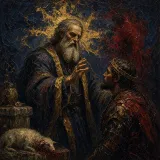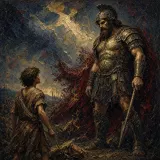
The big picture
The Amalekite campaign turns on a clash between Saul's repeated claim that he obeyed and the visible, audible evidence that he altered the command. Agag lives, valuable livestock survives, and sheep are still bleating when Saul tells Samuel, “I have performed the commandment of the LORD.” The Book of 1 Samuel does not hide the severity of the original command, including its reach beyond combatants, but it is equally direct about what Saul and the people chose to spare. Samuel's confrontation moves beneath sacrifice to the issue of hearing: obedience cannot be manufactured afterward by giving a religious purpose to what was kept. Saul confesses, yet the rejection of his kingship stands. A torn mantle gives the verdict physical form. The chapter closes with separation rather than triumph, as Samuel mourns Saul and the LORD's regret frames the loss.
Central truth
Saul's claim of obedience collapses before the spared king and livestock, and Samuel announces that rejected divine words cannot be repaired by sacrificial promises or public honor.
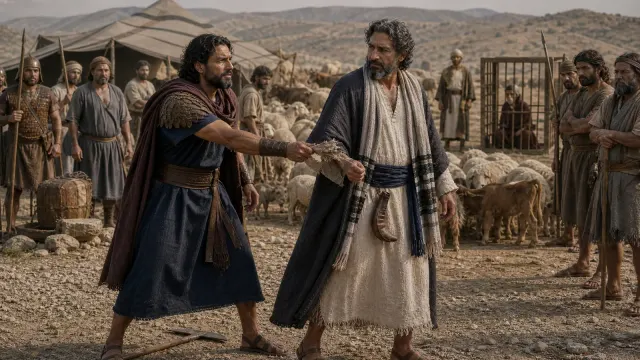

The study notes have a page of their own
The movement by movement analysis, the words to trace, the verse by verse notes and where readers differ are written for someone studying alone. They are on the Deep Personal Reflections page for this chapter. This page is the lesson.
A chapter-specific teaching brief
These anchors come from this chapter itself. They help a teacher use the Level 1 overview, the Level 2 study, and the Scripture text as one lesson.
Open with the chapter’s first image
1 Samuel 15:1: “Samuel also said unto Saul, The LORD sent me to anoint thee to be king over his people, over Israel: now therefore hearken thou unto the voice of the words…”
Slow down at the turning point
1 Samuel 15:18: “And the LORD sent thee on a journey, and said, Go and utterly destroy the sinners the Amalekites, and fight against them until they be consumed.”
Keep this word trail visible
LORD, Saul, Samuel, Israel, king, Amalekites
What to explain, in order
Teach the passage in this order. Each step names the verses it rests on, so every point can be shown in the text before it is applied.
1 Samuel 15:1-3
A hard command, stated plainly
Read the command without softening it. Samuel reminds Saul that the LORD anointed him and tells him to hearken. The LORD remembers what Amalek did when Israel came out of Egypt (Exodus 17:8-16; Deuteronomy 25:17-19), attacking the weak at the rear. Then 15:3 commands total destruction, including women, children and animals. Say honestly that this is one of the hardest verses in Scripture and that the class may feel its weight. Explain that the text presents it as God's judgment on a particular people at a particular time, and that it gives no one a command against any people today.
1 Samuel 15:4-9
What was spared and why
Saul musters a large army and, before attacking, warns the Kenites to leave because they had shown kindness to Israel (15:6). Note that care. Then 15:7-9: Saul defeats Amalek, takes Agag alive, and he and the people spare the best animals. Explain "fatlings" as fattened animals and "vile and refuse" as worthless. Teach this step to establish the facts before Saul speaks, because his account will differ from the narration. The Book of 1 Samuel tells us what happened first, so we can test what Saul says.
1 Samuel 15:10-11
It repenteth me
Pause on the LORD's word to Samuel: "It repenteth me that I have set up Saul to be king" (15:11). Explain that "repent" here expresses God's grief and his turning from Saul as king, not that God made a mistake he did not foresee. Show Samuel's response: "it grieved Samuel; and he cried unto the LORD all night". Teach this before the confrontation so learners see that God's verdict is spoken with sorrow and that Samuel prays all night before speaking. Note that 15:29 and 15:35 will return to the word "repent".
1 Samuel 15:12-21
I have performed the commandment
Saul has set up a monument for himself at Carmel (15:12), which already tells us something. He greets Samuel with a claim of obedience. Samuel answers with the bleating and lowing. Saul blames the people and adds a pious motive. Samuel reminds him, "When thou wast little in thine own sight, wast thou not made the head of the tribes of Israel" (15:17), recalling 9:21. Explain "fly upon the spoil" as rushing greedily on the plunder. Teach this as a study in self-justification, tracking how Saul's account shifts as he is pressed.
1 Samuel 15:22-23
To obey is better than sacrifice
Read Samuel's poetic verdict slowly. Explain that "rebellion is as the sin of witchcraft, and stubbornness is as iniquity and idolatry": refusing God's word puts self in God's place, as idolatry does. Then the sentence: because Saul rejected the word of the LORD, the LORD rejected him as king. Connect to 13:13-14. Teach this step as the centre of the chapter and as a principle that runs through Scripture (Psalm 51:16-17; Hosea 6:6; Micah 6:6-8): God wants hearts that hear him, not offerings that substitute for hearing.
1 Samuel 15:24-35
A torn mantle and a grieving prophet
Read Saul's confession, his request, and the tearing of the mantle. Explain "the Strength of Israel" as a title for God and show that 15:29 says God will not "repent" of this verdict, while 15:11 and 15:35 say he repented that he made Saul king. The point is that God grieves over Saul and will not reverse the sentence. Then Agag: describe his execution soberly and read Samuel's reason, "As thy sword hath made women childless" (15:33). End with Samuel mourning for Saul. Teach the chapter's last note as grief, not triumph.
Where learners get stuck
The misreadings this passage tends to produce, and how to answer each from the text.
"This chapter means God approves of killing whole peoples, and believers could do it today."
The command in 15:3 is presented as the LORD's judgment on Amalek for what it did to Israel (15:2), given through a prophet to Israel's king at one moment in history. It is not a standing command and it is not transferable to any modern group. Jesus taught his followers to love their enemies (Matthew 5:44). Say that the passage is hard and that Christians have long wrestled with it. Do not explain it away, and do not let it be used to justify violence against anyone.
"Saul did mostly what God said, so God was unfair."
Saul spared what was valuable and destroyed what was worthless (15:9), then claimed full obedience (15:13, 20). This is not a near miss but selective obedience with a religious excuse laid over it, and it repeats the pattern of chapter 13. Samuel names the root as rejecting "the word of the LORD" (15:23). Teach learners that partial obedience that keeps what we want is a form of disobedience. Saul's own admission, "I feared the people" (15:24), shows the real reason.
"God changed his mind about Saul, so God can be wrong."
The same chapter says the LORD "repented" (15:11, 35) and that he "will not lie nor repent: for he is not a man" (15:29). Verse 29 means God will not reverse this verdict as a man might. Verses 11 and 35 express God's grief over Saul's reign. Theologians in different traditions describe this language differently, and the lesson need not settle every question. Keep the plain sense: God's purposes are firm, and he is not indifferent to human failure.
"Obeying is better than sacrifice, so worship and church do not matter."
Samuel is answering Saul, who tried to use sacrifice as an excuse for disobedience (15:15, 21). The LORD had commanded sacrifices in his law. The point is that worship cannot replace hearing and doing what God says, as Psalm 51:17 and Micah 6:8 also teach. Teach learners that worship and obedience belong together; Saul's failure was not that he offered sacrifice, but that he offered what God had forbidden him to keep.
Learning objectives
- Identify the command and Saul's selective compliance.
- Explain why the surviving animals contradict Saul's greeting.
- Trace Saul's shifting explanations and admission.
- State Samuel's comparison of obedience and sacrifice.
- Explain the torn mantle's announced significance.
- Distinguish divine regret from reversal of the announced rejection.
Teacher preparation
- Read 15:1–35 with Exodus 17:8–16 and Deuteronomy 25:17–19 for the stated Amalek background.
- Acknowledge that 15:3 includes women and children; neither sanitize that difficulty nor convert this ancient command into modern authorization for violence.
- Mark who speaks each explanation in 15:13–24; do not treat Saul's account as the book's endorsement.
- Compare 15:11, 29, 35; distinguish regret over Saul's appointment from the unchanged verdict.
- Use sober, non-graphic language for Agag's execution; retain Samuel's charge concerning Agag's victims in 15:33.
Evidence and interpretation checks
Explicit
Read 15:8–9, 13–15: Agag and the best livestock survive, contradicting Saul's assertion that he performed the command.
Scripture-supported
Join 15:22–23 with 15:1: the central issue is hearkening to the Lord's words, not offering an impressive religious explanation afterward.
Strong inference
Infer from 15:24, 30 that fear of people and concern for public honor influence Saul's response; avoid claiming complete access to his inward repentance.
Possible or traditional reading
Read 15:29 as the firmness of this announced rejection while 15:11, 35 describe regret over Saul's appointment; identify this contextual distinction without claiming it exhausts questions about divine repentance.
Limit
State that 15:2–3 gives an ancient judgment command, not a transferable mandate against any present people; the chapter does not answer every moral question its severity raises.
Discussion with answer guidance
1. What survives that the command had not permitted Saul to spare?
What a good answer contains
Agag and the best of the animals. The command was "utterly destroy all that they have, and spare them not" (15:3). But "Saul and the people spared Agag, and the best of the sheep, and of the oxen, and of the fatlings, and the lambs, and all that was good, and would not utterly destroy them: but every thing that was vile and refuse, that they destroyed utterly" (15:9). A good answer notices the pattern: what was valuable was kept and what was worthless destroyed. A weak answer calls this mercy, when the text shows selection by value, and the king kept alive while his people were not.
Show teacher guidance
Compare 15:3 with 15:8–9: Agag and the best animals. Do not recast this selective preservation of valuable spoil as simple universal mercy.
2. Why does Samuel answer Saul's confident greeting by mentioning animal sounds?
What a good answer contains
Because Saul's claim is contradicted by the noise around him. Saul greets Samuel, "Blessed be thou of the LORD: I have performed the commandment of the LORD" (15:13). Samuel answers, "What meaneth then this bleating of the sheep in mine ears, and the lowing of the oxen which I hear?" (15:14). A good answer sees the irony: the evidence of disobedience is audible. Handle it carefully, since the chapter involves killing; the irony exposes Saul's claim, it does not make the subject light. A weak answer misses that Samuel lets the facts speak first.
Show teacher guidance
Read 15:13–14. The livestock supply inconvenient audible evidence; let the irony expose the claim without joking about the deaths.
3. How does Saul move responsibility between himself and the people?
What a good answer contains
First Saul claims obedience and blames the people: "the people spared the best of the sheep and of the oxen, to sacrifice unto the LORD thy God; and the rest we have utterly destroyed" (15:15). Note "they" spared and "we" destroyed. He repeats it in 15:20-21, "Yea, I have obeyed". Only after the verdict does he say, "I have sinned", and then "because I feared the people, and obeyed their voice" (15:24). A good answer traces the shifting pronouns. A weak answer takes Saul's first account as the truth or his last as full repentance.
Show teacher guidance
Follow 15:15, 20–21, 24. He claims obedience, blames the people, then admits fearing and obeying them.
4. What does 'to obey is better than sacrifice' answer here?
What a good answer contains
It answers Saul's claim that the spoil was kept for sacrifice. "Hath the LORD as great delight in burnt offerings and sacrifices, as in obeying the voice of the LORD? Behold, to obey is better than sacrifice, and to hearken than the fat of rams" (15:22). Saul offered God what God had told him to destroy. A good answer sees that worship cannot cover disobedience and that the LORD wants his word heard. A weak answer turns the verse into an attack on worship itself, when Samuel's target is worship used as an excuse.
Show teacher guidance
Use 15:21–23: Saul proposes sacrificing what should not have been retained. Correct the claim that worship can purchase exemption from obedience.
5. What does the torn mantle signify, and who supplies that meaning?
What a good answer contains
It signifies that the kingdom is torn from Saul, and Samuel supplies the meaning. When Saul grabs Samuel's mantle and it tears, Samuel says, "The LORD hath rent the kingdom of Israel from thee this day, and hath given it to a neighbour of thine, that is better than thou" (15:28). He adds that "the Strength of Israel will not lie nor repent" (15:29). A good answer lets Samuel's words interpret the tear. A weak answer invents other symbolism or makes the torn cloth an accident with no meaning.
Show teacher guidance
Read 15:27–29: Samuel explicitly interprets the tear as the kingdom being taken. Do not invent symbolism independently of his words.
6. What does Saul request after saying he has sinned?
What a good answer contains
In 15:25 he asks, "pardon my sin, and turn again with me, that I may worship the LORD". After Samuel refuses and the mantle tears, he says again, "I have sinned: yet honour me now, I pray thee, before the elders of my people, and before Israel" (15:30). The second request reveals what weighs most: public honour. Samuel goes with him and Saul worships (15:31). A good answer sees the concern for appearances and does not claim to read Saul's heart fully. A weak answer treats his attendance at worship as proof that things were repaired.
Show teacher guidance
Compare 15:24–25 with 15:30. Note forgiveness, Samuel's return, and public honor; do not make tears or religious attendance sufficient proof of repair.
Responsible application
Heart and habits
Ask learners to revise a fictional excuse that offers a generous gesture while avoiding an admitted responsibility.
Relationships and community
Draft an apology for an imaginary leader that owns the decision rather than blaming followers and protecting appearances.
Evidence before assurances
Compare a fictional report of completed work with observable omissions; practice truthful correction without humiliation or self-righteous celebration.
Session plans
Two timings of the same lesson. The shorter keeps the reading, the central discussion and one response; the longer gives the confusions and the application their own time.
45 minutes
The command
Read 15:1-3. Name the difficulty honestly and use confusion one.
What was spared
Read 15:4-9. Ask question one.
Bleating sheep
Read 15:10-21. Take questions two and three and confusion two.
To obey is better
Read 15:22-23. Ask question four and use confusion four.
The torn mantle
Read 15:24-31. Take questions five and six and confusion three.
Mourning and handout
Read 15:34-35, the key verse together, and give out the handout. Close in prayer.
90 minutes
Hard texts
Tell the group the chapter contains a hard command. Ask how they usually respond to difficult passages, and set ground rules for honest discussion.
Amalek and the command
Read Exodus 17:8-16, Deuteronomy 25:17-19 and 15:1-3. Use confusion one carefully.
The battle and the spoil
Read 15:4-9 and take question one. Note the warning to the Kenites.
Saul's account
Read 15:10-21. Take questions two and three and confusion two. Track the pronouns on the board.
The verdict
Read 15:22-23 with Psalm 51:16-17 and Micah 6:6-8. Take question four and confusion four.
Repent and not repent
Read 15:24-35. Take questions five and six and confusion three. Read 15:33 soberly.
Application
Use the lesson plan's application on partial obedience. Ask each person to write privately one area where they keep what they want.
Handout and prayer
Read the key verse together, point to the take-home line, and pray for hearts that hear.
Adapting the lesson
Children
For young children, leave out the details of the command and the death of Agag. Tell them God told Saul to do something and Saul did only the parts he liked, then said he had obeyed. Play the sound of sheep and ask what Samuel heard. Teach the line "to obey is better than sacrifice" as doing what God says instead of giving him something else. Keep it gentle and short.
Youth
Be honest that 15:3 is hard and let them ask questions. Explain that it is not a pattern for anyone today and that Jesus taught love of enemies. Then focus on Saul's excuses: blame, spin, a religious reason, and concern for image. Ask where they see that pattern in themselves. Avoid graphic discussion of Agag's death. Some may have been told God hates people; make clear this chapter does not teach that.
Adults
Give time to the moral difficulty of 15:3, the background in Exodus 17 and Deuteronomy 25, and the ways Christians have wrestled with it, without forcing a resolution. Then study Saul's self-justification in detail and the theology of 15:22-23. Discuss the language of God repenting in 15:11, 29 and 35. Adults in leadership can reflect on fearing people more than God. State plainly that no modern group may be mapped onto Amalek.
One to one
Read 15:13-24 together and ask which of Saul's excuses they recognise in their own life. If they struggle with the violence of 15:3, listen and do not rush to answers; tell them it troubles many believers and is not a command for today. Pray together for the honesty Saul lacked, to say "I have sinned" without adding "yet honour me".
Song and video learning lab
A song or video may interpret, compress, or dramatize the text. Its value becomes clearer when its choices are compared with Scripture.
- Before the media: the exact passage and its central movement.
- During the media: the words, people, events, and emotions the artist emphasizes.
- After the media: what it clarifies, what it leaves out, and what belongs back in the biblical text.
Handout
One page for learners to take home. The print button prints this section alone.
1 Samuel 15:1–35
The passage in brief
God tells Saul through Samuel to destroy the Amalekites completely, because of what they did to Israel after the exodus. Saul wins the battle but spares King Agag and the best animals. When Samuel arrives, Saul claims he has obeyed, but Samuel hears the sheep and cattle. Saul blames the people and says the animals are for sacrifice. Samuel answers that to obey is better than sacrifice and that God has rejected Saul as king. Saul admits he feared the people. Samuel leaves, and mourns for Saul.
A verse to keep
And Samuel said, Hath the LORD as great delight in burnt offerings and sacrifices, as in obeying the voice of the LORD? Behold, to obey is better than sacrifice, and to hearken than the fat of rams.
1 Samuel 15:22 · King James Version
Questions to take home
What did Saul and the people keep that God had told them to destroy (15:9)?
What reasons did Saul give for keeping the animals (15:15, 21)?
What does 15:22 say God wants more than sacrifice?
This week
Name one thing God has made clear to you that you have obeyed only partly, and finish it this week.
Music and video connected to the passage
Related media appears when its Scripture reference overlaps this study. Music and video can illuminate a theme while the biblical text remains the foundation.