

The big picture
The Second Epistle of Peter's second chapter puts false teachers inside the community they damage and describes their work in commercial language. They deny the Lord who bought them while turning other people into merchandise. Their threatened judgment is answered from earlier judgments, yet the long sentence about angels, the flood and Sodom finally lands on the Lord's ability to deliver as well as reserve for punishment. From there the language grows deliberately animal and humiliating. Men boast about realities they do not understand, Balaam's madness is checked by an ass, and the teachers themselves become wells without water and clouds that fail to deliver rain. They promise liberty while already enslaved to corruption. The chapter closes with escape followed by entanglement and two proverbs, leaving the return itself starkly visible without settling the later theological arguments built around it.
Central truth
2 Peter 2 exposes false teachers through destructive teaching, greed, sensuality, and empty promises of liberty while insisting that God delivers the godly and reserves the unjust for judgment.

The study notes have a page of their own
The movement by movement analysis, the words to trace, the verse by verse notes and where readers differ are written for someone studying alone. They are on the Deep Personal Reflections page for this chapter. This page is the lesson.
A chapter-specific teaching brief
These anchors come from this chapter itself. They help a teacher use the Level 1 overview, the Level 2 study, and the Scripture text as one lesson.
Open with the chapter’s first image
2 Peter 2:1: “But there were false prophets also among the people, even as there shall be false teachers among you, who privily shall bring in damnable heresies, even…”
Slow down at the turning point
2 Peter 2:10: “But chiefly them that walk after the flesh in the lust of uncleanness, and despise government. Presumptuous are they, selfwilled, they are not afraid to…”
Keep this word trail visible
Lord, delivered, evil, judgment, world, angels
What to explain, in order
Teach the passage in this order. Each step names the verses it rests on, so every point can be shown in the text before it is applied.
2 Peter 2:1-3
Insiders who come with a price
Begin with the link to 1:21: holy men were moved by the Holy Ghost, "But there were false prophets also among the people". Explain privily as secretly, damnable heresies as teachings that destroy, and feigned words as invented, plausible speech. Stop on "make merchandise of you": the hearers are treated as goods to trade. Then read "denying the Lord that bought them", a sharp phrase, since the Master who paid for them is the one they reject. Teach this first because the rest of the chapter fills in this portrait, and the class needs to see greed and doctrine together from the start.
2 Peter 2:4-9
Three judgments, two rescues, one conclusion
Explain that verses 4-9 are one long sentence: if God judged the angels, the old world and Sodom, and rescued Noah and Lot, then the Lord knows how to do both now. Hell in verse 4 renders a word associated with Tartarus; keep to Peter's point, that the angels are held "to be reserved unto judgment". Explain conversation in verse 7 as conduct, so "the filthy conversation of the wicked" is their way of living. Show that Lot "vexed his righteous soul from day to day". Then land on verse 9 slowly. This comes second because it gives the believers their footing before Peter describes the teachers in detail.
2 Peter 2:10-14
A portrait at the feast
Read verses 10-14 without stopping, then go back. These men "despise government" and are "not afraid to speak evil of dignities", while even angels refrain from railing accusation (2:11). Peter calls them "natural brute beasts" who "speak evil of the things that they understand not". Then the setting: "Spots they are and blemishes, sporting themselves with their own deceivings while they feast with you", probably the church's shared meals (compare Jude 12). Explain exercised in verse 14 as trained, the word behind gymnasium. Their hearts are in training for greed, and their prey is unstable souls.
2 Peter 2:15-16
Balaam and the wages
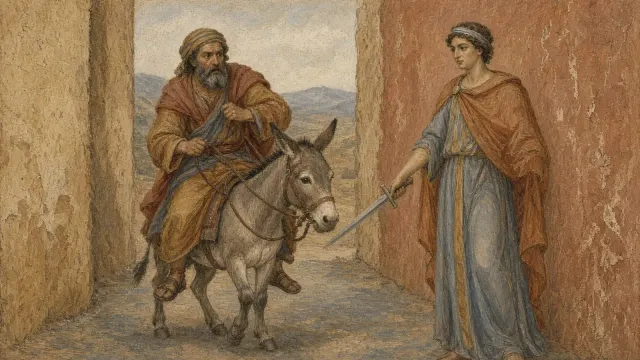
Read Numbers 22:21-35 so the class has the scene of the donkey on the road. Peter's interest is in what drove the prophet: Balaam "loved the wages of unrighteousness". Bosor is the King James spelling for Beor, Balaam's father in Numbers 22:5. Then show Peter's irony: "the dumb ass speaking with man's voice forbad the madness of the prophet". An animal had more sense than a seer who could be hired. Place Balaam here because he gathers up the greed of 2:3 and 2:14 into one figure the class will remember.
2 Peter 2:17-19
Wells without water and promises of liberty
Give the two pictures time: "wells without water, clouds that are carried with a tempest". Both promise what a thirsty land needs and deliver nothing. Then explain how they work: "they speak great swelling words of vanity", impressive and empty, and "allure through the lusts of the flesh" those who were just escaping. Read verse 19 last and teach its rule plainly: "of whom a man is overcome, of the same is he brought in bondage". Put this step before the last because the class needs to understand the lure before it hears what happens to those who take it.
2 Peter 2:20-22
Worse than the beginning
Read verses 20-21 slowly. Those who "escaped the pollutions of the world through the knowledge of the Lord and Saviour Jesus Christ" and are "again entangled therein" end worse than they began; it would have been "better for them not to have known the way of righteousness". Then read the proverbs in verse 22; the first is from Proverbs 26:11. Do not soften them or make them comic. End the chapter here, as Peter does, and let the weight of the warning stand before you move to the debates it raises.
Where learners get stuck
The misreadings this passage tends to produce, and how to answer each from the text.
"Verse 4 means the devil and all demons are already locked away, so they cannot touch us."
Peter speaks of "the angels that sinned", held in "chains of darkness, to be reserved unto judgment" (2:4). He does not identify which rebellion he means, and Jude 6 speaks in similar terms of angels "which kept not their first estate". Peter's own first letter warns that the devil "walketh about, seeking whom he may devour" (1 Peter 5:8). So the verse cannot mean every evil spirit is now inactive. Keep to Peter's purpose: God has already judged rebels of the highest rank and will judge these teachers.
"We would spot false teachers easily; they are obvious outsiders."
Peter says the opposite. They are "among you" (2:1), they work "privily", with "feigned words" (2:3), and they sit at the church's table, "while they feast with you" (2:13). Their speech is "great swelling words" (2:18), which sound impressive. The marks Peter gives are not their accent or their dress but their conduct: greed, sensuality, contempt for authority, and the way they treat unstable people. Teach the class to watch those things, not only the doctrine statement.
"Lot could not really have been righteous after what Genesis 19 tells us."
Peter calls him "just Lot" and "that righteous man" (2:7-8), and says he "vexed his righteous soul from day to day" at what he saw. Genesis 19 does record grave failures, including his offer of his daughters and his lingering when told to flee (19:16). Peter does not deny them. He shows a man who was grieved by the evil around him and whom the Lord rescued anyway. That is the comfort of verse 9: the Lord knows how to deliver the godly, imperfect as they are.
"Verses 20-22 prove that true Christians can lose their salvation," or, "They prove these people were never Christians."
Both conclusions are held by serious readers, and the passage does not settle the wider debate. Peter says they "escaped the pollutions of the world through the knowledge of the Lord" (2:20), which is real contact with the truth. He also says the dog returned to "his own vomit" (2:22), which some read as a nature that never changed. Present both readings fairly. What no reading may do is weaken the warning: "the latter end is worse with them than the beginning".
Learning objectives
- Identify the motives and methods assigned to false teachers in verses 1–3.
- Trace the judgment examples in verses 4–9 and the deliverances within them.
- Describe the character traits Peter piles up in verses 10–14.
- Explain how Balaam functions as a greed-driven warning in verses 15–16.
- Interpret the wells without water and promised liberty images.
- State the warning of verses 20–22 without softening its severity.
Teacher preparation
- Read the whole chapter aloud because its force depends on accumulated examples and descriptions.
- Review Genesis 6–9, Genesis 19, and Numbers 22–24 before teaching Noah, Lot, and Balaam.
- Explain privily as secretly and feigned words as fabricated or deceptive speech.
- Note that KJV hell in verse 4 translates language associated with Tartarus; avoid building an entire afterlife doctrine here.
- Deliver verses 12–22 calmly. The language is already severe and needs no theatrical thunder.
Evidence and interpretation checks
Explicit
Verses 1–3 describe secret destructive teaching, denial of the Lord, many followers, covetous exploitation, and feigned words.
Scripture-supported
Verses 4–9 recall judgments and deliverances, ending with the Lord’s ability to deliver the godly and reserve the unjust for judgment.
Strong inference
Verses 13–14 place the teachers at shared feasts while they beguile unstable souls, showing danger from inside the congregation.
Possible or traditional reading
Verse 4’s sinful angels are often linked with Genesis 6 or a broader angelic rebellion. The chapter itself does not identify the event.
Limit
Verses 20–22 warn of a terrible return to corruption but do not settle every later debate about apostasy, perseverance, or prior spiritual state.
Discussion with answer guidance
1. What warning signs appear before verse 4 mentions an ancient judgment?
What a good answer contains
Verses 1-3 give five before any history is recalled. The teachers are "among you"; they "privily shall bring in damnable heresies"; they go as far as "denying the Lord that bought them"; "many shall follow their pernicious ways"; and "through covetousness shall they with feigned words make merchandise of you" (2:3). A good answer notices that doctrine, popularity and money appear together, and that the damage spreads beyond the church, since "the way of truth shall be evil spoken of". A weak answer names only wrong doctrine.
Show teacher guidance
Look for secret heresies, denial, many followers, and covetous exploitation through feigned words.
2. How do Noah and Lot complicate a chapter dominated by judgment?
What a good answer contains
They show that judgment and rescue belong to the same God. In the flood God "saved Noah the eighth person, a preacher of righteousness" (2:5); at Sodom he "delivered just Lot" (2:7). Peter's long sentence lands on verse 9: "The Lord knoweth how to deliver the godly out of temptations, and to reserve the unjust unto the day of judgment to be punished". A strong answer keeps both halves of verse 9 and sees the comfort in it for believers living among false teachers. A weak answer hears only the judgment.
Show teacher guidance
Use verses 5, 7, and 9: judgment is real, and the Lord also delivers the godly.
3. What does Peter emphasize while the false teachers feast with the congregation in verses 13–14?
What a good answer contains
That the danger sits at the church's own table. They are "sporting themselves with their own deceivings while they feast with you" (2:13), with "eyes full of adultery", "beguiling unstable souls", and "an heart they have exercised with covetous practices" (2:14). A good answer notices the word exercised, trained as an athlete trains, and the target, the unstable. The strong answer also sees that these men are welcome guests, not strangers at the door. A weak answer lists vices without noticing where they are practised.
Show teacher guidance
Point to deception, adultery, unstable souls, and a heart trained in covetous practices.
4. Why is Balaam fitting in verses 15–16?
What a good answer contains
Because Balaam was a prophet who could be bought. Peter says the teachers are "following the way of Balaam the son of Bosor, who loved the wages of unrighteousness" (2:15). Numbers 22-24 shows him willing to curse Israel for Balak's reward. Then the humiliation: "the dumb ass speaking with man's voice forbad the madness of the prophet" (2:16). A good answer joins Balaam to the covetousness of 2:3 and 2:14. A weak answer dwells on the talking donkey and loses the point about wages.
Show teacher guidance
Anchor the answer in loving unrighteous wages. The donkey is memorable, but greed is Peter’s point.
5. What contradiction sits inside the promise of liberty in verse 19?
What a good answer contains
They offer freedom while being slaves. "While they promise them liberty, they themselves are the servants of corruption" (2:19), and Peter gives the rule: "of whom a man is overcome, of the same is he brought in bondage". A good answer explains that whatever masters a person owns them, so a teacher ruled by appetite cannot hand out freedom. The strong answer connects this to the "wells without water" of verse 17: promise without supply. A weak answer treats liberty as bad in itself, which Peter does not say.
Show teacher guidance
They promise liberty while serving corruption. Keep the discussion on mastery and bondage.
6. What do the dog and washed sow images add after verses 20–21?
What a good answer contains
They show that the return is a return to what was always there. "The dog is turned to his own vomit again; and the sow that was washed to her wallowing in the mire" (2:22). The dog returns to its own vomit; the sow was washed outside but goes back to the mud. A good answer links this to verse 20, "the latter end is worse with them than the beginning", and verse 21's "better for them not to have known". A weak answer softens the images or treats them as a joke.
Show teacher guidance
They make return vivid and repulsive. Do not sanitize Peter’s closing images.
Responsible application
Check the invoice
Use verses 2–3 and 14–15 to examine whether teaching is entangled with greed, manipulation, or exploitation.
Test promised liberty
Use verse 19 to evaluate any message of freedom by asking what its teachers are themselves mastered by.
Protect unstable souls
Use verse 14 to build safeguards around learners easily impressed by confidence, charisma, or spiritual-sounding novelty.
Session plans
Two timings of the same lesson. The shorter keeps the reading, the central discussion and one response; the longer gives the confusions and the application their own time.
45 minutes
Among you
Read 2:1-3 aloud and take question one. List the five warning signs on the board.
The Lord knows how
Read 2:4-9 as one sentence. Take question two and confusion three on Lot, and finish on verse 9.
At your table
Read 2:10-14. Take question three and confusion two, explaining exercised as trained.
The wages of Balaam
Read 2:15-16 and take question four. Keep the class on the wages, not the donkey.
Empty wells and the way back
Read 2:17-22. Take questions five and six, then confusion four briefly, keeping the force of verse 21.
Handout and prayer
Read the key verse together and pray for any who are being drawn away by attractive teaching.
90 minutes
How would you know
Ask the group how they would recognise a false teacher in their own church. Write their answers down and keep them for later.
Insiders with a price
Read 1:21 and 2:1-3. Take question one. Explain privily, damnable heresies and make merchandise.
Judgment and rescue
Read 2:4-9, then Genesis 19:15-16. Take question two and confusions one and three. Have the class finish the sentence of verse 9 from memory.
The portrait at the feast
Read 2:10-14 and Jude 12. Take question three and confusion two. Mark every phrase about appetite, contempt or greed.
Balaam on the road
Read Numbers 22:21-35, then 2 Peter 2:15-16. Take question four and connect it back to 2:3 and 2:14.
Liberty that enslaves
Read 2:17-19 and take question five. Ask what modern promises of freedom come from people mastered by something.
Worse than the beginning
Read 2:20-22 and Proverbs 26:11. Take question six and confusion four, presenting both readings fairly.
Back to the list, and prayer
Compare the opening list with Peter's marks. Read the key verse together, give out the sheet, and pray for the unstable and for those leading them.
Adapting the lesson
Children
Focus on Noah, Lot and Balaam, three people from accounts the children may know, and on verse 9: God knows how to rescue those who love him. Use a cup with no water in it to show the empty well of verse 17. Leave out the sexual sins of verses 10-14 and the details of Sodom, and do not try to frighten them with the chapter.
Youth
Spend time on verses 18-19, because promises of freedom are aimed at them constantly. Ask what the people offering that freedom are themselves mastered by. Let them say what makes a teacher sound convincing, then compare it with Peter's marks. Treat the sexual language of verse 14 honestly and briefly, and keep the focus on how they are being targeted as unstable souls.
Adults
Read the whole chapter in one sitting first, then trace the links between doctrine, money, appetite and contempt for authority. Give time to Lot and to the debate around verses 20-22, presenting the main readings fairly. Ask how a congregation protects new and unsettled believers from attractive teachers without becoming suspicious of everyone.
One to one
Ask whether the person has ever followed a teacher who later proved false, and listen before teaching. If they have, verse 9 is for them: the Lord knows how to deliver. If they are being drawn now, read verse 19 together and ask gently what the teaching has asked of them, including money. Do not use verses 20-22 to frighten a struggling believer.
Song and video learning lab
A song or video may interpret, compress, or dramatize the text. Its value becomes clearer when its choices are compared with Scripture.
- Before the media: the exact passage and its central movement.
- During the media: the words, people, events, and emotions the artist emphasizes.
- After the media: what it clarifies, what it leaves out, and what belongs back in the biblical text.
Handout
One page for learners to take home. The print button prints this section alone.
2 Peter 2
The passage in brief
Peter warns that false teachers will rise up inside the church. They bring in harmful teaching secretly, they are driven by greed, and they use smooth words to take advantage of people. Peter reminds his readers that God judged the sinning angels, the world of Noah's day and Sodom, yet rescued Noah and Lot. The Lord knows how to rescue the godly. False teachers promise freedom, but they are slaves to their own desires. Turning back from the truth after knowing it leaves a person worse off than before.
A verse to keep
The Lord knoweth how to deliver the godly out of temptations, and to reserve the unjust unto the day of judgment to be punished:
2 Peter 2:9 · King James Version
Questions to take home
What warning signs does Peter give in 2:1-3?
What do Noah and Lot show about God in 2:5-9?
Why can't someone who is a slave to something give real freedom (2:19)?
This week
Before you trust a teacher this week, ask what they want from you and what masters them.
Music and video connected to the passage
No exact media match is cataloged for this passage yet. New material can be connected when it becomes available.