The big picture
The Book of Acts, chapter 19, makes Ephesus a prolonged center of teaching whose effects spread far beyond one room. Disciples limited to John's baptism receive fuller instruction, daily teaching continues for years, and extraordinary healings are explicitly attributed to God. The attempt by exorcists to borrow Jesus' name as a technique fails violently, while believers publicly renounce costly magical practices. The final crisis reveals another kind of cost. Demetrius begins with the craftsmen's wealth, expands the concern to Diana's honor, and helps trigger a confused theatre gathering. The town clerk finally restores procedure by distinguishing accusation from proof and lawful hearing from uproar. The Book of Acts shows the name of Jesus unsettling both religious technique and religious business.
Central truth
The word of the Lord prevails in Ephesus as incomplete disciples receive fuller instruction, magical practices are abandoned, and threatened profits help drive opposition to the worship of the living God.

The study notes have a page of their own
The movement by movement analysis, the words to trace, the verse by verse notes and where readers differ are written for someone studying alone. They are on the Deep Personal Reflections page for this chapter. This page is the lesson.
A chapter-specific teaching brief
These anchors come from this chapter itself. They help a teacher use the Level 1 overview, the Level 2 study, and the Scripture text as one lesson.
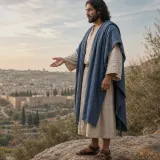
Open with the chapter’s first image
Acts 19:1: “And it came to pass, that, while Apollos was at Corinth, Paul having passed through the upper coasts came to Ephesus: and finding certain disciples,”
Slow down at the turning point
Acts 19:21: “After these things were ended, Paul purposed in the spirit, when he had passed through Macedonia and Achaia, to go to Jerusalem, saying, After I have been…”
Keep this word trail visible
Paul, Jesus, Asia, Diana, evil, people
What to explain, in order
Teach the passage in this order. Each step names the verses it rests on, so every point can be shown in the text before it is applied.
Acts 19:1-7
Disciples who knew only John
Begin in Ephesus with about twelve disciples who know only John’s baptism. Read Paul’s question and their answer, and explain that they had not heard that the Spirit John promised had been given. Paul explains that John pointed to Jesus, and they are baptized in his name; when he lays hands on them, they speak with tongues and prophesy. Traditions read this and the earlier outpourings differently, as a pattern for believers or as a unique completion of John’s followers. Present the views fairly. Teach that faith is filled out in Jesus.
Acts 19:8-10
Two years in the school of Tyrannus
Paul speaks boldly in the synagogue for three months, reasoning about the kingdom of God. When some harden and speak evil of the way, he moves the disciples to the lecture hall of Tyrannus and teaches daily for two years. Mention that some ancient manuscripts add that he taught from the fifth hour to the tenth, the heat of the day when the hall stood empty; the King James does not include it. Show the result in verse 10: all Asia heard the word. Teach that patient, daily teaching was as important as the dramatic events that follow.
Acts 19:11-20
The name is not a spell
God works special miracles by Paul, even through cloths taken from him. Read this carefully: the Book of Acts credits God, not the cloths. Then the sons of Sceva, travelling exorcists who try to use the name of Jesus as a formula. The spirit knows Jesus and knows Paul but not them, and they flee naked and wounded. Explain how this leads to fear and to the name of Jesus being magnified. Then the confession and the burning of magic books worth fifty thousand pieces of silver, and verse 20, the word growing mightily.
Acts 19:21-27
Demetrius and the silver shrines
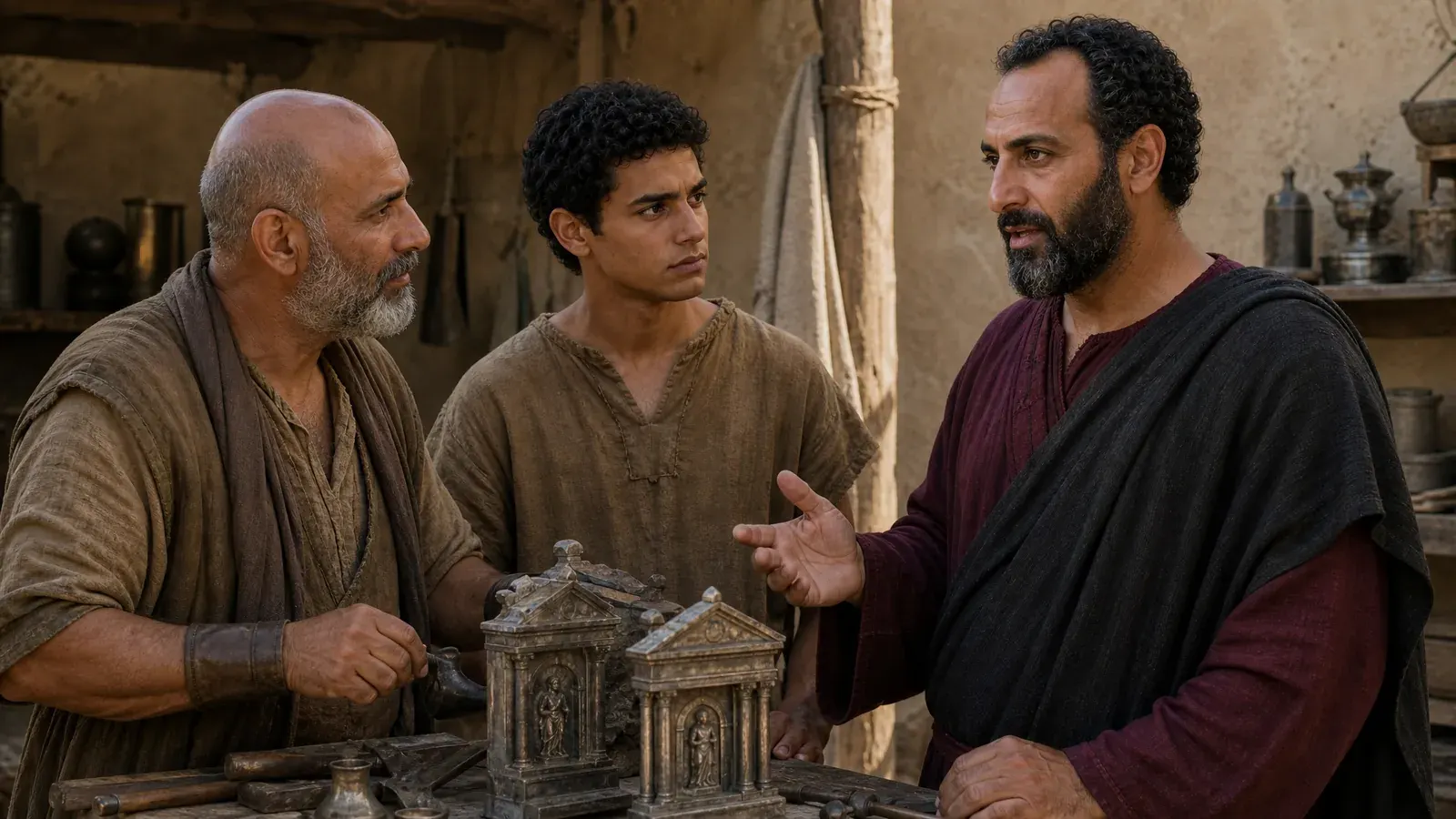
Note verse 21, where Paul purposes in the spirit to go to Jerusalem and then to Rome, which sets the course of the rest of Acts. Then the stir about that way. Introduce Demetrius, a silversmith making shrines of Diana, the Roman name for Artemis, whose temple at Ephesus was one of the wonders of the ancient world. Read his speech slowly and let the class notice that he begins with wealth and only then turns to the goddess. Teach that the gospel unsettled not only beliefs but an economy built on idols.
Acts 19:28-34
Two hours of shouting
The craftsmen shout “Great is Diana of the Ephesians”, the city fills with confusion, and two of Paul’s companions are dragged into the theatre, which could hold many thousands. Paul wants to go in, but the disciples and some officials of Asia, his friends, stop him. Read verse 32, which is almost comic: most of them do not know why they are there. Then Alexander, put forward by the Jews, perhaps to separate them from Paul, is shouted down for two hours. Teach the power and the emptiness of a crowd.
Acts 19:35-41
The town clerk
The town clerk was the chief civic officer, responsible to Rome for order. Show his argument: Ephesus’s devotion is beyond question, so there is no need to riot; the accused have not robbed temples or blasphemed; the courts and proconsuls are open; other matters belong to the lawful assembly; and Rome may punish the city for this uproar. Then he dismisses them. Teach that, as with Gallio, God used an ordinary official to protect his people. The chapter that began with twelve disciples ends with a whole city quieted.
Where learners get stuck
The misreadings this passage tends to produce, and how to answer each from the text.
“These disciples were not really saved until they spoke in tongues.”
The twelve knew only John’s baptism (19:3) and had not heard that the Holy Ghost had been given (19:2). Paul explains that John pointed to Jesus, and they believe and are baptized in his name (19:4-5). The tongues and prophecy in 19:6 accompany the Spirit’s coming. Traditions read this differently, some as a pattern for all and some as particular to John’s followers being brought into the church. Present the views fairly and do not cast doubt on any learner.
“The handkerchiefs show that objects can carry healing power.”
Verse 11 says God wrought special miracles by the hands of Paul, and calls them special, that is unusual. The cloths were the means on this occasion, but the power was God’s. Christian traditions differ in how they regard objects associated with holy people, and Acts does not settle that. The same chapter shows the sons of Sceva trying to use the name of Jesus mechanically and failing (19:13-16), which warns against treating anything as a technique.
“Burning the books means we should destroy anything we disagree with.”
The people who burned the books were believers who owned them and had used them for magic (19:18-19). They destroyed their own property as a public sign of repentance. Paul did not seize or burn anyone else’s possessions, and the town clerk later says that Paul’s companions were not robbers of temples (19:37). The lesson is personal renunciation of what draws us from God, not attacks on other people’s belongings.
“Demetrius was simply defending his religion.”
Demetrius speaks first of wealth: “by this craft we have our wealth” (19:25), and of the danger to the trade (19:27). His appeal to the goddess comes second. The Book of Acts lets us hear the mix of motives. Believers can learn from this to examine their own motives when the gospel threatens something they profit from. The text is not a rule against trade but a warning about wealth tied to idols.
Learning objectives
- Identify what Paul discovers about the Ephesian disciples’ instruction.
- Distinguish God’s special miracles from attempted use of Jesus’ name as magic.
- Explain the significance of the voluntarily burned books.
- Separate Demetrius’s financial and religious appeals.
- Contrast the crowd’s volume with its understanding.
- Describe the town clerk’s argument for ending the uproar.
Teacher preparation
- Read Acts 18:24–19:7; distinguish Apollos from the approximately twelve disciples Paul encounters.
- Gloss “curious arts” in 19:19 as magical practices, not creative arts or intellectual curiosity.
- Mark God as the actor in 19:11; do not turn handkerchiefs and aprons into a reproducible healing technique.
- Keep the fifty thousand pieces of silver as the chapter’s stated valuation; avoid an unsupported modern currency conversion.
- Explain “robbers of churches” in 19:37 in its temple setting and “implead” in 19:38 as bringing a legal charge; avoid reenacting violence or burning objects.
Evidence and interpretation checks
Explicit
Read Acts 19:4–7, 11–12, 18–20: Paul points to Jesus, God works unusual miracles, and practitioners abandon their own magical books.
Scripture-supported
Compare Acts 19:26 with Isaiah 44:9–20: objects manufactured by human hands are challenged as gods.
Strong inference
Infer from Acts 19:19 and 19:24–27 that changed allegiance has real economic consequences, both willingly accepted and angrily resisted.
Possible or traditional reading
Identify differing readings of the disciples’ spiritual condition before Acts 19:5–6. Keep their limited knowledge, John’s baptism, further instruction, baptism in Jesus’ name, and reception of the Spirit visible.
Limit
State that Acts 19:19 authorizes no seizure of other people’s books, and 19:11–12 promises no commercial healing objects or universal method.
Discussion with answer guidance
1. What does Paul ask after the disciples say they have not heard about the Holy Ghost?
What a good answer contains
He asks about their baptism: “Unto what then were ye baptized? And they said, Unto John’s baptism” (19:3). Then he explains that John’s baptism of repentance pointed people to “believe on him which should come after him, that is, on Christ Jesus” (19:4). They are baptized in the name of the Lord Jesus, Paul lays hands on them, and the Holy Ghost comes on them (19:5-6). A good answer follows the conversation to Jesus. A weak answer stops at the disciples’ surprising first reply.
Show teacher guidance
Read 19:2–4. He asks about their baptism and explains John’s direction toward Jesus; do not stop at their first answer.
2. How does the Book of Acts distinguish Paul’s miracles from Sceva’s sons’ attempt?
What a good answer contains
By who is acting. “God wrought special miracles by the hands of Paul” (19:11); the healings are God’s work. The sons of Sceva try to use the name as a formula: “We adjure you by Jesus whom Paul preacheth” (19:13). The spirit answers “Jesus I know, and Paul I know; but who are ye?” (19:15), and they flee wounded. A strong answer sees that the name of Jesus is not a spell; it belongs to those who belong to him. A weak answer turns the scene into a contest of techniques.
Show teacher guidance
Compare 19:11–16. God works through Paul; the others invoke Jesus as the one Paul preaches, and their attempted formula fails.
3. Why does the value of the burned books matter?
What a good answer contains
Because it shows how real the change was. Those who “used curious arts brought their books together, and burned them before all men”, and the value came to “fifty thousand pieces of silver” (19:19), a very great sum. They had confessed their deeds first (19:18). The result is stated: “So mightily grew the word of God and prevailed” (19:20). A good answer sees a costly public turning from the old life. It is not a payment for forgiveness, and it was their own property they burned.
Show teacher guidance
Use 19:18–20. The abandonment is public and costly; do not make the price an entry fee for forgiveness or encourage destroying anyone else’s property.
4. Which concern does Demetrius name first to the craftsmen?
What a good answer contains
Money. Demetrius tells the workmen “Sirs, ye know that by this craft we have our wealth” (19:25), then says Paul’s teaching that “they be no gods, which are made with hands” threatens their trade (19:26). Only after that does he add that “the temple of the great goddess Diana should be despised” (19:27). A strong answer notes the order: profit first, piety second. A weak answer takes his religious concern at face value and misses what the Book of Acts lets us overhear.
Show teacher guidance
Read 19:24–27. Begin with their wealth and endangered trade, then include his appeal to Diana’s temple and prestige.
5. What does the crowd know about why it has gathered?
What a good answer contains
Very little. “Some therefore cried one thing, and some another: for the assembly was confused; and the more part knew not wherefore they were come together” (19:32). Yet when Alexander tries to speak, they shout “Great is Diana of the Ephesians” with one voice for about two hours (19:34). A good answer sees how loud agreement can sit on top of thin understanding. A weak answer mocks the crowd rather than noticing how easily any crowd can be moved.
Show teacher guidance
Read 19:29–34. Many do not know the reason, despite prolonged shouting. Let the contrast between loud agreement and thin understanding speak for itself.
6. How does the town clerk redirect the crowd?
What a good answer contains
By calming them and pointing to the law. He says Ephesus’s devotion to Diana is beyond dispute, so “ye ought to be quiet, and to do nothing rashly” (19:36). He says Paul’s companions are neither temple robbers nor blasphemers of the goddess (19:37), that “the law is open” for any real complaint (19:38), and that a lawful assembly can settle other matters (19:39). He warns of being called to account for the uproar (19:40) and dismisses them. A good answer includes all these steps.
Show teacher guidance
Trace 19:35–41: he calls for calm, denies specified crimes, points to courts and lawful assembly, and warns about the uproar’s consequences.
Responsible application
Heart and habits
Assess a fictional offer to buy access to spiritual power using the distinction between God’s action and a borrowed formula.
Relationships and community
Write a calm response to an unverified group accusation, using the crowd’s confusion and the clerk’s demand for proper process.
Costly change without coercion
Design a hypothetical decision to leave a harmful income source while respecting other people’s property and freedom.
Session plans
Two timings of the same lesson. The shorter keeps the reading, the central discussion and one response; the longer gives the confusions and the application their own time.
45 minutes
Twelve disciples
Read 19:1-7 and take question one and the confusion about tongues, presenting the traditions fairly.
Two years
Read 19:8-10 and mark Asia on the map.
The name is not a spell
Read 19:11-20 and take questions two and three.
Demetrius
Read 19:21-27 and take question four.
The theatre
Read 19:28-41 in parts. Take questions five and six.
Handout
Read the key verse together and pray for courage to let go of what keeps us from God.
90 minutes
Opening
Ask the group what things people trust in for luck or protection today. Keep it general and kind.
Twelve disciples
Read 19:1-7 with 18:24-26. Take question one and the tongues confusion, presenting the views fairly.
Two years
Read 19:8-10 and discuss patient, daily teaching.
The name is not a spell
Read 19:11-17. Take question two and the confusion about handkerchiefs.
Burning the books
Read 19:18-20. Take question three and the confusion about burning.
Demetrius
Read 19:21-27. Take question four and the confusion about defending religion.
The theatre and the clerk
Read 19:28-41. Take questions five and six. Compare the clerk with Gallio in 18:14-16.
Handout and response
Read the key verse together and invite each learner, privately, to name one thing they need to give up for Christ.
Adapting the lesson
Children
Bring old papers and let the children pretend to tear up and throw away bad books in a bin as a sign of following Jesus, explaining it was their own things they gave up. Then let them shout great is Diana for a few seconds and stop to ask, why are we shouting? Explain that many people did not know. Keep the sons of Sceva simple: you cannot use Jesus’ name like magic.
Youth
Ask what people pay for today hoping to control their future: horoscopes, charms, apps. Read 19:18-20 and ask what costly things believers might need to give up. Show the sons of Sceva as a warning about using Jesus’ name without knowing him. Then the riot: ask how crowds online behave like the crowd in 19:32, loud and unsure why.
Adults
Discuss the economics of idolatry in Ephesus and where faith and money still clash. Give time to 19:1-7 and the different traditions’ readings. Ask what the Ephesian believers’ confession in 19:18 means for honesty in a congregation. Consider the role of civic officials in protecting the church and how believers can speak to such authorities with respect.
One to one
Ask the person whether there is anything in their life they rely on instead of God, and listen without judging. Read 19:18-20 together. If they feel God is asking them to let go of something, pray with them and help them think of one concrete step. If they are nervous about opposition, read 19:30-31 and talk about the friends God gave Paul.
Song and video learning lab
A song or video may interpret, compress, or dramatize the text. Its value becomes clearer when its choices are compared with Scripture.
- Before the media: the exact passage and its central movement.
- During the media: the words, people, events, and emotions the artist emphasizes.
- After the media: what it clarifies, what it leaves out, and what belongs back in the biblical text.
Handout
One page for learners to take home. The print button prints this section alone.
Acts 19
The passage in brief
In Ephesus Paul meets disciples who know only John’s baptism. He tells them about Jesus, they are baptized, and the Holy Spirit comes on them. For two years Paul teaches daily, and God does unusual miracles through him. When some men try to use Jesus’ name like a spell, they are beaten by an evil spirit. Many believers burn their costly magic books. A silversmith named Demetrius, afraid of losing money, starts a riot, but the town clerk calms the crowd.
A verse to keep
So mightily grew the word of God and prevailed.
Acts 19:20 · King James Version
Questions to take home
What did Paul ask the disciples in 19:2-3?
What did the new believers do with their magic books in 19:19?
What was Demetrius really worried about in 19:25-27?
This week
Give up one thing this week that pulls your trust away from God, and tell a believer you trust.
Music and video connected to the passage
Related media appears when its Scripture reference overlaps this study. Music and video can illuminate a theme while the biblical text remains the foundation.