

The big picture
The Book of Acts, chapter 20, begins with movement through established churches and named companions who make the itinerary look like a map populated by communities rather than a solo journey. At Troas, a long farewell gathering is interrupted by Eutychus's fatal fall and ends with the young man alive. The chapter then slows for Paul's address to the Ephesian elders at Miletus. He appeals to conduct they have witnessed, describes a ministry he intends to finish despite expected affliction, warns of threats from outside and within, and commends the church to God rather than to his continuing presence. The farewell closes with working hands, support for the weak, prayer, embraces, and tears. Authority and affection are allowed to occupy the same relationship.
Central truth
Eutychus is brought alive after his fatal fall at Troas, and Paul entrusts the Ephesian elders to God’s gracious word while charging them to guard the flock and support the weak.

The study notes have a page of their own
The movement by movement analysis, the words to trace, the verse by verse notes and where readers differ are written for someone studying alone. They are on the Deep Personal Reflections page for this chapter. This page is the lesson.
A chapter-specific teaching brief
These anchors come from this chapter itself. They help a teacher use the Level 1 overview, the Level 2 study, and the Scripture text as one lesson.
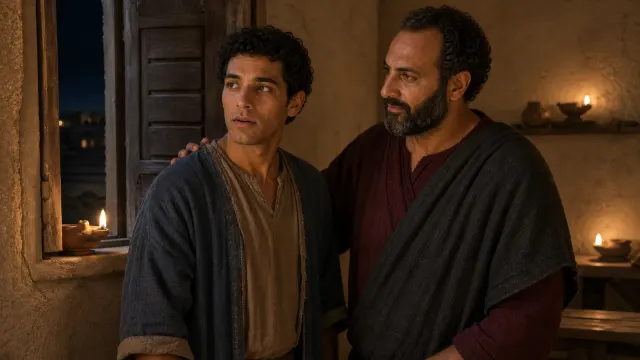
Open with the chapter’s first image
Acts 20:1: “And after the uproar was ceased, Paul called unto him the disciples, and embraced them, and departed for to go into Macedonia.”
Slow down at the turning point
Acts 20:24: “But none of these things move me, neither count I my life dear unto myself, so that I might finish my course with joy, and the ministry, which I have…”
Keep this word trail visible
Paul, Asia, know, Lord, bread, days
What to explain, in order
Teach the passage in this order. Each step names the verses it rests on, so every point can be shown in the text before it is applied.
Acts 20:1-6
Leaving Ephesus and gathering a company
Begin with the movement after the riot. Paul embraces the disciples, goes through Macedonia giving much exhortation, spends three months in Greece, and changes his route when a plot is laid. Read the list of companions in verse 4 aloud. Explain that many think they carried the collection for the poor in Jerusalem from the churches, which Paul mentions in Romans 15:25-26 and 2 Corinthians 8 and 9. Note the return of we in verse 5. Teach this briefly so the class understands that the rest of the chapter is a journey of farewells toward Jerusalem.
Acts 20:7-12
Midnight at Troas
Set the scene: the first day of the week, a gathering to break bread, many lamps in an upper room, a long night because Paul leaves at dawn. Explain that traditions read breaking bread here as the Lord’s Supper, a shared meal, or both, and that the first day is often seen as an early sign of Sunday gathering. Then Eutychus, overcome by sleep in a window, falls three storeys and is taken up dead. Paul embraces him as Elijah and Elisha did. Teach the comfort of verse 12, which is the chapter’s first word of hope.
Acts 20:13-17
Sending for the elders
Trace the coastal journey quickly on a map: Assos, Mitylene, Chios, Samos, Miletus. Explain why Paul sails past Ephesus: he wants to reach Jerusalem by Pentecost, and a visit would take too long. So he sends for the elders to come to him at Miletus, about thirty miles away. Note that in this chapter the same men are called elders (20:17) and overseers (20:28). Churches today structure these offices differently; present the text and let the traditions differ. Teach this as the setting for Paul’s only recorded address to church leaders in Acts.
Acts 20:18-27
Paul’s account of his ministry
Read the address as a farewell. Paul first reminds them how he lived: humility, tears, trials, teaching everything profitable in public and in homes, repentance and faith for all. Then the future: bound in the spirit to Jerusalem, warned by the Spirit of bonds and afflictions, yet not counting his life dear so that he might finish his course with joy. Then he says they will see his face no more and that he is pure from the blood of all, since he declared all the counsel of God. Explain that phrase as the whole of God’s purpose.
Acts 20:28-31
Guard the flock
Now the charge. Take heed to yourselves and to the flock, over which the Holy Ghost has made you overseers, to feed the church of God, which he hath purchased with his own blood. Pause on that phrase, which ties the church’s worth to the cross. Explain the image of grievous wolves from outside and perverse men from inside. Then watch and remember: three years of warning with tears. Teach that care for a church is both feeding and guarding, and that it begins with the leader’s own life.
Acts 20:32-38
Commended to God
Paul commends them to God and to the word of his grace, which is able to build them up and give them an inheritance. Then he points to his hands and his refusal to covet silver, gold or clothing, and gives a saying of Jesus found nowhere in the Gospels: it is more blessed to give than to receive. Explain that this shows the apostles passed on Jesus’ words beyond the written Gospels. Close with the prayer on their knees, the weeping, the embraces and the walk to the ship. Let the farewell be felt.
Where learners get stuck
The misreadings this passage tends to produce, and how to answer each from the text.
“Eutychus only fainted and Paul just reassured everyone.”
The text says he “was taken up dead” (20:9), not as dead, and the Book of Acts was written by a careful writer. Paul’s words “his life is in him” (20:10) are spoken after he has embraced him, as Elijah and Elisha did with the dead (1 Kings 17:21, 2 Kings 4:34). The comfort of verse 12 makes sense only if a death had happened. Teach it as God giving life back, and be gentle with anyone who has lost a young person.
“Paul’s long sermon shows that good preaching must be long.”
This was a farewell meeting with an apostle leaving at dawn (20:7), and it continued through the night with a meal and conversation (20:11). The Book of Acts records it without making it a rule. Other speeches in Acts are short. The lesson is about the value the disciples placed on Paul’s last teaching, and about God’s care when a young man fell, not about the length of every meeting.
“Paul was disobeying the Spirit by going to Jerusalem.”
Paul says he goes “bound in the spirit unto Jerusalem” (20:22) and that the Holy Ghost warns him in every city of bonds and afflictions (20:23). The warnings tell him what awaits, not that he must not go. In 21:4 and 21:11-14 believers urge him not to go, and he insists, and they conclude “The will of the Lord be done”. Readers weigh these verses differently. The text presents Paul as willing to suffer for the gospel.
“Elders and overseers are two different offices in this chapter.”
Paul calls the same group elders in 20:17 and says the Holy Ghost made them overseers in 20:28. The words describe the same men from different angles: maturity and responsibility. Churches today order these offices in different ways, some with one office and some with several, and they draw on other passages too. Teach what this chapter shows and present the traditions’ structures respectfully without choosing between them.
Learning objectives
- Trace the Troas gathering through Eutychus’s fall and restoration.
- Explain why Paul calls the Ephesian elders to Miletus.
- Identify the content and manner of Paul’s remembered teaching.
- Distinguish the dangers coming from outside and inside the church.
- Explain the elders’ responsibility for themselves and the flock.
- Connect Paul’s manual labor with his call to support the weak.
Teacher preparation
- Read Acts 19:21 and 20:1–17; mark Paul’s route and his intention to reach Jerusalem by Pentecost.
- Keep “taken up dead” in 20:9 beside “brought the young man alive” in 20:12; do not explain away either statement.
- Plan no window, height, or falling reenactment; distinguish gentle recognition of a long evening from making Eutychus’s death a joke.
- Connect the elders summoned in 20:17 with the overseers addressed in 20:28; explain the shepherding language.
- Mark the quoted words of Jesus in 20:35; explain that Acts supplies this saying without requiring a matching Gospel quotation.
Evidence and interpretation checks
Explicit
Read Acts 20:9–12, 28–35: Eutychus is restored alive, and the elders receive commands to watch, feed, and support the weak.
Scripture-supported
Compare Acts 20:20–21, 27 with 20:32: comprehensive teaching of repentance, faith, and God’s counsel is joined to reliance on the word of grace.
Strong inference
Infer from Acts 20:29–30 that leadership status does not make someone incapable of harming the church; threats can arise among the elders themselves.
Possible or traditional reading
Identify the use of Acts 20:7 in discussions of Sunday worship and the Lord’s supper. The verse reports a first-day gathering to break bread, but does not independently settle every later scheduling practice.
Limit
State that Acts 20:8–9 does not give a medical explanation for Eutychus’s sleep, and 20:33–35 does not prohibit all financial support for ministers.
Discussion with answer guidance
1. What makes the Troas gathering unusually extended?
What a good answer contains
It is Paul’s last night with them. The disciples gather “upon the first day of the week” to break bread, and Paul, “ready to depart on the morrow”, “continued his speech until midnight” (20:7). After Eutychus is raised he breaks bread, eats and talks “even till break of day” (20:11). A good answer sees a farewell, not a model service length. A weak answer either makes long meetings a rule or pokes fun at Paul for preaching too long.
Show teacher guidance
Read 20:7–12: Paul plans to leave the next day and continues through the night. Do not turn that particular farewell into a command for every meeting.
2. How does the Book of Acts describe Eutychus before and after Paul goes down?
What a good answer contains
As dead and then alive. He falls from the third loft and “was taken up dead” (20:9). Paul goes down, falls on him, embraces him and says “his life is in him” (20:10), and at the end “they brought the young man alive, and were not a little comforted” (20:12). A strong answer takes the death seriously, as the physician who wrote Acts reports it, and sees the comfort it brought. A weak answer reduces it to a sleepy young man who was only stunned.
Show teacher guidance
Keep 20:9 and 20:12 together: he is taken up dead and later brought alive. Reject treating the incident as a harmless nap.
3. What does Paul ask the elders to remember about his manner of serving?
What a good answer contains
His whole manner of life among them. He served “with all humility of mind, and with many tears” (20:19); he “kept back nothing that was profitable”, teaching “publickly, and from house to house” (20:20); he testified to Jews and Greeks “repentance toward God, and faith toward our Lord Jesus Christ” (20:21); and for three years he warned every one “night and day with tears” (20:31). A good answer includes the tears and the content, not only the endurance.
Show teacher guidance
Use 20:18–21, 31. Include humility, tears, public and household instruction, and sustained warning, not merely his endurance as a speaker.
4. Why must the elders watch themselves before watching the flock?
What a good answer contains
Because danger will come from inside too. Paul says “Take heed therefore unto yourselves, and to all the flock” (20:28), because wolves will come in, and “of your own selves shall men arise, speaking perverse things, to draw away disciples after them” (20:30). The church they guard was purchased with God’s own blood. A good answer sees that overseers are accountable first for themselves. A weak answer treats the office as protection from scrutiny.
Show teacher guidance
Read 20:28–30. Their own conduct and potential distortion matter; “overseer” is responsibility, not immunity from examination.
5. To whom or what does Paul entrust the believers when he leaves?
What a good answer contains
To God and his word. “And now, brethren, I commend you to God, and to the word of his grace, which is able to build you up, and to give you an inheritance among all them which are sanctified” (20:32). Paul will not see them again (20:25), and he does not tell them to rely on his memory or his authority. A strong answer notices that the word of grace is what builds them up. A weak answer makes Paul’s presence the safeguard he has just said they will lose.
Show teacher guidance
Locate God and the word of his grace in 20:32. Correct an answer that makes continued dependence on Paul personally the final safeguard.
6. Why does Paul draw attention to his hands at the farewell?
What a good answer contains
To show the way to serve the weak. “these hands have ministered unto my necessities, and to them that were with me” (20:34). Then he says “so labouring ye ought to support the weak, and to remember the words of the Lord Jesus, how he said, It is more blessed to give than to receive” (20:35). A good answer sees that his work freed him to give, not to boast. A weak answer makes the point self-sufficiency, which leaves out the weak and the words of Jesus.
Show teacher guidance
Read 20:33–35. His work supplies needs and models help for the weak; do not reduce the point to pride in self-sufficiency.
Responsible application
Heart and habits
Draft an integrity check for a hypothetical teacher using Paul’s refusal to covet money or clothing.
Relationships and community
Design a leadership review that examines leaders’ own conduct and protection of vulnerable members, without treating scrutiny as disloyalty.
A handover beyond one personality
Prepare a transition plan that strengthens access to sound teaching and practical care rather than making a departing leader indispensable.
Session plans
Two timings of the same lesson. The shorter keeps the reading, the central discussion and one response; the longer gives the confusions and the application their own time.
45 minutes
Gathering a company
Read 20:1-6 quickly and name the companions in verse 4.
Midnight at Troas
Read 20:7-12. Take questions one and two and the confusion about Eutychus.
Paul’s account
Read 20:17-27 and take question three. List the marks of his ministry.
Guard the flock
Read 20:28-31 and take question four and the confusion about elders and overseers.
Commended to God
Read 20:32-38 and take questions five and six.
Handout
Read the key verse together and pray for the leaders of your church.
90 minutes
Opening
Ask the group what they would want to say to people they love if they knew they would not see them again.
Gathering a company
Read 20:1-6 and Romans 15:25-26 on the collection.
Midnight at Troas
Read 20:7-12 with 1 Kings 17:17-24. Take questions one and two and both confusions about Eutychus and long sermons.
Paul’s account
Read 20:13-27. Take question three and the confusion about Jerusalem.
Guard the flock
Read 20:28-31 and 1 Peter 5:1-4. Take question four and the elders confusion, presenting the structures fairly.
Commended to God
Read 20:32-35. Take questions five and six. Ask where the weak in your church most need support.
Farewell
Read 20:36-38 and pray on your knees, if able, for the church’s leaders and its weakest members.
Handout
Read the key verse together and point to the take-home line.
Adapting the lesson
Children
Make an upper room with paper lamps and let a child sit by a window. Explain that a boy named Eutychus fell asleep and fell, and that God gave him his life back, and everyone was comforted. For the elders, use a toy sheep and a paper wolf to show shepherds guarding the flock. End with Jesus’ words, it is more blessed to give than to receive, and plan one small gift.
Youth
Ask what a good leader looks like, and give them Paul’s own answer in 20:18-21 and 20:33-35: humble, honest, hard working, generous. Ask how they would spot a wolf among those claiming to speak for God, using 20:30. Let them talk about farewells they have known. Close by asking how they could support someone weak in their school or group this week.
Adults
Study Paul’s address as the clearest picture in Acts of how he understood pastoral ministry. Give time to 20:28, the church purchased with God’s own blood, and to the dangers within and without. Present the traditions’ different structures for elders and overseers fairly. Discuss how a congregation supports the weak, and what Paul’s example of work and generosity means for leaders and members today.
One to one
If the person is a leader, read 20:28 together and ask how they are taking heed to themselves. If they are tired, read 20:24 and 20:32 and talk about being commended to God’s grace. If they are grieving a parting, read 20:36-38 and let the tears in the passage give them permission for their own.
Song and video learning lab
A song or video may interpret, compress, or dramatize the text. Its value becomes clearer when its choices are compared with Scripture.
- Before the media: the exact passage and its central movement.
- During the media: the words, people, events, and emotions the artist emphasizes.
- After the media: what it clarifies, what it leaves out, and what belongs back in the biblical text.
Handout
One page for learners to take home. The print button prints this section alone.
Acts 20
The passage in brief
Paul leaves Ephesus and travels toward Jerusalem. At Troas he preaches late into the night, and a young man named Eutychus falls from a window and dies, but God gives him back his life. At Miletus Paul says goodbye to the elders from Ephesus. He reminds them how he served humbly and taught them everything, warns them to guard the church from false teachers, and commends them to God and his word. He reminds them that it is more blessed to give than to receive.
A verse to keep
And now, brethren, I commend you to God, and to the word of his grace, which is able to build you up, and to give you an inheritance among all them which are sanctified.
Acts 20:32 · King James Version
Questions to take home
What happened to Eutychus in 20:9-12?
What does Paul tell the elders to do in 20:28?
What words of Jesus does Paul remember in 20:35?
This week
Give something this week to someone weaker than you, remembering it is more blessed to give than to receive.
Music and video connected to the passage
No exact media match is cataloged for this passage yet. New material can be connected when it becomes available.