

The big picture
The Book of Acts, chapter 18, gives Corinth an unusual amount of time. Paul lives and works with Aquila and Priscilla, reasons regularly in the synagogue, moves next door when opposition hardens, and remains for eighteen months after a vision assures him that he is not to be silent. Gallio's refusal to adjudicate the accusation gives practical protection without becoming an endorsement of the message. Later travel shifts attention away from Paul alone. Priscilla and Aquila remain in Ephesus, where they take Apollos aside and explain the way of God more exactly. Apollos then becomes a strong public witness in Achaia. The Book of Acts presents a mission strengthened by teachers willing both to instruct and to receive instruction.
Central truth
The Lord sustains Paul’s teaching in Corinth, while shared work, hospitality, and Aquila and Priscilla’s fuller instruction of Apollos strengthen the continuing witness to Jesus as Christ.

The study notes have a page of their own
The movement by movement analysis, the words to trace, the verse by verse notes and where readers differ are written for someone studying alone. They are on the Deep Personal Reflections page for this chapter. This page is the lesson.
A chapter-specific teaching brief
These anchors come from this chapter itself. They help a teacher use the Level 1 overview, the Level 2 study, and the Scripture text as one lesson.
Open with the chapter’s first image
Acts 18:1: “After these things Paul departed from Athens, and came to Corinth;”
Slow down at the turning point
Acts 18:15: “But if it be a question of words and names, and of your law, look ye to it; for I will be no judge of such matters.”
Keep this word trail visible
Jews, Paul, synagogue, Lord, Aquila, believed
What to explain, in order
Teach the passage in this order. Each step names the verses it rests on, so every point can be shown in the text before it is applied.
Acts 18:1-4
Tentmakers in Corinth
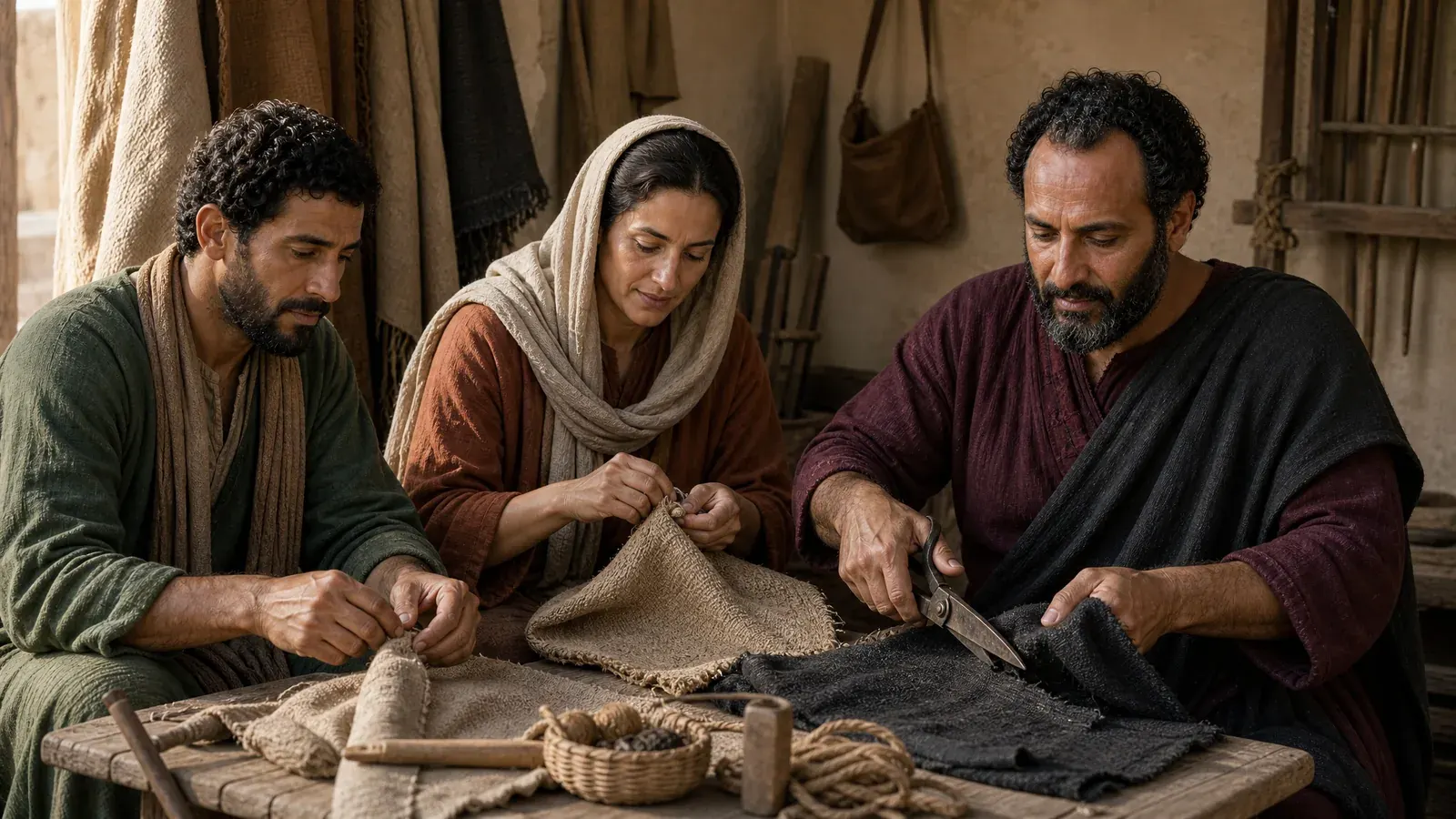
Begin with Corinth: a wealthy port city between two seas, known for its commerce and its loose morals. Paul arrives from Athens and finds Aquila and Priscilla, Jews expelled from Rome by the emperor Claudius. Explain that rabbis often learned a trade, and that Paul worked with his hands so as not to burden the churches, as he says in 1 Thessalonians 2:9. Show the rhythm: work during the week and reasoning in the synagogue every sabbath. Teach this first because the couple will matter at the end of the chapter.
Acts 18:5-11
Be not afraid, but speak
Silas and Timothy arrive, and Paul gives himself fully to testifying that Jesus is the Christ. When opposition turns to blasphemy he shakes his raiment, a public sign that he is not responsible for their refusal, and moves next door to the house of Justus. Note that Crispus, the ruler of the synagogue, believes with his household. Then the night vision. Read the four parts: do not fear, speak, I am with you, I have much people here. Explain much people as those God would yet bring to faith. Paul stays eighteen months.
Acts 18:12-17
Before Gallio
Gallio was the proconsul of Achaia, the brother of the philosopher Seneca, and a known date for his office helps fix the timing of Paul’s visit. The opponents accuse Paul of teaching worship contrary to the law. Before Paul can answer, Gallio dismisses the case as a dispute about words and names and Jewish law. Explain why this mattered: a Roman official treated the faith as a matter within Judaism, not a crime. Then show the beating of Sosthenes and Gallio’s indifference. Note that 1 Corinthians 1:1 names a Sosthenes with Paul, perhaps the same man.
Acts 18:18-23
A vow and a quick journey
Paul stays a good while, then sails with Priscilla and Aquila, having cut his hair at Cenchrea because of a vow. Explain that this was a Jewish vow, perhaps of thanksgiving, and that the text does not give its details. At Ephesus he reasons in the synagogue, is asked to stay, and promises to return if God will. Then he travels quickly: Caesarea, Jerusalem, Antioch, and out again through Galatia and Phrygia. Teach this brief section as the bridge into the third journey and as a picture of strengthening disciples.
Acts 18:24-28
Apollos and the way of God more perfectly
Introduce Apollos from Alexandria, a great centre of learning. List what he has: eloquence, command of the Scriptures, instruction in the way of the Lord, fervour, accurate teaching about Jesus. Then what he lacks: he knows only the baptism of John. Show what Priscilla and Aquila do: they listen, take him aside and explain the way of God more fully. Many note that Priscilla is often named first. Traditions differ on what this means for women’s teaching today; present the readings fairly. End with Apollos helping the church in Achaia.
Where learners get stuck
The misreadings this passage tends to produce, and how to answer each from the text.
“Paul was never afraid, because he had great faith.”
The Lord tells Paul in 18:9 “Be not afraid”, which suggests he was. In 1 Corinthians 2:3 Paul says he came to Corinth “in weakness, and in fear, and in much trembling”. He had just been driven out of Philippi, Thessalonica and Berea. The vision meets real fear with God’s presence and a promise. Let learners hear that courage in Scripture is often fear answered by God, not the absence of fear.
“Gallio was on Paul’s side.”
Gallio refused to judge a question he saw as belonging to Jewish law (18:15). That ruling protected Paul in practice, but his motive appears to be indifference rather than sympathy, since he cared for none of those things when Sosthenes was beaten in front of him (18:17). God kept his promise of 18:10 through a disinterested official. The Book of Acts does not make Gallio a friend of the gospel.
“Apollos was not a real believer until Priscilla and Aquila taught him.”
The Book of Acts says he was instructed in the way of the Lord and taught diligently the things of the Lord (18:25). What he lacked was fuller understanding, knowing only the baptism of John. The couple expounded the way of God more perfectly (18:26), which means more accurately or fully, not from the beginning. The chapter does not say he was rebaptized, unlike the disciples in 19:1-7. Treat him as a gifted believer who needed more teaching.
“Priscilla’s part in teaching Apollos settles how women may teach in the church.”
The text says that Aquila and Priscilla together took him to themselves and expounded the way of God to him (18:26), in a private setting. Christians draw different conclusions from this for roles in the church, especially alongside passages such as 1 Timothy 2:12 and Romans 16:3-5. The Book of Acts honours both of them. Present the readings respectfully and let the class see what the verse plainly records without settling the wider question.
Learning objectives
- Describe the working partnership of Paul, Aquila, and Priscilla.
- Connect the Lord’s encouragement with Paul’s extended stay.
- Distinguish Gallio’s legal response from moral approval of the crowd.
- Trace the movement from Corinth through Ephesus and back into teaching.
- Identify both Apollos’s strengths and the limit of his knowledge.
- Explain how further instruction makes Apollos more useful to believers.
Teacher preparation
- Map Corinth, Cenchrea, Ephesus, Caesarea, and Antioch; read 18:2 carefully before explaining why Aquila and Priscilla have left Rome.
- Gloss “wrought” in 18:3 as worked and “more perfectly” in 18:26 as more fully or accurately, not instant flawlessness.
- Read 18:9–11 together; distinguish the Lord’s particular promise to Paul in Corinth from a universal guarantee against harm.
- Mark the limited information about the vow in 18:18; do not confidently name its full ritual requirements or private purpose.
- Read Acts 19:1–7 in advance to distinguish Apollos’s limited knowledge of John’s baptism from the separate disciples Paul later meets.
Evidence and interpretation checks
Explicit
Read Acts 18:2–3, 9–11, 24–28: shared trade supports partnership, the Lord encourages Paul, and the couple instructs Apollos more fully.
Scripture-supported
Compare Acts 18:28 with Acts 17:2–3: the public case concerns showing from Scripture that Jesus is Christ.
Strong inference
Infer from Acts 18:26–28 that Apollos receives useful correction and continues effectively; his eloquence does not make further learning unnecessary.
Possible or traditional reading
Identify the common description of the vow in Acts 18:18 as Nazirite. The verse mentions a vow and cut hair but does not supply that label or enough details to reconstruct it fully.
Limit
State that Acts 18:17 does not commend Gallio’s indifference to Sosthenes’s beating, and 18:3 does not require every teacher to earn a living through the same arrangement.
Discussion with answer guidance
1. What brings Paul into daily contact with Aquila and Priscilla?
What a good answer contains
Their trade. Aquila and Priscilla had come from Italy after Claudius expelled the Jews from Rome (18:2), and “because he was of the same craft, he abode with them, and wrought: for by their occupation they were tentmakers” (18:3). Work brought them under one roof. A good answer notices that Paul supported himself with his hands while he reasoned in the synagogue every sabbath (18:4). A weak answer guesses when the couple believed, which the text does not say.
Show teacher guidance
Use 18:2–3: their shared occupation leads to lodging and work together. Avoid inventing how or when the couple first believed.
2. What does the Lord tell Paul to continue doing in Corinth?
What a good answer contains
To keep speaking. The Lord says “Be not afraid, but speak, and hold not thy peace: For I am with thee, and no man shall set on thee to hurt thee: for I have much people in this city” (18:9-10). Then “he continued there a year and six months, teaching the word of God among them” (18:11). A strong answer includes the command, the presence, the promise and the long stay. A weak answer leaves out that Paul seems to have been afraid, or that the promise was for this city.
Show teacher guidance
Read 18:9–11. Expect speaking rather than silence, supported by divine presence and a particular assurance; include the eighteen-month teaching period.
3. What does Gallio refuse to adjudicate, and what disturbing event follows?
What a good answer contains
Gallio refuses to judge a religious dispute. He says that if it were “a matter of wrong or wicked lewdness” he would hear them, “But if it be a question of words and names, and of your law, look ye to it; for I will be no judge of such matters” (18:14-15), and drives them out. Then the crowd beats Sosthenes, the synagogue ruler, before the judgement seat, “And Gallio cared for none of those things” (18:17). A good answer sees both a legal protection and an official’s indifference to violence.
Show teacher guidance
Trace 18:12–17. Distinguish dismissal of the religious-law dispute from the beating of Sosthenes that Gallio disregards.
4. How does Paul express his intention to return to Ephesus?
What a good answer contains
With firm plans held loosely. He will not stay longer at Ephesus because he must keep the feast at Jerusalem, “but I will return again unto you, if God will” (18:21). Then he travels to Caesarea, Jerusalem and Antioch and goes through Galatia and Phrygia “strengthening all the disciples” (18:23). A good answer sees planning and submission together, as in James 4:15. A weak answer treats if God will as a polite phrase or as a reason not to plan.
Show teacher guidance
Read 18:19–23. Note “if God will” alongside purposeful travel and renewed strengthening of disciples, not a refusal to plan.
5. What does Acts praise about Apollos before mentioning what he lacks?
What a good answer contains
Almost everything. Apollos is “an eloquent man, and mighty in the scriptures” (18:24); “instructed in the way of the Lord”, “fervent in the spirit”, and he “spake and taught diligently the things of the Lord” (18:25). Only then: “knowing only the baptism of John.” A strong answer lists the gifts and then names the gap without contempt. A weak answer either ignores the gap or uses it to belittle a man the Book of Acts clearly admires.
Show teacher guidance
List eloquence, scriptural ability, fervor, and diligent teaching from 18:24–25; then identify his knowledge of only John’s baptism.
6. What do Aquila and Priscilla do with a gifted but incompletely instructed speaker?
What a good answer contains
They take him aside and teach him. “they took him unto them, and expounded unto him the way of God more perfectly” (18:26). The correction is private, not public. Then the brethren write a letter commending him to Achaia, where he “helped them much which had believed through grace” and “mightily convinced the Jews, and that publickly, shewing by the scriptures that Jesus was Christ” (18:27-28). A good answer sees that their quiet help multiplied his public usefulness.
Show teacher guidance
Read 18:26–28. They take him to themselves and explain more fully; the result includes recommendation, help to believers, and public scriptural reasoning.
Responsible application
Heart and habits
Assess a fictional expert’s claim that impressive speaking removes the need for further instruction; answer through Apollos’s example.
Relationships and community
Design a partnership in which workers share practical support and teaching responsibilities without making one person the whole ministry.
Correction that increases usefulness
Draft a gracious invitation to clarify an incomplete lesson, naming both the speaker’s genuine strengths and the point needing fuller explanation.
Session plans
Two timings of the same lesson. The shorter keeps the reading, the central discussion and one response; the longer gives the confusions and the application their own time.
45 minutes
Tentmakers
Read 18:1-4 and take question one. Ask how work and witness fit together in Paul’s week.
Be not afraid
Read 18:5-11. Take question two and the confusion about Paul’s fear, with 1 Corinthians 2:3.
Gallio
Read 18:12-17. Take question three and the confusion about Gallio.
If God will
Read 18:18-23 and take question four.
Apollos
Read 18:24-28. Take questions five and six and the confusion about Apollos’s faith.
Handout
Read the key verse together and pray for someone who is afraid to speak.
90 minutes
Opening
Ask who helped the group understand their faith more fully, and how they did it.
Tentmakers
Read 18:1-4 and 1 Thessalonians 2:9. Take question one and discuss work as part of a believer’s witness.
Be not afraid
Read 18:5-11 and 1 Corinthians 2:1-5. Take question two and the fear confusion.
Gallio
Read 18:12-17. Take question three and the Gallio confusion. Note 1 Corinthians 1:1.
If God will
Read 18:18-23 and James 4:13-15. Take question four.
Apollos
Read 18:24-28. Take questions five and six and both confusions about Apollos and Priscilla, presenting the readings fairly.
Application
Ask each learner to think of one person they could encourage privately, as Priscilla and Aquila did, and one way to do it kindly.
Handout and prayer
Read the key verse together and pray for courage and teachable hearts.
Adapting the lesson
Children
Bring a piece of canvas and let the children pretend to sew tents with Paul, Aquila and Priscilla. Tell them God told Paul at night not to be afraid. Let a child whisper a fear and then say together, God is with me. For Apollos, explain that even a great speaker needed friends to teach him more about Jesus, and that learning more is a good thing.
Youth
Ask what makes them afraid to talk about Jesus, and read 18:9-10. Show that Paul was afraid too. Then give them Apollos: gifted, passionate and still with things to learn. Ask how they respond when someone corrects them, and how they should correct a friend. Note the private, kind way Priscilla and Aquila did it, and keep any debate on roles fair.
Adults
Discuss bivocational ministry and the place of ordinary work in Paul’s mission. Look at the Lord’s words in 18:9-10 and how they shaped eighteen months of teaching. Consider Gallio as an example of how the gospel fares before indifferent authorities. Spend time on Apollos and on how churches can strengthen gifted people who lack some teaching, and present the different readings of Priscilla’s role respectfully.
One to one
Ask whether there is somewhere God may be asking them to keep speaking when they would rather go quiet. Read 18:9-10 together. If they are a gifted leader, read 18:24-26 and ask who helps them see what they lack. If they are the kind of person others confide in, talk about how Priscilla and Aquila helped Apollos without embarrassing him.
Song and video learning lab
A song or video may interpret, compress, or dramatize the text. Its value becomes clearer when its choices are compared with Scripture.
- Before the media: the exact passage and its central movement.
- During the media: the words, people, events, and emotions the artist emphasizes.
- After the media: what it clarifies, what it leaves out, and what belongs back in the biblical text.
Handout
One page for learners to take home. The print button prints this section alone.
Acts 18
The passage in brief
In Corinth Paul lives and works as a tentmaker with a couple named Aquila and Priscilla, and teaches in the synagogue each sabbath. When people oppose him, the Lord speaks to him at night: do not be afraid, keep speaking, for I am with you. Paul stays a year and a half. A Roman official named Gallio refuses to judge the case against him. Later, in Ephesus, Aquila and Priscilla meet Apollos, a gifted preacher, and gently teach him the way of God more fully.
A verse to keep
Then spake the Lord to Paul in the night by a vision, Be not afraid, but speak, and hold not thy peace: For I am with thee, and no man shall set on thee to hurt thee: for I have much people in this city.
Acts 18:9-10 · King James Version
Questions to take home
What work did Paul do with Aquila and Priscilla in 18:3?
What did the Lord tell Paul in 18:9-10?
How did Aquila and Priscilla help Apollos in 18:26?
This week
Encourage one believer privately this week with something true from the Bible.
Music and video connected to the passage
No exact media match is cataloged for this passage yet. New material can be connected when it becomes available.