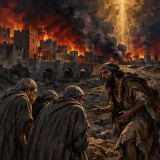
The big picture
Ezekiel 33 returns to the watchman and makes responsibility painfully exact. Ezekiel must sound the warning he receives from the LORD, while the hearer remains responsible for what he does with it. The chapter then rejects two opposite evasions: despair that past wickedness makes turning useless, and confidence that past righteousness can excuse present wrongdoing. A fugitive finally arrives with the words, "The city is smitten," confirming Jerusalem's fall and marking a changed phase in the prophet's work. Survivors in the land misread Abraham as a numerical precedent for automatic inheritance, but their conduct contradicts the claim. The exiles present a different problem. They enjoy Ezekiel as though he were a lovely song, gathering eagerly to hear him while leaving their lives untouched by what they hear.
Central truth
The Lord renews Ezekiel’s watchman duty to call people from despair and self-trust toward life, making clear that turning must reach their actual conduct. When Jerusalem’s fall is reported and Ezekiel’s mouth is opened, the Lord exposes both survivors who claim the land without obedience and hearers who admire the prophet without doing his words.


The study notes have a page of their own
The movement by movement analysis, the words to trace, the verse by verse notes and where readers differ are written for someone studying alone. They are on the Deep Personal Reflections page for this chapter. This page is the lesson.
A chapter-specific teaching brief
These anchors come from this chapter itself. They help a teacher use the Level 1 overview, the Level 2 study, and the Scripture text as one lesson.
Open with the chapter’s first image
Ezekiel 33:1: “Again the word of the LORD came unto me, saying,”
Slow down at the turning point
Ezekiel 33:19: “But if the wicked turn from his wickedness, and do that which is lawful and right, he shall live thereby.”
Keep this word trail visible
wicked, land, LORD, live, people, iniquity
What to explain, in order
Teach the passage in this order. Each step names the verses it rests on, so every point can be shown in the text before it is applied.
Ezekiel 33:1–20
Ezekiel 33:1-6
The town's watchman
Begin with the ordinary picture before applying it. A town under threat chooses one of its own as lookout. If he blows the trumpet and people ignore it, they are responsible; if he stays silent, he is. Read 33:2-6 and draw a wall with a watchman, a trumpet and people below. Explain "a man of their coasts" as one from their own territory. Teach this first because it sets up the comparison in plain terms anyone can follow. The point of this step is fairness: everyone knows what a watchman is for.
Ezekiel 33:7-9
The same office, renewed
Read 33:7-9 and set it beside 3:17-19. Explain that the words are almost the same, and that this repetition is deliberate: the book is about to turn from judgment to hope, and before it does, God renews Ezekiel's commission. Point out "I have set thee" (33:7): this time God, not the people, appoints. Ask the class why the commission is repeated now. Note 33:21-22 just after this unit, where the fall of Jerusalem is reported; the renewed watchman will speak to a people in shock.
Ezekiel 33:10-11
How should we then live
This is the new note in the chapter, and it needs the most time. Read 33:10 slowly. For years the people denied their guilt; now they admit it and sink into despair. Explain "pine away" as wasting away. Then read God's answer in 33:11. Point out the oath, "As I live", the denial of pleasure in death, and the double "turn ye, turn ye". Explain that God's answer to guilt is not denial and not despair but turning. Teach this here, at the centre of the unit, because it is the heart of what the watchman now says.
Ezekiel 33:12-13
Trusting one's own righteousness
Read 33:12 and draw a simple line with two arrows on it. The righteous man cannot rely on his past in the day he transgresses; the wicked man is not ruined by his past in the day he turns. Then read 33:13 and underline the phrase "if he trust to his own righteousness". Explain that the danger is a person who treats past obedience as a credit to be spent on present sin. Teach this right after 33:11 because the same call to turn applies to the confident as well as to the despairing.
Ezekiel 33:14-16
Restore the pledge
Read 33:14-16 and write the three actions on the board: restore the pledge, give back what was robbed, walk in the statutes of life. Explain the pledge as security taken for a loan, perhaps a cloak, which the law required to be returned (Exodus 22:26-27). Compare Zacchaeus in Luke 19:8. Explain "the statutes of life" as God's commands that lead to life. Teach this step because it gives turning a concrete shape. Use a fictional example of stolen property, and do not ask learners for their own histories.
Ezekiel 33:17-20
Not equal
End with the complaint and God's answer. Read 33:17-20 and explain "equal" as fair or level. The people think it unfair that a righteous man could die and a wicked man live. God says it is their way that is unfair, because they want to be judged by labels and records rather than by their actual direction of life. Close with "I will judge you every one after his ways" (33:20). Teach this last because it gathers the whole unit into one principle the class can take away.
Ezekiel 33:21–33
Ezekiel 33:21-22
The city is smitten
Start with the date and the three words. Explain that news took months to travel from Jerusalem to Babylon. Then read 24:25-27 aloud, where God promised that on the day an escapee arrived Ezekiel's mouth would be opened. Now read 33:22 and point out the timing: the LORD opened his mouth the evening before. Explain "dumb" as unable to speak. Teach this first because it is the hinge of the whole book. Until now Ezekiel has spoken mainly of judgment; from here on he will speak mainly of restoration.
Ezekiel 33:23-24
We are many
Move from the exiles to the people left in the ruins of Judah. Explain "wastes" as the ruined places, the land after the Babylonian army had gone through. Read their argument in 33:24 and write it as a simple equation on the board: Abraham one, we many, the land ours. Ask the class whether it sounds reasonable. Teach this step slowly, because a claim that uses Scripture can sound strong, and learners need to see how the next verses test it rather than dismissing it.
Ezekiel 33:25-26
Shall ye possess the land
Read 33:25-26 and list the six charges: eating with blood, idols, bloodshed, standing on the sword, abomination, adultery. Explain "stand upon your sword" as making violence the foundation of security. Draw out the repeated question, "shall ye possess the land?", and let it hang. Explain that Abraham's inheritance came with faith and obedience (Genesis 15:6; 26:5), so their claim to be his heirs is hollow. Teach this here because it exposes the gap between quoting a promise and living as its heirs.
Ezekiel 33:27-29
The land laid desolate
Read 33:27-29 briefly. Sword, beasts and pestilence reach the ruins, the open field and the caves. Explain "the pomp of her strength" as the pride and power they still trusted. The step ends with the refrain "Then shall they know that I am the LORD" (33:29). Keep this short and sober. Its place in the lesson is to show that the survivors' confidence was misplaced, and that the land's desolation is linked to "all their abominations which they have committed" (33:29), not to God's weakness.
Ezekiel 33:30-33
A lovely song
Turn back to the exiles, who are now eager to hear Ezekiel. Read 33:30 and notice they talk about him "by the walls and in the doors of the houses". Then read 33:31-32. Explain "covetousness" as the greedy desire for gain. The image of a skilled singer is affectionate, not contemptuous: Ezekiel's words are beautiful to them. The problem is that they listen as an audience, not as disciples. End with 33:33. Teach this last because it turns the lesson toward everyone who hears Scripture taught well.
Where learners get stuck
The misreadings this passage tends to produce, and how to answer each from the text.
Ezekiel 33:1–20
"Once I have done something terrible, it is too late for me to change."
This is almost exactly what the people say in 33:10: "If our transgressions and our sins be upon us, and we pine away in them, how should we then live?" God answers with an oath that he has no pleasure in the death of the wicked, and calls, "turn ye, turn ye from your evil ways" (33:11). Then 33:16 says that none of the turning man's sins "shall be mentioned unto him". Speak this gently but plainly: the passage was written for people who thought they were finished.
"If I say sorry, that is enough, even if I keep what I took."
The turning in 33:15 is described by actions: "If the wicked restore the pledge, give again that he had robbed". Repentance in this passage reaches the neighbour who was harmed. God's forgiveness is not bought by restitution, but restitution is what real turning looks like where it is possible. Help learners think about repair in a fictional case, and be sensitive to those who have been wronged and never repaid.
"Every Christian is a watchman like Ezekiel, responsible for everyone's eternal fate."
God says to Ezekiel, "I have set thee a watchman unto the house of Israel" (33:7). The commission is personal and prophetic. Paul uses similar language in Acts 20:26-27 about his own ministry, and many teachers and pastors take the passage as a pattern for their duty to speak the truth. That analogy can be helpful. But the passage does not make every believer answerable for every person's choices; each person still dies "in his iniquity" (33:8). Keep the analogy, and keep its limits.
"God keeps changing his mind about people, so we can never be sure where we stand."
The passage says the opposite. God's standard does not change: "I will judge you every one after his ways" (33:20). What changes is the person's direction, and God responds to it. The call in 33:11 shows his settled desire, that the wicked "turn from his way and live." Traditions differ on how this relates to assurance of salvation, and you need not settle that here. Teach the steady character of God and the real possibility of turning.
Ezekiel 33:21–33
"If people enjoy a lesson or a song, it has done its job."
Ezekiel was enjoyed: he was "as a very lovely song of one that hath a pleasant voice" (33:32). Yet "they hear thy words, but they do them not." The passage does not criticise beauty, skill or music; Scripture is full of songs. It criticises hearing that never becomes doing. This is worth saying plainly in any setting where Scripture is sung or taught well. Compare James 1:22-25. Enjoyment is good; it is not the goal.
"We are God's people, so the promises belong to us whatever we do."
The survivors in Judah reasoned, "Abraham was one, and he inherited the land: but we are many" (33:24). God's answer is a list of their deeds and the question, "shall ye possess the land?" (33:25-26). Being descended from Abraham did not make them his heirs in practice. John the Baptist makes the same point in Matthew 3:9. Promises are received in faith and lived out in obedience; they are not a title deed that ignores how we live.
"Ezekiel's mouth was opened because the messenger brought the news."
The text gives a careful order: "the hand of the LORD was upon me in the evening, afore he that was escaped came; and had opened my mouth" (33:22). God opened his mouth before the news arrived. This matters because it shows that Ezekiel's speaking was governed by God throughout, from the restriction in 3:26-27 to the promise in 24:27 and its fulfilment here. Keep the order straight, and let the class see that God was in control of his prophet's voice the whole time.
Learning objectives
- Distinguish the appointed civic watchman from Ezekiel’s commission.
- Compare an ignored trumpet with an unsounded trumpet.
- Explain the people’s question about how they can live.
- Identify the Lord’s stated desire for the wicked.
- Describe the restitution that demonstrates a changed direction.
- Answer the charge that the Lord’s judgment is unfair.
- Identify the escaped messenger’s announcement.
- Connect Ezekiel’s opened mouth with the earlier promise.
- Explain the survivors’ argument from Abraham and numbers.
- Name the conduct that contradicts their inheritance claim.
- Distinguish spoken affection from covetous allegiance.
- Explain the comparison between Ezekiel and a lovely song.
Teacher preparation
- Read Ezekiel 33:1–20, then 33:21–22 to locate the commission near news of Jerusalem’s fall.
- Compare 3:16–21; notice the new attention to the people’s despair in 33:10.
- Prepare a responsibility table separating watchman, hearer, warning, and response in 33:2–9.
- Explain “pine away” as wasting away and “equal” as fair or just in 33:10,17.
- Prepare a fictional stolen-property example for 33:15; keep restitution concrete without requesting anyone’s private history.
- Read 24:25–27 and 33:21–33 together; mark announcement, opened mouth, land claim, and admired performance.
- Retain the KJV’s “twelfth year” in 33:21; avoid constructing a precise messenger itinerary the passage does not provide.
- Explain “wastes” as devastated places and “dumb” as unable to speak in 33:22,24.
- Prepare two audience columns: survivors in the land and people gathered to hear Ezekiel among the exiles.
- Plan to distinguish the criticism of disobedient hearing from any supposed condemnation of music or engaging teaching.
Evidence and interpretation checks
Explicit
Anchor the purpose of the appeal in 33:11: the Lord takes no pleasure in the wicked person’s death but calls that person to turn and live. Anchor the turning point in 33:21–22: an escapee reports the city’s fall, and Ezekiel’s mouth has been opened by the Lord.
Scripture-supported
Use 33:14–16 alongside 18:27–28: turning is described through lawful and right conduct, including returning what was robbed. Use 24:26–27 to show that the escapee’s arrival and opened mouth fulfill an earlier announcement within the Book of Ezekiel.
Strong inference
Infer from 33:10–11 that recognition of guilt can become despair unless the call to turn is heard; the Lord answers the question rather than endorsing hopelessness. Infer from 33:24–26 that the survivors treat numerical strength as entitlement while excluding their own conduct from the argument.
Possible or traditional reading
Present extension of this watchman office to later preaching as an analogy, compared with Acts 20:26–27; 33:7 directly commissions Ezekiel, not every self-appointed warning voice. Read the opened mouth in 33:22 as release from the prophetic restriction of 3:26–27; do not assume that no speech of any kind occurred between them.
Limit
Do not use 33:13–16 to promise a painless future, excuse unrepaired harm, or settle every debate about salvation without the wider scriptural witness. Do not make 33:32 an attack on skill, beauty, or music; the repeated contrast is hearing the words and refusing to do them (33:31–32).
Discussion with answer guidance
1. Who appoints the watchman in the illustration, and who appoints Ezekiel?
What a good answer contains
In the picture, the people choose: "if the people of the land take a man of their coasts, and set him for their watchman" (33:2). Ezekiel's appointment is different: "So thou, O son of man, I have set thee a watchman unto the house of Israel; therefore thou shalt hear the word at my mouth, and warn them from me" (33:7). A good answer sees the shift from a town's lookout to God's messenger, and that Ezekiel's warning must come "from me". A weak answer misses the difference and treats Ezekiel as a man the people hired, who could be dismissed or told what to say.
Show teacher guidance
Compare 33:2 and 33:7. The people choose their lookout; the Lord assigns Ezekiel to hear and convey his word.
2. What difference is there between an ignored trumpet and a silent watchman?
What a good answer contains
Who carries the blood. When the trumpet sounds and a man ignores it, "his blood shall be upon his own head" (33:4), and "he that taketh warning shall deliver his soul" (33:5). When the watchman sees the sword and stays silent, the person is "taken away in his iniquity; but his blood will I require at the watchman's hand" (33:6). A good answer notices that the one who dies still dies "in his iniquity" in both cases, and that each party answers for his own part. A weak answer lets one responsibility swallow the other.
Show teacher guidance
Read 33:3–9. Keep the hearer’s responsibility and the messenger’s responsibility distinct; neither removes the other.
3. How does the Lord answer “How should we then live?”?
What a good answer contains
With an oath and a plea. The people say, "If our transgressions and our sins be upon us, and we pine away in them, how should we then live?" (33:10). God answers, "As I live, saith the Lord GOD, I have no pleasure in the death of the wicked; but that the wicked turn from his way and live: turn ye, turn ye from your evil ways; for why will ye die, O house of Israel?" (33:11). A good answer sees that God does not deny their guilt, but refuses their despair. A weak answer either says the guilt is not real or agrees that nothing can be done.
Show teacher guidance
Read 33:10–11. Expect an oath, the declared absence of pleasure in death, and a repeated call to turn, not surrender to despair.
4. What goes wrong when the righteous person trusts his own righteousness?
What a good answer contains
He leans on his record while doing wrong: "if he trust to his own righteousness, and commit iniquity, all his righteousnesses shall not be remembered; but for his iniquity that he hath committed, he shall die for it" (33:13). Verse 12 states the principle: "The righteousness of the righteous shall not deliver him in the day of his transgression". A good answer catches the word trust: the danger is presumption, treating the past as permission. A weak answer reads the verse as saying God forgets every good deed at the first mistake.
Show teacher guidance
Use 33:12–13. He commits iniquity while relying on his prior record; past obedience is not advance permission for wrongdoing.
5. What makes the wicked person’s turning visible to a harmed neighbor?
What a good answer contains
He gives back what he took. "If the wicked restore the pledge, give again that he had robbed, walk in the statutes of life, without committing iniquity; he shall surely live, he shall not die" (33:15). The pledge returned and the stolen goods restored are things the neighbour can see and use. Then 33:16 says, "None of his sins that he hath committed shall be mentioned unto him". A good answer sees that turning reaches the person harmed. A weak answer thinks a changed attitude or a fine speech is enough, without repair.
Show teacher guidance
Read 33:14–16. The pledge is restored and stolen goods returned; a better-sounding speech alone does not match these actions.
6. What standard answers the complaint that the Lord’s way is not equal?
What a good answer contains
Judgment by each one's ways. The people say, "The way of the Lord is not equal" (33:17, 33:20). God answers that their way is the unequal one, then sets out both turnings again (33:18-19), and ends, "O ye house of Israel, I will judge you every one after his ways" (33:20). A good answer sees that no one is fixed forever by a label: the righteous can fall, the wicked can turn. That is why the way is fair. A weak answer concludes that God is unpredictable, or that a person's past decides everything.
Show teacher guidance
Trace 33:17–20. Each is judged according to his ways; refusing a permanent label for either person is part of the answer.
7. What do the escapee’s few words settle for Ezekiel’s audience?
What a good answer contains
That everything Ezekiel warned of has happened. The man arrives "in the twelfth year of our captivity, in the tenth month, in the fifth day of the month" and says only, "The city is smitten" (33:21). Three words end years of denial among the exiles. Compare 24:1-2, where Ezekiel wrote down the day the siege began. A good answer sees that the prophet's word is now confirmed by events, as 24:26-27 had promised. A weak answer wants to know who the messenger was or how he travelled, which the Book of Ezekiel does not say.
Show teacher guidance
Read 33:21 beside 24:1–2. Jerusalem’s fall is now reported, not merely predicted; do not invent the unnamed messenger’s biography.
8. When was Ezekiel’s mouth opened relative to the messenger’s arrival?
What a good answer contains
The evening before. "Now the hand of the LORD was upon me in the evening, afore he that was escaped came; and had opened my mouth, until he came to me in the morning; and my mouth was opened, and I was no more dumb" (33:22). God opens Ezekiel's mouth before the news arrives, so the release does not depend on the messenger. A good answer keeps the order: the LORD acts in the evening, the man arrives in the morning. It also links this to 3:26-27 and 24:27. A weak answer says the news itself opened his mouth.
Show teacher guidance
Read 33:22 carefully: the Lord’s hand was upon him the evening before the morning arrival. Preserve that order.
9. How do the inhabitants of the ruins use Abraham to argue for possession?
What a good answer contains
They argue from the smaller to the greater. "Abraham was one, and he inherited the land: but we are many; the land is given us for inheritance" (33:24). If one man received the promise, surely a whole group of his descendants holds it. The argument sounds biblical; it appeals to Genesis 12 and 15. A good answer states it fairly before showing what it leaves out: Abraham's faith and obedience. A weak answer mocks the survivors without hearing why their claim sounded convincing.
Show teacher guidance
Use 33:24: Abraham was one and they are many. State the argument fairly before exposing what it leaves out.
10. Which actions make the survivors’ land claim untenable?
What a good answer contains
God lists them. "Ye eat with the blood, and lift up your eyes toward your idols, and shed blood: and shall ye possess the land?" (33:25). "Ye stand upon your sword, ye work abomination, and ye defile every one his neighbour's wife: and shall ye possess the land?" (33:26). Eating with the blood breaks the command of Genesis 9:4 and Leviticus 17:10-14; standing on the sword means relying on violence. A good answer names each act and notes the repeated question. A weak answer just says they were sinners, which loses the point that they claimed Abraham while living unlike him.
Show teacher guidance
Read 33:25–26. Name bloodshed, idols, reliance on the sword, and violated marriages; do not answer only with a generic reference to sin.
11. What mismatch does the Lord identify between the listeners’ mouths and hearts?
What a good answer contains
Their words are warm and their hearts are elsewhere. People say to one another, "Come, I pray you, and hear what is the word that cometh forth from the LORD" (33:30). They come and sit "as my people", and "they hear thy words, but they will not do them: for with their mouth they shew much love, but their heart goeth after their covetousness" (33:31). A good answer catches the gap between mouth and heart, and names covetousness as what draws the heart away. A weak answer says the problem was that they did not come to listen; they came often.
Show teacher guidance
Point to 33:30–31. They attend, hear, and express affection while their hearts pursue covetousness and their conduct remains unchanged.
12. Why compare Ezekiel to a lovely song played skillfully?
What a good answer contains
Because they enjoy him the way they enjoy music: "thou art unto them as a very lovely song of one that hath a pleasant voice, and can play well on an instrument: for they hear thy words, but they do them not" (33:32). The failure is not the song or the voice; it is that the words stay in the air. Then 33:33 says that "when this cometh to pass", "then shall they know that a prophet hath been among them." A good answer sees that the problem is hearing without doing. A weak answer turns the verse into criticism of music or of good speaking.
Show teacher guidance
Use 33:32–33. The listeners appreciate the performance without heeding its words; their problem is not poor attendance or insufficiently attractive delivery.
Responsible application
Heart and habits
Ask pairs to answer a fictional person who thinks acknowledged wrongdoing leaves no meaningful possibility of change; use 33:10–11 without minimizing harm.
Relationships and community
Have learners outline what the fictional thief’s change would require for the owner of the stolen property, following 33:15.
Warn with the passage’s purpose
Ask the class to revise a warning that delights in punishment so it reflects 33:11’s purpose of turning and life.
Beyond beautiful delivery
Discuss how a compelling lesson or song can serve understanding without becoming a substitute for it; let 33:31–32 identify the actual failure.
Session plans
Two timings of the same lesson. The shorter keeps the reading, the central discussion and one response; the longer gives the confusions and the application their own time.
Ezekiel 33:1–20
45 minutes
The lookout
Read 33:1-6. Draw the wall and the trumpet, and take question one in part.
Trumpet and silence
Take question two, then read 33:7-9 and finish question one. Compare 3:17 briefly.
How should we live
Read 33:10-11 twice. Take question three and confusion one.
Trust and restitution
Read 33:12-16. Take questions four and five, and confusion two.
Not equal
Read 33:17-20 and take question six.
Handout
Read the key verse together and give out the sheet.
90 minutes
When guilt is admitted
Ask the group what happens to people who finally admit they were wrong: relief, despair, or both. Keep their answers.
The watchman picture
Read 33:1-9 with 3:17-19. Take questions one and two.
Turn ye, turn ye
Read 33:10-11 slowly. Take question three and confusion one. Return to the opening answers.
Leaning on the past
Read 33:12-13. Take question four and confusion four.
Giving back
Read 33:14-16 with Exodus 22:26-27 and Luke 19:8. Take question five and confusion two, and use the application on the fictional thief.
Fair ways
Read 33:17-20 and take question six. Compare 18:25-29 briefly.
The watchman today
Take confusion three, and use the application on revising a warning that delights in punishment.
Handout and prayer
Read the key verse together and pray for any who feel too far gone to turn.
Ezekiel 33:21–33
45 minutes
Three words
Read 33:21-22 with 24:25-27. Take questions one and two.
The argument from Abraham
Read 33:23-24. Write the equation on the board and take question three.
Shall ye possess
Read 33:25-29. Take question four and confusion two.
The lovely song
Read 33:30-33. Take questions five and six, and confusion one.
Response and handout
Use the application on the listener's next action. Read the key verse together and give out the sheet.
90 minutes
Favourite speakers
Ask the group what makes a teacher or singer enjoyable to listen to. Keep the list for later.
The news arrives
Read 24:25-27 and 33:21-22. Take questions one and two and confusion three.
We are many
Read 33:23-24 with Genesis 15:6-7. Take question three and set out the survivors' argument fairly.
The six charges
Read 33:25-29. Take question four and confusion two, with Matthew 3:9.
Mouth and heart
Read 33:30-31 and take question five. Discuss what covetousness looks like when it pulls the heart away from listening.
Hearers and doers
Read 33:32-33 with James 1:22-25. Take question six and confusion one, and return to the opening list.
Application
Work the application on beyond beautiful delivery: how a song or lesson serves understanding without replacing it.
Handout and prayer
Read the key verse together and pray to be doers of the word, not hearers only.
Adapting the lesson
Ezekiel 33:1–20
Children
Let one child be a watchman with a toy trumpet on a chair. When you say danger, the watchman blows; the others run to safety. Explain that God gave Ezekiel this job so his people could be safe. Then read 33:11 simply: God does not want anyone to be lost; he says turn and live. Use the example of giving back a toy that was taken. Leave out the death language.
Youth
Ask whether anyone has felt so guilty that they gave up trying. Read 33:10-11 and let them hear God's oath. Talk about 33:15 and what making things right looks like, with fictional examples. Discuss 33:13 and the danger of thinking past goodness covers present wrong. Offer a written way to ask about anything personal.
Adults
Compare this chapter with chapter 3 and chapter 18 so the group sees what is new: the people's despair and God's answer. Discuss restitution, both its importance and its limits. Talk about Acts 20:26-27 and how far the watchman pattern applies to teachers today. Leave room for those carrying guilt to hear 33:11 without being asked to speak.
One to one
Read 33:10-11 together and ask whether the person has ever felt that their sins made life impossible. Let them hear the oath and the plea. If there is something they have taken or damaged, talk gently about what repair could look like. Read 33:16 and pray together.
Ezekiel 33:21–33
Children
Tell children that a man ran all the way from Jerusalem with sad news, and that God had already told Ezekiel it would happen. Then read 33:32 simply: people loved listening to Ezekiel like a beautiful song, but they did not do what he said. Play a game where you give an instruction and see who does it, not just who hears it. Leave out the list of sins in 33:25-26.
Youth
Ask who their favourite speaker, singer or video maker is, and whether they have ever changed anything because of what they heard. Read 33:30-32. Talk about the difference between liking something and obeying it. Read 33:24 and discuss how people use Bible promises to excuse themselves. Keep the discussion on doing, not on criticising anyone's style.
Adults
Give time to the hinge of the book in 33:21-22 and its link with 3:26-27 and 24:25-27. Discuss the survivors' appeal to Abraham and how promises are rightly claimed. Spend time on 33:30-33 as a word to any church that enjoys good preaching or music. Ask what keeps hearing from becoming doing, and how covetousness competes for the heart.
One to one
Read 33:31-32 together and ask the person honestly which teaching or song they have enjoyed lately without acting on. Help them choose one concrete thing to do. If they feel discouraged by their own track record, read 33:11 from just before this passage, and pray together.
Song and video learning lab
A song or video may interpret, compress, or dramatize the text. Its value becomes clearer when its choices are compared with Scripture.
- Before the media: the exact passage and its central movement.
- During the media: the words, people, events, and emotions the artist emphasizes.
- After the media: what it clarifies, what it leaves out, and what belongs back in the biblical text.
Handout
One page for learners to take home. The print button prints this section alone.
Ezekiel 33:1–20
The passage in brief
God reminded Ezekiel that he was a watchman for Israel, like a lookout who warns a city when an enemy comes. Now the people admitted their sins but felt hopeless. God answered with an oath: he has no pleasure in the death of the wicked, and he calls them to turn and live. Turning means real change, such as giving back what was taken. Past goodness is no excuse for present sin, and past sin need not be the end. God judges each person by their ways.
A verse to keep
Say unto them, As I live, saith the Lord GOD, I have no pleasure in the death of the wicked; but that the wicked turn from his way and live: turn ye, turn ye from your evil ways; for why will ye die, O house of Israel?
Ezekiel 33:11 · King James Version
Questions to take home
What did the people say in 33:10, and how did God answer in 33:11?
What does a wicked man do when he turns, according to 33:15?
Why is it fair for God to judge each person "after his ways" (33:20)?
This week
If you have wronged someone and can make it right, take one step to do so this week.
Ezekiel 33:21–33
The passage in brief
Years after the siege began, a man escaped from Jerusalem and told the exiles, "The city is smitten." God had opened Ezekiel's mouth the night before, as he had promised. The people left in the ruins of Judah claimed the land because they were Abraham's descendants, but they were living in violence and idolatry. Meanwhile the exiles loved to hear Ezekiel, like listening to a beautiful song, but they did not do what he said.
A verse to keep
And they come unto thee as the people cometh, and they sit before thee as my people, and they hear thy words, but they will not do them: for with their mouth they shew much love, but their heart goeth after their covetousness.
Ezekiel 33:31 · King James Version
Questions to take home
What news did the escapee bring in 33:21, and when was Ezekiel's mouth opened?
Why could the people in the ruins not claim the land just because they were many (33:24-26)?
What was wrong with the way the exiles listened to Ezekiel (33:31-32)?
This week
Choose one thing you heard from Scripture this week and do it before the next time you hear a sermon or song.
Music and video connected to the passage
Related media appears when its Scripture reference overlaps this study. Music and video can illuminate a theme while the biblical text remains the foundation.