The big picture
Ezra 7 finally introduces the man whose name the book bears, and his arrival marks a new phase after the temple has already been completed. Ezra is established through priestly descent, skill in the law of Moses, and a heart prepared to seek that law, do it, and teach it. Artaxerxes gives him a broad commission: willing Israelites may return with him, offerings and vessels may be carried to Jerusalem, treasury resources may be used, temple servants receive tax exemptions, and Ezra may appoint judges and teach the law. The Book of Ezra does not leave that authority as a royal achievement alone. Its closing first-person thanksgiving attributes the king's favorable disposition to God, and Ezra responds by gathering leaders for the journey ahead.
Central truth
Ezra prepares his heart to seek, do, and teach the Lord's law, receives authority and resources for the return, and attributes his strengthening before the king to God's good hand.

The study notes have a page of their own
The movement by movement analysis, the words to trace, the verse by verse notes and where readers differ are written for someone studying alone. They are on the Deep Personal Reflections page for this chapter. This page is the lesson.
A chapter-specific teaching brief
These anchors come from this chapter itself. They help a teacher use the Level 1 overview, the Level 2 study, and the Scripture text as one lesson.
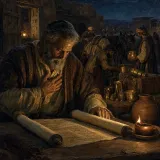
Open with the chapter’s first image
Ezra 7:1: “Now after these things, in the reign of Artaxerxes king of Persia, Ezra the son of Seraiah, the son of Azariah, the son of Hilkiah,”
Slow down at the turning point
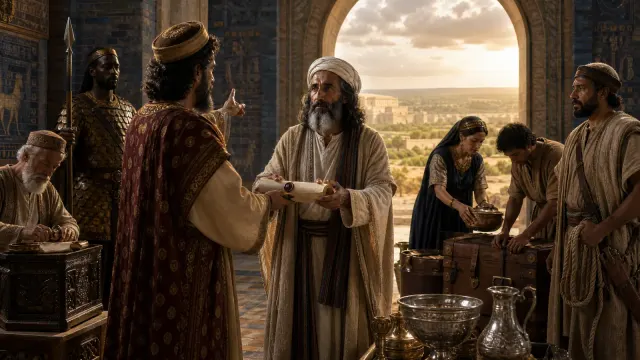
Ezra 7:11: “Now this is the copy of the letter that the king Artaxerxes gave unto Ezra the priest, the scribe, even a scribe of the words of the commandments of the…”
Keep this word trail visible
king, Jerusalem, house, Ezra, Israel, LORD
What to explain, in order
Teach the passage in this order. Each step names the verses it rests on, so every point can be shown in the text before it is applied.
Ezra 7:1-5
Mind the gap in time
Begin with "after these things". On the usual dating, almost sixty years separate the temple's completion in 6:15 from Ezra's journey. Draw that gap on the timeline. Then read the genealogy back to Aaron and set it beside 1 Chronicles 6:3-15, which has more names; this one is selective, giving Ezra's priestly line rather than every generation. Note that Seraiah was the chief priest executed in 2 Kings 25:18-21, so son here means descendant. Teach this first so learners meet Ezra as the heir of a long and wounded priestly line.
Ezra 7:6
A ready scribe
Explain ready as skilled, practised, quick in the work. A scribe here is not only a copyist but a scholar and teacher of the law. Notice that the law is described as the one "which the LORD God of Israel had given": Ezra studies a gift, not a human code. Then the king grants "all his request", which the verse does not specify, and the reason given is the hand of the LORD upon him. Teach this second because it gives Ezra's qualification and the source of his favour together, in one verse.
Ezra 7:7-9
Four months on the road
Read the dates: they set out on the first day of the first month and arrive on the first day of the fifth. Four months of travel, roughly nine hundred miles by the route along the Euphrates, with families, Levites and temple servants. Point out that the first month is the month of the exodus and the Passover, a quiet echo of Israel's first journey out of captivity. Then read the phrase "according to the good hand of his God upon him" and let learners feel what four months of protection meant.
Ezra 7:10
Seek, do, teach
This is the centre of the chapter. Read it slowly and write the three verbs on the board. Explain "prepared his heart" as fixed or set his heart; this is a settled direction of life. Explain statutes and judgments as the law's commands and the rulings that apply them. Then point to the first word, "For": the Book of Ezra places this verse right after the good hand of God, linking Ezra's devotion and God's favour without making the favour a wage. Teach it here because everything Ezra does in chapters 8-10 grows from this one sentence.
Ezra 7:11-26
The king's letter
Read selected parts of the letter, which is written in Aramaic in the original. Mark its provisions: volunteers may go (7:13); Ezra is to enquire according to the law in his hand (7:14); silver and gold for offerings (7:15-18); vessels to deliver (7:19); treasury support, with "salt without prescribing how much" (7:22); tax exemption for all who serve the house (7:24); judges and teaching (7:25); and penalties (7:26). Ask why a Persian king would care, and read his reason: "for why should there be wrath against the realm of the king and his sons". Keep 7:26 as the king's law for his province.
Ezra 7:27-28
Ezra blesses the LORD
End with the change of voice. Suddenly Ezra speaks: "Blessed be the LORD God of our fathers". He praises God for putting it in the king's heart "to beautify the house", and for mercy shown to him before the king, the counsellors and the princes. Then he says he was strengthened, and he gathered chief men to go up with him. Teach this last because it shows the right response to favour: praise first, then action. Ezra takes no credit, and he does not sit still.
Where learners get stuck
The misreadings this passage tends to produce, and how to answer each from the text.
"Ezra came back with Zerubbabel in the first return."
The phrase "after these things" (7:1) and "the seventh year of Artaxerxes" (7:7) place Ezra long after the temple was finished under Darius (6:15). Chapters 1-6 cover the first return and the rebuilding; chapters 7-10 cover a second return led by Ezra, on the usual dating some sixty years later. Draw the timeline on the board and most of the confusion clears.
"Ezra was just a scholar who knew a lot about the Bible."
7:10 gives three verbs, not one: seek, do and teach. The king's letter asks him to teach those who do not know the law (7:25), and chapters 9-10 show him acting on it at great personal cost. His learning serves obedience and instruction. A lesson that admires Ezra's knowledge and skips his obedience has kept the first verb and dropped the other two.
"The good hand of God means Ezra got everything because he was good enough."
The phrase marks God's favour (7:6, 9, 28), and 7:10 is linked to it by "For". But Ezra's own words credit mercy: God "hath extended mercy unto me" (7:28). In chapter 8 he still has to fast and pray for safety (8:21-23). The hand of God in this book is grace experienced by a devoted man, not a payment earned. Do not promise learners royal favour as a reward for study.
"7:26 shows that churches should punish those who break God's law."
7:26 is part of a Persian king's decree for his own province, and it joins "the law of thy God, and the law of the king". The penalties are death, banishment, confiscation and imprisonment, the powers of an empire. The Book of Ezra reports the authority the king granted; it does not give instructions to the church. Traditions handle church discipline in different ways, and this verse is not the place to settle that.
Learning objectives
- Trace Ezra's stated priestly ancestry to Aaron.
- Explain ready scribe as competence in the law.
- Distinguish seeking, doing, and teaching in 7:10.
- Identify the commission's provisions for worship and instruction.
- Separate the king's decree from Ezra's thanksgiving.
- Connect the repeated hand of God language with concrete events.
Teacher preparation
- Read 6:15 and 7:1-10; Ezra's named arrival belongs after the temple's completion, not to Zerubbabel's first building party.
- Compare 7:1-5 with 1 Chronicles 6:3-15; prepare the genealogy as selected ancestry, not a guarantee that every generation appears.
- Explain ready scribe as a skilled or proficient scribe; Ezra's distinction is not simply being the fastest page-turner in the room.
- Divide 7:11-26 from 7:27-28 so royal instructions and Ezra's first-person blessing receive different voices in the reading.
- Mark the punishments in 7:26 as provisions within an imperial decree; do not convert them into classroom discipline or a modern congregation's enforcement policy.
Evidence and interpretation checks
Explicit
Read 7:10: Ezra has prepared his heart to seek the law, do it, and teach statutes and judgments in Israel.
Scripture-supported
Compare 7:6, 9, and 28: the book connects God's hand with royal favor, arrival, and Ezra's strengthening rather than only repeating a decorative phrase.
Strong inference
Infer from the placement of 7:10 before the commission that Ezra's readiness involves practiced allegiance as well as publicly recognized expertise.
Possible or traditional reading
Identify the Artaxerxes of 7:1 as Artaxerxes I within the conventional historical reading; the verse itself supplies the royal name without a regnal numeral.
Limit
Observe that 7:1-28 gives no transcript of Ezra's lessons, no description of his writing materials, and no promise that every faithful teacher receives comparable royal support.
Discussion with answer guidance
1. Why introduce Ezra through both ancestry and learned competence?
What a good answer contains
Because each says something the other cannot. The genealogy of 7:1-5 runs back to "the son of Aaron the chief priest", so Ezra has standing as a priest. Then 7:6 adds that "he was a ready scribe in the law of Moses, which the LORD God of Israel had given". Birth gives him the office; study gives him the skill. A good answer keeps both and notices that the genealogy is selective (compare 1 Chronicles 6:3-15). A weak answer picks one and ignores the other.
Show teacher guidance
Compare 7:1-6: the book identifies Aaronic descent and skill in Moses' law; neither description makes the other disappear.
2. What would be missing if 7:10 stopped after seek?
What a good answer contains
The living and the passing on. The verse reads "Ezra had prepared his heart to seek the law of the LORD, and to do it, and to teach in Israel statutes and judgments" (7:10). Seeking without doing produces knowledge that changes nothing; teaching without doing produces words without weight. A good answer notices that doing comes before teaching. A weak answer pictures Ezra only as a scholar with a large library.
Show teacher guidance
Keep do and teach in the answer; do not let knowledge of the correct answer substitute for the passage's stated practice and instruction.
3. Where does the good hand language occur, and what surrounds it?
What a good answer contains
Three times in this chapter. In 7:6 the king grants Ezra's request "according to the hand of the LORD his God upon him"; in 7:9 he arrives in Jerusalem "according to the good hand of his God upon him"; in 7:28 he is strengthened "as the hand of the LORD my God was upon me" and gathers leaders. Favour, travel and courage are each tied to God's hand. A weak answer treats the phrase as a lucky charm repeated for effect.
Show teacher guidance
Use 7:6, 9, 28 to connect favor, travel, and strengthened leadership rather than treating the phrase as a travel charm.
4. Who may accompany Ezra under the decree?
What a good answer contains
Volunteers. The decree allows "all they of the people of Israel, and of his priests and Levites, in my realm, which are minded of their own freewill to go up to Jerusalem" (7:13). It permits; it does not compel. 7:7 shows who actually went: some of the people, priests, Levites, singers, porters and Nethinims. A good answer stresses freewill. A weak answer reads the decree as a royal order to relocate everyone.
Show teacher guidance
Read 7:13: willing members of Israel, priests, and Levites may go; the provision is permission, not an order forcing every person to relocate.
5. What responsibilities accompany the silver, vessels, and official authority?
What a good answer contains
Ezra is to buy offerings and sacrifice them (7:17), use the rest of the silver and gold "after the will of your God" (7:18), deliver the vessels "before the God of Jerusalem" (7:19), draw on the provincial treasurers within set limits (7:21-22), appoint "magistrates and judges" and teach those who do not know the law (7:25). A good answer sees service and accountability attached to every gift. A weak answer calls it Ezra's reward.
Show teacher guidance
Use 7:17-19, 25: offerings, delivery, appointment of judges, and teaching; distinguish entrusted resources from a personal reward purse.
6. Whose voice closes the chapter, and whom does it bless?
What a good answer contains
Ezra's own voice, for the first time: "Blessed be the LORD God of our fathers, which hath put such a thing as this in the king's heart" (7:27). He blesses God for moving the king and because he "hath extended mercy unto me" (7:28). The first person continues into chapter 9. A good answer sees that Ezra credits God rather than his own influence at court. A weak answer hears self-congratulation where the text gives praise.
Show teacher guidance
Locate the first-person response in 7:27-28; Ezra blesses the Lord for mercy before the king rather than blessing his own influence.
Responsible application
Heart and habits
Give an imaginary teacher an impressive reading list but no plan for practice; revise the preparation using all three actions in 7:10.
Relationships and community
Ask groups to connect specialized knowledge with the responsibility to teach those who do not know, using 7:25 without contempt for beginners.
Authority with defined purposes
Draft an assignment sheet distinguishing resources, permitted tasks, and limits for a fictional educational leader; do not reproduce the decree's punishments.
Session plans
Two timings of the same lesson. The shorter keeps the reading, the central discussion and one response; the longer gives the confusions and the application their own time.
45 minutes
After these things
Read 6:15 and 7:1-6. Draw the timeline, ask question one and take confusion one.
The journey
Read 7:7-9 and begin question three with 7:6 and 7:9.
Seek, do, teach
Read 7:10 slowly. Ask question two and take confusion two.
The king's letter
Read 7:13, 7:15-20 and 7:24-26. Ask questions four and five, then take confusion four.
Ezra blesses the LORD
Read 7:27-28. Ask question six, finish question three with 7:28, and take confusion three.
Handout
Read the key verse together, give out the handout and pray.
90 minutes
A teacher who lived it
Ask the group to think of a teacher who shaped them and whether that teacher lived what they taught. Take a few answers.
After these things
Read 7:1-5 with 1 Chronicles 6:3-15 and 2 Kings 25:18. Ask question one, take confusion one and draw the timeline.
A ready scribe and a long road
Read 7:6-9, trace the route on a map and begin question three.
Seek, do, teach
Read 7:10 with Deuteronomy 6:6-7 and James 1:22. Ask question two and take confusion two.
The king's letter
Read 7:11-24 in part. Ask questions four and five.
Judges and teaching
Read 7:25-26 and take confusion four.
The blessing
Read 7:27-28. Ask question six, complete question three and take confusion three.
Application
Choose one application and work on it in pairs.
Close
Read the key verse together, give out the handout and pray.
Adapting the lesson
Children
Hold up three cards: a magnifying glass for seek, a pair of shoes for do, and a speech bubble for teach. Read 7:10 and let children put the cards in order, then act each one out with a simple command such as being kind. Show the long journey with a string across the room from Babylon to Jerusalem and walk it slowly. Leave out the punishments in 7:26.
Youth
Ask which of the three verbs in 7:10 comes easiest to them and which is hardest. Many young people know the answers before they live them, so let the order of seek, do and teach challenge that gently. Trace the hand of God through 7:6, 9 and 28 and ask what it shows, without promising that God will always give them what they ask.
Adults
Adults can explore the king's letter in detail: what it funds, whom it exempts, what authority it grants and why a Persian king would care (7:23). Discuss seek, do and teach for parents, teachers and leaders, using Deuteronomy 6:6-7. Be careful with 7:26; set it in its imperial setting and do not let it become a template for church discipline.
One to one
Read 7:10 together and ask which of the three the person is in right now: seeking, doing or teaching. Suggest one small step in the one they find hardest. Then read 7:27-28 and ask where they have seen God's hand in the past year. Let them answer in their own words and pray with them in Ezra's spirit of blessing.
Song and video learning lab
A song or video may interpret, compress, or dramatize the text. Its value becomes clearer when its choices are compared with Scripture.
- Before the media: the exact passage and its central movement.
- During the media: the words, people, events, and emotions the artist emphasizes.
- After the media: what it clarifies, what it leaves out, and what belongs back in the biblical text.
Handout
One page for learners to take home. The print button prints this section alone.
Ezra 7:1–28
The passage in brief
Many years after the temple was finished, Ezra, a priest descended from Aaron and an expert in the law of Moses, travelled from Babylon to Jerusalem. The journey took four months, and the good hand of God was on him. Ezra had set his heart to study the Lord's law, to obey it and to teach it. King Artaxerxes gave him a letter allowing volunteers to go with him, funding offerings for the temple and authorising him to appoint judges and teach the law. Ezra praised God for moving the king's heart.
A verse to keep
For Ezra had prepared his heart to seek the law of the LORD, and to do it, and to teach in Israel statutes and judgments.
Ezra 7:10 · King James Version
Questions to take home
What three things had Ezra set his heart to do in 7:10?
Where does the phrase about God's hand appear in this chapter, and what was happening each time?
Whom does Ezra praise in 7:27-28, and for what?
This week
Choose one thing you have read in Scripture and do it this week before you tell anyone about it.
Music and video connected to the passage
Related media appears when its Scripture reference overlaps this study. Music and video can illuminate a theme while the biblical text remains the foundation.