The big picture
Ezra 7 finally introduces the man whose name the book bears, and his arrival marks a new phase after the temple has already been completed. Ezra is established through priestly descent, skill in the law of Moses, and a heart prepared to seek that law, do it, and teach it. Artaxerxes gives him a broad commission: willing Israelites may return with him, offerings and vessels may be carried to Jerusalem, treasury resources may be used, temple servants receive tax exemptions, and Ezra may appoint judges and teach the law. The Book of Ezra does not leave that authority as a royal achievement alone. Its closing first-person thanksgiving attributes the king's favorable disposition to God, and Ezra responds by gathering leaders for the journey ahead.
In this chapter
- The Teacher Appears After the Temple Is Built Ezra 7:1-10
Ezra enters his own book after the temple stands.
- Permission to Go, Resources to Carry Ezra 7:11-20
Artaxerxes addresses Ezra as priest and scribe, then puts the law "in thine hand" at the center of the commission.
- The Treasury Receives Instructions of Its Own Ezra 7:21-24
The king's decree now speaks directly to the treasurers beyond the river, turning Ezra's authority into instructions other officials must honor.
- Teaching Carries Judicial Authority Ezra 7:25-26
Ezra's commission is not only educational.
- The Document Gives Way to Thanksgiving Ezra 7:27-28
The long royal document ends, and suddenly Ezra speaks in the first person.

Scripture beside the summary
Ezra · King James Version · 28Ezra 7:1-10
The Teacher Appears After the Temple Is Built
Ezra enters his own book after the temple stands. That timing immediately defines his work as a new stage of restoration rather than the cause of everything already accomplished. His genealogy reaches back to Aaron, establishing priestly descent, while the phrase "ready scribe" describes trained competence in the law of Moses. The Book of Ezra gives both ancestry and preparation their place. Verse 10 then provides the clearest portrait of his vocation: Ezra has prepared his heart to seek the law, to do it, and to teach it. The order is difficult to miss. Study is not detached from practice, and teaching is not presented as a substitute for either. The journey itself is dated from departure to arrival, while God's good hand is repeatedly credited for its success. Divine favor does not erase Ezra's preparation, and Ezra's learning does not erase the book's conviction that the favorable journey rests under God's hand.

Deep dive
The man whose name the book bears enters only now. The temple has already been rebuilt, which makes his arrival a new task within restoration rather than the origin of everything that preceded it. His ancestry reaches Aaron, while the description "ready scribe" identifies proficiency in the law of Moses. The genealogy establishes priestly standing; the description of his work establishes trained competence.
Verse 10 arranges Ezra's preparation in a significant order: seeking, doing, and teaching. The law is not merely material he can reproduce. It is something he has undertaken to investigate and practice before instructing Israel. This characterization is the Book of Ezra's account of his purpose, not a claim that he will never encounter a difficult judgment. The chapter also gives departure and arrival months and repeatedly mentions God's hand. The journey is dated, the learning is described, and the favorable outcome is attributed to God without making Ezra's preparation disappear.
Words to trace: king, Ezra, first, Israel, Jerusalem, LORD
Verse-by-verse path
- Ezra 7:1
“After these things” skips about fifty-seven years, from 515 to 458 BC, the gap in which the events of Esther fall. Seraiah was the high priest executed at Riblah in 586 (2 Kings 25:18-21), so “son” here means descendant. Hilkiah is the high priest who found the book of the law under Josiah.
- Ezra 7:2
Zadok was high priest under David and Solomon, and his line held the office from Solomon’s day onward; Ezekiel 44:15 gives the sons of Zadok sole charge of the altar. Shallum appears as Meshullam in 1 Chronicles 9:11, the same man under a variant form.
- Ezra 7:3
Between Meraioth and Azariah, 1 Chronicles 6:7-10 lists six more generations that are skipped here. The genealogy is telescoped, a common practice, keeping the names that anchor a claim rather than every link in the chain.
- Ezra 7:4
Zerahiah, Uzzi and Bukki belong to the obscure centuries of the judges, known only from priestly lists (1 Chronicles 6:5-6). Their inclusion shows the line was being traced back link by link through the dark stretch of Israel’s history.
- Ezra 7:5
The line ends at Aaron, “the chief priest”, through Phinehas, whose zeal at Peor won “the covenant of an everlasting priesthood” (Numbers 25:13). Sixteen generations are named in these five verses to cover roughly a thousand years. Ezra was of high priestly descent without holding the office himself.
- Ezra 7:6
“A ready scribe” uses the Hebrew mahir, skilled or quick, the word of Psalm 45:1, “my tongue is the pen of a ready writer”. “The hand of the LORD his God upon him” is the phrase that recurs through Ezra and Nehemiah to explain royal favour.
- Ezra 7:7
The seventh year of Artaxerxes I is 458 BC. The list repeats the categories of chapter 2, Israelites, priests, Levites, singers, porters and Nethinims, as though a second return is being counted with the same columns as the first.
- Ezra 7:8
The fifth month, Ab, is midsummer, July to August. The verse gives the arrival first, before the next verse explains how long the journey took, as if the destination mattered more than the road.
- Ezra 7:9
Four months exactly, from the first of Nisan to the first of Ab, for about nine hundred miles, much of it on the long loop up the Euphrates and down through Syria. The Hebrew “began he to go up” reads literally “that was the foundation of the going up”, perhaps the date the departure was fixed.
- Ezra 7:10
The three verbs come in a significant order: to seek, to do, to teach. “Prepared his heart” is the phrase used of Jehoshaphat’s good reign (2 Chronicles 19:3) and denied of Rehoboam, who “prepared not his heart to seek the LORD” (2 Chronicles 12:14).
Ezra 7:1-10
King James Version1Now after these things, in the reign of Artaxerxes king of Persia, Ezra the son of Seraiah, the son of Azariah, the son of Hilkiah,
2The son of Shallum, the son of Zadok, the son of Ahitub,
3The son of Amariah, the son of Azariah, the son of Meraioth,
4The son of Zerahiah, the son of Uzzi, the son of Bukki,
5The son of Abishua, the son of Phinehas, the son of Eleazar, the son of Aaron the chief priest:
6This Ezra went up from Babylon; and he was a ready scribe in the law of Moses, which the LORD God of Israel had given: and the king granted him all his request, according to the hand of the LORD his God upon him.
7And there went up some of the children of Israel, and of the priests, and the Levites, and the singers, and the porters, and the Nethinims, unto Jerusalem, in the seventh year of Artaxerxes the king.
8And he came to Jerusalem in the fifth month, which was in the seventh year of the king.
9For upon the first day of the first month began he to go up from Babylon, and on the first day of the fifth month came he to Jerusalem, according to the good hand of his God upon him.
10For Ezra had prepared his heart to seek the law of the LORD, and to do it, and to teach in Israel statutes and judgments.
Ezra 7:11-20
Permission to Go, Resources to Carry
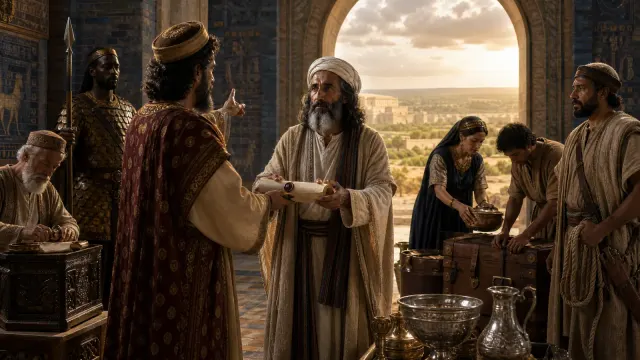
Artaxerxes addresses Ezra as priest and scribe, then puts the law "in thine hand" at the center of the commission. Ezra is sent to inquire into Judah and Jerusalem according to that law, not to improvise a new religious system for imperial convenience. The decree allows Israelites, priests, and Levites who freely choose to go to accompany him. Royal authorization therefore opens another return without turning it into universal conscription. The money has several sources too: gifts from the king and counselors, offerings gathered in Babylon, and voluntary contributions from the people and priests. The Book of Ezra keeps those sources distinct while directing them toward sacrifices and temple needs. Remaining silver and gold may be used with discretion according to God's will, and additional needs can be met from the royal treasury. The commission is generous, but it is also ordered, purpose-driven, and tied to Ezra's responsibility.
Deep dive
The letter describes the law as being in Ezra's hand. His commission is not to invent a new religious arrangement that will satisfy the court, but to inquire according to that given standard. The king and his seven counselors are named as senders, while the invitation to travel remains voluntary. An authorized expedition does not mean every Israelite in the realm is ordered to leave.
Royal gifts and the offerings of the people are brought together but remain distinguishable sources. The money first supplies sacrificial animals and the offerings that accompany them. In the King James wording, "meat offerings" here are the food or grain offerings associated with the sacrifices, not another list of slaughtered animals. Any remaining money is subject to the will of God as Ezra and his brethren discern it. The letter combines specified purposes with a measure of discretion, then adds access to further treasury support if needed.
Words to trace: Jerusalem, house, king, gold, Israel, scribe
Verse-by-verse path
- Ezra 7:11
The Hebrew word for “copy” here is nishtewan, a Persian loanword for an official document. The heading gives Ezra his double title, priest and scribe, and then adds that he is a scribe specifically of the commandments, as if the title needed explaining to Jewish readers.
- Ezra 7:12
From this verse to verse 26 the text is again in Aramaic, the language of the decree. “King of kings” was the formal Persian royal title. “Perfect peace” may instead qualify Ezra’s title, “a scribe of the law of the God of heaven, perfect”, since the Aramaic word is simply “complete”.
- Ezra 7:13
“Of their own freewill” makes this a voluntary emigration, as in the Cyrus decree. The king names the categories, people, priests and Levites, which Ezra will struggle to fill when he finds no Levites at the river Ahava (8:15).
- Ezra 7:14
The seven counsellors appear also in Esther 1:14, “the seven princes of Persia and Media, which saw the king’s face”. The law “in thine hand” is a physical scroll. Ezra goes to investigate Judah by its own law, not by Persian standards.
- Ezra 7:15
The king and his counsellors give silver and gold of their own. “Whose habitation is in Jerusalem” is how an imperial court naturally described a god, by the city of his temple; it is the Persian way of placing him.
- Ezra 7:16
“All the silver and gold that thou canst find” amounts to a licence to collect throughout the province of Babylon, among the Jewish communities and presumably beyond them. The freewill offering of priests and people is kept distinct from what the empire gives.
- Ezra 7:17
“Meat offerings” in 1611 English meant food offerings in general; the Hebrew minchah is a grain offering, which went with each animal sacrifice (Numbers 15:1-10). The drink offering was wine poured out beside the altar. The decree knows the details of Israel’s rites.
- Ezra 7:18
The discretion is wide: “whatsoever shall seem good to thee, and to thy brethren”. The only limit is “the will of your God”, which puts the Mosaic law above the king’s own treasurers in deciding how the silver is spent.
- Ezra 7:19
These vessels are new gifts, not the returned plunder of chapter 1; Ezra weighs them out in 8:25-27. “The God of Jerusalem” is again the imperial way of naming a deity by his city.
- Ezra 7:20
This is an open line of credit on the royal treasury, subject to the limits verse 22 will set. “Which thou shalt have occasion to bestow” leaves the judgement of need to Ezra himself.
Ezra 7:11-20
King James Version11Now this is the copy of the letter that the king Artaxerxes gave unto Ezra the priest, the scribe, even a scribe of the words of the commandments of the LORD, and of his statutes to Israel.
12Artaxerxes, king of kings, unto Ezra the priest, a scribe of the law of the God of heaven, perfect peace, and at such a time.
13I make a decree, that all they of the people of Israel, and of his priests and Levites, in my realm, which are minded of their own freewill to go up to Jerusalem, go with thee.
14Forasmuch as thou art sent of the king, and of his seven counsellors, to enquire concerning Judah and Jerusalem, according to the law of thy God which is in thine hand;
15And to carry the silver and gold, which the king and his counsellors have freely offered unto the God of Israel, whose habitation is in Jerusalem,
16And all the silver and gold that thou canst find in all the province of Babylon, with the freewill offering of the people, and of the priests, offering willingly for the house of their God which is in Jerusalem:
17That thou mayest buy speedily with this money bullocks, rams, lambs, with their meat offerings and their drink offerings, and offer them upon the altar of the house of your God which is in Jerusalem.
18And whatsoever shall seem good to thee, and to thy brethren, to do with the rest of the silver and the gold, that do after the will of your God.
19The vessels also that are given thee for the service of the house of thy God, those deliver thou before the God of Jerusalem.
20And whatsoever more shall be needful for the house of thy God, which thou shalt have occasion to bestow, bestow it out of the king’s treasure house.
Ezra 7:21-24
The Treasury Receives Instructions of Its Own
The king's decree now speaks directly to the treasurers beyond the river, turning Ezra's authority into instructions other officials must honor. Silver, wheat, wine, and oil are available up to stated limits, while salt is supplied without a fixed quantity. The detail is small but revealing. The Book of Ezra does not treat a generous grant as a blank check in every category. Artaxerxes also explains his concern in the language of divine wrath against his realm and sons. That is the motive the document gives, and no speculative reconstruction of his private theology is needed. Finally, temple servants are exempted from toll, tribute, and custom. Priests, Levites, singers, porters, Nethinims, and other ministers reappear here as the same institutional world counted in the return lists. Supporting the house of God now includes protecting the people who serve there from specified imperial taxes, not merely funding objects or construction.
Deep dive
The letter now addresses the treasurers directly. Silver, wheat, wine, and oil have stated allowances, while salt is supplied without a prescribed quantity. Ezra does not have to return to the court for every routine need, but neither is every category left unlimited. The unmeasured salt sits among otherwise measured provisions, a small practical distinction in a generous decree.
The reason offered by the king concerns the possible wrath of the God of heaven against the realm and his sons. That is the motive articulated in the document; the chapter need not be supplemented with a speculative account of his private beliefs. The tax exemption includes priests, Levites, singers, porters, Nethinims, and other temple ministers. Those recurring groups link the letter to the return lists. Support for the house includes sustaining the people who serve there, not simply paying for its visible ornaments.
Words to trace: heaven, baths, house, king, Artaxerxes, certify
Verse-by-verse path
- Ezra 7:21
“I, even I Artaxerxes” is emphatic; the decree now turns from Ezra to the officials who must honour it. The treasurers beyond the river are the same provincial officials whose predecessors wrote against Jerusalem in chapter 4.
- Ezra 7:22
A hundred talents of silver is over three tonnes, a very large sum. A hundred measures of wheat (kors, each about 220 litres) and a hundred baths of wine and oil are capped. Salt is unlimited: it was cheap, and every offering required it.
- Ezra 7:23
“Diligently” translates adrazda, another Persian loanword meaning precisely or correctly. In 458 BC Egypt was in revolt against Persia with Athenian support, and a king anxious about wrath on his realm had reason to court every god of the western provinces. That connection is an inference.
- Ezra 7:24
Exempting temple staff from tax was Persian practice. A Greek inscription records Darius I rebuking his satrap Gadatas for taxing the sacred gardeners of Apollo. The same three taxes, toll, tribute and custom, are those the accusers of 4:13 claimed Jerusalem would withhold.
Ezra 7:21-24
King James Version21And I, even I Artaxerxes the king, do make a decree to all the treasurers which are beyond the river, that whatsoever Ezra the priest, the scribe of the law of the God of heaven, shall require of you, it be done speedily,
22Unto an hundred talents of silver, and to an hundred measures of wheat, and to an hundred baths of wine, and to an hundred baths of oil, and salt without prescribing how much.
23Whatsoever is commanded by the God of heaven, let it be diligently done for the house of the God of heaven: for why should there be wrath against the realm of the king and his sons?
24Also we certify you, that touching any of the priests and Levites, singers, porters, Nethinims, or ministers of this house of God, it shall not be lawful to impose toll, tribute, or custom, upon them.
Ezra 7:25-26
Teaching Carries Judicial Authority
Ezra's commission is not only educational. He is to appoint magistrates and judges for those subject to the laws of his God in the region, and he is also to teach those who do not know those laws. The Book of Ezra therefore joins instruction and adjudication rather than imagining that ignorance should simply be punished without teaching. Verse 26 then gives the commission real coercive weight. Disobedience to God's law and the king's law may bring penalties ranging from imprisonment and confiscation to banishment and death. This is much more than permission for a learned priest to travel and lecture. At the same time, the list of available penalties should not be confused with a record that Ezra personally used every one of them. The chapter authorizes a range of judgments but reports no execution here. Judicial power is substantial, yet the text remains more precise than any assumption about how often each penalty was imposed.
Deep dive
The law in Ezra's hand is again joined to wisdom, this time for the appointment of magistrates and judges. The instruction includes teaching those who do not know it. Knowledge and adjudication therefore belong to the same commission: the task is not merely to punish ignorance that has never been addressed.
The wording concerns the population under the law of Ezra's God within the region beyond the river. It should not be expanded without argument into a command that every inhabitant of the entire imperial region become Jewish. Verse 26 connects God's law and the king's law and lists penalties ranging from imprisonment and confiscation to banishment and death. The passage records substantial coercive authority. It is not just a teacher's travel permit. At the same time, listing authorized penalties does not establish that Ezra used every one of them, and this chapter reports no execution.
Words to trace: know, banishment, confiscation, death, executed, Ezra
Verse-by-verse path
- Ezra 7:25
“The wisdom of thy God, that is in thine hand” equates wisdom with the scroll Ezra holds. His judges were to govern those “such as know the laws of thy God”, that is the Jews of the province, and to teach those who did not know them.
- Ezra 7:26
Four penalties are listed: death, banishment (literally “uprooting”), confiscation and imprisonment. “The law of thy God, and the law of the king” are joined, so that in the province the law of Moses carried the force of imperial law.
Ezra 7:25-26
King James Version25And thou, Ezra, after the wisdom of thy God, that is in thine hand, set magistrates and judges, which may judge all the people that are beyond the river, all such as know the laws of thy God; and teach ye them that know them not.
26And whosoever will not do the law of thy God, and the law of the king, let judgment be executed speedily upon him, whether it be unto death, or to banishment, or to confiscation of goods, or to imprisonment.
Ezra 7:27-28
The Document Gives Way to Thanksgiving
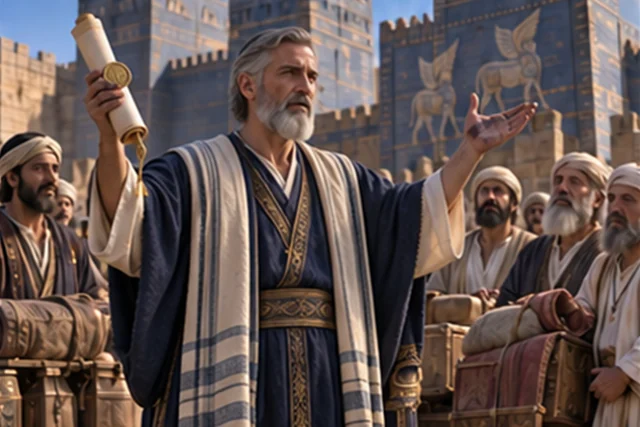
The long royal document ends, and suddenly Ezra speaks in the first person. That change of voice matters because these final sentences are not another clause of Artaxerxes's decree. Ezra blesses the LORD for putting into the king's heart a desire to beautify the house at Jerusalem and for extending mercy to him before the court. The language reaches back toward the beginning of the Book of Ezra, where Cyrus's spirit was stirred. Once again a royal decision is interpreted as part of God's action. Ezra then joins that gratitude to practical organization. He says he was strengthened because God's hand was upon him, and he gathers chief men from Israel to go with him. Thanksgiving does not replace planning. The favor of the court, the hand of God, and the assembling of capable companions all converge in a departure that still has to be carried out on the ground.
Deep dive
The shift into the first person makes the closing words different from another clause in the king's letter. Ezra now interprets the favor he has received. The ruler's decision to beautify the temple is something God has put into the king's heart, echoing the opening chapter's description of Cyrus's spirit being stirred.
The sequence joins mercy before the court, strengthening under God's hand, and the practical gathering of leaders. Ezra's gratitude does not conclude the journey before it begins. It produces a departure that still has to be organized. The official titles and extensive provisions have occupied much of the chapter, but its last movement belongs to a man who names the favor as mercy and then assembles the people needed to act on it.
Words to trace: LORD, king’s, beautify, Blessed, chief, counsellors
Verse-by-verse path
- Ezra 7:27
The Hebrew resumes, and so does the first person: from here the Book of Ezra quotes Ezra’s own memoir. “To beautify” is the verb of Isaiah 60:7, “I will glorify the house of my glory”, and the praise goes to God for what was in the king’s heart.
- Ezra 7:28
“I was strengthened” is reflexive: Ezra took courage. He credits the courage to the LORD’s hand, the phrase that framed verses 6 and 9. His first act on receiving the king’s authority is to gather other leaders, not to set off alone.
Ezra 7:27-28
King James Version27Blessed be the LORD God of our fathers, which hath put such a thing as this in the king’s heart, to beautify the house of the LORD which is in Jerusalem:
28And hath extended mercy unto me before the king, and his counsellors, and before all the king’s mighty princes. And I was strengthened as the hand of the LORD my God was upon me, and I gathered together out of Israel chief men to go up with me.
Questions to keep in mind while reading
- Track who acts, who speaks, who is affected, and what changes.
- Notice repeated promises, failures, rescues, and consequences.
- Do not assume the account approves every action that is reported.
Text first
Where readers differ
The chapter summary begins with what the passage says and how its parts fit together. It does not assume one denomination has already settled every question. Where a conclusion depends on a tradition, literary theory, or historical reconstruction, that dependence is named openly.
The KJV text is presented first. Interpretive conclusions are labeled, and differences are introduced only when they help a reader understand why serious communities do not always reach the same answer.
Comparative interpretive notes for this chapter are in preparation. Until reviewed notes are ready, this page separates the KJV text from summary and application without claiming that serious readers agree on every question.
Questions beneath the surface
- What account of God, human freedom, responsibility, and the good life emerges from Ezra 7?
- Which tension does the chapter refuse to resolve quickly?
- What changes when the chapter is read as part of the whole canon rather than as an isolated moral lesson?
- Where might a sincere reader confuse a familiar tradition with something the text states directly?
Questions for serious personal contemplation
These open-ended questions make room for tension, honest response, prayer, and conclusions that remain accountable to the chapter.
Observe without rushing
What part of Ezra 7 makes you stop, feel unsettled, or feel surprised, and why?
Which detail in the passage would be easiest to overlook? How does that detail change your understanding?
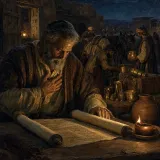
Where do you see tension between what happens and this focus: Ezra studying the law with scrolls prepared before leading the next return?
What important question does the passage leave open instead of resolving quickly?
Examine your inner life honestly
Which person, response, fear, or desire in the passage feels most like your own life right now?
What assumption about God, other people, or yourself does this text challenge?
Which part would you rather soften, avoid, or explain away too quickly? What might that reaction reveal?
If this Scripture could ask you one direct question, what do you think it would ask?
Respond with wisdom and courage
What do you need to remember, confess, grieve, thank God for, or trust after reading this passage?
How might another faithful person read this situation differently without ignoring the text?
What obedient response would be costly, uncomfortable, or slow, yet still faithful to Scripture?
What question will you carry into prayer this week, and which verses will you keep in front of you?
Music and video connected to the passage
Related media appears when its Scripture reference overlaps this study. Music and video can illuminate a theme while the biblical text remains the foundation.