The big picture
A man disabled for thirty-eight years is healed without reaching the pool he has watched, and the carried bed immediately becomes the center of a Sabbath dispute. Jesus answers by tying his work to the Father’s continuing work, which pushes the argument from one healing into claims about divine authority, life, judgment, and resurrection. The Son does what the Father does, gives life, and will call those in graves. Jesus then names the witnesses supporting those claims: John the Baptist, the works themselves, the Father, and the Scriptures. The Book of John refuses to treat Scripture as the problem. The sharper accusation is that people can search it, trust Moses, and still refuse the one to whom those writings testify. A chapter that begins with bodily restoration ends with the question of whether revered testimony will actually be received.
Central truth
John 5 begins with a man walking away from Bethesda at Jesus' command and expands into a Sabbath dispute where Jesus claims the Father's work, life-giving authority, judgment, and confirming witnesses.

The study notes have a page of their own
The movement by movement analysis, the words to trace, the verse by verse notes and where readers differ are written for someone studying alone. They are on the Deep Personal Reflections page for this chapter. This page is the lesson.
A chapter-specific teaching brief
These anchors come from this chapter itself. They help a teacher use the Level 1 overview, the Level 2 study, and the Scripture text as one lesson.
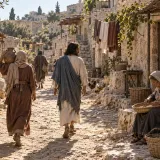
Open with the chapter’s first image
John 5:1: “After this there was a feast of the Jews; and Jesus went up to Jerusalem.”
Slow down at the turning point
John 5:19: “Then answered Jesus and said unto them, Verily, verily, I say unto you, The Son can do nothing of himself, but what he seeth the Father do: for what things…”
Keep this word trail visible
Father, Jesus, witness, life, verily, whole
What to explain, in order
Teach the passage in this order. Each step names the verses it rests on, so every point can be shown in the text before it is applied.
John 5:1-5
A crowd of the sick and one long case
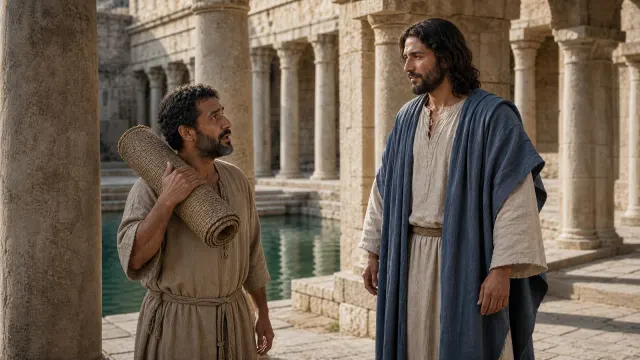
Set the scene at Bethesda, a pool with five porches by the sheep gate, now known from excavations in Jerusalem. Describe the crowd: blind, lame, withered, all waiting. Explain that verse 4, about an angel troubling the water, is in the King James but absent from many of the oldest manuscripts, which is why some Bibles leave it out or place it in a note; either way verse 7 shows what people believed about the pool. Then point to one man, ill for thirty eight years. Teach this setting first because it lets the group feel the weight of long waiting before Jesus speaks.
John 5:6-9
Wilt thou be made whole
Jesus sees him and knows how long he has been there, then asks a question that sounds obvious but is not. After decades, a person's whole life can be built around an illness. The man's answer is about the pool and the lack of help. Explain that Jesus bypasses the pool entirely with a command of three verbs: rise, take up, walk. The man is healed immediately. Then read the last clause, "on the same day was the sabbath", and point out that the Book of John holds it back until now. Teach this step slowly, because the healing must be felt before the dispute begins.
John 5:10-18
The bed, the Sabbath, and the Father who works
Explain that "the Jews" in this chapter refers to the religious authorities in Jerusalem, not the Jewish people as a whole; the healed man, the crowd and Jesus himself are Jewish. Carrying a mat was counted as work under their interpretation of the Sabbath. Show how the man shifts responsibility to the one who healed him. Then read verse 14, where Jesus finds him and warns him; do not turn this into a rule that all illness comes from sin, since 9:3 denies that. Teach verse 17 as the turning point: Jesus claims to share the Father's ongoing work, and verse 18 shows they understood the claim.
John 5:19-30
The Son who gives life and judges
This is the heart of the chapter, so give it time. Read verses 19 and 20 and explain that the Son's dependence on the Father is not weakness but perfect unity: he does what he sees the Father doing. Then trace the two great works that belong only to God, giving life and judging. Explain quickeneth as makes alive. Distinguish verse 25, the spiritually dead hearing now, "and now is", from verses 28 and 29, the physically dead hearing his voice at the end. Teach verse 24 as the promise in the middle: whoever hears and believes has passed from death to life already.
John 5:31-40
A courtroom of witnesses
Explain the legal setting: Deuteronomy 19:15 requires more than one witness. Jesus calls his witnesses one by one. John the Baptist, "a burning and a shining light" whom they enjoyed for a season. The works the Father gave him to finish, including the healing just done. The Father himself. And the Scriptures they study. Explain verse 39 carefully, as the King James reads it as a command, search, while it can also be read as a statement, ye search; either way the point is that the Scriptures testify of him. Teach this step to show that faith in Jesus rests on evidence that converges.
John 5:41-47
Honour from men and Moses as accuser
End with the diagnosis. Jesus does not seek human honour, and he says the real barrier to belief is that they "receive honour one of another, and seek not the honour that cometh from God only". Explain that faith is hard for anyone who lives on approval. Then the reversal: Moses, in whom they trust, will be their accuser, because "he wrote of me". Point to Deuteronomy 18:15 and the Passover and manna patterns that John will develop. Teach this last because it returns the chapter to Scripture and challenges every religious reader, not only the first ones.
Where learners get stuck
The misreadings this passage tends to produce, and how to answer each from the text.
"Jesus healed the man because he had great faith."
The man does not even know who Jesus is (5:13). When asked if he wants to be healed, he talks about the pool and having no one to help (5:7). Jesus commands, and he is healed (5:8-9). The healing displays Jesus' authority and the Father's work (5:17, 36), not the man's faith. Teach this to free learners from thinking healing depends on their spiritual performance.
"Sin no more, lest a worse thing come unto thee means his illness was a punishment for sin."
Jesus does warn him (5:14), and sin is serious. But the text does not say his illness came from sin, and in 9:2-3 Jesus explicitly refuses that explanation for the man born blind. The worse thing may be judgement, which the following verses discuss (5:29). Teach the warning as a call to a changed life after grace, not as a diagnosis of anyone's disability.
"The Jews in John were the enemies of Jesus, so the Book of John is against Jewish people."
In this chapter the phrase refers to the authorities who question the man and persecute Jesus (5:10, 16, 18). Jesus, his disciples, the crowds and the healed man are all Jewish, and Jesus appeals to Moses and the Scriptures as his witnesses (5:39, 46). Teach the phrase as describing particular leaders in a particular dispute, and reject any use of the passage to fuel contempt for Jewish people.
"Jesus said the Son can do nothing of himself, so he was not really equal with God."
The same speech says the Son gives life as the Father does (5:21), receives all judgement (5:22), receives the same honour as the Father (5:23) and has life in himself (5:26). His opponents understood him as "making himself equal with God" (5:18). The Son's doing nothing of himself describes perfect unity of will with the Father (5:19, 30), not lesser nature.
Learning objectives
- Describe the disabled man's condition and Jesus' command at Bethesda.
- Explain why carrying the bed becomes the visible point of Sabbath conflict.
- Trace Jesus' claims about his relation to the Father in verses 17 to 30.
- Distinguish resurrection unto life from resurrection unto damnation.
- List the witnesses Jesus names in his defense.
- Explain how searching the Scriptures can still fail if the hearer refuses to come to Christ.
Teacher preparation
- Read the KJV wording of Bethesda carefully and note verse 4's manuscript history.
- Mark Sabbath, work, Father, life, judgment, witness, and believe.
- Keep the movement from healed man to larger dispute visible.
- Read Deuteronomy 19:15 before tracing Jesus' sequence of witnesses.
- Read verses 45 to 47 twice so Moses' role lands clearly.
Evidence and interpretation checks
Explicit
Verse 8 commands the man to rise, take his bed, and walk; verse 9 says he is immediately whole.
Scripture-supported
Jesus appeals to John, works, Father, Scriptures, and Moses as converging witnesses.
Strong inference
The man's pool-centered answer shows how narrowly his hope has been organized, though Jesus does not call it unbelief.
Possible or traditional reading
The KJV includes verse 4's angelic stirring; some early Greek manuscripts omit that explanation.
Limit
'Sin no more' does not authorize teaching that every illness or disability comes from a specific personal sin.
Discussion with answer guidance
1. What does the man answer when Jesus asks whether he wants to be made whole?
What a good answer contains
He does not say yes or no. He says, "Sir, I have no man, when the water is troubled, to put me into the pool: but while I am coming, another steppeth down before me" (5:7). A good answer hears thirty eight years of disappointment (5:5) and a hope fixed entirely on the pool and on someone to carry him. It also notices that Jesus does not correct his theory or wait for faith; he simply commands, "Rise, take up thy bed, and walk" (5:8). A weak answer calls the man faithless or lazy, which the text does not say.
Show teacher guidance
He explains that he has no one to put him into the pool when the water is troubled and another gets there first. Hear his practical impossibility before Jesus' command.
2. Which part of the healing becomes evidence against the man after he can walk?
What a good answer contains
The bed. The man was "made whole, and took up his bed, and walked: and on the same day was the sabbath" (5:9). The authorities tell him, "It is the sabbath day: it is not lawful for thee to carry thy bed" (5:10), and when they ask who told him, they ask, "What man is that which said unto thee, Take up thy bed, and walk?" (5:12), not who healed him. A good answer sees how the question skips the miracle. A weak answer forgets that a man who had not walked in thirty eight years is standing in front of them.
Show teacher guidance
Verses 10 to 12 focus on carrying the bed on the Sabbath. The restored legs are not what the questioners choose to celebrate.
3. What changes when Jesus says, 'My Father worketh hitherto, and I work'?
What a good answer contains
The argument moves from a broken rule to a claim about God. Jesus says, "My Father worketh hitherto, and I work" (5:17): God has never stopped sustaining and giving life on the Sabbath, and the Son does what the Father does. Verse 18 records how his opponents heard it: "he not only had broken the sabbath, but said also that God was his Father, making himself equal with God." A good answer sees they understood him correctly on that point. A weak answer treats it as a quarrel about rules only.
Show teacher guidance
Verse 18 tells you how the opponents hear it: not merely as Sabbath disagreement, but as making himself equal with God.
4. What authority does Jesus say the Father has given the Son?
What a good answer contains
Life and judgement. Jesus says, "as the Father raiseth up the dead, and quickeneth them; even so the Son quickeneth whom he will" (5:21), and the Father "hath committed all judgment unto the Son" (5:22) "That all men should honour the Son, even as they honour the Father" (5:23). The Son has "life in himself" (5:26) and authority "to execute judgment also, because he is the Son of man" (5:27). A good answer also includes 5:28-29, the dead coming forth from the graves. A weak answer forgets that Jesus says all of this while insisting he does nothing of himself (5:19, 30).
Show teacher guidance
Use verses 21 to 29: giving life, receiving equal honor, executing judgment, and calling the dead from their graves.
5. Why does Jesus say his own solitary witness would not be enough for the argument?
What a good answer contains
He is appealing to the rule of witnesses in Deuteronomy 19:15: a matter is established by two or three witnesses. "If I bear witness of myself, my witness is not true" (5:31) means it would not count as legal proof on its own. So he names others: John the Baptist (5:33), "the works which the Father hath given me to finish" (5:36), "the Father himself" (5:37), and "the scriptures" (5:39), with Moses (5:46). A good answer lists the witnesses. A weak answer thinks Jesus is admitting he might be lying.
Show teacher guidance
Begin with verse 31, then track the witnesses that follow rather than turning the sentence into a denial that Jesus tells the truth.
6. How can people search the Scriptures and still miss what the Scriptures are doing?
What a good answer contains
"Search the scriptures; for in them ye think ye have eternal life: and they are they which testify of me. And ye will not come to me, that ye might have life" (5:39-40). A good answer sees the tragedy: they study the right books, and the books point to the one standing in front of them, yet they will not come. Verse 44 adds the cause, seeking honour from one another. A weak answer makes the problem too much Bible study; the problem is refusing where the Scriptures lead.
Show teacher guidance
Verses 39 and 40 give the tragedy: they search texts that testify of Christ, yet refuse to come to him that they might have life.
Responsible application
Do not stare past the restored person
Use verses 9 to 12 to examine how rule disputes can become so consuming that visible mercy in front of the group receives no acknowledgment.
Let witnesses converge
Use verses 31 to 40 to build a habit of testing a claim through the actual evidence offered rather than accepting or rejecting it by reflex.
Read Scripture toward its own destination
Use verses 39 to 47 to ask whether a reading honors what the text points toward or merely uses respected words to defend a settled position.
Session plans
Two timings of the same lesson. The shorter keeps the reading, the central discussion and one response; the longer gives the confusions and the application their own time.
45 minutes
Thirty eight years
Read 5:1-9. Explain verse 4 briefly and take question one and the first confusion.
The bed and the warning
Read 5:10-16. Take question two and the second and third confusions.
My Father worketh
Read 5:17-29. Take questions three and four, and the fourth confusion, with verse 24 on the board.
The witnesses
Read 5:30-47 and Deuteronomy 19:15. Take questions five and six, listing the witnesses together.
One response
Choose the application on reading Scripture toward its destination. Read the key verse together and hand out the sheet.
90 minutes
Waiting
Ask what the longest wait in anyone's life has been. Then read 5:1-5 and explain Bethesda and the manuscript history of verse 4.
Rise and walk
Read 5:6-9. Take question one and the first confusion, and let the Sabbath clause land at the end.
The authorities and the bed
Read 5:10-16. Take question two and the second and third confusions with care for any with chronic illness.
Equal with God
Read 5:17-23. Take question three and the fourth confusion. Read Genesis 2:2-3 for the Father's rest and ongoing work.
Life and judgement
Read 5:24-30. Take question four and contrast 5:25 with 5:28-29.
Witness after witness
Read 5:31-47 with Deuteronomy 18:15 and 19:15. Take questions five and six and list the witnesses on the board.
Applications
In pairs, choose an application and name one way the group might overlook mercy in front of it.
Handout and prayer
Read the key verse together, point to the take-home line, and pray for those still waiting by their own pools.
Adapting the lesson
Children
Lay a mat on the floor and ask a child to lie on it while you count to thirty eight slowly, then explain the man waited thirty eight years. Have the child stand, roll up the mat and walk when you say Jesus' words. Explain that some leaders were upset about the mat on the day of rest. Keep the judgement and resurrection teaching to one sentence about Jesus giving life.
Youth
Ask whether it is possible to get used to being stuck. Read 5:6-7 and talk about the question Jesus asks. Then read 5:10-12 and ask why the leaders could not see the miracle; discuss times people care more about rules than about people. Take verse 39 seriously: they can read the Bible and still miss Jesus. Ask how that might happen to them.
Adults
Give space to the long illness and the question Jesus asks, with care for those who live with chronic illness or disability. Explain the Sabbath dispute and the claim of equality with the Father. Spend time on the witnesses and on verse 44, the hunger for human honour that blocks faith. Ask where respected learning can be used to avoid coming to Christ.
One to one
Read 5:1-9 together and ask whether there is anything they have waited on for a long time. Listen without hurrying to an answer. Read verse 24 and talk about what it means to pass from death to life now. If they are a long-time church member, read 5:39-40 gently and ask whether their Bible reading leads them to Jesus himself.
Song and video learning lab
A song or video may interpret, compress, or dramatize the text. Its value becomes clearer when its choices are compared with Scripture.
- Before the media: the exact passage and its central movement.
- During the media: the words, people, events, and emotions the artist emphasizes.
- After the media: what it clarifies, what it leaves out, and what belongs back in the biblical text.
Handout
One page for learners to take home. The print button prints this section alone.
John 5
The passage in brief
At the pool of Bethesda, Jesus meets a man who has been ill for thirty eight years and has no one to help him into the water. Jesus tells him to rise, take up his mat and walk, and he does. Because it is the Sabbath, the authorities object to the mat. Jesus says his Father is always working and so is he. He claims power to give life and to judge, and he names his witnesses: John the Baptist, his works, the Father, and the Scriptures.
A verse to keep
Verily, verily, I say unto you, He that heareth my word, and believeth on him that sent me, hath everlasting life, and shall not come into condemnation; but is passed from death unto life.
John 5:24 · King James Version
Questions to take home
What did the man answer when Jesus asked if he wanted to be made whole?
What upset the authorities after the man was healed?
Which witnesses does Jesus name in verses 31 to 47?
This week
When you read the Bible this week, ask each time what it shows you about Jesus.
Music and video connected to the passage
Related media appears when its Scripture reference overlaps this study. Music and video can illuminate a theme while the biblical text remains the foundation.