The big picture
The disciples admire the temple buildings, but Jesus answers with a prediction of destruction that strips visible grandeur of any claim to permanence. Their private questions then join the temple’s fall, the coming of the Son of man, and the end, and the long answer refuses to reduce those matters to a simple timetable. Jesus warns first about deception. Wars, famines, pestilences, earthquakes, persecution, and false prophets are real, yet some of these are explicitly called the beginning rather than the end. The warning about Judaea includes urgent, local instructions for flight, while the coming of the Son of man is compared with lightning rather than a secret report from a hidden place. Cosmic language, the fig tree, and the difficult phrase “this generation” keep the interpretive pressure visible. Then the chapter states what calculation cannot solve: the day and hour are unknown. Readiness is therefore pictured not as date setting, but as a servant faithfully feeding the household while the master is away.
Central truth
After announcing the temple’s fall, Jesus prepares his disciples for deception, distress, and his coming by teaching watchfulness expressed in readiness, faithful stewardship, and concrete care under the certainty of final accountability.

The study notes have a page of their own
The movement by movement analysis, the words to trace, the verse by verse notes and where readers differ are written for someone studying alone. They are on the Deep Personal Reflections page for this chapter. This page is the lesson.
A chapter-specific teaching brief
These anchors come from this chapter itself. They help a teacher use the Level 1 overview, the Level 2 study, and the Scripture text as one lesson.
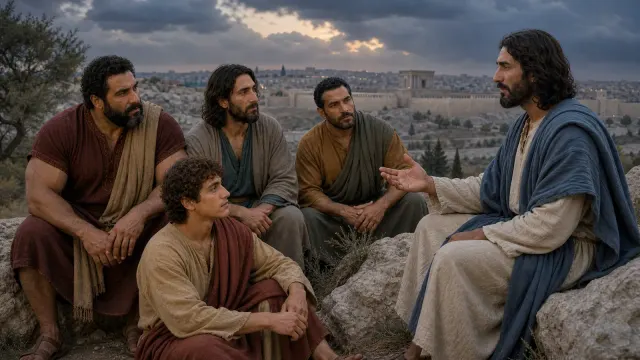
Open with the chapter’s first image
Matthew 24:1: “And Jesus went out, and departed from the temple: and his disciples came to him for to shew him the buildings of the temple.”
Slow down at the turning point
Matthew 24:23: “Then if any man shall say unto you, Lo, here is Christ, or there; believe it not.”
Keep this word trail visible
coming, days, heaven, lord, deceive, hour
What to explain, in order
Teach the passage in this order. Each step names the verses it rests on, so every point can be shown in the text before it is applied.
Matthew 24:1-3
Stones and questions
Start where chapter 23 left off: Jesus has said the house is left desolate, and now he leaves it. The disciples admire the buildings and he predicts their fall. Then they ask their questions on the mount of Olives, facing the temple. Explain "the end of the world" as the close of the age. Tell the group at the start that Christians read this discourse in several ways: some see much of it fulfilled in the fall of Jerusalem in AD 70, some see most of it as still to come, and many see both. Set the readings out and do not choose for the room.
Matthew 24:4-14
Do not be deceived; endure
Teach Jesus' first concern, deception, before anything about timing. False Christs, wars, famines, earthquakes and persecution are things that must come, and he calls them birth pains, "the beginning of sorrows". Explain the term: labour pains signal a birth without telling the hour. Stress verse 6, "see that ye be not troubled". Then the three commands that run through the whole age: endure, keep love from growing cold, and preach the gospel to all nations. Do not attach any of these verses to current events or modern nations; Jesus warned against exactly that.
Matthew 24:15-28
The abomination and the flight
Explain "the abomination of desolation" from Daniel 9:27, 11:31 and 12:11, where it describes something detestable set up in the holy place that leaves it desolate. Matthew's aside, "whoso readeth, let him understand", invites careful reading. Explain that some apply these verses to Roman armies and the temple's destruction, others to a future crisis, and others to both. The plain command is to flee quickly. Then 24:23-28: when the Son of man comes it will be as visible as lightning, so no one needs to hunt for him in deserts or secret rooms.
Matthew 24:29-35
The coming of the Son of man
Read the cosmic signs alongside Isaiah 13:10 and Joel 2:10, where darkened sun and falling stars describe God's judgement on nations. Then Daniel 7:13-14, behind "coming in the clouds of heaven with power and great glory". Explain the fig tree lesson simply. On 24:34, "This generation shall not pass", set out the main readings fairly: Jesus' contemporaries and the events of AD 70, the generation alive when the signs begin, or the word generation taken in the wider sense of a kind of people. Close on 24:35, which every reading shares: his words will not pass away.
Matthew 24:36-51
No one knows the hour
Read 24:36 aloud slowly: "no, not the angels of heaven, but my Father only". Mark 13:32 adds that the Son does not know the hour either, and some manuscripts of Matthew include it; the page's Bible does not, so teach the verse as printed. Then Noah: people were not wicked for eating and marrying, but they "knew not". On "one shall be taken, and the other left", explain that readers differ on whether the one taken is gathered to Christ or swept away in judgement, as in the flood. Then the thief and the two servants. End the step on the practical meaning of readiness: faithful care of others.
Matthew 25:1-30
Oil and talents
Teach the two parables as a pair: the virgins show that readiness cannot be borrowed at the last minute, the talents show that readiness means working faithfully with what was entrusted. Explain the wedding custom only as far as the parable needs: attendants waiting with lamps to escort the bridegroom. Explain a talent as a large sum of money; the English word for natural ability comes from this parable, but here it means money given in trust. Point out that the third servant's fear came from a false picture of his master.
Matthew 25:31-46
The King and the least
Close the discourse with the final scene. Explain the shepherd separating sheep from goats, which often grazed together by day. Read the six works in each half, and let the repetition sound. Teach the surprise: neither group knew they were serving or refusing the King. Explain the two main readings of "my brethren", disciples in need or anyone in need, without choosing. Hold together grace and judgement: the kingdom is "prepared for you from the foundation of the world", and the outcomes in 25:46 are everlasting. Teach this last because it answers the disciples' question by telling them how to live.
Where learners get stuck
The misreadings this passage tends to produce, and how to answer each from the text.
"The wars and earthquakes in the news prove the end is happening right now."
Jesus says the opposite. Wars must come, "but the end is not yet" (24:6), and "All these are the beginning of sorrows" (24:8). He warns that many will come claiming to know and "shall deceive many" (24:5). Every generation since has had wars and earthquakes, and believers have often linked them to the end. Teach the commands Jesus gives instead: do not be troubled, endure, love, preach.
"If I study carefully enough, I can work out the date."
Jesus says "of that day and hour knoweth no man, no, not the angels of heaven, but my Father only" (24:36), and "in such an hour as ye think not the Son of man cometh" (24:44). Predictions of the date have failed many times, harming faith. The fig tree teaches that the season can be recognised, but the hour belongs to God. The disciple's task is readiness, not calculation.
"The wise virgins were selfish for not sharing their oil."
The parable is not about manners but about readiness that cannot be transferred. The wise answer "lest there be not enough for us and you" (25:9). What the oil stands for, a life prepared to meet the bridegroom, cannot be lent to another at the last moment. The lesson is stated in 25:13: "Watch therefore".
"The sheep and goats means we earn heaven by doing good works."
The kingdom is called an inheritance "prepared for you from the foundation of the world" (25:34), a gift, and the righteous do not even know they have served the King (25:37-39). Their works show who they are rather than buying a reward. Christian traditions describe the relation of faith and works differently; all agree that this passage makes concrete mercy to the needy inseparable from belonging to Christ.
"One shall be taken and the other left settles exactly how the end will happen."
Readers take 24:40-41 in different ways. In the verse just before, the flood "took them all away" (24:39) in judgement, so some read the one taken as removed in judgement; others read the one taken as gathered by the angels of 24:31. The point Jesus draws is the same either way: "Watch therefore: for ye know not what hour your Lord doth come" (24:42).
Learning objectives
- Distinguish the disciples’ questions from Jesus’ opening warning.
- Identify why reports of disaster do not supply a date.
- Explain watchfulness through the household servants’ conduct.
- Compare the prepared and unprepared lamp-bearers.
- Identify faithfulness rather than equal resources in the talents parable.
- Describe the King’s identification with the least in the judgment scene.
Teacher preparation
- Assign Matthew 24–25 beforehand; select classroom anchors rather than rushing through all 97 verses.
- Mark the temple departure and private Olivet teaching; retain the disciples’ multiple questions.
- Read Daniel 9:27; 11:31; 12:11 and 7:13–14; distinguish desolation and Son of man connections from proposed chronologies.
- Gloss talents as monetary amounts, not musical or athletic abilities; explain that both groups of lamp-bearers sleep in 25:5.
- Chart evidence for disputed timing and the least’s identity; exclude speculative connections to current headlines.
Evidence and interpretation checks
Explicit
Locate the warning that the end is not yet in Matthew 24:6, the unknown day and hour in 24:36, and watchfulness in 24:42–44.
Scripture-supported
Read Matthew 24:30 with Daniel 7:13–14; the Son of man’s coming concerns revealed authority and glory, not an unnamed teacher’s prediction.
Strong inference
Compare delay in Matthew 24:48, 25:5, and 25:19; infer that conduct during waiting is central across the examples.
Possible or traditional reading
Distinguish temple-judgment, future-return, and combined-horizon readings of Matthew 24:15–35; acknowledge both disciple-focused and broader-needy-person readings of my brethren in 25:40.
Limit
State that Matthew 24:36 supplies no date calculation, 24:40–41 does not independently settle every taken-and-left interpretation, and 25:14–30 is not investment advice.
Discussion with answer guidance
1. What do the disciples ask after Jesus predicts the temple’s destruction?
What a good answer contains
Jesus has just said of the temple, "There shall not be left here one stone upon another" (24:2). On the mount of Olives the disciples ask privately: "when shall these things be? and what shall be the sign of thy coming, and of the end of the world?" (24:3). A good answer notices that they ask about the temple's fall, his coming and the end, and that they seem to expect all three together. It then says that readers divide over how Jesus' answer sorts those questions, and that the chapter does not label which verses answer which. A weak answer forces one chart onto the text.
Show teacher guidance
Read 24:1–3: when these things occur and the sign of his coming and the end. Keep the questions distinct without assuming a fully labelled answer-chart the chapter never supplies.
2. Why should wars and disasters not become instant proof of a calculated end date?
What a good answer contains
Because Jesus says so. His first words are "Take heed that no man deceive you" (24:4); false Christs will come; wars must happen, "but the end is not yet" (24:6), and such things are only "the beginning of sorrows" (24:8). What he does require is endurance, "he that shall endure unto the end, the same shall be saved" (24:13), and witness, "this gospel of the kingdom shall be preached in all the world" (24:14). A good answer turns from guessing to these duties. A weak answer reads the day's headlines into the verses, which is the very deception Jesus warns about.
Show teacher guidance
Use 24:4–8: deception is the first warning, and the end is not yet. Include endurance and witness in 24:9–14; do not let speculative timing displace the stated responsibilities.
3. What does readiness look like in the two household servants?
What a good answer contains
The faithful servant is the one his lord set over the household "to give them meat in due season" (24:45), and "Blessed is that servant, whom his lord when he cometh shall find so doing" (24:46). The evil servant says in his heart "My lord delayeth his coming" and begins "to smite his fellowservants, and to eat and drink with the drunken" (24:48-49). A good answer says readiness is measured by how we treat those in our care while the master is away. A weak answer makes watching a matter of calculating dates and ignores the fellowservants.
Show teacher guidance
Compare 24:45–51: one provides food faithfully while the other exploits delay to abuse fellowservants. Watchfulness has observable ethical content; it is not merely keeping an eye on a calendar.
4. Why is staying physically awake not the difference between the two groups with lamps?
What a good answer contains
Because "they all slumbered and slept" (25:5), wise and foolish alike. What divides them is preparation made before the night: "the wise took oil in their vessels with their lamps" (25:4), and the foolish "took no oil" (25:3). When the cry comes at midnight, oil cannot be borrowed (25:9). Then "the door was shut" and the bridegroom says "I know you not" (25:10-12). A good answer locates readiness in what was done beforehand. A weak answer assigns a fixed meaning to every lamp and drop of oil, which the parable does not supply.
Show teacher guidance
Read 25:1–13: all sleep, but only one group has prepared oil. Do not invent a fixed spiritual meaning for every lamp detail; readiness before the arrival carries the contrast.
5. Why do the servants with five and two talents receive the same commendation?
What a good answer contains
Because the master measures faithfulness, not quantity. He gave "to every man according to his several ability" (25:15), and both the five-talent and two-talent servants doubled what they received. Each hears the same words: "Well done, thou good and faithful servant" and "enter thou into the joy of thy lord" (25:21, 25:23). The third servant hid his talent because he saw his lord as "an hard man" and was afraid (25:24-25). A good answer sees that fear and a false picture of the master produced the burial. A weak answer turns the parable into a promise of financial returns.
Show teacher guidance
Compare 25:14–23: each acts faithfully with what was entrusted. Read the third servant’s explanation and judgment in 25:24–30 without turning the parable into a guarantee of financial returns.
6. What surprises both groups when the King describes their actions toward him?
What a good answer contains
Both are surprised. The righteous ask "Lord, when saw we thee an hungred, and fed thee?" (25:37), and the others ask the same in reverse (25:44). The King answers "Inasmuch as ye have done it unto one of the least of these my brethren, ye have done it unto me" (25:40). A good answer lists the six works, feeding, drink, welcome, clothing, visiting the sick and the prisoner, and explains that readers take "my brethren" as Jesus' disciples (compare 10:40-42 and 12:49-50) or as all who suffer. It keeps the seriousness of 25:46 without making the works a purchase of salvation.
Show teacher guidance
Identify food, drink, welcome, clothing, and visits in 25:35–45. Explain the debated identity of my brethren, comparing 10:40–42, while preserving the seriousness of concrete response and final judgment.
Responsible application
Heart and habits
Ask a fictional reader to replace a date-setting conclusion with a clearly commanded response from Matthew 24:4–14 or 42–46.
Relationships and community
Design a fictional household’s care for those entrusted to it, contrasting faithful provision with abuse during the master’s absence.
Ready through faithful service
Build an imaginary group plan around accountable use of resources and concrete help, without claiming such a plan purchases salvation.
Session plans
Two timings of the same lesson. The shorter keeps the reading, the central discussion and one response; the longer gives the confusions and the application their own time.
45 minutes
The questions
Read 24:1-3 and take question one. Tell the group plainly that readers interpret the discourse in more than one way.
Do not be deceived
Read 24:4-14. Take question two and confusion one. List the commands Jesus gives.
No one knows
Read 24:29-31 and 24:36-51. Take question three and confusion two.
Oil and talents
Read 25:1-30 in two voices. Take questions four and five and confusion three.
The least of these
Read 25:31-46. Take question six and confusion four.
Handout
Read the key verse and ask each learner to name one of the six works they can do this week.
90 minutes
Opening
Ask what people imagine when they hear the end of the world. Do not comment yet. Read 24:1-3.
Birth pains and endurance
Read 24:4-14. Take questions one and two and confusion one. Write the commands on the board.
The abomination and the flight
Read 24:15-28 with Daniel 9:27. Present the main readings fairly and avoid any modern application.
The Son of man coming
Read 24:29-35 with Daniel 7:13-14. Set out the readings of 24:34 without choosing.
Watch
Read 24:36-51. Take question three and confusions two and five.
The ten virgins
Read 25:1-13 and take question four and confusion three.
The talents
Read 25:14-30 and take question five. Ask what false picture of God might make someone bury what they were given.
Sheep and goats
Read 25:31-46. Take question six and confusion four. Use the application on faithful service to plan one concrete act.
Handout and prayer
Read the key verse together and pray for the hungry, strangers, sick and prisoners known to the group.
Adapting the lesson
Children
Leave out the tribulation, the abomination and the outer darkness. Tell the ten bridesmaids with torches or paper lamps and ask what the wise ones remembered. Hand out play coins for the talents and praise the servants who used them. End with 25:35-40: Jesus says that when we help someone hungry or sick, we are helping him. Reassure anxious children that Jesus says not to be afraid.
Youth
Ask what they have heard about the end times online, and then read 24:4-6 to show that Jesus' first concern is not being fooled. Keep the discussion away from current events and nations. Spend most of the time on the talents and the sheep and goats: what has God put in their hands, and who are the least around them this week.
Adults
Set out the main ways the discourse is read, with their strongest texts, and let the group see the evidence without choosing for them. Then move firmly to what all readings share: no date setting, endurance, faithful stewardship and mercy to the least. Ask which parable most unsettles them and why. Be gentle with anyone made anxious by past teaching on the end.
One to one
Ask whether thinking about Christ's return makes them afraid, hopeful or indifferent, and listen. If they are anxious, read 24:6 and 24:35 together. If they feel they have buried their talent, read 25:21 and talk about one small thing to begin with. Close by reading 25:40 and naming someone they could visit or help.
Song and video learning lab
A song or video may interpret, compress, or dramatize the text. Its value becomes clearer when its choices are compared with Scripture.
- Before the media: the exact passage and its central movement.
- During the media: the words, people, events, and emotions the artist emphasizes.
- After the media: what it clarifies, what it leaves out, and what belongs back in the biblical text.
Handout
One page for learners to take home. The print button prints this section alone.
Matthew 24–25
The passage in brief
As Jesus leaves the temple he says it will be thrown down, and on the Mount of Olives his disciples ask when, and what sign will mark his coming and the end. He warns them not to be deceived or troubled, to endure and to preach the gospel to all nations, because no one knows the day or hour. He tells of ten bridesmaids, of servants entrusted with money, and of the King who separates sheep from goats by how they treated the least of his brothers.
A verse to keep
And the King shall answer and say unto them, Verily I say unto you, Inasmuch as ye have done it unto one of the least of these my brethren, ye have done it unto me.
Matthew 25:40 · King James Version
Questions to take home
What is the first thing Jesus warns about in 24:4?
What did the wise bridesmaids do that the foolish did not, in 25:3-4?
Which of the six works in 25:35-36 could you do this week?
This week
Choose one of the works in Matthew 25:35-36 and do it for someone before next week.
Music and video connected to the passage
Related media appears when its Scripture reference overlaps this study. Music and video can illuminate a theme while the biblical text remains the foundation.