The big picture
The disciples admire the temple buildings, but Jesus answers with a prediction of destruction that strips visible grandeur of any claim to permanence. Their private questions then join the temple’s fall, the coming of the Son of man, and the end, and the long answer refuses to reduce those matters to a simple timetable. Jesus warns first about deception. Wars, famines, pestilences, earthquakes, persecution, and false prophets are real, yet some of these are explicitly called the beginning rather than the end. The warning about Judaea includes urgent, local instructions for flight, while the coming of the Son of man is compared with lightning rather than a secret report from a hidden place. Cosmic language, the fig tree, and the difficult phrase “this generation” keep the interpretive pressure visible. Then the chapter states what calculation cannot solve: the day and hour are unknown. Readiness is therefore pictured not as date setting, but as a servant faithfully feeding the household while the master is away.
In this chapter
- The Buildings and the Questions They Raise Matthew 24:1-3
The disciples look at the temple and see buildings worth pointing out.
- Alarming Events Are Not Automatically the End Matthew 24:4-14
The first answer to a request for signs is not a date but a warning: “Take heed that no man deceive you.” That ordering matters.
- Flight Is Local; the Warning Against Deception Is Wide Matthew 24:15-28
The warning suddenly becomes local enough to feel like evacuation instructions.
- Cosmic Language and the Difficult Word Generation Matthew 24:29-35
Sun, moon, stars, clouds, trumpet, angels, and the gathered elect make this one of the densest passages in the discourse.
- The Unknown Hour Is Part of the Teaching Matthew 24:36-44
The unknown day and hour are not a footnote after the timetable.
- Delay Reveals What the Servant Does with Power Matthew 24:45-51
The chapter’s final image of readiness is almost aggressively ordinary: feed the household at the proper time.

Scripture beside the summary
Matthew · King James Version · 51Matthew 24:1-3
The Buildings and the Questions They Raise
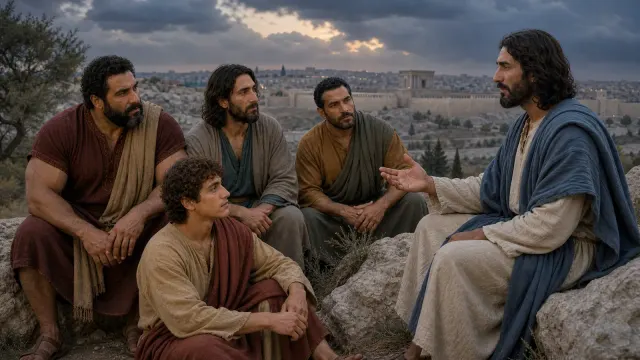
The disciples look at the temple and see buildings worth pointing out. Jesus looks at the same stones and announces a destruction so complete that their visible solidity cannot serve as a guarantee of permanence. The Book of Matthew places the statement immediately after the lament that “your house is left unto you desolate,” so the move away from the temple is already carrying theological weight. On the mount of Olives, the disciples privately ask when “these things” will happen, what sign will mark Jesus’ coming, and what will mark the end of the world. Their question joins several enormous subjects, but the joining does not automatically prove that every detail must happen at one identical moment. Much of the difficulty in the chapter comes from how the answer relates Jerusalem’s approaching catastrophe to the coming of the Son of man and the consummation. The King James phrase “end of the world” can sound more narrowly physical than the underlying idea of the completion of the age. The questions are clear enough to ask and difficult enough that the answer will resist a simple chart.
Deep dive
Jesus leaves the temple immediately after announcing the desolate house. The disciples point out its buildings, but his answer does not linger over their splendour. He declares a destruction so complete that their visible solidity can no longer serve as a guarantee of permanence. The statement is specific to what they are looking at, not an abstract remark that all impressive things eventually age.
On the mount of Olives, the disciples ask about the timing of these events, the sign of his coming, and the end of the world. Their question places those matters together; it does not establish that every element must occur at the same moment or be explained by one event. Much of the chapter’s interpretive difficulty concerns how the answer relates the temple’s destruction to the final coming.
The King James expression “end of the world” here concerns the consummation of the age. That sense allows the discussion to address the completion of a period and order without deciding every question about the physical cosmos from the English word alone.
Words to trace: disciples, Jesus, temple, buildings, coming, departed
Verse-by-verse path
- Matthew 24:1
Herod’s rebuilding had begun around 20 BC and was still going on (John 2:20 counts forty six years). Josephus describes stones some forty five cubits long and a front plated with gold that dazzled like the sun (War 5.222–224). Jesus walks out of it straight after saying “your house is left unto you desolate”.
- Matthew 24:2
Titus’s army burned the temple in AD 70, and Josephus says the city was so levelled that a visitor would not believe it had ever been inhabited (War 7.1–3). Huge Herodian blocks thrown down from the walls still lie on the paved street below the southwest corner, where excavators found them.
- Matthew 24:3
“Coming” is parousia, the word for the official arrival of a ruler on a state visit. Among the Gospels only Matthew uses it, four times in this chapter (verses 3, 27, 37, 39). Mark says they sat “over against the temple” and names the four who asked: Peter, James, John and Andrew (Mark 13:3).
Matthew 24:1-3
King James Version1And Jesus went out, and departed from the temple: and his disciples came to him for to shew him the buildings of the temple.
2And Jesus said unto them, See ye not all these things? verily I say unto you, There shall not be left here one stone upon another, that shall not be thrown down.
3And as he sat upon the mount of Olives, the disciples came unto him privately, saying, Tell us, when shall these things be? and what shall be the sign of thy coming, and of the end of the world?
Matthew 24:4-14
Alarming Events Are Not Automatically the End
The first answer to a request for signs is not a date but a warning: “Take heed that no man deceive you.” That ordering matters. False messianic claims appear before wars, rumours, famine, pestilence, and earthquakes, because danger lies not only in upheaval itself but in people attaching false certainty to it. The Book of Matthew explicitly says “the end is not yet” and calls these events “the beginning of sorrows.” That sentence refuses the habit of treating every new disaster as automatic proof that the final moment has arrived. The pressure then moves closer to the disciples: affliction, killing, hatred, betrayal, false prophets, iniquity, and love growing cold. Endurance belongs inside that environment, not outside it. The gospel of the kingdom will be preached among all nations before the end, giving the passage a horizon wider than the temple. Yet no modern measuring device is provided for calculating when worldwide witness is complete. The assignment is proclamation and endurance, while deceptive certainty about the timetable remains one of the first things Jesus warns against.
Deep dive
The first response to the disciples’ request for signs is a warning against being deceived. False claims to messianic identity appear before the catalogue of upheavals. The danger is not only that terrible things will happen, but that teachers will attach false certainty to them.
Wars, rumours, famines, pestilences, and earthquakes are named, yet Jesus explicitly says that the end is not yet and calls these the beginning of sorrows. The events cannot simply be converted into a formula in which every new disturbance proves that the final moment has arrived. The passage itself resists that inference.
The focus then moves from large public upheavals to the disciples’ experience: persecution, betrayal, hatred, false prophecy, and love growing cold. Endurance is set within that pressure. The proclamation of the kingdom to all nations gives the account a horizon wider than the immediate temple question. The text does not identify a modern reporting system by which complete proclamation can be measured and the date calculated. It describes witness reaching outward while disciples continue through opposition, rather than inviting them to substitute speculation for their assigned work.
Words to trace: deceive, kingdom, nation, nations, rise, wars
Verse-by-verse path
- Matthew 24:4
“Take heed” is blepete, look out. “Deceive” is planao, to lead astray, the verb of the straying sheep in 18:12. It recurs four times in this chapter (verses 4, 5, 11, 24): the first danger Jesus names is not war or famine but being led off course.
- Matthew 24:5
Josephus names men who fit the warning before AD 70: Theudas, who promised to part the Jordan (Antiquities 20.97–98; Acts 5:36), and “the Egyptian”, who gathered thousands on the Mount of Olives to watch Jerusalem’s walls fall (War 2.261–263; Acts 21:38).
- Matthew 24:6
“Troubled” is throeo, to be startled or alarmed. “Must come to pass” echoes the Greek of Daniel 2:28, where God reveals to Nebuchadnezzar “what shall be in the latter days”. Things that must happen are not, for that reason, the end.
- Matthew 24:7
The line echoes Isaiah 19:2, “city against city, and kingdom against kingdom”. Acts 11:28 records a famine under Claudius, and Tacitus reports an earthquake that levelled Laodicea around AD 60 (Annals 14.27). “Pestilences” is absent from the oldest manuscripts.
- Matthew 24:8
“Sorrows” is odines, the pains of childbirth, the prophets’ image for the anguish of judgment (Isaiah 13:8; 26:17). Later rabbinic writings speak of “the birth pangs of the Messiah”. Labour pains are real pains, and they are only the start of labour.
- Matthew 24:9
“Afflicted” is thlipsis, the word for the “great tribulation” of verse 21. Mark says “hated of all men” (Mark 13:13); Matthew writes “of all nations”. Tacitus, describing Nero’s persecution in AD 64, says the Christians were convicted of “hatred of the human race” (Annals 15.44).
- Matthew 24:10
“Betray” is paradidomi, the same verb as “deliver you up” in verse 9 and the verb used of Judas. The pressure from outside becomes a fracture inside, brother handing over brother, as 10:21 had warned.
- Matthew 24:11
The Sermon on the Mount had already described them: “false prophets, which come to you in sheep’s clothing, but inwardly they are ravening wolves” (7:15). Verse 5 spoke of false Christs deceiving many; here false prophets do the same, from inside the community.
- Matthew 24:12
“Love” is agape, and this is the only place Matthew uses the noun, though he uses the verb often. “Wax cold” is psycho, to cool, found nowhere else in the New Testament. The picture is of something warm left out until it chills.
- Matthew 24:13
The sentence repeats 10:22 word for word, from the instructions to the twelve. “Endure” is hypomeno, literally to remain under, to stay in place under a load rather than escape it.
- Matthew 24:14
“The gospel of the kingdom” is a phrase only Matthew uses (4:23; 9:35; 24:14). “All the world” is oikoumene, the inhabited world, the word Luke uses when Augustus orders “that all the world should be taxed” (Luke 2:1). “For a witness” is martyrion, testimony given in court.
Matthew 24:4-14
King James Version4And Jesus answered and said unto them, Take heed that no man deceive you.
5For many shall come in my name, saying, I am Christ; and shall deceive many.
6And ye shall hear of wars and rumours of wars: see that ye be not troubled: for all these things must come to pass, but the end is not yet.
7For nation shall rise against nation, and kingdom against kingdom: and there shall be famines, and pestilences, and earthquakes, in divers places.
8All these are the beginning of sorrows.
9Then shall they deliver you up to be afflicted, and shall kill you: and ye shall be hated of all nations for my name’s sake.
10And then shall many be offended, and shall betray one another, and shall hate one another.
11And many false prophets shall rise, and shall deceive many.
12And because iniquity shall abound, the love of many shall wax cold.
13But he that shall endure unto the end, the same shall be saved.
14And this gospel of the kingdom shall be preached in all the world for a witness unto all nations; and then shall the end come.
Matthew 24:15-28
Flight Is Local; the Warning Against Deception Is Wide
The warning suddenly becomes local enough to feel like evacuation instructions. Judaea, housetops, fields, winter, the sabbath, pregnancy, and nursing all appear because the danger requires immediate flight and will burden some people more heavily than others. The Book of Matthew ties this crisis to Daniel’s “abomination of desolation” and even inserts “whoso readeth, let him understand,” acknowledging that the scriptural connection requires discernment. Interpretations differ over whether the passage refers primarily to Jerusalem’s crisis, a final desecration, or an earlier event that also patterns the last. The Gospel itself does not name a modern figure. It does, however, sharply reject secret-location claims about Christ. False Christs and prophets may display impressive signs, but wonders alone cannot settle identity. A report that he is in a desert or private chamber is to be rejected, because the Son of man’s coming is compared to lightning spanning the sky. The proverb about the carcass and gathered birds remains difficult, but whatever its precise force, the surrounding warning works against hidden, privately controlled messianic sightings.
Deep dive
The reference to Daniel directs attention particularly to the desecration language in Daniel 9:27 and 12:11. Matthew’s parenthetical summons to understanding acknowledges that the connection requires discernment. Interpretations relate the warning to Jerusalem’s approaching crisis, to a final desecration, or to a pattern in which the earlier crisis anticipates the last. The passage supplies correspondences, not a named modern figure.
The instructions have unmistakably local features: Judaea, rooftops, fields, winter, and the sabbath. The danger leaves no time to recover possessions. Pregnancy and nursing are named because flight imposes unequal burdens, not because those conditions are faults. The shortening of the days places a limit on the distress for the elect’s sake.
False messiahs and prophets will make claims backed by signs, so apparent wonders cannot by themselves settle identity. The coming of the Son of man is compared with lightning across the sky, sharply unlike a secret available only in a particular chamber. The carcass and gathered birds form a difficult proverb, read as the unmistakability of the event, the certainty of judgment, or both. Its exact symbolism is disputed; it does not supply an independent map of later nations.
Words to trace: days, believe, false, shortened, abomination, arise
Verse-by-verse path
- Matthew 24:15
Daniel’s phrase (Daniel 9:27; 11:31; 12:11) was first applied to the altar to Zeus that Antiochus Epiphanes set up on the temple’s altar in 167 BC; 1 Maccabees 1:54 calls it “the abomination of desolation”. Mark writes “standing where it ought not” (Mark 13:14); Matthew names “the holy place”.
- Matthew 24:16
When Antiochus desecrated the temple, Mattathias and his sons “fled into the mountains” (1 Maccabees 2:28). Eusebius reports that the Jerusalem church, warned by an oracle, left the city before the war with Rome and settled in Pella east of the Jordan (Ecclesiastical History 3.5.3).
- Matthew 24:17
Roofs were flat and used for sleeping, drying produce and prayer (Acts 10:9), often reached by an outside stair. A man on the roof could come down and leave without going through the house. The command is to do exactly that.
- Matthew 24:18
The “clothes” are the himation, the outer cloak, left at the field’s edge while a man worked in his tunic. It doubled as a blanket at night, which is why the law forbade keeping a poor man’s cloak in pledge overnight (Exodus 22:26–27). Even that must be left.
- Matthew 24:19
“Woe” here is not the condemnation of chapter 23 but pity: alas for them. Josephus records that during the siege of Jerusalem a woman named Mary killed and ate her own infant (War 6.201–213), the horror Deuteronomy 28:56–57 had threatened in a siege.
- Matthew 24:20
Winter is the rainy season, when wadis flood and roads turn to mud. Only Matthew adds the sabbath: city gates might be shut and help refused, and a sabbath journey was limited (Acts 1:12). In 1 Maccabees 2:38 a thousand people died rather than defend themselves on the sabbath.
- Matthew 24:21
The words come from Daniel 12:1, “a time of trouble, such as never was since there was a nation”. Josephus opens his history of the war by claiming that the misfortunes of all peoples since the world began were small compared to those of the Jews (War 1.12).
- Matthew 24:22
“Shortened” is koloboo, to cut short, to dock or amputate. “No flesh” is the Hebrew idiom kol basar, no human being. “The elect” are the chosen of 22:14, and the length of the crisis is set for their sake.
- Matthew 24:23
Josephus tells of a Samaritan who promised to show sacred vessels Moses had buried on Mount Gerizim, drawing an armed crowd that Pilate’s cavalry cut down (Antiquities 18.85–87). Rumours of a deliverer here or there came with a location and a crowd, and the command is to believe none of them.
- Matthew 24:24
Deuteronomy 13:1–3 had already ruled on the case: if a prophet gives a sign or wonder and it comes to pass, yet he leads you after other gods, do not listen. A sign proves power, not truth. “If it were possible” implies it is not.
- Matthew 24:25
Three words in Greek. Mark has “I have foretold you all things” (Mark 13:23). The warning given in advance is itself the defence: when the claimants and the wonders arrive, they will confirm what Jesus said, not surprise those who listened.
- Matthew 24:26
The wilderness was where deliverers gathered followers; the Egyptian led his four thousand out into the wilderness (Acts 21:38). “Secret chambers” is tameion, the inner storeroom, the same word as the “closet” for private prayer in 6:6. Neither the open desert nor the hidden room is where the Son of man will be found.
- Matthew 24:27
Lightning is seen across the whole sky at once; nobody needs to be told where it is. Ezekiel saw the glory of the God of Israel come “from the way of the east” (Ezekiel 43:2). The contrast with verse 26 is between a rumour that needs directions and an event that needs none.
- Matthew 24:28
“Eagles” is aetoi, which in Greek also covered vultures, and vultures are what gather at a carcass. Job 39:30 says of the eagle, “where the slain are, there is she.” Some later readers saw the eagle standards of the Roman legions in the saying; the proverb itself names only birds.
Matthew 24:15-28
King James Version15When ye therefore shall see the abomination of desolation, spoken of by Daniel the prophet, stand in the holy place, (whoso readeth, let him understand:)
16Then let them which be in Judaea flee into the mountains:
17Let him which is on the housetop not come down to take any thing out of his house:
18Neither let him which is in the field return back to take his clothes.
19And woe unto them that are with child, and to them that give suck in those days!
20But pray ye that your flight be not in the winter, neither on the sabbath day:
21For then shall be great tribulation, such as was not since the beginning of the world to this time, no, nor ever shall be.
22And except those days should be shortened, there should no flesh be saved: but for the elect’s sake those days shall be shortened.
23Then if any man shall say unto you, Lo, here is Christ, or there; believe it not.
24For there shall arise false Christs, and false prophets, and shall shew great signs and wonders; insomuch that, if it were possible, they shall deceive the very elect.
25Behold, I have told you before.
26Wherefore if they shall say unto you, Behold, he is in the desert; go not forth: behold, he is in the secret chambers; believe it not.
27For as the lightning cometh out of the east, and shineth even unto the west; so shall also the coming of the Son of man be.
28For wheresoever the carcase is, there will the eagles be gathered together.
Matthew 24:29-35
Cosmic Language and the Difficult Word Generation
Sun, moon, stars, clouds, trumpet, angels, and the gathered elect make this one of the densest passages in the discourse. The Book of Matthew draws on prophetic language such as Isaiah’s darkened heavens and on Daniel’s Son of man coming with clouds to receive dominion. The imagery therefore belongs to the vocabulary of divine upheaval, judgment, and royal vindication, not merely to a weather report. Interpretive pressure comes from both directions. Some readers connect much of the scene with Jerusalem’s judgment and Jesus’ vindication, others see the final visible coming, and others hold the horizons together. “Immediately” resists casually separating the paragraph from the tribulation before it, while “this generation” resists explanations that simply forget the original hearers. Elsewhere in the Gospel the phrase ordinarily points to Jesus’ contemporaries, though other readings have been proposed here. The fig tree teaches recognition when the stated events occur, but the permanence of Jesus’ words supplies the real assurance. The passage is difficult because its phrases matter, not because they can be quietly removed until one scheme becomes effortless.
Deep dive
The darkened sun, moon, and stars belong to the language of prophetic upheaval, as in Isaiah 13:10. The Son of man on the clouds recalls Daniel 7:13–14, where the figure approaches the Ancient of days and receives dominion. These connections matter because the imagery speaks of divine judgment and royal vindication, not merely a list of atmospheric observations.
Some readings connect much of this passage with Jerusalem’s judgment and the public vindication of Jesus; others understand it principally as the final visible coming, while still others see the two horizons joined. The word “Immediately” presses against a casual separation of the paragraphs, and “this generation” presses against an explanation that simply ignores the original hearers. Elsewhere in Matthew, that expression ordinarily concerns Jesus’ contemporaries. Proposed alternatives here include the generation witnessing the final signs or the continuing people addressed.
The fig tree comparison teaches recognition when the stated things occur, while the permanence of Jesus’ words provides the passage’s assurance. It is better to acknowledge the genuine interpretive pressure than to make the chapter seem unambiguous by quietly removing the phrases that complicate a preferred scheme.
Words to trace: heaven, earth, know, angels, appear, branch
Verse-by-verse path
- Matthew 24:29
The language is drawn from the prophets’ oracles against nations: Isaiah 13:10, against Babylon, and Isaiah 34:4 against Edom, where in the Greek Old Testament “all the powers of the heavens shall melt”. Joel 2:10 has sun and moon darkened and stars withdrawing their shining.
- Matthew 24:30
The “sign of the Son of man” is never described. The Didache, an early Christian manual, speaks of “the sign of spreading out in heaven”, and many early writers took it as the cross. The mourning tribes echo Zechariah 12:10–12, where they “look upon me whom they have pierced” and mourn, family by family.
- Matthew 24:31
Isaiah 27:13 promised that “the great trumpet shall be blown”, and exiles lost in Assyria and Egypt would come home. A daily Jewish prayer, the Amidah, still asks God to sound the great shofar for freedom and gather the exiles from the four corners of the earth. “Four winds” is Zechariah 2:6.
- Matthew 24:32
Most trees in the land, olive, carob and oak, are evergreen. The fig drops its leaves in winter, so its fresh leaves are a real marker of approaching summer. It is the second fig tree in four chapters; the first, in 21:19, was all leaves and no fruit.
- Matthew 24:33
The Greek has no subject: “it is near” or “he is near” are both possible. “At the doors” is the picture of someone already outside the house; James uses the same image, “the judge standeth before the door” (James 5:9).
- Matthew 24:34
“All these things” picks up “See ye not all these things?” in verse 2, where the phrase meant the temple buildings, and 23:36, “All these things shall come upon this generation.” The words tie the saying back to the stones the disciples were admiring.
- Matthew 24:35
Isaiah 51:6 says the heavens shall vanish away like smoke, “but my salvation shall be for ever”, and Isaiah 40:8 that the word of our God stands for ever. In 5:18 Jesus said not a jot of the law would pass till heaven and earth pass. Here his own words are given that permanence.
Matthew 24:29-35
King James Version29Immediately after the tribulation of those days shall the sun be darkened, and the moon shall not give her light, and the stars shall fall from heaven, and the powers of the heavens shall be shaken:
30And then shall appear the sign of the Son of man in heaven: and then shall all the tribes of the earth mourn, and they shall see the Son of man coming in the clouds of heaven with power and great glory.
31And he shall send his angels with a great sound of a trumpet, and they shall gather together his elect from the four winds, from one end of heaven to the other.
32Now learn a parable of the fig tree; When his branch is yet tender, and putteth forth leaves, ye know that summer is nigh:
33So likewise ye, when ye shall see all these things, know that it is near, even at the doors.
34Verily I say unto you, This generation shall not pass, till all these things be fulfilled.
35Heaven and earth shall pass away, but my words shall not pass away.
Matthew 24:36-44
The Unknown Hour Is Part of the Teaching
The unknown day and hour are not a footnote after the timetable. They govern the comparisons that follow. The Book of Matthew compares the coming of the Son of man with Noah’s days, when people continued ordinary life until the flood interrupted it. Eating, drinking, and marriage are not condemned as wicked in themselves here. Their force lies in normal activity proceeding without recognition of what is approaching. Two people then share a field and two women share a mill, yet separation occurs within those ordinary settings. The passage says one is taken and one left but does not explicitly spell out the destination of each, which is why interpreters differ over whether the taking pictures judgment or gathering. Jesus’ own conclusion is clearer than those later systems: watch because the hour is unknown. The thief comparison makes surprise the point, not moral similarity between Christ and a burglar. A householder who knew the exact watch could prepare around the schedule. Disciples are told to be ready precisely because they are not given that advantage.
Deep dive
The statement about the unknown day and hour is not a minor qualification attached to an otherwise complete timetable. It governs the comparisons that follow. In Noah’s days, ordinary activities continued until the flood arrived. Eating, drinking, and marriage are not identified here as inherently wicked acts. Their place in the comparison is the continuation of normal life without recognition of the approaching interruption.
The paired workers then show separation within shared circumstances. One is taken and another left, but the passage does not explicitly identify the destination of each. Because the preceding flood took people away in judgment, some interpreters understand the taking as judgment; others understand it as gathering to Christ. The wording should not be made to prove a detailed removal sequence by itself.
The householder and thief image concerns the surprise of an unannounced arrival. It does not identify the Son of man as morally equivalent to a burglar. Its force lies in the unknown watch of the night. Readiness cannot depend on receiving the hour beforehand, because the absence of that knowledge is precisely the condition Jesus has described.
Words to trace: hour, coming, days, flood, house, know
Verse-by-verse path
- Matthew 24:36
The oldest manuscripts, Codex Sinaiticus and Codex Vaticanus among them, read “no, not the angels of heaven, neither the Son, but the Father only”, as Mark 13:32 does. The Greek text behind the King James lacks “neither the Son”, perhaps because copyists found it hard.
- Matthew 24:37
“Noe” is the Greek spelling of Noah, like Elias for Elijah. Genesis gives the days before the flood a span: “his days shall be an hundred and twenty years” (Genesis 6:3). Later tradition made Noah a preacher during those years (2 Peter 2:5); Genesis records no warning from him at all.
- Matthew 24:38
“Eating” is trogo, a blunt everyday word for munching or chewing, found only here in Matthew. The verbs are continuous: they were going on eating, drinking, marrying. “Until the day that Noe entered into the ark” echoes Genesis 7:13, “In the selfsame day entered Noah.”
- Matthew 24:39
“Took them all away” is airo, to lift and carry off, the verb of a flood sweeping everything with it. The next two verses use a different verb for “taken”. The flood generation’s failure is stated as ignorance, “knew not”, not as scoffing.
- Matthew 24:40
“Taken” here is paralambano, to take along with oneself. Matthew uses it when Joseph “took unto him his wife” (1:24) and Jesus “taketh Peter, James, and John” up the mountain (17:1), but also when soldiers “took Jesus” into the hall (27:27). The verb alone does not settle which kind of taking this is.
- Matthew 24:41
Grinding at the hand mill was women’s daily work, two women seated facing each other turning the upper stone; Exodus 11:5 speaks of “the maidservant that is behind the mill”. It is the small household mill, not the donkey’s millstone of 18:6.
- Matthew 24:42
“Watch” is gregoreo, to stay awake. It is the command Jesus will give in Gethsemane, “tarry ye here, and watch with me” (26:38), where the three fall asleep three times. Some manuscripts read “what day” instead of “what hour”.
- Matthew 24:43
The night was divided into watches; the Romans counted four, and Jesus came walking on the sea “in the fourth watch” (14:25). “Broken up” is diorysso, to dig through, since house walls were often mudbrick. The same verb was used of thieves who “break through and steal” in 6:19–20.
- Matthew 24:44
“Ready” is hetoimos, the word used of the wise virgins in the next chapter: “they that were ready went in with him to the marriage” (25:10). “In such an hour as ye think not” makes the least likely moment the likeliest.
Matthew 24:36-44
King James Version36But of that day and hour knoweth no man, no, not the angels of heaven, but my Father only.
37But as the days of Noe were, so shall also the coming of the Son of man be.
38For as in the days that were before the flood they were eating and drinking, marrying and giving in marriage, until the day that Noe entered into the ark,
39And knew not until the flood came, and took them all away; so shall also the coming of the Son of man be.
40Then shall two be in the field; the one shall be taken, and the other left.
41Two women shall be grinding at the mill; the one shall be taken, and the other left.
42Watch therefore: for ye know not what hour your Lord doth come.
43But know this, that if the goodman of the house had known in what watch the thief would come, he would have watched, and would not have suffered his house to be broken up.
44Therefore be ye also ready: for in such an hour as ye think not the Son of man cometh.
Matthew 24:45-51
Delay Reveals What the Servant Does with Power
The chapter’s final image of readiness is almost aggressively ordinary: feed the household at the proper time. The faithful servant is not praised for identifying the date of his lord’s return or for producing a brilliant theory about the delay. The Book of Matthew calls him blessed because, when the master arrives, he is found doing the work entrusted to him. The evil servant interprets delay differently. “My lord delayeth his coming” becomes permission to beat fellow servants and join the drunken. His error is not merely chronological. A belief about timing becomes a moral excuse for using delegated power against the people under his care. When the master returns unexpectedly, judgment answers an established pattern of conduct during the absence. That connection gives the whole discourse a sharper edge. Uncertainty about the hour does not create a neutral interval in which nothing can be evaluated. It creates the very interval in which loyalty becomes visible through ordinary stewardship. The servant’s treatment of the household reveals what his attitude toward the absent master has become.
Deep dive
The faithful servant is found giving the household its food at the proper time. That ordinary duty supplies the chapter’s final picture of readiness. He is not praised for having correctly announced the date of the master’s return. He is doing the work entrusted to him when the master arrives.
The evil servant’s inner statement about delay changes his conduct. He beats fellow servants and joins the drunken, using borrowed authority for appetite and violence. The problem is more than a mistaken forecast. His explanation of the delay becomes a justification for mistreating people under his care.
The return is unexpected, but the judgment answers actions that have been continuing during the absence. Matthew ends the chapter with a severe separation and the familiar language of weeping and gnashing of teeth. The connection to the opening warnings is precise: uncertainty about timing is not an empty space in which nothing matters. It is the interval in which the servant’s relation to the master becomes visible through the treatment of the household.
Words to trace: lord, servant, ruler, appoint, asunder, aware
Verse-by-verse path
- Matthew 24:45
In 1611 “meat” meant food of any kind. “Meat in due season” is the language of Psalm 145:15, “thou givest them their meat in due season”, said of God feeding every creature. The steward is set to do in the household what God does in the world.
- Matthew 24:46
Outside the Sermon on the Mount, Matthew’s Jesus pronounces only a handful of beatitudes (11:6; 13:16; 16:17). This one is conditional and hangs on two words: “so doing”. The servant is blessed for being caught in the middle of his ordinary task.
- Matthew 24:47
Potiphar made Joseph overseer and put all he had into his hand (Genesis 39:4), and Pharaoh later set him over all Egypt (Genesis 41:40). The reward for faithful stewardship is a larger stewardship, as the parable of the talents will repeat: “I will make thee ruler over many things” (25:21).
- Matthew 24:48
“That evil servant” implies the same man: the steward of verse 45 could turn out either way. “Say in his heart” is how Psalm 14:1 speaks of the fool: “The fool hath said in his heart”. “Delayeth” is chronizo, the verb used when “the bridegroom tarried” in 25:5.
- Matthew 24:49
Beating fellow servants is what the unforgiving servant did when he took his fellow by the throat (18:28). Eating and drinking recall the days of Noah in verse 38, where the same pair of verbs described a world that did not know what was coming.
- Matthew 24:50
The sentence says the same thing twice, a day he does not expect and an hour he does not know, answering verse 36’s “that day and hour”. Luke’s version of the parable (Luke 12:46) is nearly identical here.
- Matthew 24:51
“Cut him asunder” is dichotomeo, literally to cut in two, a known execution; in the Greek Susanna, Daniel tells the lying elder that the angel will “cut thee in two” (Susanna 55). Luke puts the servant “with the unbelievers” (Luke 12:46); Matthew writes “with the hypocrites”, the word of the woes in chapter 23.
Matthew 24:45-51
King James Version45Who then is a faithful and wise servant, whom his lord hath made ruler over his household, to give them meat in due season?
46Blessed is that servant, whom his lord when he cometh shall find so doing.
47Verily I say unto you, That he shall make him ruler over all his goods.
48But and if that evil servant shall say in his heart, My lord delayeth his coming;
49And shall begin to smite his fellowservants, and to eat and drink with the drunken;
50The lord of that servant shall come in a day when he looketh not for him, and in an hour that he is not aware of,
51And shall cut him asunder, and appoint him his portion with the hypocrites: there shall be weeping and gnashing of teeth.
Questions to keep in mind while reading
- Watch what Jesus says and does, and how people respond.
- Trace kingdom, discipleship, opposition, cross, and resurrection in the evangelist’s own sequence.
- Let later doctrine clarify the scene without erasing its immediate setting.
Text first
Where readers differ
The chapter summary begins with what the passage says and how its parts fit together. It does not assume one denomination has already settled every question. Where a conclusion depends on a tradition, literary theory, or historical reconstruction, that dependence is named openly.
The KJV text is presented first. Interpretive conclusions are labeled, and differences are introduced only when they help a reader understand why serious communities do not always reach the same answer.
Comparative interpretive notes for this chapter are in preparation. Until reviewed notes are ready, this page separates the KJV text from summary and application without claiming that serious readers agree on every question.
Questions beneath the surface
- What account of God, human freedom, responsibility, and the good life emerges from Matthew 24?
- Which tension does the chapter refuse to resolve quickly?
- What changes when the chapter is read as part of the whole canon rather than as an isolated moral lesson?
- Where might a sincere reader confuse a familiar tradition with something the text states directly?
Questions for serious personal contemplation
These open-ended questions make room for tension, honest response, prayer, and conclusions that remain accountable to the chapter.
Observe without rushing
What part of Matthew 24 makes you stop, feel unsettled, or feel surprised, and why?
Which detail in the passage would be easiest to overlook? How does that detail change your understanding?
Where do you see tension between what happens and this focus: Matthew 24 develops its own movement around coming, days, heaven, lord, deceive?
What important question does the passage leave open instead of resolving quickly?
Examine your inner life honestly
Which person, response, fear, or desire in the passage feels most like your own life right now?
What assumption about God, other people, or yourself does this text challenge?
Which part would you rather soften, avoid, or explain away too quickly? What might that reaction reveal?
If this Scripture could ask you one direct question, what do you think it would ask?
Respond with wisdom and courage
What do you need to remember, confess, grieve, thank God for, or trust after reading this passage?
How might another faithful person read this situation differently without ignoring the text?
What obedient response would be costly, uncomfortable, or slow, yet still faithful to Scripture?
What question will you carry into prayer this week, and which verses will you keep in front of you?
Music and video connected to the passage
Related media appears when its Scripture reference overlaps this study. Music and video can illuminate a theme while the biblical text remains the foundation.