The big picture
Three scenes complete the teaching on readiness by asking what delay reveals. Ten attendants all grow sleepy while the bridegroom tarries, so the dividing line is not physical wakefulness but preparation made before the midnight announcement. The next comparison gives servants unequal amounts of their master’s money according to ability. The first two produce different totals yet receive the same welcome, while the third buries what was entrusted and defends inaction by accusing the master of harshness. The final scene leaves domestic imagery behind for the Son of man seated in glory before gathered nations. Food, drink, welcome, clothing, visitation, and presence with prisoners become matters of judgment because the king identifies himself with “the least of these.” Both groups are surprised by that identification, but their conduct is not the same. The Book of Matthew ends the discourse with eternal life and everlasting punishment set side by side. Unknown timing never means empty time; what people do during the delay becomes visible at the return.
In this chapter
- All Ten Sleep; Only Five Are Ready Matthew 25:1-13
All ten attendants sleep.
- Different Trusts Receive the Same Welcome Matthew 25:14-23
The master distributes money unequally, but he does not distribute approval by the same scale.
- The Buried Money Comes with an Accusation Matthew 25:24-30
The third servant returns exactly what he was given, which makes the problem more searching than simple theft or reckless loss.
- The King Names Himself Among the Least Matthew 25:31-40
The imagery moves from household servants to the Son of man enthroned in glory, with all nations gathered before him.
- The Missing Act Is Named as an Answer Matthew 25:41-46
The second group receives the same list with one devastating change: “ye gave me no.” Their indictment is not that they caused every hunger, illness, imprisonment, or condition of exposure.

Scripture beside the summary
Matthew · King James Version · 46Matthew 25:1-13
All Ten Sleep; Only Five Are Ready
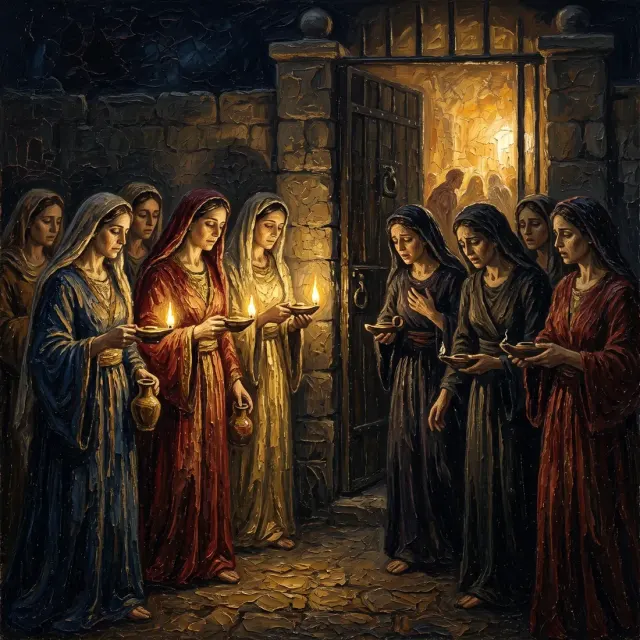
All ten attendants sleep. That one detail prevents the parable from being reduced to a warning that faithful people must somehow remain physically awake until the bridegroom arrives. The Book of Matthew establishes the real distinction before anyone becomes drowsy: five carry oil with their lamps and five do not. When the midnight cry sounds, the same delay and the same announcement confront everyone, but only some are prepared for it. The foolish attendants ask to borrow oil, and the refusal belongs to the mechanics of the parable: one person’s preparation cannot simply be transferred at the last moment without risking that no one has enough. The passage does not explicitly identify the oil as the Holy Spirit, good works, or one fixed spiritual equivalent. Readiness itself is the controlling point. The closed door and the words “I know you not” make intention insufficient. These women meant to attend and eventually came to the door, yet the missed moment still matters. “Watch” therefore means more than sleeplessness. It means living prepared for an arrival whose hour remains unknown.
Deep dive
The detail that all ten slumber and sleep prevents the parable from being reduced to a warning against tiredness. Wise and foolish share the same delay and the same midnight announcement. The difference has already been established in the provision of oil. Readiness concerns what enables them to meet the bridegroom when the announcement comes, not a superior ability to keep their eyes open.
The request to share meets a practical refusal within the parable: there may not be enough for both groups. That refusal is not a general correction of Jesus’ teaching about generosity. It belongs to an image in which one person’s preparation cannot simply be transferred at the last moment to another. Matthew does not explicitly identify the oil as the Holy Spirit, good works, or any other single item in a symbolic key. The emphasis falls on readiness itself.
The door closes while the unprepared attendants are away. Their subsequent address, “Lord, Lord,” recalls the earlier warning that correct address alone does not establish relationship in Matthew 7:21–23. They intended to attend the wedding, but intention and eventual arrival do not erase the missed moment. The final command to watch returns to the unknown day and hour, even though the parable has shown that this watching means more than sleeplessness.
Words to trace: lamps, bridegroom, took, wise, foolish, virgins
Verse-by-verse path
- Matthew 25:1
“To meet” is the word for a civic delegation going out to greet an arriving dignitary and escort him back in, used of believers meeting the Lord in 1 Thessalonians 4:17. Outdoors and on the move, the “lamps” were probably torches, the word John uses for the arresting party’s torches (John 18:3).
- Matthew 25:2
“Wise” is phronimos, the man who built on the rock (7:24) and the faithful and wise servant (24:45); “foolish” is moros, the builder on sand (7:26). In the oldest manuscripts the foolish are listed first. The two kinds of builder at the end of the Sermon on the Mount become two kinds of bridesmaid.
- Matthew 25:3
A torch of oil soaked rags burned for only a short while before it had to be dipped again, according to studies of wedding customs in the region. Setting out without a supply was fine for a short walk and useless for a long wait. The foolish have lamps; what they lack is what keeps a lamp going.
- Matthew 25:4
“Vessels” is angeia, flasks or jars, the word used for the vessels into which fishermen gather the good fish (13:48). The difference between the two groups is one small container, packed before anyone knew how long the night would be.
- Matthew 25:5
Two verbs: nystazo, to nod, the first drooping of the head, and then katheudo, to sleep, the word used of the disciples in Gethsemane (26:40, 43). The tenses move from dozing off to being asleep. No one is blamed for it.
- Matthew 25:6
Midnight was the hour the LORD passed through Egypt (Exodus 12:29). Jerome reports a Jewish tradition that the Messiah would come at midnight on Passover night, as the destroyer had; this chapter is spoken two days before Passover (26:2). “Cry” is krauge, a shout.
- Matthew 25:7
“Trimmed” is kosmeo, to put in order or adorn: trimming wicks, or re-dipping torches. It is the verb of the house “swept, and garnished” in 12:44 and of the prophets’ tombs that the scribes “garnish” in 23:29. Everyone gets up and does the same thing; only then does the difference show.
- Matthew 25:8
“Are gone out” is present tense in Greek: our lamps are going out. They had been lit, and are now guttering. The verb is sbennymi, the one Isaiah uses of the servant who will not quench the smoking flax (Isaiah 42:3, quoted in 12:20).
- Matthew 25:9
The advice to go and buy at midnight reads oddly as a picture of village life; dealers would have to be woken. The parable is not concerned with how they would find oil, only that they must now go and the bridegroom will not wait.
- Matthew 25:10
“The door was shut” is kleio, the verb of 23:13, “ye shut up the kingdom of heaven against men”. It also recalls the ark, which follows the days of Noah in 24:37–39: “and the LORD shut him in” (Genesis 7:16).
- Matthew 25:11
“Open to us” turns around the promise of 7:7, “knock, and it shall be opened unto you.” They do knock, and it is not opened. They call him “Lord, Lord”, the double address that was not enough in 7:21.
- Matthew 25:12
“I know you not” is ouk oida hymas. Peter will use the same two words about Jesus in the high priest’s courtyard: “I know not the man” (26:72, 74). In 7:23 the rejected hear “I never knew you”. To be unknown by the host is to be a stranger at the door.
- Matthew 25:13
In the oldest manuscripts the verse ends at “the day nor the hour”; “wherein the Son of man cometh” is a later addition that makes the application explicit. The command “Watch” repeats 24:42 and returns once more in Gethsemane.
Matthew 25:1-13
King James Version1Then shall the kingdom of heaven be likened unto ten virgins, which took their lamps, and went forth to meet the bridegroom.
2And five of them were wise, and five were foolish.
3They that were foolish took their lamps, and took no oil with them:
4But the wise took oil in their vessels with their lamps.
5While the bridegroom tarried, they all slumbered and slept.
6And at midnight there was a cry made, Behold, the bridegroom cometh; go ye out to meet him.
7Then all those virgins arose, and trimmed their lamps.
8And the foolish said unto the wise, Give us of your oil; for our lamps are gone out.
9But the wise answered, saying, Not so; lest there be not enough for us and you: but go ye rather to them that sell, and buy for yourselves.
10And while they went to buy, the bridegroom came; and they that were ready went in with him to the marriage: and the door was shut.
11Afterward came also the other virgins, saying, Lord, Lord, open to us.
12But he answered and said, Verily I say unto you, I know you not.
13Watch therefore, for ye know neither the day nor the hour wherein the Son of man cometh.
Matthew 25:14-23
Different Trusts Receive the Same Welcome
The master distributes money unequally, but he does not distribute approval by the same scale. Five talents go to one servant, two to another, and one to a third, each according to ability. The Book of Matthew uses “talent” here for a large sum of money, not for a natural skill, and explicitly distinguishes the entrusted money from the ability according to which it is assigned. The first two servants put their master’s goods to work and double them. One returns ten, the other four, yet the words of welcome are identical: “Well done, good and faithful servant.” The smaller starting amount has not produced a smaller share in the master’s joy. After “a long time,” the master returns and reckons, continuing the previous parable’s theme of delay. That interval was not empty. It gave the servants room to act with what belonged to someone else. Strikingly, the master calls these substantial trusts “a few things” and promises greater responsibility. Faithfulness, not raw total, is what the equal welcome recognizes.
Deep dive
The talents are the master’s money, not the servants’ natural gifts. The familiar modern sense of “talent” can obscure the opening transaction. Matthew distinguishes the entrusted sums from the ability according to which they are distributed. Each servant begins with responsibility for something that belongs to another.
The first two put the money to work, and each doubles the amount received. The comparison does not result in a more enthusiastic welcome for the servant with ten talents than for the one with four. Their master’s approval is the same: each has been faithful in what was entrusted, and each is invited into his joy. The differing initial amounts do not create two grades of belonging.
The return occurs “after a long time,” carrying forward the delayed arrival of the preceding parable. The interval permits action, and the reckoning concerns what occurred during it. The master’s description of these substantial trusts as a few things is striking beside the larger responsibility promised. The reward is not merely permission to keep the original money. The servants are brought into an enlarged participation in the master’s affairs and joy.
Words to trace: talents, five, lord, received, faithful, gained
Verse-by-verse path
- Matthew 25:14
The Greek begins simply “For as a man”; the King James supplies “the kingdom of heaven is” in italics. In the Roman world slaves often ran business for their masters, trading with a fund called a peculium. The master going abroad leaves his capital in their hands.
- Matthew 25:15
A talent was first a weight, perhaps twenty six to thirty six kilograms, and then that weight of silver. The English sense of natural ability comes from this parable, through medieval readers. “Several ability” is 1611 English for each man’s own ability.
- Matthew 25:16
In the oldest manuscripts “straightway” belongs to this verse, not the last: “straightway he that had received the five talents went and traded”. The master’s departure is not what is hurried; the servant’s start is. “Traded” is ergazomai, to work with it.
- Matthew 25:17
Legal interest in the Roman provinces was commonly capped at twelve percent a year, so doubling a sum meant bold trade or long years. The second servant’s return is the same rate as the first’s: two into four, five into ten.
- Matthew 25:18
Burying was the approved way to keep money safe. The Talmud rules that a man who buries money left with him is not liable if it is stolen (Bava Metzia 42a). In Luke’s version the servant wraps it in a napkin (Luke 19:20), which the same rulings treat as negligent. This servant was careful.
- Matthew 25:19
This is the third delay in a row: the evil servant says “My lord delayeth” (24:48), the bridegroom tarries (25:5), and the master returns “after a long time”. In each the delay is what tests the servants, not the arrival.
- Matthew 25:20
The servant names what he was given before what he gained: “thou deliveredst unto me five talents”. The capital and the profit alike are handed back to their owner. “Behold” presents the full sum on the spot.
- Matthew 25:21
“Well done” is a single word, eu, Good! “The joy of thy lord” may carry a second sense: the Aramaic word for joy could also mean a feast, so the servant may be invited into the master’s celebration, the banquet of the previous parable.
- Matthew 25:22
In Luke’s parallel the servant who gained five pounds is told to rule five cities, while the one who gained ten rules ten (Luke 19:17–19). Matthew’s second servant brings a smaller total and, in the next verse, gets exactly the same words as the first.
- Matthew 25:23
The master calls this servant “good”, agathos, the adjective the landowner applied to himself in 20:15, “because I am good”. The praise matches verse 21 word for word, and in the Greek the two servants’ reports match too, apart from the numbers.
Matthew 25:14-23
King James Version14For the kingdom of heaven is as a man travelling into a far country, who called his own servants, and delivered unto them his goods.
15And unto one he gave five talents, to another two, and to another one; to every man according to his several ability; and straightway took his journey.
16Then he that had received the five talents went and traded with the same, and made them other five talents.
17And likewise he that had received two, he also gained other two.
18But he that had received one went and digged in the earth, and hid his lord’s money.
19After a long time the lord of those servants cometh, and reckoneth with them.
20And so he that had received five talents came and brought other five talents, saying, Lord, thou deliveredst unto me five talents: behold, I have gained beside them five talents more.
21His lord said unto him, Well done, thou good and faithful servant: thou hast been faithful over a few things, I will make thee ruler over many things: enter thou into the joy of thy lord.
22He also that had received two talents came and said, Lord, thou deliveredst unto me two talents: behold, I have gained two other talents beside them.
23His lord said unto him, Well done, good and faithful servant; thou hast been faithful over a few things, I will make thee ruler over many things: enter thou into the joy of thy lord.
Matthew 25:24-30
The Buried Money Comes with an Accusation
The third servant returns exactly what he was given, which makes the problem more searching than simple theft or reckless loss. He has preserved the money and done nothing with it. Then he explains why. His description of the master as “an hard man” who reaps where he did not sow belongs first to the servant’s accusation and should not be lifted out as the Book of Matthew’s unqualified description of God. Fear, he says, led him to bury the talent. The master answers on the servant’s own stated terms. If that was truly his understanding, even depositing the money with exchangers would have been more consistent than making it completely unproductive. The contrast with the two faithful servants is therefore not spectacular profit versus modest profit. The servant with two talents received the same praise as the one with five. The dividing line is engagement with the trust versus refusal defended by an accusation against the giver. The ending is severe because the reckoning is severe: the trust is removed, and the servant is excluded from the joy he refused to serve during the long absence.

Deep dive
The third servant has not spent the money on himself or lost it in reckless trade. He returns the original amount. That detail makes the indictment more searching: preservation without faithful use does not satisfy the trust as the parable defines it.
His explanation begins with a claim about the master, then names fear as the reason for burial. The claim that the master reaps where he has not sown is the servant’s description; it should not automatically be lifted out as Matthew’s unqualified account of God. The master’s reply answers the servant on the ground he has chosen. Even under that stated belief, the money could have been placed with exchangers rather than made wholly unproductive.
The conclusion removes the trust and excludes the servant from the joy into which the others entered. The contrast is not between spectacular success and a modest honest return, since the servant with the smaller productive trust received full approval. It is between faithful engagement and a refusal defended by an accusation against the giver. The severity of the ending belongs to the final reckoning that has governed the discourse, not to a claim that every unsuccessful financial venture deserves condemnation.
Words to trace: talent, lord, received, servant, strawed, abundance
Verse-by-verse path
- Matthew 25:24
“Hard” is skleros, harsh, from the family of “hardness of your hearts” in 19:8. “Strawed” means scattered, used of winnowing: to gather where you have not winnowed is to take grain off another man’s threshing floor. He accuses his master of living on other people’s harvests.
- Matthew 25:25
“There thou hast that is thine” echoes the landowner in 20:14, “Take that thine is, and go thy way.” The servant uses the formula of a fair settlement, as though handing back the talent closes the account.
- Matthew 25:26
“Slothful” is okneros, shrinking back, hesitant, the word the Greek Old Testament uses for the sluggard: “Go to the ant, thou sluggard” (Proverbs 6:6). The master’s repetition of the charge can be read as a question: “You knew that about me, did you?”
- Matthew 25:27
The “exchangers” are trapezitai, men at tables, trapeza, the word for the moneychangers’ tables overturned in 21:12. In 1611 “usury” meant any interest, not only excessive interest; the Greek is tokos, literally offspring, money that breeds money.
- Matthew 25:28
In Luke the bystanders protest, “Lord, he hath ten pounds” (Luke 19:25). Matthew records no objection. The one talent goes to the servant who made the most of five, which reads as policy, not favouritism: capital goes to the one who uses it.
- Matthew 25:29
The saying first appeared in 13:12, where it was about understanding the parables of the kingdom: to him that has, more shall be given. Now it closes a parable about money, and the principle is the same in both places.
- Matthew 25:30
“Unprofitable” is achreios, literally useless, without use. A servant given something to use and returning it untouched has become the one thing a servant cannot be. Luke puts the same word in the mouths of servants who have done everything: “We are unprofitable servants” (Luke 17:10).
Matthew 25:24-30
King James Version24Then he which had received the one talent came and said, Lord, I knew thee that thou art an hard man, reaping where thou hast not sown, and gathering where thou hast not strawed:
25And I was afraid, and went and hid thy talent in the earth: lo, there thou hast that is thine.
26His lord answered and said unto him, Thou wicked and slothful servant, thou knewest that I reap where I sowed not, and gather where I have not strawed:
27Thou oughtest therefore to have put my money to the exchangers, and then at my coming I should have received mine own with usury.
28Take therefore the talent from him, and give it unto him which hath ten talents.
29For unto every one that hath shall be given, and he shall have abundance: but from him that hath not shall be taken away even that which he hath.
30And cast ye the unprofitable servant into outer darkness: there shall be weeping and gnashing of teeth.
Matthew 25:31-40
The King Names Himself Among the Least
The imagery moves from household servants to the Son of man enthroned in glory, with all nations gathered before him. A shepherd’s separation supplies the picture, but the Book of Matthew is describing judgment. The surprising centre is the king’s identification with people who appeared ordinary enough to be overlooked. Hunger, thirst, strangeness, nakedness, sickness, and imprisonment receive equally concrete answers: food, drink, welcome, clothing, visitation, and presence. The righteous are surprised because they do not remember encountering the king in those forms. Jesus’ answer gives their actions a meaning they did not recognize while performing them: what was done to “one of the least of these my brethren” was done to him. The phrase “my brethren” is genuinely debated. Some read it as the needy generally; others see a more specific reference to Jesus’ vulnerable disciples and messengers, an interpretation with strong links elsewhere in The Book of Matthew. Either way, the passage does not permit need to become abstract. The enthroned king locates himself in relation to actual people whose hunger, exposure, illness, or confinement called for response.
Deep dive
The setting changes from a domestic comparison to the Son of man enthroned in glory with the angels. The shepherd’s separation supplies an image, but the scene is a judgment of people. The one approaching suffering in Jerusalem is the king before whom the nations are gathered.
The acts named are concrete: food, drink, welcome, clothing, visitation, and presence in imprisonment. The righteous are surprised not because they deny having done them, but because they did not recognize the king as their recipient. His answer establishes the identification that gives those acts their full significance.
The meaning of “the least of these my brethren” is debated. A broad reading understands the needy generally. Another identifies the brethren particularly with Jesus’ disciples, including vulnerable messengers received or rejected by the nations. Matthew 12:50 defines his family through doing the Father’s will, and Matthew 10:40–42 closely connects receiving his messengers with receiving him, giving the second reading substantial contextual support. The passage’s concern with real hunger and exposure remains on either reading. The kingdom is described as an inheritance prepared from the foundation of the world, while the judgment makes visible how those standing before the king have treated the people with whom he identifies.
Words to trace: gave, answer, clothed, drink, glory, goats
Verse-by-verse path
- Matthew 25:31
“All the holy angels with him” recalls Zechariah 14:5, “the LORD my God shall come, and all the saints with thee.” “The throne of his glory” is the phrase of 19:28, and the Parables of Enoch, a Jewish work of about this period, seat a Son of Man on “the throne of his glory” as judge (1 Enoch 62:5).
- Matthew 25:32
“All nations” is the phrase of the final command, “teach all nations” (28:19). Flocks in the region grazed mixed by day and were separated at evening, since goats need warmer shelter at night. Ezekiel 34:17 already had God judging “between the rams and the he goats”.
- Matthew 25:33
The right hand is the side of favour: Jacob set his right hand on the younger Ephraim for the greater blessing (Genesis 48:14). “Goats” here is eriphia, a diminutive, kids. Nothing in the text says the goats are worse animals; the separation is the shepherd’s choice.
- Matthew 25:34
This is the one place in his teaching where Jesus calls himself “the King”. “Come” is deute, the word of 11:28, “Come unto me, all ye that labour”, and of the wedding invitation in 22:4. “Inherit” is the language of sons receiving an estate.
- Matthew 25:35
“An hungred” is old English for hungry, from Old English ofhyngrod. Isaiah 58:7 gives the nearest list: deal your bread to the hungry, bring the outcast poor to your house, and when you see the naked, cover him. “Took me in” is synago, to gather in, the verb of hospitality.
- Matthew 25:36
Prisons did not feed their prisoners; food came from family and friends. The Talmud grounds visiting the sick in imitating God, who appeared to Abraham after his circumcision (Sotah 14a). “Visited” is episkeptomai, to look in on and care for, the verb used of God visiting his people.
- Matthew 25:37
The list of six needs is now spoken for the second of four times (verses 35–36, 37–39, 42–43, 44), each round shorter than the last. The righteous call him “Lord” and ask sincerely; they do not remember any of it.
- Matthew 25:38
“Stranger” is xenos, a foreigner or someone far from home. Two chapters later the chief priests use Judas’s returned silver to buy the potter’s field “to bury strangers in” (27:7), the same word.
- Matthew 25:39
Matthew’s own pages hold one such visit: John the Baptist, in prison, was reached by his disciples, who carried his question to Jesus and Jesus’ answer back to him (11:2–4). The righteous here ask when they ever did the same for the king.
- Matthew 25:40
“Inasmuch as” means to the extent that. “The least” is elachistos, the superlative Matthew used of Bethlehem, “not the least among the princes of Juda” (2:6), and of the “least commandments” (5:19). The smallest of the brothers stands in for the king himself.
Matthew 25:31-40
King James Version31When the Son of man shall come in his glory, and all the holy angels with him, then shall he sit upon the throne of his glory:
32And before him shall be gathered all nations: and he shall separate them one from another, as a shepherd divideth his sheep from the goats:
33And he shall set the sheep on his right hand, but the goats on the left.
34Then shall the King say unto them on his right hand, Come, ye blessed of my Father, inherit the kingdom prepared for you from the foundation of the world:
35For I was an hungred, and ye gave me meat: I was thirsty, and ye gave me drink: I was a stranger, and ye took me in:
36Naked, and ye clothed me: I was sick, and ye visited me: I was in prison, and ye came unto me.
37Then shall the righteous answer him, saying, Lord, when saw we thee an hungred, and fed thee? or thirsty, and gave thee drink?
38When saw we thee a stranger, and took thee in? or naked, and clothed thee?
39Or when saw we thee sick, or in prison, and came unto thee?
40And the King shall answer and say unto them, Verily I say unto you, Inasmuch as ye have done it unto one of the least of these my brethren, ye have done it unto me.
Matthew 25:41-46
The Missing Act Is Named as an Answer
The second group receives the same list with one devastating change: “ye gave me no.” Their indictment is not that they caused every hunger, illness, imprisonment, or condition of exposure. It is that need stood before them and the corresponding care was absent. The Book of Matthew again makes the king’s identification the hinge. They too are surprised, asking when they ever saw him in such a condition. Lack of recognition is therefore common to both groups; it does not make their conduct equivalent. One group acted without knowing the full significance, and the other did not. The fire is described as prepared for the devil and his angels, while the kingdom was prepared for the blessed, and the final sentence places everlasting punishment beside eternal life with the same underlying adjective describing both. Interpretations of the exact nature of punishment differ, but the passage offers no basis for reducing the negative outcome to a minor inconvenience. The long discourse about the end finishes not with a disclosed date but with conduct during the waiting period brought under the king’s judgment.
Deep dive
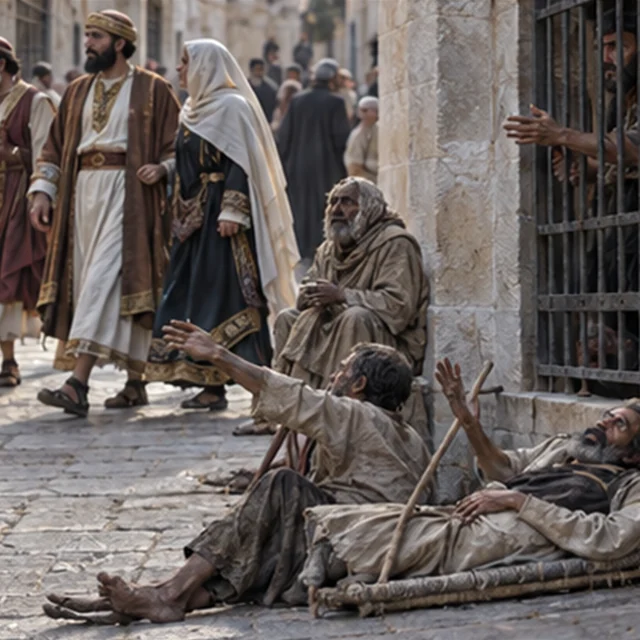
The second group receives the same list in negative form. Their indictment is not that they personally created every hunger, imprisonment, or illness. It is that the need was present and the corresponding care was absent. The omission matters because the king identifies himself with those left unaided.
Their answer mirrors the righteous group’s surprise, but the resemblance does not make the conduct equivalent. Neither group recognized the king in the encounter; one nevertheless supplied what was needed, and the other did not. The scene therefore prevents recognition of importance from becoming the condition on which care is extended.
The fire is described as prepared for the devil and his angels, in contrast to the kingdom prepared for the blessed. The final sentence places punishment and life side by side, using the same Greek adjective, aionios, behind the KJV’s “everlasting” and “eternal.” That parallel must be retained in any discussion of the judgment, even where interpreters differ over its exact nature. Matthew provides no warrant here for making the negative outcome a trivial inconvenience. Jesus’ teaching on the end closes not with a disclosed date, but with the searching significance of conduct during the time before his coming.
Words to trace: answer, everlasting, gave, hungred, naked, prison
Verse-by-verse path
- Matthew 25:41
The blessed are “blessed of my Father” (verse 34); the cursed are not said to be cursed of anyone. The kingdom was prepared “for you”; the fire was prepared “for the devil and his angels”, not for them. The asymmetry is in the grammar.
- Matthew 25:42
The first two needs, food and drink, are the most basic, and elsewhere in the book the smallest version of them was enough to earn a reward: “a cup of cold water” to a little one (10:42). Here even those are missing.
- Matthew 25:43
The negative list runs faster. “Sick, and in prison” are joined, and one verb, “visited me not”, covers both. Six needs are compressed into five clauses, as if the neglect took fewer words to describe than the care.
- Matthew 25:44
The second group gathers the whole list under one verb, diakoneo, to serve or minister: when did we not minister to thee? It is the verb Jesus used of his own mission in 20:28, “not to be ministered unto, but to minister”.
- Matthew 25:45
The negative answer drops “my brethren” and says only “one of the least of these”. The sentence is shorter, but the identification is the same: what was not done to them was not done to him.
- Matthew 25:46
The verse follows the pattern of Daniel 12:2, “some to everlasting life, and some to shame and everlasting contempt”. These are the last words of the last of the five discourses; the next verse is the formula that closes them all, “when Jesus had finished all these sayings” (26:1).
Matthew 25:41-46
King James Version41Then shall he say also unto them on the left hand, Depart from me, ye cursed, into everlasting fire, prepared for the devil and his angels:
42For I was an hungred, and ye gave me no meat: I was thirsty, and ye gave me no drink:
43I was a stranger, and ye took me not in: naked, and ye clothed me not: sick, and in prison, and ye visited me not.
44Then shall they also answer him, saying, Lord, when saw we thee an hungred, or athirst, or a stranger, or naked, or sick, or in prison, and did not minister unto thee?
45Then shall he answer them, saying, Verily I say unto you, Inasmuch as ye did it not to one of the least of these, ye did it not to me.
46And these shall go away into everlasting punishment: but the righteous into life eternal.
Questions to keep in mind while reading
- Watch what Jesus says and does, and how people respond.
- Trace kingdom, discipleship, opposition, cross, and resurrection in the evangelist’s own sequence.
- Let later doctrine clarify the scene without erasing its immediate setting.
Text first
Where readers differ
The chapter summary begins with what the passage says and how its parts fit together. It does not assume one denomination has already settled every question. Where a conclusion depends on a tradition, literary theory, or historical reconstruction, that dependence is named openly.
The KJV text is presented first. Interpretive conclusions are labeled, and differences are introduced only when they help a reader understand why serious communities do not always reach the same answer.
Comparative interpretive notes for this chapter are in preparation. Until reviewed notes are ready, this page separates the KJV text from summary and application without claiming that serious readers agree on every question.
Questions beneath the surface
- What account of God, human freedom, responsibility, and the good life emerges from Matthew 25?
- Which tension does the chapter refuse to resolve quickly?
- What changes when the chapter is read as part of the whole canon rather than as an isolated moral lesson?
- Where might a sincere reader confuse a familiar tradition with something the text states directly?
Questions for serious personal contemplation
These open-ended questions make room for tension, honest response, prayer, and conclusions that remain accountable to the chapter.
Observe without rushing
What part of Matthew 25 makes you stop, feel unsettled, or feel surprised, and why?
Which detail in the passage would be easiest to overlook? How does that detail change your understanding?
Where do you see tension between what happens and this focus: Matthew 25 develops its own movement around Lord, talents, five, took, received?
What important question does the passage leave open instead of resolving quickly?
Examine your inner life honestly
Which person, response, fear, or desire in the passage feels most like your own life right now?
What assumption about God, other people, or yourself does this text challenge?
Which part would you rather soften, avoid, or explain away too quickly? What might that reaction reveal?
If this Scripture could ask you one direct question, what do you think it would ask?
Respond with wisdom and courage
What do you need to remember, confess, grieve, thank God for, or trust after reading this passage?
How might another faithful person read this situation differently without ignoring the text?
What obedient response would be costly, uncomfortable, or slow, yet still faithful to Scripture?
What question will you carry into prayer this week, and which verses will you keep in front of you?
Music and video connected to the passage
Related media appears when its Scripture reference overlaps this study. Music and video can illuminate a theme while the biblical text remains the foundation.