

The big picture
The final teaching has ended, and the passion begins under the shadow of Passover. Jesus announces his crucifixion before the leaders describe their plan, holding his foreknowledge beside their responsibility. An unnamed woman pours costly ointment on him and is defended against the charge of waste; immediately afterward Judas asks what he will be paid to deliver Jesus. At the Passover table, betrayal is announced from within the twelve, then bread and cup receive their interpretation as body, blood, covenant, and remission of sins. Jesus predicts that all the disciples will scatter and that Peter will deny him three times, but he also promises a meeting in Galilee beyond the failure. In Gethsemane, sorrow is explicit and the cup is faced through repeated submission to the Father’s will. Arrest follows by a kiss, yet Jesus refuses the sword and says angelic rescue is available but not sought. Before the council he speaks of the Son of man at the right hand of power. Outside, Peter’s denials intensify until the cock crows and memory breaks his confidence into bitter tears.
In this chapter
- The Feast Fixes the Setting, Not the Conspirators Matthew 26:1-5
The passion opens with two clocks running beside each other.
- One Person Pours Out; Another Names a Price Matthew 26:6-16
One person spends something precious on Jesus; another immediately asks what Jesus is worth as a delivery.
- The Betrayal Sits at the Table Matthew 26:17-25
The Passover meal takes place under Jesus’ direction, not merely in a gap left by the conspirators.
- Jesus Gives the Meaning Before His Body Is Taken Matthew 26:26-30
Before soldiers take his body, Jesus gives the meaning of his death at the table.
- The Reunion Is Promised Before the Denial Matthew 26:31-35
Jesus predicts failure and reunion in the same breath.
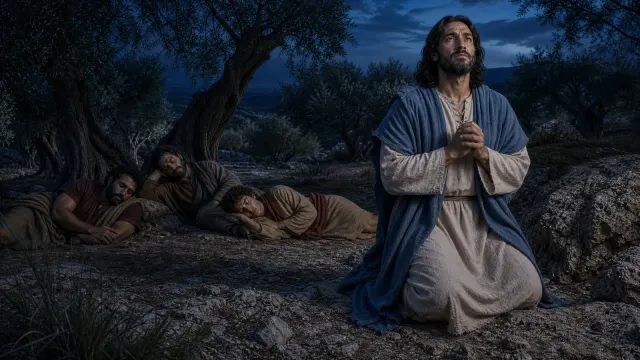
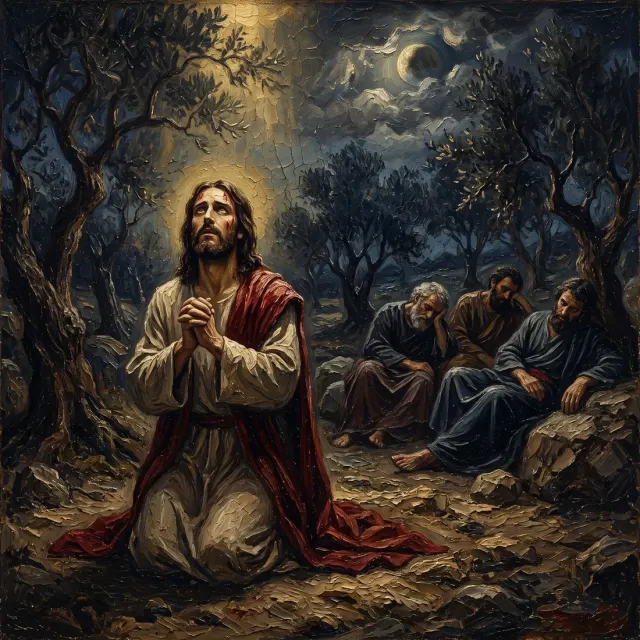
- The Cup Is Faced in Repeated Prayer Matthew 26:36-46
Gethsemane does not need invented emotion because the Book of Matthew supplies it directly.
- The Arrest Does Not Prove a Lack of Power Matthew 26:47-56
Judas arrives as “one of the twelve,” a phrase that keeps the personal betrayal visible even when a large armed crowd fills the scene.
- The Accused Speaks of the Throne Matthew 26:57-68
The council begins with the desired verdict already in view.
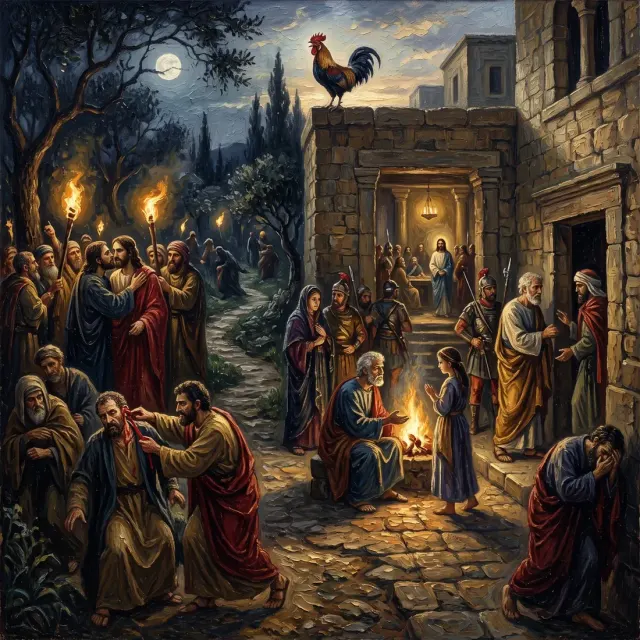
- His Accent Remains When His Allegiance Is Denied Matthew 26:69-75
Peter is not first confronted by the council.

Scripture beside the summary
Matthew · King James Version · 75Matthew 26:1-5
The Feast Fixes the Setting, Not the Conspirators
The passion opens with two clocks running beside each other. Jesus tells the disciples that Passover is two days away and that the Son of man will be delivered to crucifixion. Only then does the Book of Matthew describe chief priests, scribes, and elders gathering with Caiaphas to plan how to take and kill him. Their preferred timetable is cautious: not during the feast, lest the people riot. Yet the death will occur within the Passover setting Jesus has already named. That juxtaposition prevents either side from swallowing the other. Jesus is not discovering the destination only after his opponents arrange it, and their plotting is not made innocent because the event fits what he knew would happen. Foreknowledge and responsibility remain together. The conspirators make real decisions, including a desire to avoid public trouble, while the announced course proceeds through decisions they do not fully control. The chapter therefore begins neither with an accident nor with helplessness. It begins with Jesus naming the road and powerful men simultaneously trying to manage how that road will unfold.
Deep dive
The phrase announcing that Jesus has finished all these sayings closes the great discourse and turns the book toward the passion itself. Before the leaders’ meeting is described, Jesus identifies the approaching Passover with his delivery to crucifixion. The timing is spoken from his side of the account before the plans made against him are reported.
The leaders want secrecy and fear an uproar during the feast. Their proposed caution does not determine the eventual course: the arrest and death will occur within the very Passover setting they regard as dangerous. Matthew holds their planning beside Jesus’ announcement without suggesting that their intention becomes morally innocent because the event fulfils his words.
The juxtaposition establishes a pattern that continues through the chapter. Jesus is not discovering the destination only as his opponents arrange it, yet those opponents are making real decisions. Foreknowledge and human responsibility are presented together. The passion begins with a known path and a murderous consultation, not with an accidental collapse of a ministry that had never anticipated resistance.
Words to trace: feast, Jesus, people, assembled, betrayed, Caiaphas
Verse-by-verse path
- Matthew 26:1
Only here does the closing formula say “all these sayings”; the four earlier ones lack “all” (7:28; 11:1; 13:53; 19:1). The phrasing recalls Moses at the end of Deuteronomy, who “made an end of speaking all these words to all Israel” (Deuteronomy 32:45). The teaching is over; from here Jesus mostly acts and suffers.
- Matthew 26:2
“Is betrayed” is present tense in Greek, as if the handing over were already under way. This is the fourth passion prediction in Matthew (16:21; 17:22–23; 20:18–19) and the first to fix a date. Jesus names the feast before his enemies set their plan in the next verse.
- Matthew 26:3
Joseph Caiaphas held the high priesthood from about AD 18 to 36, longer than anyone else in that century, and John makes him son in law of Annas (John 18:13). In 1990 an ornate ossuary inscribed “Yehosef bar Qayafa” was found in Jerusalem. The “palace” is aule, the courtyard of a great house.
- Matthew 26:4
“Subtilty” is the 1611 spelling of subtlety; the Greek dolos means guile, a trick, originally bait. Jesus had taught openly in the temple every day (verse 55); they want to take him by stealth, away from the crowds who hold him a prophet (21:46).
- Matthew 26:5
“The feast” covers the whole week of Passover and Unleavened Bread, when Jerusalem swelled with pilgrims. Josephus records a Passover riot under the governor Cumanus, set off by a soldier’s obscene gesture, in which thousands died in the crush (War 2.224–227). The fear of an uproar was realistic.
Matthew 26:1-5
King James Version1And it came to pass, when Jesus had finished all these sayings, he said unto his disciples,
2Ye know that after two days is the feast of the passover, and the Son of man is betrayed to be crucified.
3Then assembled together the chief priests, and the scribes, and the elders of the people, unto the palace of the high priest, who was called Caiaphas,
4And consulted that they might take Jesus by subtilty, and kill him.
5But they said, Not on the feast day, lest there be an uproar among the people.
Matthew 26:6-16
One Person Pours Out; Another Names a Price
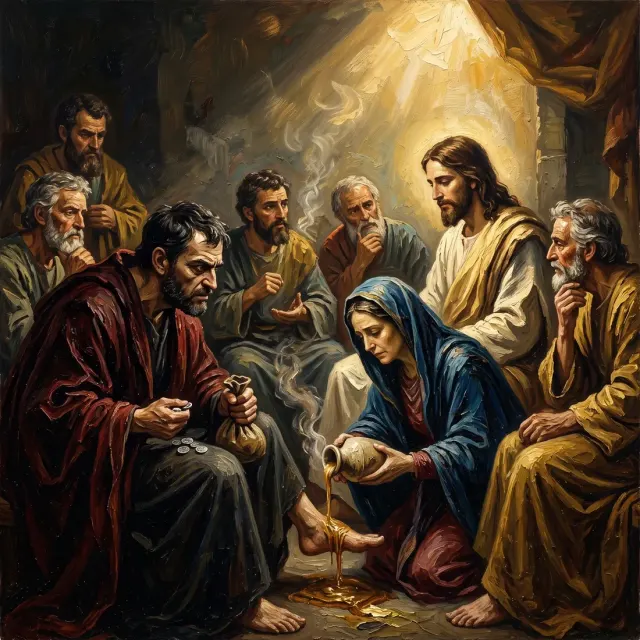
One person spends something precious on Jesus; another immediately asks what Jesus is worth as a delivery. The placement creates the contrast. In Bethany, an unnamed woman pours very costly ointment on Jesus’ head. The Book of Matthew says the disciples, in the plural, call it waste and suggest the money could have gone to the poor. Jesus defends her action and interprets it in relation to his burial. The account does not claim the woman herself fully understood every dimension of that approaching death. His words give the deed its meaning. “The poor always with you” cannot honestly be turned into permission to ignore them, especially with Deuteronomy’s open-hand command behind the phrase. The point is the unrepeatable moment before Jesus’ death. Her unnamed act will be remembered wherever the gospel is preached. Judas then goes to the chief priests and asks, “What will ye give me?” Thirty pieces of silver establish the transaction, and he begins looking for opportunity. No hidden patriotic motive or scheme to force Jesus’ hand is supplied. The Gospel leaves the contrast in the valuation itself.
Deep dive
Matthew places the anointing in the house of Simon the leper and leaves the woman unnamed. Her action is lavish, but the disciples call it waste and propose the poor as a better destination for the money. Their objection is reported in the plural. The account should not be silently rewritten so that Judas alone speaks the complaint found in a different Gospel setting.
Jesus identifies the act with his burial. This is his stated interpretation; Matthew does not separately describe how much of the approaching death the woman herself understood. His statement about the continuing presence of the poor recalls Deuteronomy 15:11, where their continuing need is a reason for an open hand, not a reason to abandon them. The contrast concerns this unrepeatable opportunity before his death. Her deed will be remembered wherever the gospel is proclaimed, giving an unnamed woman a durable place in the public account.
Judas then asks what he will receive for delivering Jesus. The placement makes the two valuations sharply different: one action expends something precious upon him, while the other seeks a payment for handing him over. Matthew names the thirty pieces of silver and the search for opportunity. He does not supply a hidden plan to force Jesus into action or a political disappointment that explains away the transaction.
Words to trace: ointment, woman, always, Jesus, poor, poured
Verse-by-verse path
- Matthew 26:6
A leper had to live alone outside the camp (Leviticus 13:46), so Simon cannot still have had the disease if he was hosting a dinner; he keeps the name as others kept theirs. Matthew and Mark name him; neither says whether Jesus had healed him.
- Matthew 26:7
An alabastron was a slender flask of translucent stone, often sealed, with a neck snapped off to pour. Matthew and Mark have the ointment poured on the head, as kings were anointed: Samuel poured oil on Saul’s head (1 Samuel 10:1). “Sat at meat” means reclined at table.
- Matthew 26:8
“Waste” is apoleia, the word for destruction or ruin. Matthew uses it in only one other place: “the way, that leadeth to destruction” (7:13). The disciples reach for a strong word to describe perfume poured out on their teacher.
- Matthew 26:9
Mark gives the price, more than three hundred pence (Mark 14:5), close to a labourer’s wages for a year. Matthew leaves the figure out and keeps only “much”. Giving to the poor at Passover was customary, so the objection sounds pious and well timed.
- Matthew 26:10
“When Jesus understood it” suggests the complaint was muttered among them, not said to him. “A good work” is kalon ergon, a fine or beautiful deed, the phrase of 5:16: “that they may see your good works.”
- Matthew 26:11
The book ends with another kind of presence: “lo, I am with you alway, even unto the end of the world” (28:20). What they will not always have is the body reclining at this table, which is about to be handed over.
- Matthew 26:12
Bodies were anointed with spices after death. In Mark and Luke the women bring spices to the tomb; in Matthew they come only “to see the sepulchre” (28:1). So in this book this is the only anointing Jesus’ body ever receives, given in advance by a woman at dinner.
- Matthew 26:13
“Memorial” is mnemosynon, the word the Greek Old Testament uses for the “memorial” portion of an offering burned on the altar (Leviticus 2:2). Her deed will rise before God and the world. Matthew never gives her a name; the memorial is to what she did.
- Matthew 26:14
“Iscariot” is most often explained as ish Kerioth, man of Kerioth, a town in Judah (Joshua 15:25), which would make him perhaps the one Judean among Galileans; others connect it with sicarius, a dagger man. “Then” ties his visit tightly to the scene in Bethany.
- Matthew 26:15
Only Matthew has Judas ask for a price. “Covenanted” is histemi, to weigh out, the verb of Zechariah 11:12: “they weighed for my price thirty pieces of silver.” Thirty shekels was the compensation the law set for a slave gored by an ox (Exodus 21:32).
- Matthew 26:16
“Opportunity” is eukairia, a convenient moment. What Judas can sell is exactly what the leaders lacked in verse 5: knowledge of where Jesus would be at night, away from the crowd.
Matthew 26:6-16
King James Version6Now when Jesus was in Bethany, in the house of Simon the leper,
7There came unto him a woman having an alabaster box of very precious ointment, and poured it on his head, as he sat at meat.
8But when his disciples saw it, they had indignation, saying, To what purpose is this waste?
9For this ointment might have been sold for much, and given to the poor.
10When Jesus understood it, he said unto them, Why trouble ye the woman? for she hath wrought a good work upon me.
11For ye have the poor always with you; but me ye have not always.
12For in that she hath poured this ointment on my body, she did it for my burial.
13Verily I say unto you, Wheresoever this gospel shall be preached in the whole world, there shall also this, that this woman hath done, be told for a memorial of her.
14Then one of the twelve, called Judas Iscariot, went unto the chief priests,
15And said unto them, What will ye give me, and I will deliver him unto you? And they covenanted with him for thirty pieces of silver.
16And from that time he sought opportunity to betray him.
Matthew 26:17-25
The Betrayal Sits at the Table
The Passover meal takes place under Jesus’ direction, not merely in a gap left by the conspirators. He supplies the instruction that leads the disciples to the house and tells the unnamed host, “My time is at hand.” Once the twelve are seated, the Book of Matthew places betrayal inside the table fellowship. “One of you shall betray me” produces exceeding sorrow, and each disciple asks the question toward himself. The shared dish makes the coming act more intimate than an attack by known enemies outside. Proximity has not made treachery impossible. Jesus then holds two truths together without allowing either to excuse the other: the Son of man goes “as it is written,” yet woe remains on the person through whom betrayal comes. Fulfilment does not dissolve responsibility. Judas finally asks his own question, addressing Jesus as “Master” where others said “Lord,” and receives the reply “Thou hast said.” Vocabulary alone should not be made into a complete psychology of Judas, but the contrast is preserved. Before anyone arrives with weapons, the fracture within the twelve has already been named at the meal.
Deep dive
The preparation begins with the disciples’ question, but Jesus supplies the location through an unnamed householder and the announcement that his time is at hand. Matthew does not provide a secret recognition sign here or explain a prior arrangement. The emphasis is that the meal takes place under Jesus’ direction rather than becoming merely an interval in the conspirators’ timetable.
The announcement of betrayal produces exceeding sorrow among the disciples. Each turns the question toward himself. The shared dish then gives betrayal its intimate setting: the act will come from within the fellowship of the meal, not only from enemies already outside. Proximity to Jesus is real, but it does not make treachery impossible.
Jesus joins the Son of man’s scriptural course to a severe woe on the betrayer. Fulfilment is not treated as an excuse that removes responsibility from the person through whom betrayal comes. Judas’ address is “Master,” where the others have said “Lord,” a distinction Matthew preserves without making vocabulary alone a complete diagnosis of every speaker. Jesus’ reply shows that the betrayal is known. The paragraph ends before the arrest, but the table has already disclosed the fracture within the twelve.
Words to trace: disciples, passover, betray, betrayed, hand, Jesus
Verse-by-verse path
- Matthew 26:17
Strictly the lambs were killed on the fourteenth of Nisan and the feast of Unleavened Bread began on the fifteenth, but in common speech the fourteenth, when leaven was cleared from every house, was counted its first day; Josephus speaks the same way.
- Matthew 26:18
“Such a man” is deina, the Greek for “so and so”, a way of not naming someone; it appears nowhere else in the New Testament. The man is not identified, and the message assumes he will understand “The Master” without further explanation. “My time” is kairos, the appointed moment.
- Matthew 26:19
Making ready meant having the lamb slaughtered in the temple court and roasting it whole (Exodus 12:8–9), with unleavened bread, bitter herbs and wine, and preparing a room large enough for thirteen to recline.
- Matthew 26:20
“Sat down” is anakeimai, to recline. The first Passover was eaten standing, staff in hand (Exodus 12:11), but by Jesus’ day it was eaten reclining, the posture of free people; the Mishnah says even the poorest man must recline that night (Pesahim 10:1).
- Matthew 26:21
Psalm 41:9 speaks of the familiar friend “which did eat of my bread”, who lifted up his heel. Matthew does not quote it, though John does (John 13:18). “As they did eat” sets the announcement in the middle of the meal, with everyone’s hand still at the table.
- Matthew 26:22
The question in Greek, meti ego eimi, kyrie, expects the answer no: “Surely it is not I, Lord?” Eleven men ask it honestly. None of them asks it of anyone else.
- Matthew 26:23
Everyone dipped bread or herbs into shared bowls; at Passover the bitter herbs went into a sauce. The words do not single out one man but stress closeness: it is someone eating from the same dish as Jesus.
- Matthew 26:24
“Goeth” is hypago, to go on one’s way. First Enoch says of sinners who deny the Lord of Spirits that “it would have been good for them if they had not been born” (1 Enoch 38:2). The sentence is lament and verdict at once.
- Matthew 26:25
“Thou hast said” is sy eipas: yes, but put back on the questioner. Jesus gives the same answer to the high priest in verse 64, and Pilate hears something like it in 27:11, “Thou sayest.” It affirms without volunteering.
Matthew 26:17-25
King James Version17Now the first day of the feast of unleavened bread the disciples came to Jesus, saying unto him, Where wilt thou that we prepare for thee to eat the passover?
18And he said, Go into the city to such a man, and say unto him, The Master saith, My time is at hand; I will keep the passover at thy house with my disciples.
19And the disciples did as Jesus had appointed them; and they made ready the passover.
20Now when the even was come, he sat down with the twelve.
21And as they did eat, he said, Verily I say unto you, that one of you shall betray me.
22And they were exceeding sorrowful, and began every one of them to say unto him, Lord, is it I?
23And he answered and said, He that dippeth his hand with me in the dish, the same shall betray me.
24The Son of man goeth as it is written of him: but woe unto that man by whom the Son of man is betrayed! it had been good for that man if he had not been born.
25Then Judas, which betrayed him, answered and said, Master, is it I? He said unto him, Thou hast said.
Matthew 26:26-30
Jesus Gives the Meaning Before His Body Is Taken
Before soldiers take his body, Jesus gives the meaning of his death at the table. Bread is blessed, broken, given, and called “my body.” The cup is given with thanks and called “my blood of the new testament,” shed for many for the remission of sins. The Book of Matthew uses the older English “testament” where covenant is the sense, drawing the meal into the scriptural world of covenant blood and promised forgiveness rather than naming the later collection of Christian writings. Exodus and Jeremiah stand behind the language, and The Book of Matthew’s explicit mention of remission of sins reaches back to the opening announcement that Jesus will save his people from their sins. Christian traditions disagree about how the bread and cup relate to the body and blood, and these few sentences should not be forced to settle every later sacramental dispute. What they do settle is that Jesus interprets the coming death as gift before his enemies interpret it as defeat. The promise to drink anew with the disciples in the Father’s kingdom then places future fellowship beyond the death now being explained.

Deep dive
The actions are familiar in form: taking, blessing or giving thanks, breaking, and giving. The words now attach them directly to Jesus’ body and blood. Before the soldiers lay hands on him, he describes his life as something given. The coming violence remains violence, but it will not provide the only interpretation of his death.
The Greek word diatheke, rendered “testament,” means covenant here. Jesus is not naming the later collection of Christian books. The blood language recalls Exodus 24:8, while the new covenant and forgiveness recall Jeremiah 31:31–34. Matthew explicitly includes remission of sins, connecting the meal to the opening announcement in Matthew 1:21 that Jesus will save his people from their sins. Different Christian traditions understand the relation between the elements and the body and blood in different ways; the wording should not be presented as though those sacramental differences were already resolved within these few sentences.
The invitation concerning the cup is addressed to them all. The saying about drinking anew in the Father’s kingdom then places a promised fellowship beyond the approaching death. The table is both an interpretation of what is about to happen and a pledge that the relationship will not end with it. They sing a hymn and leave. Matthew does not reproduce its words, but the departure carries thanksgiving toward the place where Jesus will ask that the cup pass from him.
Words to trace: drink, gave, took, blessed, blood, body
Verse-by-verse path
- Matthew 26:26
The blessing was said to God, not over the bread: “Blessed art thou, O Lord our God, King of the world, who bringest forth bread from the earth” (Mishnah Berakhot 6:1). The four verbs, took, blessed, brake, gave, are those of the feeding of the five thousand (14:19).
- Matthew 26:27
“All” refers to the disciples, not the contents: “Drink of it, all of you.” Mark reports “they all drank of it” (Mark 14:23); Matthew turns the report into a command. The Passover meal had four cups of wine through the evening (Mishnah Pesahim 10).
- Matthew 26:28
Mark describes John’s baptism as “for the remission of sins” (Mark 1:4); Matthew removes the phrase from John’s preaching (3:1–2) and places it here, at the cup. “Shed” is present, being poured out, the verb for pouring blood at the base of the altar (Leviticus 4:7). “For many” recalls the ransom of 20:28.
- Matthew 26:29
“Fruit of the vine” is the language of the blessing over wine: “who createst the fruit of the vine” (Mishnah Berakhot 6:1). Only Matthew adds “with you”. The next drink offered to Jesus, mingled with gall at the cross, he will taste and refuse (27:34).
- Matthew 26:30
At the end of the Passover meal the second half of the Hallel, Psalms 115 to 118, was sung (Mishnah Pesahim 10:7), so this was almost certainly the hymn. It ends with Psalm 118, the rejected stone and “Blessed be he that cometh in the name of the LORD.”
Matthew 26:26-30
King James Version26And as they were eating, Jesus took bread, and blessed it, and brake it, and gave it to the disciples, and said, Take, eat; this is my body.
27And he took the cup, and gave thanks, and gave it to them, saying, Drink ye all of it;
28For this is my blood of the new testament, which is shed for many for the remission of sins.
29But I say unto you, I will not drink henceforth of this fruit of the vine, until that day when I drink it new with you in my Father’s kingdom.
30And when they had sung an hymn, they went out into the mount of Olives.
Matthew 26:31-35
The Reunion Is Promised Before the Denial
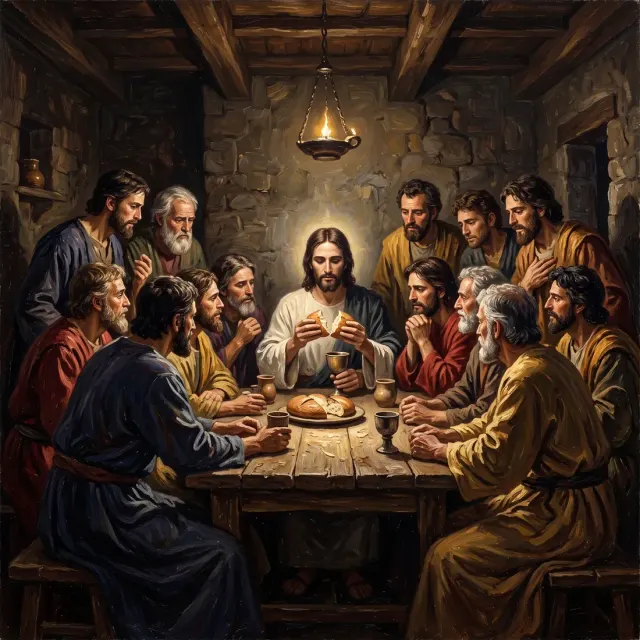
Jesus predicts failure and reunion in the same breath. Zechariah supplies the image of a struck shepherd and scattered sheep, and the Book of Matthew says all the disciples will be offended because of him that night. Yet before Peter protests, Jesus has already spoken beyond the scattering: after he is risen, he will go before them into Galilee. Peter answers by setting his loyalty above the group’s possible weakness. Even if everyone else falls away, he says, he will not. Jesus responds with a precise prediction of three denials before the cock crows. Peter raises the promise further, insisting that death itself will not make him deny Jesus, and the other disciples join him. Their confidence is therefore collective, even if Peter’s words receive the sharpest focus. The crucial order is easy to miss. Galilee is promised before the failure occurs. Jesus does not wait to see whether the disciples deserve a future after they collapse. Their scattering and Peter’s denial remain real, but so does a meeting already spoken on the far side of them.

Deep dive
The citation of Zechariah 13:7 places the scattering within the image of a struck shepherd and dispersed sheep. Jesus speaks of all the disciples being offended because of him that night. Peter’s reply separates his anticipated loyalty from everyone else’s possible failure, insisting that he will not fall away even if others do.
Jesus answers with a precise prediction: before the cock crows, Peter will deny him three times. Peter responds by raising the terms of his promise to death itself, and Matthew adds that the others say the same. Their declarations belong to the whole group, even though Peter’s insistence receives particular attention. The coming flight will therefore answer a shared confidence, not merely one unusually boastful disciple.
Between the announcement of scattering and the exchange about denial stands the promise of Galilee after the resurrection. That order is important. Jesus does not wait until after their failure to discover whether a future with them remains possible. He speaks the meeting beforehand. The disciples’ weakness is not concealed, and the prediction is not softened; nevertheless, their collapse is already enclosed within words that reach beyond it. Matthew 28 will return to that promised place.
Words to trace: offended, deny, Jesus, night, Peter, abroad
Verse-by-verse path
- Matthew 26:31
Zechariah 13:7 in Hebrew is a command, “smite the shepherd”. Matthew’s quotation makes it first person, “I will smite”, with God as the one who strikes. “Offended” is skandalizo: they will trip over what happens to him.
- Matthew 26:32
“Go before you” is proago, the verb of a shepherd walking ahead of his flock, which carries on the image of verse 31: the scattered sheep will be gathered by the same shepherd. The angel at the tomb will repeat the promise almost word for word (28:7).
- Matthew 26:33
This is the second time Peter has contradicted a passion prediction. In 16:22 he said, “this shall not be unto thee”; now he says it of himself. He takes up Jesus’ own verb, offended, and turns the prophecy into a boast.
- Matthew 26:34
The Romans called the third watch of the night, ending around three in the morning, gallicinium, cockcrow, and Mark lists “at the cockcrowing” among the watches (Mark 13:35). Whether a bird or the hour is meant, the prediction gives Peter only part of one night.
- Matthew 26:35
“Deny” is aparneomai, the verb of 16:24: “If any man will come after me, let him deny himself.” Peter is about to deny Jesus in place of himself. “Die with thee” is one Greek verb, synapothnesko, to die together.
Matthew 26:31-35
King James Version31Then saith Jesus unto them, All ye shall be offended because of me this night: for it is written, I will smite the shepherd, and the sheep of the flock shall be scattered abroad.
32But after I am risen again, I will go before you into Galilee.
33Peter answered and said unto him, Though all men shall be offended because of thee, yet will I never be offended.
34Jesus said unto him, Verily I say unto thee, That this night, before the cock crow, thou shalt deny me thrice.
35Peter said unto him, Though I should die with thee, yet will I not deny thee. Likewise also said all the disciples.
Matthew 26:36-46
The Cup Is Faced in Repeated Prayer
Gethsemane does not need invented emotion because the Book of Matthew supplies it directly. Jesus becomes sorrowful and very heavy, tells the three disciples that his soul is “exceeding sorrowful, even unto death,” falls on his face, and asks whether the cup can pass. The first prayer holds desire and submission together: “not as I will, but as thou wilt.” The second faces the possibility that the cup cannot pass without being drunk, and the third repeats the same words. Repetition here is not the empty babbling condemned earlier in The Book of Matthew. It is sustained address to the Father under pressure. Obedience is not portrayed as never wanting another way; it is choosing the Father’s will in the presence of that desire. Against this, the disciples sleep repeatedly. Peter has just promised to die with Jesus and cannot maintain one hour of watch. Jesus names both sides without pretending one cancels the other: the spirit is willing, the flesh weak. When Judas approaches, prayer gives way to action. The hour Jesus predicted is no longer future. He rises to meet it.
Deep dive
Matthew explicitly describes Jesus as sorrowful and very heavy, then gives his own words about sorrow approaching death. The anguish is not an interpretation added to make the scene dramatic. It belongs to the account. His posture on the ground and his request concerning the cup make the cost visible without requiring an imagined account of every sensation or thought.
The first prayer asks whether the cup may pass, while placing the Father’s will above that desire. The second faces the necessity of drinking it if there is no other course, and the third repeats the same words. Repetition here is not the vain repetition criticized in Matthew 6:7. The distinction is between persevering address to the Father and speech that treats accumulated words as a means of securing a hearing. Jesus’ obedience is not portrayed as an absence of desire that things could be otherwise. It is expressed through submission in the presence of that desire.
The disciples’ repeated sleep forms a painful counterpoint. Peter, who has promised to face death, cannot maintain the requested watch. Jesus names a willing spirit and weak flesh, directing them toward prayer because temptation is near. Matthew does not make their physical heaviness a complete excuse, nor does it deny that the heaviness is real. When the betrayer approaches, Jesus rises to meet the event he has faced in prayer. The hour is no longer only predicted; it has arrived.
Words to trace: cometh, disciples, prayed, watch, asleep, Father
Verse-by-verse path
- Matthew 26:36
Gethsemane is Aramaic gat shemanim, oil press, a plot on the Mount of Olives. The words echo Abraham at Moriah: “Abide ye here with the ass; and I and the lad will go yonder and worship” (Genesis 22:5). In both, the one who goes on alone goes to face a sacrifice.
- Matthew 26:37
The two sons of Zebedee are the brothers who told Jesus “We are able” when he asked if they could drink his cup (20:22); now they are brought to watch him face it. “Very heavy” is ademoneo, to be distressed or in anguish, a strong word used of Epaphroditus near death (Philippians 2:26).
- Matthew 26:38
“Exceeding sorrowful” is perilypos, the word of the refrain in the Greek of Psalms 42 and 43: “Why art thou cast down, O my soul?” “Even unto death” echoes Jonah’s cry, “I do well to be angry, even unto death” (Jonah 4:9).
- Matthew 26:39
He falls on his face as the three had fallen on theirs at the transfiguration (17:6). Only Matthew adds “my” to “O Father”. Where Mark’s Jesus begins “all things are possible unto thee” (Mark 14:36), Matthew’s says “if it be possible”, a request placed inside a condition.
- Matthew 26:40
He speaks to Peter, but the verb is plural: could you not, all of you. Passover night was “a night to be much observed unto the LORD” (Exodus 12:42), a night of keeping watch. They cannot manage an hour of it.
- Matthew 26:41
“Enter not into temptation” is the petition of the Lord’s Prayer, “lead us not into temptation” (6:13), now urged on the three as a present danger. “Willing” is prothymos, eager, ready. Peter’s eagerness in verse 35 was real.
- Matthew 26:42
“Thy will be done” is word for word the third petition of the Lord’s Prayer (6:10), genetheto to thelema sou. The disciples had been taught to pray it; here it is prayed by the teacher, with a cup in front of him.
- Matthew 26:43
“Heavy” is barynomai, weighed down. This time Matthew records no word from Jesus to them at all. He finds them sleeping, sees why, and goes back to pray.
- Matthew 26:44
Three prayers and, before morning, three denials. Many readers have seen the pattern: the one who prays three times does not fail, and the one who swore he would not deny fails three times. Paul too asked three times for relief and received an answer other than the one he sought (2 Corinthians 12:8–9).
- Matthew 26:45
“Sleep on now, and take your rest” can be read as a question, “Are you still sleeping?”, or as a weary concession; the Greek allows either. “Sinners” was often used by Jews of Gentiles, as Paul’s “sinners of the Gentiles” (Galatians 2:15), which may point to the Romans.
- Matthew 26:46
“At hand” is engiken, the verb of the first preaching, “the kingdom of heaven is at hand” (3:2; 4:17). “Let us be going” moves toward the arresting party, not away. The command to rise is the one he gave on the mountain in 17:7.
Matthew 26:36-46
King James Version36Then cometh Jesus with them unto a place called Gethsemane, and saith unto the disciples, Sit ye here, while I go and pray yonder.
37And he took with him Peter and the two sons of Zebedee, and began to be sorrowful and very heavy.
38Then saith he unto them, My soul is exceeding sorrowful, even unto death: tarry ye here, and watch with me.
39And he went a little further, and fell on his face, and prayed, saying, O my Father, if it be possible, let this cup pass from me: nevertheless not as I will, but as thou wilt.
40And he cometh unto the disciples, and findeth them asleep, and saith unto Peter, What, could ye not watch with me one hour?
41Watch and pray, that ye enter not into temptation: the spirit indeed is willing, but the flesh is weak.
42He went away again the second time, and prayed, saying, O my Father, if this cup may not pass away from me, except I drink it, thy will be done.
43And he came and found them asleep again: for their eyes were heavy.
44And he left them, and went away again, and prayed the third time, saying the same words.
45Then cometh he to his disciples, and saith unto them, Sleep on now, and take your rest: behold, the hour is at hand, and the Son of man is betrayed into the hands of sinners.
46Rise, let us be going: behold, he is at hand that doth betray me.
Matthew 26:47-56
The Arrest Does Not Prove a Lack of Power
Judas arrives as “one of the twelve,” a phrase that keeps the personal betrayal visible even when a large armed crowd fills the scene. His kiss, normally a sign of greeting, has been turned into the agreed signal for arrest. The Book of Matthew then reports one of Jesus’ companions drawing a sword and cutting off the high priest’s servant’s ear, but does not name either man or narrate the healing found in another Gospel. Jesus’ response makes his refusal of violence a choice rather than proof of helplessness. He can ask the Father for more than twelve legions of angels. Escape is not unavailable because the opposition has brought enough weapons. He refuses the sword because the scriptural course must be fulfilled. Then he asks why men have come with swords and staves as though taking a thief when he taught openly in the temple. The discrepancy exposes their method. The scene ends with all the disciples fleeing, fulfilling the scattering they had confidently denied. Jesus stands abandoned at the very moment he has made clear that accepting arrest is not the same thing as lacking power.
Deep dive
Matthew again calls Judas one of the twelve. The description keeps the personal breach before the reader as the armed multitude enters. The kiss serves as an agreed signal, turning a gesture of greeting into the means of identification. Jesus’ address to Judas as “Friend” does not undo what the act accomplishes or supply a simple account of Judas’ inner condition.
The swordsman and the high priest’s servant are unnamed in Matthew. The cutting off of the ear is reported, but the healing described in Luke is not narrated here. Jesus’ answer moves from the sword’s destructive course to a larger possibility: he could appeal to the Father for more than twelve legions of angels. His refusal is therefore not explained as an inability to obtain force sufficient for escape. It is governed by the necessity of the scriptural course.
He then addresses the manner of the arrest. He had taught publicly in the temple, yet they have come armed as against a thief. The contrast exposes the discrepancy between his open activity and their chosen procedure. Matthew closes the scene by connecting it to prophetic fulfilment and recording the disciples’ flight. They had all promised constancy, and they all forsake him. His abandonment is complete at the very point where he has made clear that his acceptance of arrest is not helplessness.
Words to trace: Jesus, sword, fulfilled, hold, laid, scriptures
Verse-by-verse path
- Matthew 26:47
“Staves” are xyla, wooden clubs. In Matthew the crowd comes from the chief priests and elders, probably temple police and household servants; John adds Roman soldiers (John 18:3). “One of the twelve” is repeated as though the reader might have forgotten which side Judas was on.
- Matthew 26:48
The Pharisees had asked Jesus for a sign (12:38; 16:1) and been refused. The only “sign”, semeion, given tonight is Judas’s kiss. “Hold him fast” is krateo, to seize firmly, the verb they had used for their plan in verse 4, to “take” him.
- Matthew 26:49
“Hail” is chaire, the greeting the soldiers will turn into mockery, “Hail, King of the Jews” (27:29), and the one the risen Jesus will give the women, “All hail” (28:9). “Kissed him” is an intensive form, kissed warmly. Joab took Amasa by the beard to kiss him and stabbed him (2 Samuel 20:9–10).
- Matthew 26:50
The Greek is clipped, eph’ ho parei, “for what you are here”. The King James makes it a question; many modern translations take it as a command, “Friend, do what you came to do.” Either way it is the last thing Jesus says to Judas.
- Matthew 26:51
“Stretched out his hand” is the gesture Jesus made to heal a leper (8:3) and to catch Peter sinking in the sea (14:31). This hand draws a sword. John names the swordsman as Peter and the servant as Malchus (John 18:10); Matthew leaves both anonymous.
- Matthew 26:52
The saying echoes the law given to Noah: “Whoso sheddeth man’s blood, by man shall his blood be shed” (Genesis 9:6). “Into his place” means the sheath. Jesus had taught not to resist evil in 5:39, and now applies it with an armed crowd in front of him.
- Matthew 26:53
A Roman legion was about six thousand men, so twelve legions would be over seventy thousand angels, a legion for each of the twelve with more to spare. “Presently” means at once. Elisha’s servant was shown a mountain full of horses and chariots of fire around them (2 Kings 6:17).
- Matthew 26:54
“Must” is dei, the necessity of the first prediction: “he must go unto Jerusalem, and suffer many things” (16:21). The question turns the angels down on scriptural grounds, not practical ones.
- Matthew 26:55
Sitting was the teacher’s posture: Jesus sat to deliver the Sermon on the Mount (5:1) and to teach from the boat (13:2). “Daily” implies a longer teaching presence in the temple than the few days Matthew records.
- Matthew 26:56
“The scriptures of the prophets”, in the plural, names no single passage. The scattering Jesus quoted from Zechariah in verse 31 is fulfilled within hours. Mark adds the young man who fled naked, leaving his linen cloth behind (Mark 14:51–52); Matthew omits him.
Matthew 26:47-56
King James Version47And while he yet spake, lo, Judas, one of the twelve, came, and with him a great multitude with swords and staves, from the chief priests and elders of the people.
48Now he that betrayed him gave them a sign, saying, Whomsoever I shall kiss, that same is he: hold him fast.
49And forthwith he came to Jesus, and said, Hail, master; and kissed him.
50And Jesus said unto him, Friend, wherefore art thou come? Then came they, and laid hands on Jesus, and took him.
51And, behold, one of them which were with Jesus stretched out his hand, and drew his sword, and struck a servant of the high priest’s, and smote off his ear.
52Then said Jesus unto him, Put up again thy sword into his place: for all they that take the sword shall perish with the sword.
53Thinkest thou that I cannot now pray to my Father, and he shall presently give me more than twelve legions of angels?
54But how then shall the scriptures be fulfilled, that thus it must be?
55In that same hour said Jesus to the multitudes, Are ye come out as against a thief with swords and staves for to take me? I sat daily with you teaching in the temple, and ye laid no hold on me.
56But all this was done, that the scriptures of the prophets might be fulfilled. Then all the disciples forsook him, and fled.
Matthew 26:57-68
The Accused Speaks of the Throne
The council begins with the desired verdict already in view. The chief priests and elders seek false witness “to put him to death,” and many witnesses fail before two finally produce a temple accusation. The Book of Matthew explicitly calls them false, so their wording cannot simply be treated as a reliable transcript because it is repeated by two people. Jesus remains silent until the high priest places him under oath regarding whether he is the Christ, the Son of God. His answer does more than acknowledge the title. He speaks of the Son of man sitting at the right hand of power and coming in the clouds, joining Psalm 110 to Daniel 7. The man on trial describes authority beyond the court examining him. The high priest tears his clothes and calls the statement blasphemy; the council declares Jesus worthy of death. Spitting, blows, and mock prophecy follow. Their taunt, “Who is he that smote thee?” tries to expose prophetic inability, while outside the chamber events are already moving toward the exact denials Jesus predicted. The mockery misunderstands where the fulfilled word is appearing.
Deep dive
Matthew states the desired outcome before describing the testimony: the leaders seek a basis for putting Jesus to death. The witnesses are explicitly called false. Their eventual temple accusation resembles the book’s repeated concern with the sanctuary, but Matthew has not previously recorded Jesus making the exact destructive boast they attribute to him. The accusation cannot simply be treated as an accurate transcript because two people finally present it.
Jesus remains silent until the high priest adjures him by the living God concerning whether he is the Christ, the Son of God. His reply combines acknowledgment with a larger declaration. The Son of man will be seen at the right hand of power and coming on the clouds, joining Psalm 110:1 to Daniel 7:13–14. The accused man speaks of authority that exceeds the court presently examining him. The earlier debate about David’s Lord now returns under circumstances where its consequence is deadly.
The high priest interprets the statement as blasphemy and declares further witnesses unnecessary. The council judges him worthy of death, and abuse follows. Their demand that he prophesy who struck him is a mockery of the identity they have rejected. The irony is already active outside the chamber: Peter’s coming denials will fulfil the very word Jesus spoke earlier that night. The inability they pretend to expose is not the reality Matthew has been presenting.
Words to trace: high, Jesus, priest, false, witnesses, blasphemy
Verse-by-verse path
- Matthew 26:57
John says Jesus was taken first to Annas (John 18:13); Matthew goes straight to Caiaphas. The Mishnah later forbids capital trials at night or on the eve of a festival (Sanhedrin 4:1); whether those rules held in Jesus’ day is debated, but a night hearing at Passover was irregular by them.
- Matthew 26:58
“Afar off” is makrothen, the word used of the women watching the crucifixion “afar off” (27:55). “To see the end” is telos: Peter wants to know how it will turn out, and finds out more about himself.
- Matthew 26:59
The Mishnah gives the great Sanhedrin seventy one members (Sanhedrin 1:6). The law set a penalty for false witness: do to him “as he had thought to have done unto his brother” (Deuteronomy 19:19). The court is seeking evidence that the law itself would punish.
- Matthew 26:60
The law demanded two or three witnesses for a death sentence (Deuteronomy 17:6). Mark adds that even these two did not agree (Mark 14:59); Matthew only calls them false. It takes many attempts to find two.
- Matthew 26:61
Matthew’s version is “I am able to destroy”, where Mark’s has “I will destroy this temple that is made with hands” (Mark 14:58). John records something Jesus did say: “Destroy this temple, and in three days I will raise it up” (John 2:19). The passers-by at the cross will repeat the charge (27:40).
- Matthew 26:62
Isaiah 53:7 said of the servant, “he opened not his mouth: he is brought as a lamb to the slaughter.” The high priest stands to force an answer. Silence before a charge left the accuser without the response he needed.
- Matthew 26:63
“I adjure thee” is exorkizo, to put under oath. Leviticus 5:1 held that a man who hears the voice of adjuration and does not speak bears his iniquity. Under oath, silence would itself become an offence, and Jesus answers.
- Matthew 26:64
“Power” is a reverent way of naming God without saying the name; the rabbis later spoke of God as haggevurah, “the Might”. “Ye shall see” is plural: the words are addressed to the whole council, not to Caiaphas alone.
- Matthew 26:65
The Mishnah later prescribed that judges tear their garments on hearing blasphemy (Sanhedrin 7:5), though Leviticus 21:10 forbade the high priest to rend his clothes in mourning. The act announces a verdict before any vote.
- Matthew 26:66
“Guilty of death” is enochos thanatou, liable to death. The law’s penalty for blasphemy was stoning (Leviticus 24:16), yet Jesus will die by Roman crucifixion. The council can declare a sentence but, as the next chapter shows, needs Pilate to carry it out.
- Matthew 26:67
Isaiah 50:6: “I hid not my face from shame and spitting.” Spitting was public disgrace (Deuteronomy 25:9). “Buffeted” is kolaphizo, to strike with the fist; “smote with the palms” is rhapizo, to slap, the verb of 5:39, “whosoever shall smite thee on thy right cheek”.
- Matthew 26:68
Mark says they blindfolded him first (Mark 14:65), which makes the taunt make sense. Matthew omits the blindfold, so the game becomes stranger: name which of many hands struck you. “Thou Christ” turns the high priest’s question into a sneer.
Matthew 26:57-68
King James Version57And they that had laid hold on Jesus led him away to Caiaphas the high priest, where the scribes and the elders were assembled.
58But Peter followed him afar off unto the high priest’s palace, and went in, and sat with the servants, to see the end.
59Now the chief priests, and elders, and all the council, sought false witness against Jesus, to put him to death;
60But found none: yea, though many false witnesses came, yet found they none. At the last came two false witnesses,
61And said, This fellow said, I am able to destroy the temple of God, and to build it in three days.
62And the high priest arose, and said unto him, Answerest thou nothing? what is it which these witness against thee?
63But Jesus held his peace. And the high priest answered and said unto him, I adjure thee by the living God, that thou tell us whether thou be the Christ, the Son of God.
64Jesus saith unto him, Thou hast said: nevertheless I say unto you, Hereafter shall ye see the Son of man sitting on the right hand of power, and coming in the clouds of heaven.
65Then the high priest rent his clothes, saying, He hath spoken blasphemy; what further need have we of witnesses? behold, now ye have heard his blasphemy.
66What think ye? They answered and said, He is guilty of death.
67Then did they spit in his face, and buffeted him; and others smote him with the palms of their hands,
68Saying, Prophesy unto us, thou Christ, Who is he that smote thee?
Matthew 26:69-75
His Accent Remains When His Allegiance Is Denied
Peter is not first confronted by the council. A maid recognizes him, then another servant identifies him, and finally bystanders hear his speech and connect him with the Galileans. The Book of Matthew lets the danger build through ordinary recognition rather than a formal interrogation. Peter’s denials also build. He first claims not to understand, then swears that he does not know Jesus, and finally adds cursing and swearing. His own speech becomes a strange enemy. He is using words to sever the association, while the sound of those words reveals the regional connection he is trying to erase. Then the cock crows. The Book of Matthew does not add the exchanged look found elsewhere. Memory is enough. Peter remembers Jesus’ exact prediction and goes out to weep bitterly. The tears do not cancel the denials, and this chapter does not yet narrate a private restoration. It closes on the collapse of Peter’s self-confidence. Yet the same night still contains the earlier promise of Galilee, so Peter’s failure is not allowed to become the final statement about whether the relationship has a future.
Deep dive
Peter’s first confrontation comes from a maid, not from the formal council questioning Jesus. He denies before the people present, then moves to the porch, where another identification follows. Matthew lets the danger accumulate through ordinary recognition rather than a single dramatic interrogation by the authorities.
The denials intensify. Peter first disclaims understanding, then denies knowing Jesus with an oath, and finally adds cursing and swearing. His speech is meant to separate him from the man inside, but the people standing nearby hear in that same speech evidence that he belongs among the Galileans. The instrument of denial keeps disclosing a connection he is trying to erase.
The cock’s crow brings Jesus’ earlier words back to him. Matthew does not add the exchanged look described in Luke; memory is the stated turning point here. Peter goes out and weeps bitterly. The tears do not erase the denials, and the chapter does not yet narrate a private restoration. It ends with the truth of Jesus’ prediction and the collapse of Peter’s self-assurance. Yet the promised meeting in Galilee remains part of the same night’s speech. The man who has failed is not given the final word on whether the relationship has a future.
Words to trace: Jesus, know, Peter, cock, denied, began
Verse-by-verse path
- Matthew 26:69
“Without” means outside the hall, in the open courtyard. The “damsel” is paidiske, a slave girl; John says she kept the door (John 18:17). “Jesus of Galilee” is a label with a sneer in it, the region the Judeans looked down on.
- Matthew 26:70
“Before them all” makes the denial public. Jesus had said, “whosoever shall deny me before men, him will I also deny before my Father” (10:33). Peter’s first answer is the evasion of a man pretending not to follow the conversation.
- Matthew 26:71
The “porch” is pylon, the gateway passage from courtyard to street, where Peter has moved as if to leave. The second maid names Jesus by his hometown, Nazoraios, the title of 2:23, “He shall be called a Nazarene”.
- Matthew 26:72
“With an oath”: the man who heard “Swear not at all” (5:34) now swears. And he will not say the name, only “the man”. The first denial pretended ignorance of a question; this one disowns a person.
- Matthew 26:73
“Bewrayeth” is 1611 English for reveals or exposes, not betrays. Galilean Aramaic slurred its guttural sounds; the Talmud tells of a Galilean in the market asking for amar, and nobody could tell whether he wanted a donkey, wine, wool or a lamb (Eruvin 53b).
- Matthew 26:74
“Curse” is katathematizo, to call down a curse; the text does not say on whom, and it may be on himself if he is lying. The third denial repeats the second, “I know not the man”, with oaths piled on. The cock crows at once, with the words still in the air.
- Matthew 26:75
Judas, in the next chapter, regrets and returns the silver and goes out and hangs himself (27:3–5). Peter goes out and weeps. “Bitterly” is pikros, the word of Isaiah 22:4, “I will weep bitterly”. Both men go out; the book follows only one of them back to Galilee.
Matthew 26:69-75
King James Version69Now Peter sat without in the palace: and a damsel came unto him, saying, Thou also wast with Jesus of Galilee.
70But he denied before them all, saying, I know not what thou sayest.
71And when he was gone out into the porch, another maid saw him, and said unto them that were there, This fellow was also with Jesus of Nazareth.
72And again he denied with an oath, I do not know the man.
73And after a while came unto him they that stood by, and said to Peter, Surely thou also art one of them; for thy speech bewrayeth thee.
74Then began he to curse and to swear, saying, I know not the man. And immediately the cock crew.
75And Peter remembered the word of Jesus, which said unto him, Before the cock crow, thou shalt deny me thrice. And he went out, and wept bitterly.
Questions to keep in mind while reading
- Watch what Jesus says and does, and how people respond.
- Trace kingdom, discipleship, opposition, cross, and resurrection in the evangelist’s own sequence.
- Let later doctrine clarify the scene without erasing its immediate setting.
Text first
Where readers differ
The chapter summary begins with what the passage says and how its parts fit together. It does not assume one denomination has already settled every question. Where a conclusion depends on a tradition, literary theory, or historical reconstruction, that dependence is named openly.
The KJV text is presented first. Interpretive conclusions are labeled, and differences are introduced only when they help a reader understand why serious communities do not always reach the same answer.
Comparative interpretive notes for this chapter are in preparation. Until reviewed notes are ready, this page separates the KJV text from summary and application without claiming that serious readers agree on every question.
Questions beneath the surface
- What account of God, human freedom, responsibility, and the good life emerges from Matthew 26?
- Which tension does the chapter refuse to resolve quickly?
- What changes when the chapter is read as part of the whole canon rather than as an isolated moral lesson?
- Where might a sincere reader confuse a familiar tradition with something the text states directly?
Questions for serious personal contemplation
These open-ended questions make room for tension, honest response, prayer, and conclusions that remain accountable to the chapter.
Observe without rushing
What part of Matthew 26 makes you stop, feel unsettled, or feel surprised, and why?
Which detail in the passage would be easiest to overlook? How does that detail change your understanding?
Where do you see tension between what happens and this focus: The woman anointing Jesus, Judas arranging betrayal, and the Passover meal with bread and cup; Jesus praying in Gethsemane, being arrested, questioned before Caiaphas, and Peter denying him in the courtyard?
What important question does the passage leave open instead of resolving quickly?
Examine your inner life honestly
Which person, response, fear, or desire in the passage feels most like your own life right now?
What assumption about God, other people, or yourself does this text challenge?
Which part would you rather soften, avoid, or explain away too quickly? What might that reaction reveal?
If this Scripture could ask you one direct question, what do you think it would ask?
Respond with wisdom and courage
What do you need to remember, confess, grieve, thank God for, or trust after reading this passage?
How might another faithful person read this situation differently without ignoring the text?
What obedient response would be costly, uncomfortable, or slow, yet still faithful to Scripture?
What question will you carry into prayer this week, and which verses will you keep in front of you?
Music and video connected to the passage
Related media appears when its Scripture reference overlaps this study. Music and video can illuminate a theme while the biblical text remains the foundation.
 The Cup in the GardenMatthew 26:36-56Listen to related music →
 Before the Cock CrowMatthew 26:47-75; Mark 14:43-72; Luke 22:47-62; John 18:1-27Listen to related music →
 Thy Will Be DoneMatthew 26:36-46; Mark 14:32-42; Luke 22:39-46Listen to related music →
 This Do in RemembranceMatthew 26:17-35; Mark 14:12-31; Luke 22:7-38; John 13-17Listen to related music →