
The big picture
Matthew 27 keeps placing declarations of Jesus’ innocence beside decisions that move his execution forward. Judas confesses “innocent blood,” Pilate knows envy is involved, Pilate’s wife calls Jesus just, and the governor himself asks what evil he has done, yet the chapter still moves from hearing to scourging and crucifixion. Royal language follows Jesus into the abuse: robe, crown, kneeling, accusation, and repeated mockery all call him king while attempting to empty the title of meaning. At his death, the scale changes. Darkness falls, the veil tears, the earth shakes, rocks split, and graves open. The centurion and those with him respond in fear, while the women remain as witnesses. Joseph then gives Jesus his own new tomb. The chapter ends with the stone sealed and a watch set because Jesus’ opponents remember his resurrection prediction well enough to fear what might be said next.
In this chapter
- The Money Is Returned; the Blood Is Not Undone Matthew 27:1-10
The silver comes back, but nothing else can be put back where it was.
- Silence Before the Governor Matthew 27:11-14
Pilate asks the political question directly: “Art thou the King of the Jews?” Jesus answers the title put to him, but he does not turn the hearing into a campaign for acquittal.
- Clean Hands Do Not Cancel the Order Matthew 27:15-26
The scene keeps adding reasons for Pilate to stop, then records him proceeding anyway.
- The Mock Coronation Speaks More Than It Knows Matthew 27:27-37
The soldiers stage a coronation meant to humiliate, but every prop keeps repeating Matthew’s royal theme.
- The Demand to Come Down Misunderstands the Saving Matthew 27:38-44
Nearly every voice around the cross offers the same test in a different form: prove who you are by getting out of this.
- The Cry Remains a Cry Matthew 27:45-50
For three hours the scene is placed under darkness, and Matthew offers no physical mechanism to explain it away.
- The Signs Move from the Sanctuary to the Graves Matthew 27:51-56
The consequences of Jesus’ death move outward in a sequence that begins at the sanctuary and reaches the graves.
- A Disciple Gives the Condemned Man His Own Tomb Matthew 27:57-61
After public humiliation and execution, the handling of Jesus’ body becomes unexpectedly careful.
- The Promise Is Remembered by Its Opponents Matthew 27:62-66
The final action before the resurrection account comes from men determined to make burial the end of the matter.

Scripture beside the summary
Matthew · King James Version · 66Matthew 27:1-10
The Money Is Returned; the Blood Is Not Undone
The silver comes back, but nothing else can be put back where it was. Judas confesses that he has betrayed “the innocent blood,” returns the thirty pieces, and dies, while the men who paid him answer as though the guilt belongs to him alone. Their scruple about the treasury is almost painfully narrow: the money is too stained by blood to be deposited, yet the blood itself has already been handed over to Roman authority. Matthew lets that contradiction stand without softening it. The purchase of the potter’s field gives the payment a permanent location in the landscape, a burial place for strangers created from the price of betrayal. The prophetic reference is intentionally difficult. Matthew names Jeremiah, while the thirty pieces most closely resemble Zechariah 11 and Jeremiah contributes the linked themes of potter, innocent blood, judgment, and burial. The book does not stop to solve the attribution. It leaves the field itself as the visible remainder of a transaction that cannot be reversed by returning its price.
Deep dive
The transfer to Pilate is followed by Judas’ response to the condemnation. He confesses that he has sinned by betraying innocent blood and brings back the silver. The leaders answer by assigning the matter to him, although their own transaction made the betrayal possible. Their concern about putting blood money in the treasury comes too late to become concern about the blood itself.
Matthew reports Judas’ remorse, confession, return of the money, and hanging. The account does not make the suicide a means of atonement, and it should not be romanticized as one. Nor is the KJV phrase “repented himself” sufficient on its own to settle every theological question about his final state. The immediate point is the irreversibility of what the payment has set in motion. Returning the price does not recall the condemned man from his captors.
The prophetic attribution is difficult. Matthew names Jeremiah, but the thirty pieces of silver cast in the Lord’s house most directly resemble Zechariah 11:12–13. Jeremiah 19 joins a potter’s vessel, innocent blood, judgment, and burial, offering a significant thematic connection. A combined prophetic reference is one explanation; others see a problem of attribution or transmission. Matthew does not explain the naming. The connection should therefore be described without pretending the quotation occurs word for word in Jeremiah. The purchased field preserves the consequence of the transaction in a place used to bury strangers.
Words to trace: field, pieces, silver, took, blood, chief
Verse-by-verse path
- Matthew 27:1
The night hearing is followed by a dawn session, perhaps to give the decision a daytime form. “To put him to death” names the goal, but under Roman rule the council could not carry out an execution itself; John records them telling Pilate, “It is not lawful for us to put any man to death” (John 18:31). The counsel is about how to bring Rome to do it.
- Matthew 27:2
An inscription found at Caesarea in 1961 names “Pontius Pilatus, prefect of Judea”, the only stone that mentions him. He governed from AD 26 to 36 and normally lived at Caesarea, coming up to Jerusalem at festivals with troops. Matthew calls him hegemon, governor, the title of 10:18: “ye shall be brought before governors and kings for my sake.”
- Matthew 27:3
“When he saw that he was condemned” leaves open what Judas expected; the text does not say he foresaw a death sentence. Acts gives a different account of his end, in which Judas buys a field and falls headlong (Acts 1:18). Matthew alone has him bring the money back.
- Matthew 27:4
Deuteronomy 27:25 names the deed exactly: “Cursed be he that taketh reward to slay an innocent person.” Judas’s confession is a legal one. “What is that to us?” is the answer of the men who paid the reward.
- Matthew 27:5
“In the temple” is naos, the sanctuary itself, not the outer courts, as if the coins were flung toward the holy place. The verb for hanging, apancho, is the one the Greek Old Testament uses of Ahithophel, David’s trusted counsellor who went over to Absalom and then hanged himself (2 Samuel 17:23).
- Matthew 27:6
“Treasury” is korbanas, from the Hebrew qorban, an offering dedicated to God, the “Corban” of Mark 7:11. The logic resembles Deuteronomy 23:18, which kept a harlot’s hire out of the house of the LORD. They have scruples about where the money goes, and none about what it bought.
- Matthew 27:7
Tradition places the field at Hakeldama, on the slope of the Hinnom valley south of the city, near where Jeremiah broke a potter’s vessel at the gate of the potsherds (Jeremiah 19:2, 10–11). Ground worked out for potter’s clay was useless for crops and could be bought cheap.
- Matthew 27:8
“Unto this day” shows the name was still in use when Matthew wrote. Acts 1:19 gives it in Aramaic, Aceldama, and explains it differently, as the place where Judas’s own blood was spilled. Both accounts agree the field was known by what it cost.
- Matthew 27:9
A few manuscripts omit the prophet’s name or read Zechariah, a sign that early copyists felt the difficulty. “The price of him that was valued” plays on time, price, and timao, to value or to honour: the one priced by the children of Israel is the one they declined to honour.
- Matthew 27:10
Zechariah 11:13 in Hebrew says “cast it unto the potter”, yotser; the Syriac version reads “into the treasury”, otsar, a difference of one letter. Matthew’s account uses both: the priests will not put the money in the treasury (verse 6) and buy a potter’s field with it (verse 7).
Matthew 27:1-10
King James Version1When the morning was come, all the chief priests and elders of the people took counsel against Jesus to put him to death:
2And when they had bound him, they led him away, and delivered him to Pontius Pilate the governor.
3Then Judas, which had betrayed him, when he saw that he was condemned, repented himself, and brought again the thirty pieces of silver to the chief priests and elders,
4Saying, I have sinned in that I have betrayed the innocent blood. And they said, What is that to us? see thou to that.
5And he cast down the pieces of silver in the temple, and departed, and went and hanged himself.
6And the chief priests took the silver pieces, and said, It is not lawful for to put them into the treasury, because it is the price of blood.
7And they took counsel, and bought with them the potter’s field, to bury strangers in.
8Wherefore that field was called, The field of blood, unto this day.
9Then was fulfilled that which was spoken by Jeremy the prophet, saying, And they took the thirty pieces of silver, the price of him that was valued, whom they of the children of Israel did value;
10And gave them for the potter’s field, as the Lord appointed me.
Matthew 27:11-14
Silence Before the Governor
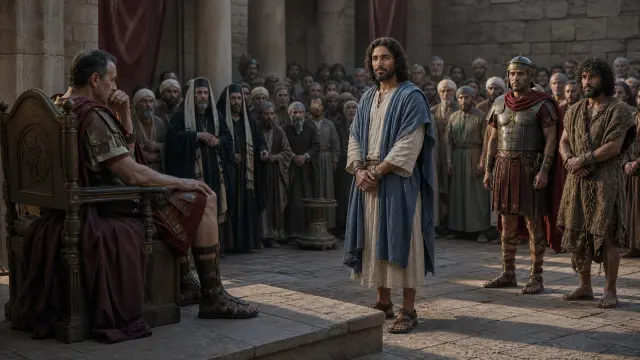
Pilate asks the political question directly: “Art thou the King of the Jews?” Jesus answers the title put to him, but he does not turn the hearing into a campaign for acquittal. When the chief priests and elders pile up accusations, his silence is not the silence of someone unable to speak. Matthew has already distinguished between occasions when Jesus answers and occasions when he refuses to engage, and that pattern continues here with striking control. Isaiah 53:7 stands close behind the scene, where the afflicted servant does not open his mouth, but Matthew does not turn the correspondence into a general rule about every accused person. The immediate effect falls on Pilate, who “marvelled greatly.” That astonishment matters precisely because it changes nothing by itself. The governor recognizes that this defendant behaves unlike the men who normally stand before him, yet amazement is still a long distance from refusing an unjust outcome.
Deep dive
The title before Pilate is King of the Jews. The religious examination has become a hearing before the governor, and the public implication of kingship now stands in the question itself. Jesus’ brief answer acknowledges the words put to him without developing a defence in the form Pilate might expect.
His silence under the accusations is deliberate within Matthew’s account. It follows the equally controlled distinction in the previous chapter between silence toward witnesses and speech about his identity under oath. The book does not portray a man incapable of answering. It portrays one who does not use every available opportunity to argue for release.
Isaiah 53:7 provides a close scriptural correspondence in the afflicted servant who does not open his mouth. That connection gives the silence weight without making silence in every human trial the subject of a general command. Pilate’s great astonishment is expressly recorded, but astonishment will not amount to refusal to condemn. Matthew keeps the governor’s reaction distinct from the decision he eventually makes. Recognizing that an accused man behaves unusually is not the same as protecting him from the accusations.
Words to trace: governor, Jesus, accused, asked, chief, elders
Verse-by-verse path
- Matthew 27:11
In Matthew only outsiders say “King of the Jews”: the wise men at his birth (2:2), Pilate, the soldiers, and the charge nailed over the cross. His own people’s leaders say “King of Israel” (verse 42). The title that opened the book in the mouths of Gentiles returns in theirs at the end.
- Matthew 27:12
“Accused” is katagoreo, to bring a charge, the verb of the courtroom. Pliny the Younger, governing Bithynia about AD 112, wrote that he executed Christians who kept refusing after being asked three times, holding that stubborn obstinacy deserved punishment whatever the charge (Letters 10.96).
- Matthew 27:13
“Witness against” is katamartyreo, the verb Caiaphas used in 26:62: “what is it which these witness against thee?” The high priest and the governor put almost the same question, and the same silence answers both.
- Matthew 27:14
“To never a word” renders an emphatic Greek phrase: not even to one word. Isaiah 52:15 in the Greek Old Testament says that many nations shall marvel at the servant and kings shall shut their mouths at him. Here a Roman governor marvels, and the prisoner’s mouth is the one shut.
Matthew 27:11-14
King James Version11And Jesus stood before the governor: and the governor asked him, saying, Art thou the King of the Jews? And Jesus said unto him, Thou sayest.
12And when he was accused of the chief priests and elders, he answered nothing.
13Then said Pilate unto him, Hearest thou not how many things they witness against thee?
14And he answered him to never a word; insomuch that the governor marvelled greatly.
Matthew 27:15-26
Clean Hands Do Not Cancel the Order
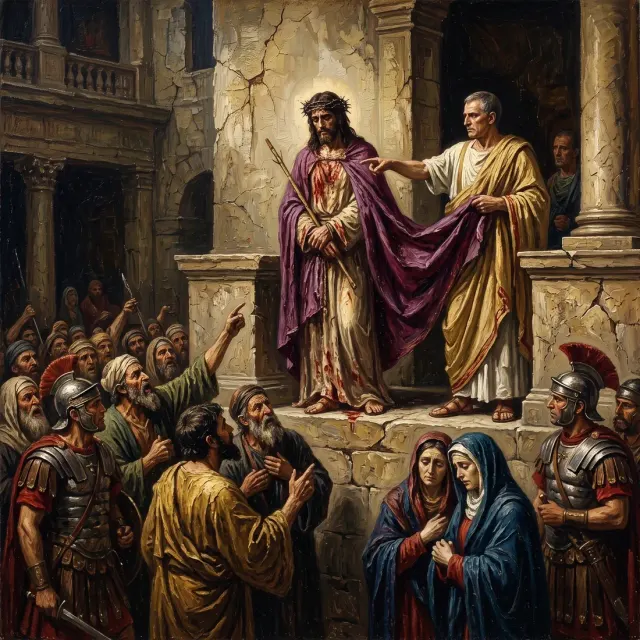
The scene keeps adding reasons for Pilate to stop, then records him proceeding anyway. He knows Jesus has been delivered through envy. His wife warns him about “that just man.” He asks the crowd, “Why, what evil hath he done?” None of those recognitions becomes a decision to protect the man they concern. Instead, the leaders persuade the multitude to demand Barabbas, the cry for crucifixion grows louder, and Pilate answers the pressure with a public washing of hands. The gesture is meant to announce innocence, but Matthew immediately records the actions that the water cannot cancel: Pilate releases Barabbas, has Jesus scourged, and delivers him to be crucified. Responsibility is not moved by a sentence spoken over a basin. The crowd’s words about blood belong to this particular confrontation and do not erase the book’s careful distinctions among Jewish disciples, women, leaders, crowd, governor, and soldiers. Matthew keeps the scene specific because its force lies in what each group actually does.
Deep dive
Several strands of testimony converge without preventing the sentence. Pilate knows that envy has prompted the delivery of Jesus. His wife’s message calls Jesus just and reports suffering in a dream. His own question asks what evil Jesus has done. These details keep the lack of an established offence before the account while the chief priests and elders persuade the crowd to demand Barabbas and the destruction of Jesus.
The washing of hands is a public declaration, not a withdrawal from authority. Pilate’s words resemble the leaders’ earlier attempt to leave Judas with the matter of innocent blood: responsibility is verbally passed elsewhere. Yet verse 26 records what Pilate does. He releases Barabbas, has Jesus scourged, and delivers him for crucifixion. The gesture cannot erase the action that follows it.
The crowd’s statement about the blood falling on them and their children belongs to this charged scene. It is neither a command from Jesus nor a warrant to assign inherited guilt to all Jewish people. Matthew’s account includes Jewish disciples, women, and Joseph as followers of Jesus, and names distinct decisions by leaders, crowd, governor, and soldiers. The passage’s gravity depends on attending to those actions rather than replacing them with an indiscriminate accusation against a people.
Words to trace: Barabbas, Jesus, crucified, governor, Pilate, release
Verse-by-verse path
- Matthew 27:15
No source outside the Gospels mentions a Passover amnesty. The Mishnah allows a Passover lamb to be slaughtered for someone “whom they have promised to bring out of prison” (Pesahim 8:6), which some cite as indirect evidence of releases at the feast. “Was wont” means was accustomed.
- Matthew 27:16
“Notable” is episemos, well known, notorious. Barabbas is Aramaic bar Abba, “son of the father”. Mark says he lay bound with rebels who had committed murder in the insurrection (Mark 15:7); Matthew gives no charge, only his fame.
- Matthew 27:17
Some manuscripts, and copies known to Origen, read “Jesus Barabbas” in verses 16 and 17, so that Pilate asks: Jesus Barabbas, or Jesus called Christ? “Jesus which is called Christ” is the phrase of the genealogy (1:16), and Pilate uses it twice (verses 17, 22).
- Matthew 27:18
“Envy” is phthonos. Philo, a contemporary, describes Pilate as inflexible, stubborn and cruel, and lists his briberies, insults and executions without trial (Embassy to Gaius 301–302). Matthew’s Pilate reads motives well and still yields.
- Matthew 27:19
The “judgment seat” is the bema, a raised tribunal platform. There are six dreams in Matthew: five guide Joseph and the wise men around the child’s birth (1:20; 2:12, 13, 19, 22), and the last comes to a Gentile woman at his death. Later tradition named her Procula and honoured her as a saint.
- Matthew 27:20
“Destroy” is apollymi, the verb used when Herod sought “the young child to destroy him” (2:13) and when the Pharisees first took counsel “how they might destroy him” (12:14). The plot begun in 12:14 reaches its aim through a persuaded crowd.
- Matthew 27:21
The choice is put as a straight either or, and the answer comes back in one word. Mark says Barabbas was held among rebels who had committed murder in the insurrection (Mark 15:7): a real insurgent against Rome is preferred to the man accused of claiming a crown.
- Matthew 27:22
“Let him be crucified” is one word in Greek, staurotheto. Crucifixion was Rome’s punishment for slaves and rebels, so the demand asks the governor to treat Jesus as an enemy of the state. Pilate’s question hands the crowd the verdict that belonged to him.
- Matthew 27:23
“Cried out the more” is the pattern of the two blind men at Jericho, who “cried the more” when rebuked (20:31). They shouted for mercy; this crowd shouts for a cross. Pilate’s question about what evil he has done goes unanswered: no one names a crime.
- Matthew 27:24
Hand washing to disclaim blood guilt was a Jewish rite. Deuteronomy 21:6–7 has the elders of a town wash their hands over a heifer and say, “Our hands have not shed this blood”; Psalm 26:6 says, “I will wash mine hands in innocency.” Pilate performs, before a Jewish crowd, a gesture they would recognise.
- Matthew 27:25
“His blood be on us” uses an Old Testament formula for accepting liability for a death (2 Samuel 1:16; Joshua 2:19). Jeremiah on trial warned his judges that killing him would bring “innocent blood upon yourselves, and upon this city” (Jeremiah 26:15). The words are the crowd’s, spoken in this courtyard, not a sentence pronounced by God or by Jesus.
- Matthew 27:26
“Scourged” is phragelloo, a loanword from the Latin flagellum, a whip of leather thongs weighted with bone or metal. Roman flogging before crucifixion had no set limit; Josephus tells of another Jesus, son of Ananias, flayed to the bone before the governor Albinus (War 6.304).
Matthew 27:15-26
King James Version15Now at that feast the governor was wont to release unto the people a prisoner, whom they would.
16And they had then a notable prisoner, called Barabbas.
17Therefore when they were gathered together, Pilate said unto them, Whom will ye that I release unto you? Barabbas, or Jesus which is called Christ?
18For he knew that for envy they had delivered him.
19When he was set down on the judgment seat, his wife sent unto him, saying, Have thou nothing to do with that just man: for I have suffered many things this day in a dream because of him.
20But the chief priests and elders persuaded the multitude that they should ask Barabbas, and destroy Jesus.
21The governor answered and said unto them, Whether of the twain will ye that I release unto you? They said, Barabbas.
22Pilate saith unto them, What shall I do then with Jesus which is called Christ? They all say unto him, Let him be crucified.
23And the governor said, Why, what evil hath he done? But they cried out the more, saying, Let him be crucified.
24When Pilate saw that he could prevail nothing, but that rather a tumult was made, he took water, and washed his hands before the multitude, saying, I am innocent of the blood of this just person: see ye to it.
25Then answered all the people, and said, His blood be on us, and on our children.
26Then released he Barabbas unto them: and when he had scourged Jesus, he delivered him to be crucified.
Matthew 27:27-37
The Mock Coronation Speaks More Than It Knows
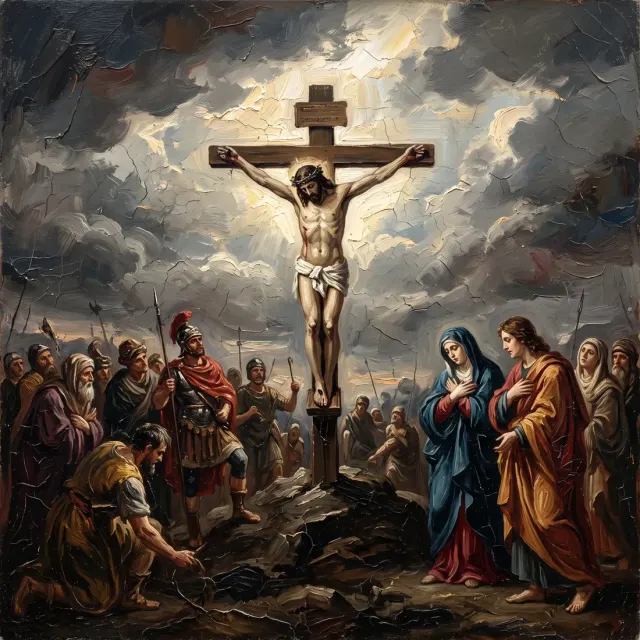
The soldiers stage a coronation meant to humiliate, but every prop keeps repeating Matthew’s royal theme. Scarlet robe, thorn crown, reed, bent knees, and “Hail, King of the Jews!” turn kingship into barracks entertainment. The reed placed in Jesus’ hand as a mock sceptre becomes the stick used to strike his head, so the symbol of rule is converted into an instrument of abuse. Even so, the title does not disappear when the costume comes off. Simon of Cyrene is compelled to carry the cross, Golgotha is reached, and the crucifixion itself is described with remarkable brevity. Attention falls instead on the divided garments, linked in the KJV to Psalm 22:18, and on the soldiers sitting down to watch. Then the accusation is fixed above Jesus’ head: “THIS IS JESUS THE KING OF THE JEWS.” What the executioners publish as the charge is the same identity their mockery has been trying to make ridiculous.
Deep dive
Robe, crown, reed, kneeling, and greeting form a deliberately degraded coronation. The reed placed in Jesus’ hand is then used to strike his head, so the mock emblem becomes an instrument of abuse. Matthew’s royal theme is not suspended during the humiliation. The soldiers use the title as ridicule, while the book has been presenting his kingship from its opening genealogy.
Simon of Cyrene is compelled to carry the cross. Matthew gives his name and origin but does not describe his thoughts, later conversion, or household. At Golgotha, Jesus tastes and refuses the mixture with gall. The account does not state a full medical explanation of the drink’s purpose, and the refusal here should not be confused with the later offering of vinegar near his death.
The actual crucifixion is narrated briefly. Matthew devotes attention to the division of garments and, in the KJV, explicitly connects it to Psalm 22:18. The soldiers sit and watch, making their ordinary custody part of the scene’s severity. Over Jesus’ head, the accusation identifies him as king. What functions for the executioners as the stated charge also repeats the identity the surrounding mockery has attempted to empty of meaning. The wording is displayed publicly even as its truth is being denied.
Words to trace: head, took, drink, garments, JESUS, JEWS
Verse-by-verse path
- Matthew 27:27
The “common hall” is the praetorium, the governor’s headquarters in Jerusalem, likely Herod’s palace. The “band” is a speira, a cohort, nominally six hundred men; the auxiliaries in Judea were recruited largely from non-Jewish towns such as Caesarea and Sebaste, men with no love for Jewish claimants to kingship.
- Matthew 27:28
A soldier’s cloak, chlamys, dyed red, stands in for royal purple; Mark and John call it purple. Stripping him first is part of the humiliation, done before a whole cohort.
- Matthew 27:29
“Platted” means plaited. A wreath of thorns may have mimicked the radiate crowns of rulers on coins, spikes pointing outward like rays. “Bowed the knee” is gonypeteo, the posture of the father who knelt to Jesus to beg for his son (17:14); here it is done as a joke.
- Matthew 27:30
The soldiers repeat what the council members did in 26:67; the spitting crosses the line between Jew and Gentile. Jesus had predicted it exactly: delivered “to the Gentiles to mock, and to scourge” (20:19). “Smote” is imperfect: they kept hitting.
- Matthew 27:31
Condemned men were often led out naked; putting his own clothes back on him may reflect a concession to Jewish feeling about nakedness, though the text gives no reason. The clothes matter to the account for another reason: within hours they will be divided by lot (verse 35).
- Matthew 27:32
Cyrene in Libya had a large Jewish community, and Jerusalem had a synagogue of Cyrenians (Acts 6:9). Mark names Simon’s sons, Alexander and Rufus (Mark 15:21), apparently known to his readers; Matthew drops them. “Compelled” is angareuo, the soldier’s right to press a civilian into service (5:41).
- Matthew 27:33
Golgotha is Aramaic gulgulta, skull; the Latin calvaria gave English “Calvary”. The traditional site, under the Church of the Holy Sepulchre, lay then just outside the city wall in a disused quarry, near tombs cut into the rock face.
- Matthew 27:34
The Greek behind the King James has oxos, vinegar; the oldest manuscripts read oinos, wine. Either way the words recall Psalm 69:21: “They gave me also gall for my meat; and in my thirst they gave me vinegar to drink.” He tastes it, so he knows what it is, and declines.
- Matthew 27:35
The quotation of Psalm 22:18 is missing from the oldest manuscripts of Matthew and appears to have been added from John 19:24; the King James text carries it. Roman law later recognised an executioner’s claim to the condemned man’s clothing. These garments were the last things Jesus owned.
- Matthew 27:36
“Watched” is tereo, to keep guard. The same verb describes the centurion “watching Jesus” in verse 54 and the guards at the tomb, the “keepers”, in 28:4. From the cross to the grave, Jesus is under guard.
- Matthew 27:37
“Accusation” is aitia, the charge. Suetonius describes a placard giving the cause of punishment carried before a condemned man to his execution (Caligula 32). Each Gospel gives the wording slightly differently; Matthew’s alone begins “THIS IS JESUS”.
Matthew 27:27-37
King James Version27Then the soldiers of the governor took Jesus into the common hall, and gathered unto him the whole band of soldiers.
28And they stripped him, and put on him a scarlet robe.
29And when they had platted a crown of thorns, they put it upon his head, and a reed in his right hand: and they bowed the knee before him, and mocked him, saying, Hail, King of the Jews!
30And they spit upon him, and took the reed, and smote him on the head.
31And after that they had mocked him, they took the robe off from him, and put his own raiment on him, and led him away to crucify him.
32And as they came out, they found a man of Cyrene, Simon by name: him they compelled to bear his cross.
33And when they were come unto a place called Golgotha, that is to say, a place of a skull,
34They gave him vinegar to drink mingled with gall: and when he had tasted thereof, he would not drink.
35And they crucified him, and parted his garments, casting lots: that it might be fulfilled which was spoken by the prophet, They parted my garments among them, and upon my vesture did they cast lots.
36And sitting down they watched him there;
37And set up over his head his accusation written, THIS IS JESUS THE KING OF THE JEWS.
Matthew 27:38-44
The Demand to Come Down Misunderstands the Saving
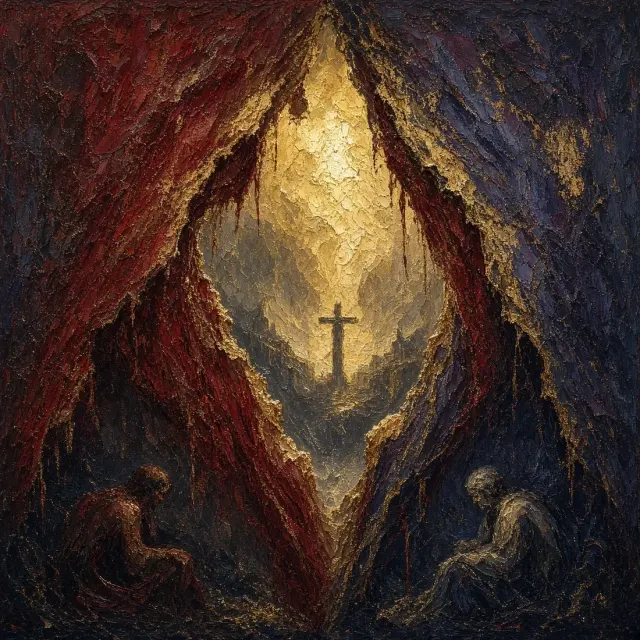
Nearly every voice around the cross offers the same test in a different form: prove who you are by getting out of this. Passers-by connect sonship with coming down. The chief priests, scribes, and elders say they will believe if the King of Israel rescues himself. Even the two condemned men join the reproach in Matthew’s account, leaving Jesus surrounded by hostility. The demand “If thou be the Son of God” reaches backward to the wilderness temptation, where sonship was also treated as something to be demonstrated through self-serving power. The line “He saved others; himself he cannot save” carries an irony the speakers do not intend. Matthew has already shown Jesus refusing available means of resistance, so inability is not the explanation the book has supplied. Their quotation-like appeal to divine deliverance also echoes Psalm 22:8. The mockers demand proof by escape while standing inside scriptural language that frames the suffering they regard as disproof.
Deep dive
The two thieves place Jesus among condemned men, and Matthew says that both join the reproach. He does not narrate the repentant criminal’s exchange found in Luke. The shared hostility makes the isolation in this particular account especially stark.
The passers-by repeat the temple accusation and frame the demand to come down with the condition that he is the Son of God. That phrasing recalls the wilderness temptation in Matthew 4:3 and 4:6, where sonship was likewise made the premise of a demand for self-serving proof. At the cross, the proposed proof would require abandoning the path Jesus has already interpreted as giving his life for others.
The leaders’ claim that he saved others but cannot save himself contains an irony deeper than they intend. Matthew has shown him possessing power to resist arrest and choosing not to use it. The inability they assert is therefore not the explanation already supplied by the book. Their appeal to trust and divine deliverance closely echoes Psalm 22:8, placing their mockery inside the very Scripture that gives language to the suffering. The promise to believe if he comes down keeps belief conditional on his accepting their definition of what the Messiah must do.
Words to trace: cross, crucified, save, thieves, believe, buildest
Verse-by-verse path
- Matthew 27:38
Isaiah 53:12 said the servant “was numbered with the transgressors”; the King James text of Mark 15:28 cites it at this point. It is an inference, but a reasonable one, that these two bandits were from the same rising as Barabbas, whose place Jesus has taken.
- Matthew 27:39
“Reviled” is blasphemeo, the verb from which “blasphemy” comes. The charge on which the council condemned him (26:65) is now committed against him by passers by. “Wagging their heads” is Psalm 22:7: “they shoot out the lip, they shake the head.”
- Matthew 27:40
“Save thyself” mocks his name. Jesus is Yeshua, “the LORD saves”, and the angel explained it at his birth: “thou shalt call his name JESUS: for he shall save his people from their sins” (1:21). The passers by demand a salvation for one man only, himself.
- Matthew 27:41
Elders, chief priests and scribes are the three groups named in the first passion prediction: he must “suffer many things of the elders and chief priests and scribes, and be killed” (16:21). Every name on that list is now standing at the cross.
- Matthew 27:42
“We will believe him” is really “believe upon him”, a condition set on a sign. The Pharisees had asked for a sign twice (12:38; 16:1) and been promised only the sign of Jonah, three days in the heart of the earth. They are offered it, and do not wait.
- Matthew 27:43
The Wisdom of Solomon has the ungodly plot against the just man in almost these terms: “if the just man be the son of God, he will help him, and deliver him from the hand of his enemies... let us condemn him with a shameful death” (Wisdom 2:18, 20). “If he will have him” means if he delights in him, as in Psalm 22:8.
- Matthew 27:44
“Cast the same in his teeth” was 1611 English for reproached him. The verb is oneidizo, used in the beatitude, “Blessed are ye, when men shall revile you” (5:11). Luke tells of one of the two taking Jesus’ side (Luke 23:40–43); in Matthew both join in.
Matthew 27:38-44
King James Version38Then were there two thieves crucified with him, one on the right hand, and another on the left.
39And they that passed by reviled him, wagging their heads,
40And saying, Thou that destroyest the temple, and buildest it in three days, save thyself. If thou be the Son of God, come down from the cross.
41Likewise also the chief priests mocking him, with the scribes and elders, said,
42He saved others; himself he cannot save. If he be the King of Israel, let him now come down from the cross, and we will believe him.
43He trusted in God; let him deliver him now, if he will have him: for he said, I am the Son of God.
44The thieves also, which were crucified with him, cast the same in his teeth.
Matthew 27:45-50
The Cry Remains a Cry
For three hours the scene is placed under darkness, and Matthew offers no physical mechanism to explain it away. The darkness simply surrounds the death as a sign larger than the decisions of the people at the cross. Then Jesus cries the opening words of Psalm 22: “My God, my God, why hast thou forsaken me?” The wider psalm eventually moves toward praise and answered prayer, but Matthew does not use that later movement to cancel the anguish of the line Jesus actually speaks. The cry names abandonment while still addressing God as “my God,” leaving both elements present at once. Some bystanders mishear the words as a call for Elijah, and the scene turns again toward the expectation of rescue. Vinegar is offered, others wait to see whether Elijah will come, and no such intervention arrives. Jesus cries once more with a loud voice and yields up the ghost. Matthew lets the cry remain a cry and the death remain a death.
Deep dive
Matthew marks the darkness from the sixth to the ninth hour, giving the death a setting that exceeds the actions of the people gathered around the cross. He does not explain its physical mechanism. The darkness belongs to the account as a sign surrounding the event, not as an invitation to supply an unreported natural cause.
Jesus’ cry uses the opening words of Psalm 22. The earlier mockery and divided garments have already made that psalm present, but the citation must not be used to turn anguish into a disguised declaration that no anguish exists. The words speak abandonment while still addressing God as his God. The psalm’s later movement toward answered prayer, praise, and the nations provides a larger scriptural horizon; it does not cancel the force of the line Jesus actually cries. Matthew does not pause to define the inner relations of Father and Son in a systematic formula at this moment.
Some hear the cry as a call for Elijah. One offers vinegar, and others wait to see whether Elijah will save him. Their interpretation keeps the scene focused on the demanded rescue from death, while Matthew moves to death itself. Jesus cries again and yields up the ghost. The expression records the giving up of his spirit in death; it is not a separate account of transferring the Holy Spirit to the people standing nearby.
Words to trace: hour, cried, Elias, Jesus, loud, ninth
Verse-by-verse path
- Matthew 27:45
Noon to three in the afternoon. A solar eclipse is impossible at Passover, which falls at full moon, a point Christian writers such as Julius Africanus were already making. Amos had foretold a day when God would “cause the sun to go down at noon” and darken the earth in the clear day (Amos 8:9).
- Matthew 27:46
Mark gives the cry in Aramaic, “Eloi”; Matthew writes “Eli”, the Hebrew of Psalm 22:1, while “sabachthani” is Aramaic (the Hebrew psalm has azavtani). Matthew’s “Eli” makes the bystanders’ mistake in the next verse easier to understand.
- Matthew 27:47
“Eli” sounds like Eliyahu, Elijah. Jewish piety held that Elijah comes to the help of the righteous in trouble. On the way down from the mountain, Jesus had told the disciples that Elijah had already come, and they had done to him whatever they wished (17:12).
- Matthew 27:48
The vinegar is oxos, the cheap sour wine Roman soldiers drank, perhaps from a jar kept at the site for the guards. “Reed” is kalamos, the same word as the reed the soldiers put in his hand as a sceptre and then beat him with (verses 29–30).
- Matthew 27:49
“Let be” means wait, leave him. Codex Sinaiticus and Codex Vaticanus add a sentence here: another took a spear and pierced his side, and water and blood came out. It seems to have been copied in from John 19:34, where the piercing comes after death; here it would come before.
- Matthew 27:50
“Ghost” in 1611 meant spirit, as in Holy Ghost. Mark writes that Jesus “gave up the ghost” with exepneusen, he breathed out (Mark 15:37). Matthew writes apheken to pneuma, he let go his spirit, using the verb of release and forgiveness, as in “forgive us our debts” (6:12).
Matthew 27:45-50
King James Version45Now from the sixth hour there was darkness over all the land unto the ninth hour.
46And about the ninth hour Jesus cried with a loud voice, saying, Eli, Eli, lama sabachthani? that is to say, My God, my God, why hast thou forsaken me?
47Some of them that stood there, when they heard that, said, This man calleth for Elias.
48And straightway one of them ran, and took a spunge, and filled it with vinegar, and put it on a reed, and gave him to drink.
49The rest said, Let be, let us see whether Elias will come to save him.
50Jesus, when he had cried again with a loud voice, yielded up the ghost.
Matthew 27:51-56
The Signs Move from the Sanctuary to the Graves
The consequences of Jesus’ death move outward in a sequence that begins at the sanctuary and reaches the graves. The temple veil tears from top to bottom, the earth shakes, rocks split, and graves open. Matthew does not reduce the torn veil to one explanation. Judgment on the temple and opened access to God both belong to later Christian reading, while Hebrews will develop the access theme explicitly. Here the immediate setting is rupture and upheaval at the moment of death. The raised saints make the breach even stranger. Matthew places their emergence and appearance in the holy city after Jesus’ resurrection, but he does not name them, describe their later lives, or invite invented biographies. Then the human witnesses come back into view. The centurion and those with him fear greatly and confess Jesus as Son of God. The women who followed from Galilee remain watching at a distance, preserving continuity where the scattered twelve are absent.
Deep dive
The veil is torn from top to bottom immediately after Jesus’ death. The direction and timing present the rupture as more than damage caused by the people who crucified him. Its precise significance has been read as judgment on the temple, the opening of access to God, or both. Matthew does not spell out a complete explanation of the sanctuary’s future. Hebrews 10:19–20 later connects access through the veil with Jesus’ flesh, giving a specific later scriptural development rather than a reason to ignore Matthew’s own setting of judgment and upheaval.
The opened graves and raised saints extend the signs into the realm of death. Matthew explicitly places their emergence and appearance in the holy city after Jesus’ resurrection. The sentence compresses the sequence, and interpreters differ over exactly when the rising itself should be placed. The saints are not named, and their subsequent lives or final destination are not described. The passage is extraordinary enough without supplying a procession of invented identities. It connects Jesus’ death and resurrection with a breach in the apparent finality of the grave.
The confession belongs to the centurion and those watching with him, not to the centurion alone. Fear accompanies their response to the earthquake and the things done. Meanwhile, the women who followed from Galilee remain witnesses at a distance. Their named presence provides continuity through death, burial, and the discovery of the empty tomb. Where the twelve have scattered, Matthew carefully preserves the people still watching.
Words to trace: graves, Jesus, Mary, mother, rent, afar
Verse-by-verse path
- Matthew 27:51
The temple had two great curtains, one at the entrance to the Holy Place and one before the Holy of Holies; Matthew does not say which. Josephus describes the outer one as a Babylonian tapestry embroidered with a panorama of the heavens (War 5.212–214). “Rent” is schizo, the same verb for veil and rocks.
- Matthew 27:52
“Slept” is the Bible’s common word for the dead, as in Daniel 12:2: “many of them that sleep in the dust of the earth shall awake.” Ezekiel 37:12 had God say, “I will open your graves, and cause you to come up out of your graves.” Only Matthew records this.
- Matthew 27:53
“The holy city” is Matthew’s name for Jerusalem, used when the devil set Jesus on the pinnacle of the temple (4:5); no other Gospel calls it that. The city that has just executed Jesus still carries the title, and its dead are the first to walk into it.
- Matthew 27:54
The centurion commanded about eighty men. His words have no article in Greek, “truly this was God’s son” or “a son of God”. On the coins he was paid with, the emperor Tiberius was styled “son of the divine Augustus”. A Roman officer gives the title to a crucified man.
- Matthew 27:55
“Ministering” is diakoneo, the verb Jesus used of his own mission in 20:28, “not to be ministered unto, but to minister”. The women have been doing, all the way from Galilee, what the Son of man came to do. “Afar off” recalls Psalm 38:11: “my kinsmen stand afar off.”
- Matthew 27:56
This is Mary Magdalene’s first appearance in Matthew. Magdala was a fishing town on the west shore of the Sea of Galilee. James and Joses are also the names of two of Jesus’ brothers in 13:55; whether this Mary is their mother is debated. Zebedee’s wife asked for her sons’ thrones in 20:20 and now stands at the cross.
Matthew 27:51-56
King James Version51And, behold, the veil of the temple was rent in twain from the top to the bottom; and the earth did quake, and the rocks rent;
52And the graves were opened; and many bodies of the saints which slept arose,
53And came out of the graves after his resurrection, and went into the holy city, and appeared unto many.
54Now when the centurion, and they that were with him, watching Jesus, saw the earthquake, and those things that were done, they feared greatly, saying, Truly this was the Son of God.
55And many women were there beholding afar off, which followed Jesus from Galilee, ministering unto him:
56Among which was Mary Magdalene, and Mary the mother of James and Joses, and the mother of Zebedee’s children.
Matthew 27:57-61
A Disciple Gives the Condemned Man His Own Tomb
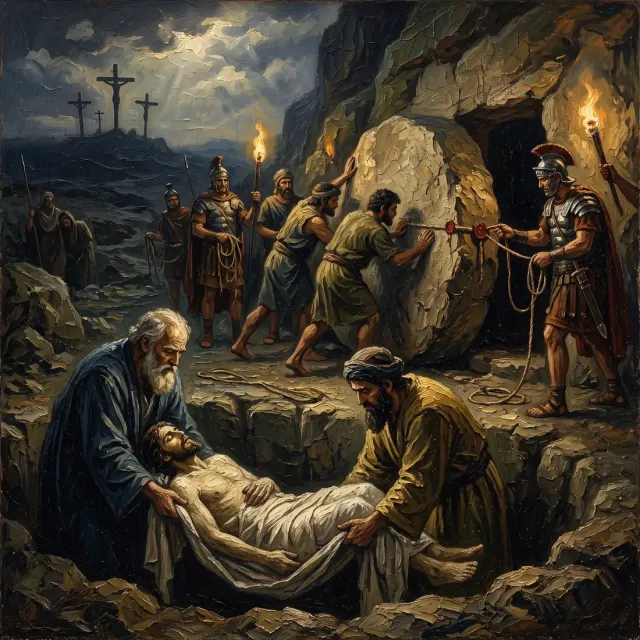
After public humiliation and execution, the handling of Jesus’ body becomes unexpectedly careful. Joseph of Arimathæa is introduced as rich and as a disciple, and his wealth now becomes the means by which the condemned man receives a known burial place. He asks Pilate for the body, wraps it in clean linen, and places it in his own new tomb cut into rock. The contrast with the stripping, mockery, and violence of the preceding hours is sharp without needing commentary from Matthew. Joseph’s status also resonates with Isaiah 53:9 and its association between the suffering servant and the rich in death, though Matthew does not mark the burial with a formal fulfilment quotation. The great stone closes the entrance and Joseph leaves. Mary Magdalene and the other Mary do not. Sitting opposite the sepulchre, they establish that the burial has a specific place known to continuing witnesses before any report of an empty tomb appears.
Deep dive
Matthew introduces Joseph as both rich and a disciple. His action follows a chapter in which public authorities and crowds have failed to secure justice for Jesus. Joseph cannot undo the sentence, but he can seek the body and provide a burial. The request to Pilate and the governor’s order make the transfer specific rather than leaving the corpse’s destination uncertain.
The tomb is Joseph’s own, newly cut in the rock. The clean linen and the care of placement stand in contrast to the stripping and mockery that preceded the death. Joseph’s wealth also creates a close correspondence with Isaiah 53:9, where the servant’s death is associated with the rich. Matthew does not insert a formal fulfilment quotation here, so the connection is best identified as a scriptural resonance rather than as an explicit citation by the book.
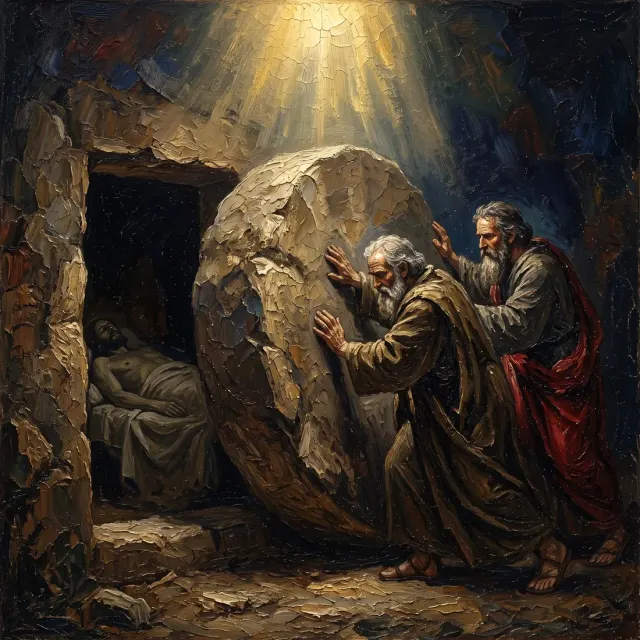
The great stone closes the entrance, and Joseph leaves. Mary Magdalene and the other Mary remain seated opposite the sepulchre. Their presence is not a decorative farewell. They have witnessed where the body is laid, and the same women will return in the next chapter. The account gives the burial a known place and a continuing line of witnesses before describing any claim about its emptiness.
Words to trace: body, Jesus, Joseph, Mary, Pilate, sepulchre
Verse-by-verse path
- Matthew 27:57
The law required that a hanged man’s body not remain overnight (Deuteronomy 21:22–23), and the sabbath was near. Arimathaea is probably Ramathaim, Samuel’s birthplace (1 Samuel 1:1). “Was Jesus’ disciple” is the verb matheteuo, to be made a disciple, which returns in the last command, “teach all nations” (28:19).
- Matthew 27:58
Rome often left crucified bodies on the cross as a warning. In 1968 an ossuary found at Giv‘at ha-Mivtar in Jerusalem held the bones of a crucified man named Yehohanan, a nail still through his heel bone, showing that a crucified man could receive family burial. Pilate grants the body to a disciple on request.
- Matthew 27:59
“Linen cloth” is sindon, fine linen, and “clean” means fresh, unused. A later rabbinic tradition says Rabban Gamaliel asked to be buried in plain linen so that funeral costs would stop ruining families (Ketubot 8b). Joseph’s linen is both costly and simple.
- Matthew 27:60
Most tombs of the period were closed with a squared block; a rolling disc stone, a golel, was rare and marked a wealthy family’s tomb. Joseph’s tomb is newly cut, so no other body had lain there. He rolls the stone himself and leaves.
- Matthew 27:61
“The other Mary” is Matthew’s shorthand for Mary the mother of James and Joses from verse 56, and he uses it again at the tomb (28:1). “Sitting over against the sepulchre” is the mourner’s posture, facing the grave, like Job’s friends who sat with him in silence (Job 2:13).
Matthew 27:57-61
King James Version57When the even was come, there came a rich man of Arimathæa, named Joseph, who also himself was Jesus’ disciple:
58He went to Pilate, and begged the body of Jesus. Then Pilate commanded the body to be delivered.
59And when Joseph had taken the body, he wrapped it in a clean linen cloth,
60And laid it in his own new tomb, which he had hewn out in the rock: and he rolled a great stone to the door of the sepulchre, and departed.
61And there was Mary Magdalene, and the other Mary, sitting over against the sepulchre.
Matthew 27:62-66
The Promise Is Remembered by Its Opponents
The final action before the resurrection account comes from men determined to make burial the end of the matter. The chief priests and Pharisees remember Jesus’ prediction, “After three days I will rise again,” with an attentiveness the disciples have not always shown. Their memory does not produce belief. It produces a security plan and, before the tomb is ever reported empty, a proposed explanation for how such a report might arise. They fear that disciples could steal the body and announce resurrection, so they ask Pilate to make the sepulchre sure. Matthew does not settle every administrative detail about the watch, but he makes the precautions unmistakable. A guard is set, the stone is sealed, and access is meant to be controlled. The chapter therefore does not drift into resurrection with a neglected grave. It closes on deliberate human effort to prevent the very claim that the next chapter will announce.
Deep dive
The leaders remember Jesus’ prediction of rising after three days. Their remembrance contrasts with the disciples’ earlier difficulty receiving his resurrection announcements, but it does not become faith. They interpret the promise as a danger that a stolen body and a false report could exploit. Their proposed explanation for an empty tomb is therefore put into the account before the tomb is found empty.
Pilate’s statement about the watch can be understood as permission to use a guard or as an instruction concerning one available to them. Matthew does not explain every detail of its administrative origin. The next chapter calls the men soldiers and includes concern about a report reaching the governor, which makes their accountability an important part of the later exchange.
The stone is sealed and the watch set. These measures intend to control access and prevent the anticipated claim. Matthew lets the chapter end with the full arrangement in place rather than weakening it in advance. The opponents’ precautions become part of the evidence the next chapter must address. The last human action before the resurrection account is an attempt to ensure that Jesus’ burial remains the final event.
Words to trace: sure, Pilate, sepulchre, watch, alive, chief
Verse-by-verse path
- Matthew 27:62
“The preparation”, paraskeue, was the day of getting ready for the sabbath, and in modern Greek the word still names Friday. So “the next day” is the sabbath itself, though Matthew does not call it that: chief priests and Pharisees go to a Gentile governor on the holy day.
- Matthew 27:63
“Sir” is kyrie, lord, their address to Pilate. “That deceiver” is planos, from planao, the verb Jesus used for the false Christs who “shall deceive many” (24:5). “After three days” matches the sign of Jonah, “three days and three nights” (12:40), which was said in their hearing.
- Matthew 27:64
“The last error shall be worse than the first” echoes Jesus’ saying about the unclean spirit that returns: “the last state of that man is worse than the first” (12:45). “Error” is plane, from the same root as “deceiver”. “Made sure” is asphalizo, to secure.
- Matthew 27:65
“Watch” is koustodia, a Latin loanword, custodia, the usual term for a Roman military guard, which suggests soldiers, and 28:14 speaks of the matter reaching the governor’s ears. “Make it as sure as ye can” may carry a dry edge: secure it as well as you know how.
- Matthew 27:66
A seal was a cord across the stone fixed at both ends with clay or wax stamped with an official mark. Darius sealed the stone over Daniel’s den with his own signet, “that the purpose might not be changed concerning Daniel” (Daniel 6:17). Daniel came out alive the next morning.
Matthew 27:62-66
King James Version62Now the next day, that followed the day of the preparation, the chief priests and Pharisees came together unto Pilate,
63Saying, Sir, we remember that that deceiver said, while he was yet alive, After three days I will rise again.
64Command therefore that the sepulchre be made sure until the third day, lest his disciples come by night, and steal him away, and say unto the people, He is risen from the dead: so the last error shall be worse than the first.
65Pilate said unto them, Ye have a watch: go your way, make it as sure as ye can.
66So they went, and made the sepulchre sure, sealing the stone, and setting a watch.
Questions to keep in mind while reading
- Watch what Jesus says and does, and how people respond.
- Trace kingdom, discipleship, opposition, cross, and resurrection in the evangelist’s own sequence.
- Let later doctrine clarify the scene without erasing its immediate setting.
Text first
Where readers differ
The chapter summary begins with what the passage says and how its parts fit together. It does not assume one denomination has already settled every question. Where a conclusion depends on a tradition, literary theory, or historical reconstruction, that dependence is named openly.
The KJV text is presented first. Interpretive conclusions are labeled, and differences are introduced only when they help a reader understand why serious communities do not always reach the same answer.
Comparative interpretive notes for this chapter are in preparation. Until reviewed notes are ready, this page separates the KJV text from summary and application without claiming that serious readers agree on every question.
Questions beneath the surface
- What account of God, human freedom, responsibility, and the good life emerges from Matthew 27?
- Which tension does the chapter refuse to resolve quickly?
- What changes when the chapter is read as part of the whole canon rather than as an isolated moral lesson?
- Where might a sincere reader confuse a familiar tradition with something the text states directly?
Questions for serious personal contemplation
These open-ended questions make room for tension, honest response, prayer, and conclusions that remain accountable to the chapter.
Observe without rushing
What part of Matthew 27 makes you stop, feel unsettled, or feel surprised, and why?
Which detail in the passage would be easiest to overlook? How does that detail change your understanding?
Where do you see tension between what happens and this focus: Jesus before Pilate, led toward crucifixion, and raised on the cross; Darkness, Jesus’ death, the torn veil reported, burial in Joseph’s tomb, and the sealed guard?
What important question does the passage leave open instead of resolving quickly?
Examine your inner life honestly
Which person, response, fear, or desire in the passage feels most like your own life right now?
What assumption about God, other people, or yourself does this text challenge?
Which part would you rather soften, avoid, or explain away too quickly? What might that reaction reveal?
If this Scripture could ask you one direct question, what do you think it would ask?
Respond with wisdom and courage
What do you need to remember, confess, grieve, thank God for, or trust after reading this passage?
How might another faithful person read this situation differently without ignoring the text?
What obedient response would be costly, uncomfortable, or slow, yet still faithful to Scripture?
What question will you carry into prayer this week, and which verses will you keep in front of you?
Music and video connected to the passage
Related media appears when its Scripture reference overlaps this study. Music and video can illuminate a theme while the biblical text remains the foundation.
 Sealed until the Third DayMatthew 27:57-66Listen to related music →
 The Veil Was TornMatthew 27:27-56Listen to related music →
 A Stone at the DoorMatthew 27:57-66; Mark 15:42-47; Luke 23:50-56; John 19:38-42Listen to related music →
 It Is FinishedMatthew 27:32-56; Mark 15:21-41; Luke 23:26-49; John 19:16-37Listen to related music →