
The big picture
Numbers 31 returns to the crisis at Peor through the campaign against Midian, and the chapter refuses to let victory become a simple triumphal report. Balaam dies with the Midianite kings, and the surviving women and children are brought to the camp, where Moses issues the chapter's starkest order concerning the captives. The army itself must then remain outside the camp for purification because killing and contact with the dead still produce impurity. Spoil is divided equally between the combatants and the congregation, but each half pays a different levy to the sanctuary servants. The inventory counts livestock and human captives with the same numerical precision. Finally, the officers report that none of their own soldiers is missing and present gold as an additional offering for their lives, placing the army's return under one more act of accountability.
Central truth
Numbers 31–32 closes the Midian crisis with severe wartime judgment and purification, then tests Reuben and Gad’s east-bank request until they bind themselves to fight with the rest of Israel before settling their own families and cattle.
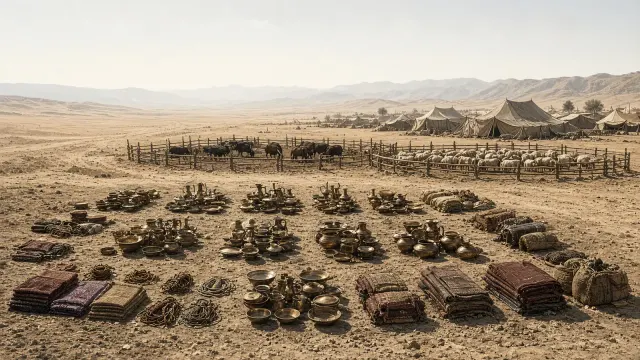

The study notes have a page of their own
The movement by movement analysis, the words to trace, the verse by verse notes and where readers differ are written for someone studying alone. They are on the Deep Personal Reflections page for this chapter. This page is the lesson.
A chapter-specific teaching brief
These anchors come from this chapter itself. They help a teacher use the Level 1 overview, the Level 2 study, and the Scripture text as one lesson.
Open with the chapter’s first image
Numbers 31:1: “And the LORD spake unto Moses, saying,”
Slow down at the turning point
Numbers 31:18: “But all the women children, that have not known a man by lying with him, keep alive for yourselves.”
Keep this word trail visible
Moses, LORD, Eleazar, priest, children, thirty
What to explain, in order
Teach the passage in this order. Each step names the verses it rests on, so every point can be shown in the text before it is applied.
Numbers 31:1-12
A war commanded and its setting
Begin with 31:2, “Avenge the children of Israel of the Midianites: afterward shalt thou be gathered unto thy people”. This is Moses' last campaign, and it is tied directly to 25:16-18. Explain that a thousand from each tribe go, with Phinehas and the holy instruments, which marks it as the Lord's war, not a raid. Read the outcome in 31:7-12, including the death of Balaam. Teach this first with honesty: warn the class that the chapter is among the hardest in the Bible, and that you will read it carefully rather than quickly.
Numbers 31:13-18
Moses' anger and the hardest verses
Read Moses' anger and his command in 31:15-18. Do not soften it and do not justify it beyond the text. Explain the link the text makes in 31:16 with Peor and Balaam's counsel. Acknowledge that the killing of boys and women is deeply troubling, that faithful readers in every tradition have struggled with it, and that the passage describes judgement in a specific war under the covenant, not a pattern for any later conduct. Give the room time. Some learners may have experienced war or abuse, and the teacher should be ready to listen afterward.
Numbers 31:19-24
Even a commanded war defiles
Read the purification laws for soldiers, captives and spoil. Show that the water of separation from chapter 19 is used, and that metals go through fire and water. Explain that the soldiers remain outside the camp for seven days. Teach this step to show that the chapter does not treat killing as a light thing even in war the Lord commanded. Death defiles, and those who have taken life must be cleansed before they return to the camp where the Lord dwells.
Numbers 31:25-54
Spoil shared and gold given
Walk through the division of the spoil into two halves, the tribute to the priests and Levites, and the officers' gift. Read 31:49 aloud, “there lacketh not one man of us”, and explain the officers' response as thanksgiving and atonement. Point out that the gold becomes a memorial in the tabernacle. Teach this step to show how the Book of Numbers turns spoil into worship and shares it with those who did not fight. Keep the numbers brief; the principle is the point.
Numbers 32:1-15
A request that sounds like Kadesh
Turn to chapter 32. Reuben and Gad, rich in cattle, see good pasture in Gilead and ask to settle there and “bring us not over Jordan” (32:5). Read Moses' response in 32:6-15, which retells the spies' failure. Explain why Moses fears a repeat: two and a half tribes staying behind could discourage the rest just as ten spies did. Teach this step to show that the issue is not where they live but whether they will share the fight for the promise with their brothers.
Numbers 32:16-42
A promise to cross armed
Read the tribes' new proposal: build folds and cities, then cross armed ahead of Israel and stay until every tribe has its inheritance. Show Moses' conditions, his warning in 32:23, and the arrangement passed to Eleazar and Joshua. Note that half of Manasseh is included in 32:33. Read Joshua 22:1-4, where Joshua sends them home with praise for keeping their word. Teach this last because it ends the unit with a dispute resolved by negotiation and promise, and with the warning that sin, if they break their word, will find them out.
Where learners get stuck
The misreadings this passage tends to produce, and how to answer each from the text.
“Numbers 31 shows that God approves of genocide.”
Numbers 31 records a war commanded against Midian in response to Peor (25:16-18; 31:16), in Israel's covenant history. It is described, not offered as a model, and the soldiers must be purified afterward (31:19-24). Teachers should not explain the horror away, and should not claim more than the text says. Many faithful readers hold together God's justice in these accounts and the clear New Testament command to love enemies (Matthew 5:44). No passage here licenses violence against any people today, and the class should hear that said plainly.
“The girls who were kept alive were taken to be abused.”
Numbers 31:18 says they were kept alive, and 31:19 requires their purification with the soldiers. Deuteronomy 21:10-14 regulates the treatment of a captive woman taken as a wife and forbids treating her as a slave. The text does not describe abuse, and teachers should not invent detail either way. Acknowledge that the situation of captives in ancient war was grievous, and leave room for learners' discomfort.
“Reuben and Gad were selfish and Moses rejected them.”
Moses' first response in 32:6-15 is sharp because their request sounds like Kadesh. But when they promise to cross armed and stay until the others have their land (32:17-18), Moses agrees (32:20-24) and gives them Gilead (32:33). Joshua 22:1-4 shows them keeping their word. The chapter shows a dangerous request turned into a faithful agreement.
“Be sure your sin will find you out means God is always watching to catch us.”
In Numbers 32:23 the warning applies to a specific broken promise: if Reuben and Gad do not go to war with their brothers, the consequences of that sin will catch up with them. It is a warning about keeping one's word to God and others. The verse is often quoted on its own, but here it is part of a negotiation that ends with a promise kept.
Learning objectives
- Explain how Numbers 31 connects the Midian campaign to the Peor crisis.
- Trace the purification and spoil-distribution procedures after battle.
- Identify why Moses is angry when the army returns.
- Explain the officers’ voluntary gold offering after the troop count.
- State Moses’ initial objection to Reuben and Gad’s land request.
- Describe the condition that makes the east-bank settlement acceptable.
Teacher preparation
- Treat Numbers 31 as one of the book’s hardest passages.
- Read Numbers 25 and especially 31:16 together.
- Prepare a spoil chart: one half goes to the warriors and one half to the congregation, with different tribute rates to the priest and Levites.
- Mark 31:19–24.
- For chapter 32, prepare a map east and west of Jordan.
Evidence and interpretation checks
Explicit
Numbers 31:16 links the women in question, Balaam’s counsel, Israel’s trespass at Peor, and the plague.
Scripture-supported
Numbers 32:20–23 makes the east-bank grant conditional on armed men crossing until the land is subdued; refusal is called sin.
Strong inference
Moses’ comparison with the spies in 32:8–15 shows his central fear: discouraging the rest of Israel from entering the land.
Possible or traditional reading
Numbers 31 raises severe ethical questions. The chapter presents commanded judgment tied to Peor but does not answer every later philosophical question about warfare.
Limit
The chapter does not authorize modern religious warfare, private vengeance, or violence against contemporary peoples.
Discussion with answer guidance
1. What reason does 31:16 give for Moses’ anger about the spared women?
What a good answer contains
Moses says, “Behold, these caused the children of Israel, through the counsel of Balaam, to commit trespass against the LORD in the matter of Peor, and there was a plague among the congregation of the LORD” (31:16). The verse links the war back to chapter 25 and reveals Balaam's part, which chapters 22 to 24 did not show. A good answer sees that the Book of Numbers presents the women of Midian as agents of a deliberate plan that killed 24,000 Israelites. A weak answer either ignores the verse or uses it to make the passage easy, which it is not.
Show teacher guidance
The verse connects them with Balaam’s counsel and Israel’s trespass against the Lord in the matter of Peor, which produced the plague.
2. What happens before soldiers and captives reenter the camp?
What a good answer contains
“do ye abide without the camp seven days: whosoever hath killed any person, and whosoever hath touched any slain, purify both yourselves and your captives on the third day, and on the seventh day” (31:19). Clothing, leather, goats' hair and wood are purified (31:20); metal goes “through the fire” and then the water of separation (31:23). A good answer connects this to the law of chapter 19 and sees that even a commanded war leaves the soldiers unclean. Killing is never treated as clean. A weak answer passes over the purification.
Show teacher guidance
Those involved remain outside seven days and undergo purification, while garments and objects are cleansed according to the stated procedures.
3. How is the spoil divided in 31:25–47?
What a good answer contains
The prey is divided “into two parts; between them that took the war upon them, who went out to battle, and between all the congregation” (31:27). From the soldiers' half, one in five hundred goes to Eleazar as “an heave offering of the LORD” (31:28-29); from the people's half, one in fifty goes to the Levites (31:30). A good answer sees that those who fought and those who stayed share alike, and that both halves give to the Lord's servants. David later follows the same principle (1 Samuel 30:24). A weak answer misses the shared division.
Show teacher guidance
It is split between those who went to war and the rest of the congregation, with tribute from each half assigned respectively to the priest and Levites.
4. Why do the officers bring gold in 31:48–54?
What a good answer contains
The officers report, “Thy servants have taken the sum of the men of war which are under our charge, and there lacketh not one man of us” (31:49). They bring gold jewellery “to make an atonement for our souls before the LORD” (31:50), and Moses and Eleazar place it in the tabernacle “for a memorial for the children of Israel before the LORD” (31:54). A good answer sees gratitude for lives spared and perhaps an awareness of guilt for taking spoil (31:53). A weak answer treats the gold as a trophy.
Show teacher guidance
After numbering the soldiers they report that not one is missing and bring gold as an offering to make atonement, which becomes a memorial before the Lord.
5. Why does Moses initially react so sharply to Reuben and Gad in 32:6–15?
What a good answer contains
“Shall your brethren go to war, and shall ye sit here? And wherefore discourage ye the heart of the children of Israel from going over into the land which the LORD hath given them? Thus did your fathers” (32:6-8). Moses hears in their request an echo of Kadesh: a refusal to cross that will discourage the rest. He warns that they could bring the same wilderness judgement on the whole people (32:15). A good answer sees that his anger is about solidarity and faith. A weak answer thinks Moses simply disliked their choice of land.
Show teacher guidance
He fears their settling east will leave their brethren to fight alone and discourage Israel, repeating the disaster caused by the spies.
6. What promise changes the negotiation in 32:16–27?
What a good answer contains
“we ourselves will go ready armed before the children of Israel, until we have brought them unto their place” (32:17), and “We will not return unto our houses, until the children of Israel have inherited every man his inheritance” (32:18). Moses accepts on that condition and warns, “be sure your sin will find you out” (32:23). A good answer notices that Moses reverses their order, “cities for your little ones, and folds for your sheep” (32:24), putting children before cattle. Joshua 22:1-6 records the promise kept.
Show teacher guidance
They promise to build for their families and cattle but cross armed before Israel and remain until the other tribes receive their inheritance.
Responsible application
Heart and habits
When discussing Numbers 31, require learners to separate what the text explicitly commands, what it reports, and what questions remain unanswered.
Relationships and community
Use Numbers 32 to examine the difference between receiving an early advantage and abandoning shared responsibility.
A promise with conditions
Have learners list every condition in 32:20–24 and compare it with the final grant.
Session plans
Two timings of the same lesson. The shorter keeps the reading, the central discussion and one response; the longer gives the confusions and the application their own time.
45 minutes
A war tied to Peor
Read 25:16-18 and 31:1-8. Warn the class about the chapter's difficulty.
The hardest verses
Read 31:13-18 carefully. Take question one and confusions one and two, slowly.
Purification
Read 31:19-24 and take question two.
Shared spoil and gold
Read 31:25-30 and 31:48-54. Take questions three and four.
Reuben and Gad
Read 32:1-27. Take questions five and six, and confusions three and four.
Handout and prayer
Read the key verse and pray for all who suffer in war.
90 minutes
Hard texts
Explain that today's passage is hard and that questions are welcome. Read 25:16-18 and 31:1-12.
Moses' command
Read 31:13-18. Take question one and confusions one and two. Give time for silence and response.
Cleansing after war
Read 31:19-24 and 19:11-12. Take question two.
Spoil and memorial
Read 31:25-54 and 1 Samuel 30:24. Take questions three and four.
A request that sounds like Kadesh
Read 32:1-15 and 13:31-33. Take question five.
A promise to cross
Read 32:16-33 and Joshua 22:1-4. Take question six and confusions three and four.
Application
Ask learners where they are tempted to settle comfortably while others carry the hard work, and what keeping their word would mean.
Handout and prayer
Read the key verse together and pray for peace and for faithfulness to promises.
Adapting the lesson
Children
Do not teach chapter 31 to children beyond saying that Israel fought a war against the people who had led them away from God. Teach chapter 32: two tribes wanted to stay on one side of the river with their animals, Moses was worried, and they promised to help their brothers first. Ask the children why keeping a promise to help others matters.
Youth
Read chapter 31 with them only with preparation and with time for honest questions. Do not hurry to tidy answers; show them how to read a hard text carefully, noting what it says and what it does not. Then spend more time on chapter 32 and the question of solidarity: when is it wrong to settle while others still fight? Discuss 32:23 in context.
Adults
Read chapter 31 in full, acknowledge its moral difficulty, and let adults voice their responses. Present the textual links to chapter 25 and the purification laws. Avoid both excusing and dismissing the passage. Be aware of veterans, refugees and survivors of violence in the room. Give chapter 32 its own time as a study in community obligation and keeping one's word.
One to one
Ask the person whether they want to read chapter 31 or focus on chapter 32. If they read 31, listen to their questions and do not pretend to resolve everything. If they have been affected by war or violence, offer care and appropriate help. In chapter 32, ask whether there is a commitment to others they have been tempted to abandon.
Song and video learning lab
A song or video may interpret, compress, or dramatize the text. Its value becomes clearer when its choices are compared with Scripture.
- Before the media: the exact passage and its central movement.
- During the media: the words, people, events, and emotions the artist emphasizes.
- After the media: what it clarifies, what it leaves out, and what belongs back in the biblical text.
Handout
One page for learners to take home. The print button prints this section alone.
Numbers 31:1–32:42
The passage in brief
The Lord tells Moses to take vengeance on Midian for leading Israel into sin at Peor. Israel defeats Midian, and Balaam is killed. Moses is angry that the women who had followed Balaam's counsel were spared, and gives severe orders. The soldiers and captives are purified, and the spoil is shared between the soldiers and the people, with portions for the priests and Levites. Reuben and Gad ask to settle east of the Jordan. Moses fears a repeat of Kadesh, but they promise to cross armed and fight until all Israel has its land.
A verse to keep
But if ye will not do so, behold, ye have sinned against the LORD: and be sure your sin will find you out.
Numbers 32:23 · King James Version
Questions to take home
How does 31:16 connect the war with chapter 25?
What did the soldiers have to do before returning to the camp (31:19-24)?
What did Reuben and Gad promise in 32:17-18?
This week
Think of one person or group who is still carrying a hard load, and keep your promise to help them this week.
Music and video connected to the passage
Related media appears when its Scripture reference overlaps this study. Music and video can illuminate a theme while the biblical text remains the foundation.