The big picture
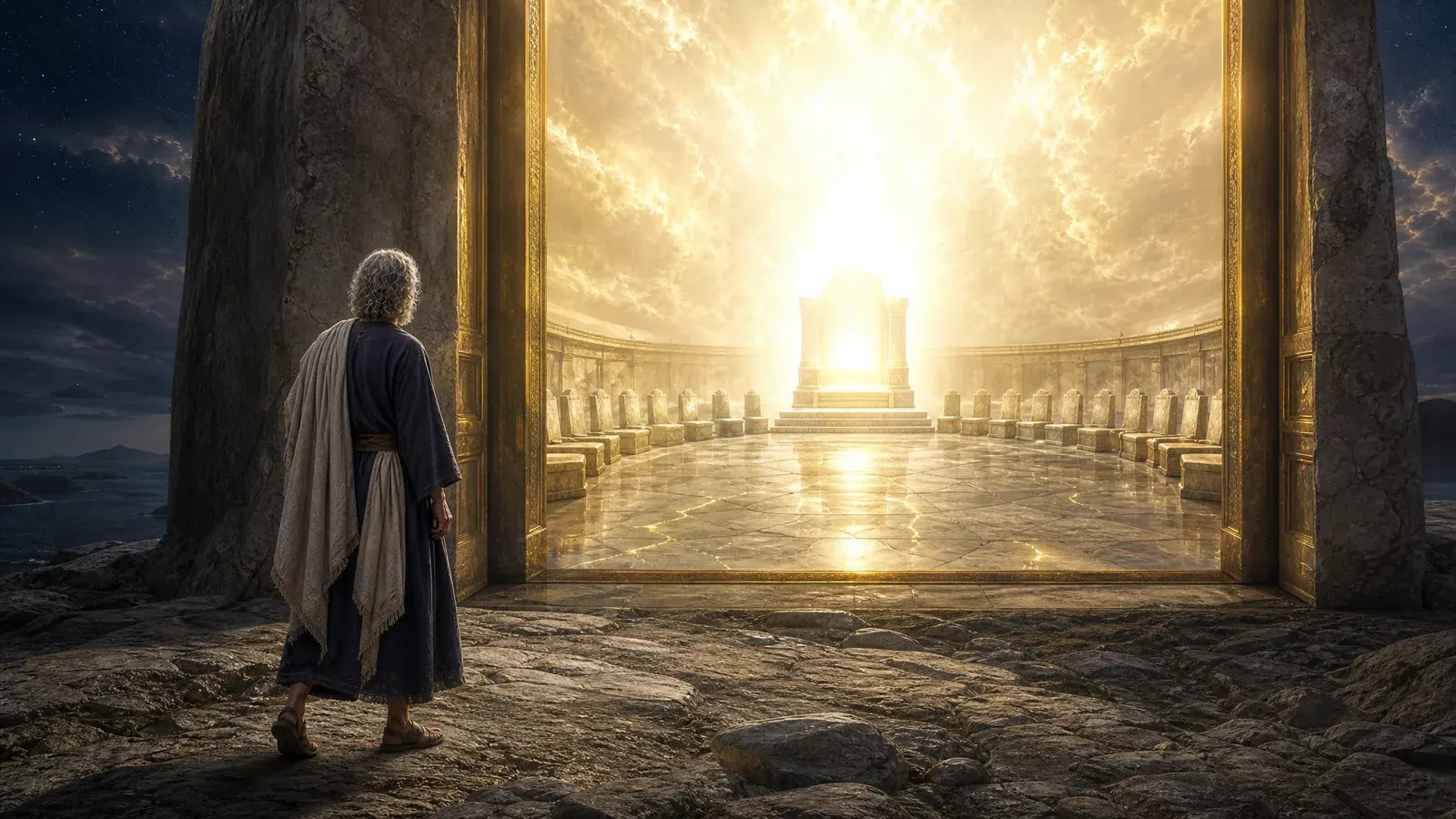
After the messages to the churches, the Book of Revelation opens a door in heaven and immediately centers the vision on a throne that is already occupied. Before any new judgment is shown, government is established. The seated one is described through jewel-like radiance and an emerald-looking rainbow rather than a physical portrait. Around the throne sit twenty-four crowned elders, while four living creatures full of eyes answer divine holiness without rest. Lightning, thunder, seven burning lamps, and a glasslike sea make the scene immense without making it chaotic. The elders repeatedly leave their own seats of dignity to fall before the greater throne and cast down their crowns. Their song explains God's worthiness through creation: all things exist by his will. The chapter prepares the question of worthiness in chapter 5 by first showing that every lesser honor in heaven remains oriented toward the Creator.
Central truth
Revelation 4 moves the reader through heaven's open door to one dominant reality: a throne occupied by the Creator, surrounded by ceaseless worship that gives him glory because all things exist by his will.
The study notes have a page of their own
The movement by movement analysis, the words to trace, the verse by verse notes and where readers differ are written for someone studying alone. They are on the Deep Personal Reflections page for this chapter. This page is the lesson.
A chapter-specific teaching brief
These anchors come from this chapter itself. They help a teacher use the Level 1 overview, the Level 2 study, and the Scripture text as one lesson.
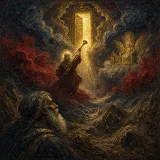
Open with the chapter’s first image
Revelation 4:1: “After this I looked, and, behold, a door was opened in heaven: and the first voice which I heard was as it were of a trumpet talking with me; which said…”
Slow down at the turning point
Revelation 4:1: “After this I looked, and, behold, a door was opened in heaven: and the first voice which I heard was as it were of a trumpet talking with me; which said…”
Keep this word trail visible
throne, beast, beasts, holy, round, twenty
What to explain, in order
Teach the passage in this order. Each step names the verses it rests on, so every point can be shown in the text before it is applied.
Revelation 4:1
A door opened in heaven
Begin with the phrase "After this I looked", which marks a new vision. On earth there were seven churches under pressure; now a door opens upward. Explain that this is the book's great change of perspective. Before anything happens to the world, John must see who is on the throne. Note the phrase "things which must be hereafter", which echoes 1:19, and tell the group that the four reading schools differ on what follows: whether it describes the first century, church history, the end of the age, or the ongoing pattern of every age. They all agree on what comes first, the throne.
Revelation 4:2-6a
Build the room around the throne
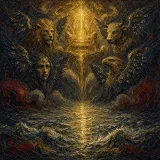
Draw the scene on the board as John describes it, starting with the throne at the centre and working outward. Notice what John does not describe: the one seated is never given a face, only the colour of precious stones. Explain jasper, sardine and emerald as brilliant gems, and the rainbow as a reminder of Genesis 9 and Ezekiel 1:28. The lightnings and thunderings recall Sinai in Exodus 19:16. The sea of glass suggests calm and distance. Teach this before the creatures speak, because the whole room exists to point at the throne, and the group should see that before they hear the worship.
Revelation 4:6b-8
Creatures who never stop
Read Ezekiel 1:5-10 and Isaiah 6:1-3 beside these verses. Revelation combines Ezekiel's four faces with Isaiah's six wings and threefold holiness. Explain that the KJV word "beasts" here means living creatures, not the beasts of chapters 13 and 17, which are a different Greek word. Many readers take the four faces as the whole of animate creation gathered in worship. Put the emphasis on what the creatures say rather than how they look: God is holy, almighty, eternal, and his praise continues day and night.
Revelation 4:9-11
Crowns before the throne
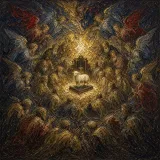
Show how worship moves. The creatures give glory, and the elders fall, worship and lay down their crowns. Explain the gesture as subjects acknowledging a sovereign: the crown they wear is held by permission. Then read the song of verse 11 and underline its reason, creation. Close by pointing ahead: in chapter 5 the same worshippers will sing to the Lamb for redemption, and the two songs together form the theology of the book. A church that knows God as Creator and the Lamb as Redeemer is ready to face what the seals will show.
Where learners get stuck
The misreadings this passage tends to produce, and how to answer each from the text.
"'Come up hither' is the rapture of the church, and the church is not mentioned again after chapter 3."
This is a reading held by many futurist interpreters, and it can be presented fairly. Verse 1 describes John being called up in vision to see the throne, and the text does not say the church is taken. Other readers note that the word church is absent after chapter 3 but God's people appear throughout as saints, servants and those who keep the testimony of Jesus (6:9, 7:3, 12:17). Teachers should present both readings and keep the chapter's own point central.
"The four beasts are evil creatures, like the beast later in the book."
The King James calls them "beasts", but these are living creatures around the throne who praise God without rest (4:8). They are drawn from Ezekiel 1 and Isaiah 6, where they are holy attendants of God. The beast of 13:1 is a different figure entirely, rising from the sea and opposing God. Explain the word plainly so that no learner imagines monsters in the throne room.
"We know exactly who the twenty-four elders are."
Revelation describes them, seated, in white, crowned, worshipping (4:4, 4:10), but never names them. Some readers take them as the people of God, twelve tribes and twelve apostles together, which fits 21:12-14. Others take them as a council of heavenly beings, which fits their role beside the angels. Some see the twenty-four divisions of priests in 1 Chronicles 24. Present the options honestly and let the elders' action, laying down crowns, be the lesson.
"Heaven sounds boring if all they do is say the same words over and over."
The chapter shows worship that never runs dry, not repetition from habit. The creatures "rest not day and night" (4:8) because what they see never ceases to be true. The worship also moves: the creatures' praise sets off the elders' prostration, and in chapter 5 the song grows until every creature joins (5:13). Help the group hear the scene as the fullest life there is, in the presence of the one for whose pleasure all things were made.
Learning objectives
- List the principal features surrounding the throne.
- Explain the living creatures' unending declaration.
- Describe the elders' response to divine glory.
- Identify the seven lamps and glassy sea.
- Connect verse 11's worship directly to creation.
- Distinguish vision description from a heavenly floor plan.
Teacher preparation
- Read Ezekiel 1 and Isaiah 6 for prophetic background.
- Mark every occurrence of 'throne' in Revelation 4.
- Sketch the scene with the throne firmly at the center.
- Do not let the gemstones become a geology exam.
- Note that verse 5 identifies the seven lamps.
Evidence and interpretation checks
Explicit
Verses 2 to 6 describe the throne, the one seated upon it, twenty-four seats and elders, lightning, voices, thunderings, seven lamps, and a glass-like sea.
Scripture-supported
Verse 8 gives the living creatures' repeated declaration of holiness, and verses 10 to 11 show the elders falling down, casting crowns, and praising the Creator.
Strong inference
The repeated use of throne and the movement of every surrounding figure toward worship strongly indicate that the chapter is organized around divine sovereignty rather than around the creatures themselves.
Possible or traditional reading
Interpreters have identified the twenty-four elders in several ways, including representatives of God's people or a heavenly council; Revelation 4 never names their identity directly.
Limit
The chapter does not provide a floor plan of heaven, explain every eye and wing symbol, or tell the reader to calculate a hidden code from the numbers.
Discussion with answer guidance
1. What changes when verse 1 says a door is opened in heaven and the voice says, 'Come up hither'?
What a good answer contains
The scene moves from earth to heaven. After the seven letters, "a door was opened in heaven" and the trumpet-like voice of 1:10 says, "Come up hither, and I will shew thee things which must be hereafter" (4:1). John is invited to see things from the throne's point of view. A strong answer stays with the change of viewpoint and the invitation to see. Some readers connect the summons with a later gathering of the church; the verse itself describes John's vision, and a teacher should say that this connection is an interpretation.
Show teacher guidance
Keep the answer to the scene change and invitation to see what follows; do not make John himself a proof text for a later event the verse does not name.
2. How many different throne-related features can the class locate in verses 2 to 6 before discussing what any of them might mean?
What a good answer contains
Before anyone asks what anything means, the group should find: a throne set in heaven and one seated on it (4:2), a jasper and sardine stone appearance and an emerald rainbow (4:3), twenty-four seats with elders in white and crowns of gold (4:4), lightnings, thunderings and voices, seven lamps of fire (4:5), a sea of glass like crystal and four living creatures (4:6). A good answer notices that every feature is placed in relation to the throne: on it, around it, out of it, before it. The word throne appears again and again on purpose.
Show teacher guidance
Require observation first: seated figure, rainbow, elders, lightning, voices, thunderings, lamps, and sea all arrange the scene around the throne.
3. What do the four living creatures say in verse 8, and which divine attributes or time statements appear in their words?
What a good answer contains
They say, "Holy, holy, holy, Lord God Almighty, which was, and is, and is to come" (4:8). Holiness is repeated three times, God is named Almighty, and his life spans past, present and future. A strong answer notes the echo of Isaiah 6:3 and observes that they "rest not day and night", so the worship never stops. It also notices that the time phrase repeats 1:4 and 1:8 with a different order, which ties the throne to the God who greeted the churches. A weak answer paraphrases the line into general praise.
Show teacher guidance
Expect triple holiness, Lord God Almighty, and the one which was, is, and is to come; read the line rather than paraphrasing it away.
4. What triggers the elders to fall down and cast their crowns in verses 9 and 10?
What a good answer contains
Verse 9 says "when those beasts give glory and honour and thanks to him that sat on the throne", and verse 10 follows: the elders "fall down before him", worship and "cast their crowns before the throne". One act of worship sets off another. A good answer sees that the elders have crowns of their own (4:4) and lay them down, so whatever honour they have is returned to the one who gave it. A weak answer treats the crowns as decoration and misses the gesture.
Show teacher guidance
Follow the grammar: when the creatures give glory, honor, and thanks, the elders answer with prostration, worship, and surrendered crowns.
5. Why is God called worthy in verse 11?
What a good answer contains
"Thou art worthy, O Lord, to receive glory and honour and power: for thou hast created all things, and for thy pleasure they are and were created" (4:11). The reason is creation. God is worthy because everything exists by his will and for his purpose. A strong answer keeps the word "for" in view; the song gives the ground of worship, not merely a feeling. It also prepares for 5:9, where the Lamb is worthy for a second reason, redemption. A weak answer offers a reason from elsewhere instead of the one the verse supplies.
Show teacher guidance
Keep creation at the center: all things were created by him and exist for his pleasure or will; the chapter supplies its own reason.
6. Which details does Revelation 4 explain, and which ones tempt us to pretend we know more than John says?
What a good answer contains
Revelation explains the seven lamps directly: they "are the seven Spirits of God" (4:5). It does not say who the twenty-four elders are, what the eyes or wings signify, or why the creatures have the faces they do. A good answer labels interpretations as interpretations: the elders may represent the twelve tribes with the twelve apostles, or a heavenly council; the four faces have been read as the strongest of wild animals, domestic animals, birds and humankind. A weak answer presents one of these as what the text says.
Show teacher guidance
Use the lamps as an explained example, then name elders, eyes, and some creature imagery as places where interpretation should be labeled rather than asserted as fact.
Responsible application
Put the throne back in the center
Organize difficult passages around what they reveal about God before chasing secondary details.
Practice surrendered honor
Use the elders' crown-casting to redirect recognition toward the Creator who gave it.
Creation has a purpose claim
Let verse 11 shape how learners speak about why created things exist.
Session plans
Two timings of the same lesson. The shorter keeps the reading, the central discussion and one response; the longer gives the confusions and the application their own time.
45 minutes
A door upward
Read 4:1 and ask question one. Contrast the setting of chapters 2 and 3 with this one.
Draw the room
Read 4:2-6a while one learner sketches. Ask question two before anyone interprets anything.
Holy, holy, holy
Read 4:6b-8 with Isaiah 6:3. Ask question three and take the confusion about the word beasts.
Crowns down
Read 4:9-11. Ask questions four and five and underline the reason in verse 11.
What we do not know, and the handout
Ask question six briefly, read the key verse together, give out the handout and pray in words from verse 11.
90 minutes
Where the book looks first
Ask what the group would expect a book about the end to show first. Read 4:1 and ask question one.
The rapture question
Take the first confusion and present the readings fairly. Point to 6:9, 7:3 and 12:17.
Draw the room
Read 4:2-6a, sketch the scene and ask question two. Read Exodus 19:16 and Ezekiel 1:26-28 beside it.
The living creatures
Read 4:6b-8 beside Ezekiel 1:5-10 and Isaiah 6:1-3. Ask question three and take the beasts confusion.
Elders and crowns
Read 4:9-11. Ask questions four and five, then the elders confusion. Talk about what a crown laid down means.
Labelled guesses
Ask question six. Sort the chapter's details into explained, interpreted, and unknown on three sheets.
Worship as response
Take the confusion about heaven being boring. Choose one application, read the key verse, give out the handout, and close by reading verse 8 and verse 11 aloud together.
Adapting the lesson
Children
Put a chair in the middle of the room and make it the throne. Let the children place a paper rainbow, seven lamps, a blue sheet for the sea of glass and four animal pictures around it. Have everyone say holy, holy, holy together. Give each child a paper crown and let them lay it down before the throne as they say thank you, God, for making everything.
Youth
Ask what they think is at the centre of the universe. Then read 4:2 and let the throne answer. Have them count how many times the word throne appears. Spend time on the crowns: what would it mean to lay down the thing you are proudest of. Keep speculation about the rapture brief and fair.
Adults
Use the Old Testament background fully: Exodus 19, Isaiah 6, Ezekiel 1 and Genesis 9. Present the interpretations of the elders and of 4:1 fairly and with labels. Discuss what it does to suffering believers to see the throne before the seals, and how worship of the Creator shapes the way a church faces its times.
One to one
Read the chapter slowly and ask the person to close their eyes and imagine the room. Then ask what they notice is missing: there is no anxiety in heaven. If they are carrying worry, end with verse 11 and pray it together. Leave the interpretive questions for another time unless they ask.
Song and video learning lab
A song or video may interpret, compress, or dramatize the text. Its value becomes clearer when its choices are compared with Scripture.
- Before the media: the exact passage and its central movement.
- During the media: the words, people, events, and emotions the artist emphasizes.
- After the media: what it clarifies, what it leaves out, and what belongs back in the biblical text.
Handout
One page for learners to take home. The print button prints this section alone.
Revelation 4
The passage in brief
In Revelation 4 a door opens in heaven and John sees a throne with God seated on it. Around the throne are twenty-four elders in white with crowns, seven lamps of fire, a sea like glass and four living creatures who never stop saying that God is holy. When the creatures give glory, the elders fall down and lay their crowns before the throne, praising God because he created all things.
A verse to keep
Thou art worthy, O Lord, to receive glory and honour and power: for thou hast created all things, and for thy pleasure they are and were created.
Revelation 4:11 · King James Version
Questions to take home
What is at the centre of everything John sees in heaven (4:2)?
What do the four living creatures say without stopping (4:8)?
Why do the elders lay down their crowns (4:10-11)?
This week
Begin each day this week by naming one thing God made and thanking him with the words of Revelation 4:11.
Music and video connected to the passage
Related media appears when its Scripture reference overlaps this study. Music and video can illuminate a theme while the biblical text remains the foundation.