Objects of the Bible

The crown of thorns

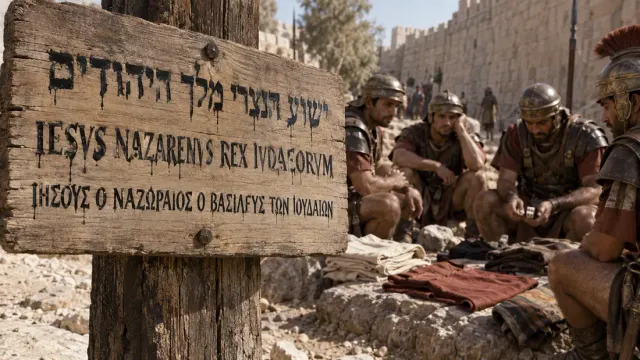
Part of a costume. The soldiers made a whole outfit, and the crown is the only piece anyone remembers.

Matthew and Mark describe it as a set. They stripped him, and put on him a scarlet robe, and when they had platted a crown of thorns, they put it upon his head, and a reed in his right hand. Robe, crown, sceptre. This is not improvised cruelty so much as a routine, and Roman soldiers stationed in a province had a well documented taste for mock coronations. The salute is part of it: hail, King of the Jews.

Where it appearsMatthew 27 · Mark 15 · John 19

Scroll down to the account
The crown of thorns

The movements, in the order the text gives them.

The Account of The crown of thorns

  1. 01

    Matthew 27:28-29

    A reed in his right hand

    The list is a coronation kit assembled from what a barracks had to hand, and the account names all three items.

    The crown has a whole outfit around it. A robe supplies the royal clothing, a reed occupies the right hand as a mock sceptre, and bent knees complete the false court. Matthew does not leave the purpose uncertain: they mocked him. The recognizable gestures of honor are being used to deliver contempt, and the thorns make the costume an instrument of pain.

    The reed is especially important because it does not remain a prop. In the next verse the soldiers take it and strike his head with it. What pretended to signify rule becomes the means of assault. The passage moves between those functions without changing the object. It also refuses any confusion about who is doing this: the governor's soldiers have gathered around their prisoner. The crown is not an unfortunate ornament someone placed on an otherwise solemn proceeding. It belongs to a deliberate performance of humiliation. The kneeling does not interrupt the violence. It is part of it.

    Verse by verse

    1. 27:28

      Matthew calls the robe scarlet; Mark 15:17 and John 19:2 describe purple. The accounts should retain their own color terms.

    2. 27:29

      Platted means woven or twisted together. The verse does not identify the plant species or give the crown's precise shape.
    Matthew 27:28-29

    King James Version · 2 verses

    27:28And they stripped him, and put on him a scarlet robe.

    27:29And when they had platted a crown of thorns, they put it upon his head, and a reed in his right hand: and they bowed the knee before him, and mocked him, saying, Hail, King of the Jews!

    Matthew 27:28-29: A reed in his right hand
  2. 02

    Mark 15:18-19

    They began to salute him, Hail, King of the Jews

    The mockery uses the correct formula, which is what makes it work as mockery and, in the account, as something else.

    Worshipped him is the most disturbing verb in the sentence because it comes after the blows and the spitting. Here it does not describe faith suddenly appearing among the soldiers. It describes bodily homage turned into mockery. Their knees bend while the rest of their conduct denies the honor the posture ordinarily expresses.

    Mark keeps greeting, striking, spitting and kneeling in the same small space. The result is not a dignified coronation spoiled by one outburst of rough treatment. The whole arrangement is abusive. Even the salutation King of the Jews is being spoken as an insult, though it carries a royal title the Gospel takes seriously. That double significance does not excuse the men using it. Nor does the passage ask for an invented speech from Jesus or a reconstruction of every wound. The recorded actions are sufficient. The soldiers know how homage looks, and they reproduce its appearance while doing the opposite of honoring the person before them.

    Verse by verse

    1. 15:18

      The salutation belongs to the mockery explicitly identified in Mark 15:20. It is not a confession of allegiance.

    2. 15:19

      Worshipped here describes the act of bowing in feigned homage. Context determines that the posture is derisive.

    Mark 15:18-19

    King James Version · 2 verses

    15:18And began to salute him, Hail, King of the Jews!

    15:19And they smote him on the head with a reed, and did spit upon him, and bowing their knees worshipped him.

    Mark 15:18-19: They began to salute him, Hail, King of the Jews
  3. 03

    John 19:1-3

    Then Pilate therefore took Jesus, and scourged him

    John places the flogging inside the hearing, which makes it a tactic rather than a preliminary to execution.

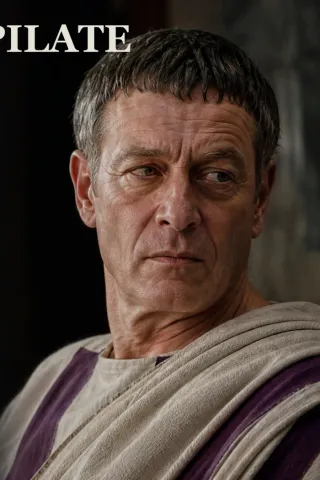
    Pilate's name opens the sentence about the scourging. The soldiers then take over the action, but the governor does not disappear from responsibility merely because other hands carry it out. John puts official custody and physical abuse together before the repeated declarations that no fault has been found in Jesus. The contrast is not subtle: a prisoner declared without fault is already being punished.

    The crown and purple robe add ridicule to the scourging rather than replacing it. The soldiers address a king and strike the man they have dressed as one. John gives no measurements of the thorns and no count of lashes. Such additions can make a vivid reconstruction while moving beyond the evidence. His own account is spare and devastating enough: the authority presiding over the case has delivered the body into violence, and the men handling that body make its royal claim their entertainment. The clothing changes the display. It does not make the prisoner less exposed to their hands.

    Verse by verse

    1. 19:1

      Pilate is responsible for the scourging in John's wording; the sentence does not require imagining him personally wielding the whip.

    2. 19:2-3

      The passage names a purple robe, a thorn crown and blows from the soldiers' hands. It gives no number of blows or botanical identification.

    John 19:1-3

    King James Version · 3 verses

    19:1Then Pilate therefore took Jesus, and scourged him.

    19:2And the soldiers platted a crown of thorns, and put it on his head, and they put on him a purple robe,

    19:3And said, Hail, King of the Jews! and they smote him with their hands.

    John 19:1-3: Then Pilate therefore took Jesus, and scourged him
  4. 04

    John 19:5

    Behold the man

    The display is meant to close the case by exhausting the appetite for it, and the crowd does not accept the offer.

    The crown is still on when Jesus is brought outside. What happened among the soldiers now becomes part of a public presentation, and John names both the thorns and the purple robe before recording Pilate's words. Behold the man directs attention not merely to a case under discussion, but to the person who has been made to wear its mockery.

    Pilate has just said he finds no fault in him. That statement and this appearance belong together: the man being presented as unconvicted has already been scourged and struck. The verse does not explain Pilate's inner calculation, and pity, contempt and tactical display should not be asserted as though one were supplied in the sentence. Its visible facts do not need that help. The governor presents the prisoner in the soldiers' regalia, and the next response is a demand for crucifixion. The crown remains a cruel claim about who Jesus is while the proceedings decide what to do with him.

    Verse by verse

    1. 19:5

      Wearing explicitly establishes that the crown and robe remain on Jesus at this presentation.

    2. 19:5

      The Greek phrase is idou ho anthropos, behold the man. The verse gives the words, not an explanation of Pilate's intended emotional effect.

    John 19:5

    King James Version · 1 verse

    19:5Then came Jesus forth, wearing the crown of thorns, and the purple robe. And Pilate saith unto them, Behold the man!

    John 19:5: Behold the man
  5. 05

    Matthew 27:31

    They took the robe off from him, and put his own raiment on him

    The costume is removed before the execution. The crown is the only part the gospels do not say was taken off.

    His own clothes come back, but his freedom does not. The soldiers remove the robe that served their mockery and restore the garments in which they will take him to execution. The ordinary detail is grim precisely because the change is so practical. A costume can be put away while the violence continues without interruption.

    Matthew marks the end of the mocking episode, not the end of the humiliation. They lead him away to crucify him, a purpose stated without softening. The passage does not report removal of the crown, and silence should not be made to prove either that it was removed or that it certainly remained throughout the crucifixion. The text follows the clothing it actually names. Those garments will later be divided in Matthew 27:35, so even the brief restoration of his own raiment does not become lasting possession. The soldiers finish with their royal outfit. They are not finished with the man they dressed in it.

    Verse by verse

    1. 27:31

      His own raiment contrasts Jesus' clothing with the robe supplied for the mockery.

    2. 27:31

      The robe is expressly removed. The verse does not state when, or whether at this point, the crown is removed.

    Matthew 27:31

    King James Version · 1 verse

    27:31And after that they had mocked him, they took the robe off from him, and put his own raiment on him, and led him away to crucify him.

    Matthew 27:31: They took the robe off from him, and put his own raiment on him

Why it matters

John puts the crown somewhere different and it changes what it is doing. In his account the scourging and the crown come in the middle of the trial rather than after the sentence, and Pilate brings him out still wearing both: then came Jesus forth, wearing the crown of thorns, and the purple robe. And Pilate saith unto them, Behold the man. It reads as an attempt to make the crowd feel the case is closed, a man already ruined being displayed as sufficiently punished. It does not work, and the next sentence is crucify him.

4 songs

The music

Every song in the catalogue whose passage falls inside these chapters.

  1. Matthew 27:1-31; Mark 15:1-20; Luke 22:63-23:25; John 18:28-19:16

    Behold the Man

  2. Matthew 27:27-56

    The Veil Was Torn

  3. Mark 15:1-20

    Before Pilate

  4. John 19:1-37

    It is Finished

    Play here
    Open song pageRead lyrics

Nearby

All the objects

Report an error on this page