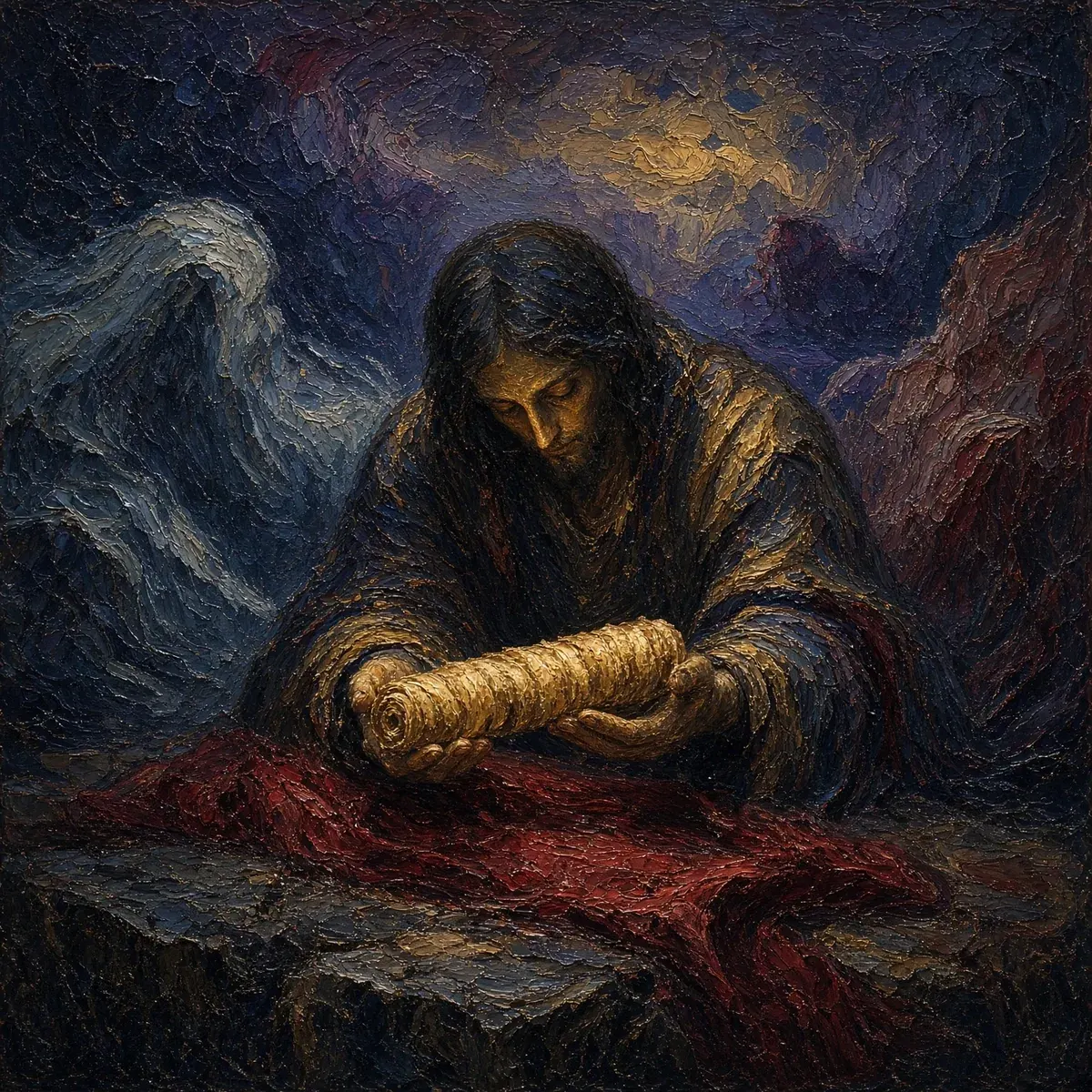
Objects of the Bible

The scroll Ezekiel ate

It was written on both sides with lamentations and mourning and woe, and it tasted like honey.

A hand is put out towards him holding a roll of a book, and it is spread out in front of him so he can see what is on it before he is asked to do anything. It is written within and without, which is unusual, since scrolls were normally written on one side only, and the contents are given in three words: lamentations, and mourning, and woe. Then the instruction. Eat this roll, and go speak unto the house of Israel.

Where it appearsEzekiel 2 to 3 · Revelation 10

Scroll down to the account
The scroll Ezekiel ate

The movements, in the order the text gives them.

The Account of The scroll Ezekiel ate

  1. 01

    Ezekiel 2:9-10

    It was written within and without

    Scrolls were written on one side. This one is full on both, which says there is more to deliver than will fit.

    The prophet is handed no blank page. The roll arrives already written, and when it is spread before him, writing appears on both sides. Ezekiel does not begin by supplying material for a message. He is shown the material he must receive. The order of events puts the origin of the words outside the man who will speak them.

    Within and without is quite physical language here. The Hebrew says front and back, not a hidden spiritual meaning behind an outward one. The object is a scroll, and both its surfaces bear writing. Lamentations, mourning, and woe name its contents. The Book of Ezekiel does not transcribe the scroll line by line, but it leaves no uncertainty about the burden of what is written. This is not a pleasant message wrapped in intimidating packaging.

    The preceding command gives the object its personal edge for Ezekiel: he must not become rebellious like the people to whom he is sent (2:8). Before their willingness to hear becomes the issue, his own reception of the word is at issue. The hand brings a message of judgment to the messenger first. He is not exempt from having to receive it.

    Verse by verse

    1. 2:9

      Roll of a book describes a scroll. The Hebrew expression uses megillah, a roll, with sefer, a written document or book.

    2. 2:10

      The Hebrew panim and ahor identify the front and back. Within and without refers to the written surfaces, not two levels of interpretation.

    3. 2:10

      Lamentations, mourning, and woe describe the contents. The verse does not supply the complete wording or identify the material from which the scroll was made.


    Ezekiel 2:9-10

    King James Version · 2 verses

    2:9And when I looked, behold, an hand was sent unto me; and, lo, a roll of a book was therein;

    2:10And he spread it before me; and it was written within and without: and there was written therein lamentations, and mourning, and woe.

    Ezekiel 2:9-10: It was written within and without
  2. 02

    Ezekiel 3:1-2

    Eat this roll, and go speak

    The order of operations is the whole instruction. Eating comes before speaking, and he opens his mouth before he understands.

    The first assignment given to this spokesman is not a speech. It is a meal. Eat this roll comes before go speak, and that sequence is the center of the action. The mouth that will deliver the message must first receive it. The words are not merely placed in Ezekiel's hand as something to carry; they enter the man himself.

    The response is brief enough to be missed: he opens his mouth, and the one addressing him causes him to eat. Both actions matter. Ezekiel does not manufacture the scroll, and he is not described as composing the terms of his commission. He responds to a gift whose contents and destination have already been specified. The contrast with the rebellious house in 2:8 is immediate: at this point the appointed speaker receives what his intended hearers are warned against refusing.

    The destination also prevents the unusual action from becoming an isolated spectacle. He is to speak to the house of Israel, and the next verses distinguish that assignment from a mission among people whose language he cannot understand (3:4-7). The difficulty will not be finding the correct vocabulary. The words will be intelligible. Acceptance is another matter.

    Verse by verse

    1. 3:1

      Son of man is the address to Ezekiel, emphasizing the human recipient of the commission. It should not automatically be assigned every meaning that the phrase carries in other biblical settings.

    2. 3:1

      Eating precedes speaking in the command. Ezekiel 3:10 later expresses reception through the heart and ears as well.

    3. 3:2

      Ezekiel opens his mouth, while the one giving the command causes him to eat. The wording preserves the prophet's response and the divine initiative together.

    Ezekiel 3:1-2

    King James Version · 2 verses

    3:1Moreover he said unto me, Son of man, eat that thou findest; eat this roll, and go speak unto the house of Israel.

    3:2So I opened my mouth, and he caused me to eat that roll.

    Ezekiel 3:1-2: Eat this roll, and go speak
  3. 03

    Ezekiel 3:3

    It was in my mouth as honey for sweetness

    The taste contradicts the contents, and the text offers no explanation, which leaves the reader to make the connection.

    The contents have not changed. The roll still bears lamentations, mourning, and woe, yet its taste is honey. That contrast is what makes the verse arresting. Turning the scroll into a collection of comforting promises would remove the very detail that needs explaining: a severe word can be sweet in the prophet's mouth without ceasing to be severe.

    The command is bodily and emphatic. Belly and bowels name the interior that is to be filled, not merely the lips that will form the sentences. Ezekiel is not asked to take a polite taste and set the remainder aside. In the vision, the message is received inwardly and fully. Its sweetness belongs to that reception; the text does not say that he enjoys the suffering announced by its words.

    The qualification in my mouth also deserves its full weight. Later, Ezekiel goes in bitterness and in the heat of his spirit (3:14). The book can place those experiences together without allowing either to cancel the other. The word is received as sweet, and the commission remains heavy. Honey does not turn the lamentations into a different message.

    Verse by verse

    1. 3:3

      Belly and bowels name bodily inward parts. Their pairing emphasizes inward reception rather than a passing taste.

    2. 3:3

      As honey is a comparison of taste. The verse does not say that the writing was replaced by honey or that the announced judgments disappeared.

    3. 3:3

      Ezekiel reports sweetness in his mouth, but not bitterness in his belly here. The latter is explicit in John's account in Revelation 10:9-10.

    Ezekiel 3:3

    King James Version · 1 verse

    3:3And he said unto me, Son of man, cause thy belly to eat, and fill thy bowels with this roll that I give thee. Then did I eat it; and it was in my mouth as honey for sweetness.

    Ezekiel 3:3: It was in my mouth as honey for sweetness
  4. 04

    Ezekiel 3:14-15

    I sat where they sat, and remained there astonished seven days

    The first act of a commissioned prophet is a week of silence among the people he was sent to.

    The mouth has tasted honey; the man now goes in bitterness. The Book of Ezekiel refuses to let the sweetness of the scroll become an account of effortless enthusiasm. Heat and bitterness are his own stated experience, not feelings that need to be invented for him. Their exact object is not identified. The verse does not settle whether his anguish is directed toward the people's rebellion, the burden of the commission, or another aspect of what he has received.

    What it does make definite is the hand of the LORD: strong upon him. The spirit takes him away, and divine power remains active while his own spirit is heated. He is neither untouched by the commission nor left to carry it on the strength of a pleasant feeling. The movement brings him to fellow captives, not to a platform above them.

    I sat where they sat. After the noise of wings and wheels in verses 12-13, the account becomes strikingly still. Seven days pass with Ezekiel among the exiles, astonished. No inaugural speech is recorded here. Only after the seven days does the word appoint him as a watchman (3:16-17). Before that charge, there is the place they occupy together.

    Verse by verse

    1. 3:14

      The Hebrew ruach appears in the spirit that lifts Ezekiel and in my spirit. The repeated word should not erase the distinction between the carrying power and the prophet's own state.

    2. 3:14

      Heat translates a term associated with heat or anger. The verse identifies Ezekiel's bitterness but does not name a single, explicit target for it.

    3. 3:15

      Astonished here conveys being stunned or overwhelmed, not merely curious. The Hebrew form is from shamem.

    4. 3:15

      Telabib is the settlement of captives by the Chebar in this account. Ezekiel 1:3 places the Chebar setting in the land of the Chaldeans.

    5. 3:15

      The watchman commission follows at the end of the seven days in 3:16-17. The passage gives the duration without explaining it as a particular consecration or mourning ceremony.

    Ezekiel 3:14-15

    King James Version · 2 verses

    3:14So the spirit lifted me up, and took me away, and I went in bitterness, in the heat of my spirit; but the hand of the LORD was strong upon me.

    3:15Then I came to them of the captivity at Tel-abib, that dwelt by the river of Chebar, and I sat where they sat, and remained there astonished among them seven days.

    Ezekiel 3:14-15: I sat where they sat, and remained there astonished seven days
  5. 05

    Revelation 10:9-10

    It shall make thy belly bitter, but it shall be in thy mouth sweet as honey

    The later vision gives both halves of the same experience, and warns about the second one in advance.

    John is told the aftertaste before he takes the book. The angel names the bitterness in the belly first, then the honey in the mouth; John's report follows the order of experience, sweet in the mouth and bitter once eaten. The warning and its fulfillment are placed in deliberate proximity. Nothing has gone wrong with the instructions when the bitterness arrives.

    The echo of Ezekiel is unmistakably physical: a book received, an order to eat, and sweetness like honey in the mouth. But Revelation supplies a distinction that should not be read backward into Ezekiel 3:3. John explicitly describes a bitter belly. Ezekiel described a sweet mouth and later a bitter, heated spirit. The connection is strong enough without making their wording interchangeable.

    John receives both experiences from one little book, not from separate comforting and distressing volumes. The next verse ties the eating to a renewed prophetic task before many peoples, nations, tongues, and kings. This is not a private tasting detached from speech. The message enters its bearer before he is sent to speak again. The honey is real. So is what follows it.

    Verse by verse

    1. 10:9

      The heavenly voice in 10:8 first directs John to take the open little book. His request to the angel follows that instruction.

    2. 10:9

      The book is already described as open in 10:2 and 10:8. Identifying it with the seven-sealed book of Revelation 5 is an interpretive proposal, not an identification made in these verses.

    3. 10:10

      The Greek pikraino expresses making bitter, while glyky describes sweetness. The contrasting tastes belong to the same act of receiving the little book.

    4. 10:10

      The verse locates bitterness in the belly after the eating. The explanation should preserve that bodily detail rather than replacing it with an invented sequence of private emotions.

    Revelation 10:9-10

    King James Version · 2 verses

    10:9And I went unto the angel, and said unto him, Give me the little book. And he said unto me, Take it, and eat it up; and it shall make thy belly bitter, but it shall be in thy mouth sweet as honey.

    10:10And I took the little book out of the angel’s hand, and ate it up; and it was in my mouth sweet as honey: and as soon as I had eaten it, my belly was bitter.

    Revelation 10:9-10: It shall make thy belly bitter, but it shall be in thy mouth sweet as honey

Why it matters

He obeys and reports the taste, and the taste is the surprise: then did I eat it; and it was in my mouth as honey for sweetness. Nothing in the contents accounts for that. The point of the image is that the message has to go inside the messenger before it goes out of him, and the sweetness is about the source rather than the subject. Immediately afterwards he goes to the exiles at Telabib and sits among them for seven days saying nothing. Centuries later John is given a little book with the same instruction and gets both halves: sweet in the mouth, bitter in the belly.

4 songs

The music

Every song in the catalogue whose passage falls inside these chapters.

  1. Ezekiel 1-3

    Wheels Within Wheels

  2. Ezekiel 2:1-3:27

    Eat This Roll

  3. Revelation 10:1–11:19

    The Little Book and the Two Witnesses

  4. Revelation 10:1-11

    The Little Book, Sweet and Bitter

Nearby

All the objects

Report an error on this page