Objects of the Bible

The widow’s jar of oil

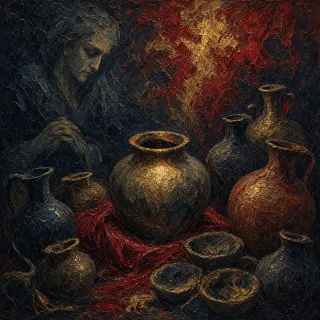
There are two of them, one that never empties and one that stops only when the borrowed jars run out.

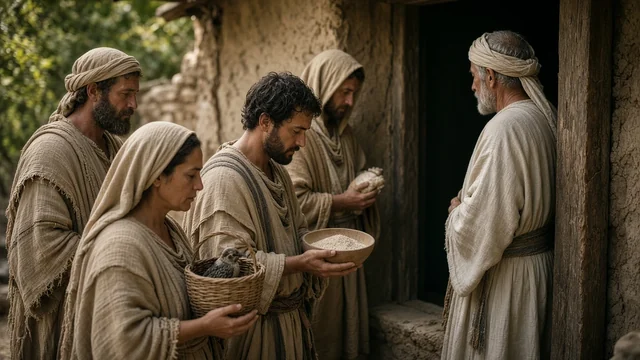
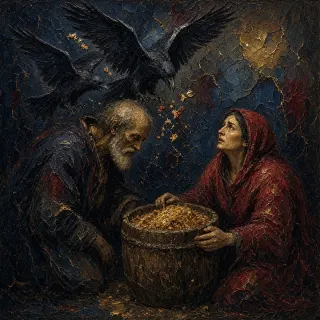
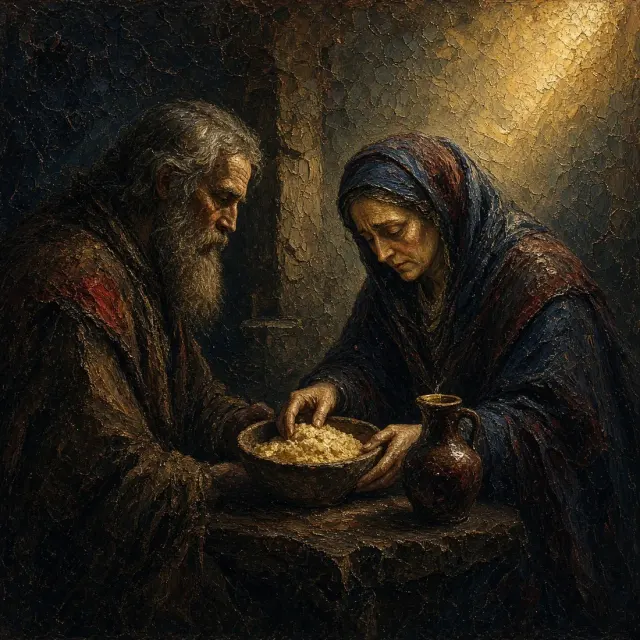
The first belongs to a widow in Zarephath, which is Gentile territory, and she is gathering sticks to cook a last meal for herself and her son before they die. Elijah asks for it first, which reads badly until the promise arrives with it: the barrel of meal shall not waste, neither shall the cruse of oil fail, until the day that the LORD sendeth rain upon the earth. She feeds him, and the account says she and he and her house did eat many days.

Where it appears1 Kings 17 · 2 Kings 4

Scroll down to the account
The widow’s jar of oil

The movements, in the order the text gives them.

The Account of The widow’s jar of oil

  1. 01

    1 Kings 17:10-12

    That we may eat it, and die

    She states her situation without pleading. The request made of her is the last thing she has, and she says so plainly.

    The woman appointed to feed the prophet has almost nothing to cook. Verse 9 has already announced that God commanded a widow at Zarephath to sustain Elijah; verse 12 supplies the inventory. A handful of flour. A little oil. Two sticks. The promise has brought him to a household preparing for its last meal, not to a hidden storehouse untouched by famine.

    The conversation narrows by stages. She is willing to fetch water, and only the added request for bread brings out the extent of her need. I have not a cake is literal in its immediate setting: there is no prepared bread to hand over. There are ingredients for one final act of cooking. Her sentence ends with death, without decoration. The Book of First Kings does not need to invent tears to make those quantities terrible.

    The jar matters because it is not yet an emblem of abundance. It is the measure of what is running out. And Elijah arrives as another person needing food. Divine provision in this passage begins with two needs meeting at a city gate: the prophet's and the widow's, the very woman appointed to sustain him. Neither arrives with a storehouse capable of solving the other's hunger.

    Verse by verse

    1. 17:10

      Zarephath is placed in Sidonian territory by 17:9; Luke 4:26 calls it Sarepta.

    2. 17:12

      Meal here means flour. The Hebrew kad behind barrel is a jar, not a specification for a wooden cask.

    3. 17:12

      Dress it means prepare it for eating. No prepared cake is available when Elijah asks.
    1 Kings 17:10-12

    King James Version · 3 verses

    17:10So he arose and went to Zarephath. And when he came to the gate of the city, behold, the widow woman was there gathering of sticks: and he called to her, and said, Fetch me, I pray thee, a little water in a vessel, that I may drink.

    17:11And as she was going to fetch it, he called to her, and said, Bring me, I pray thee, a morsel of bread in thine hand.

    17:12And she said, As the LORD thy God liveth, I have not a cake, but an handful of meal in a barrel, and a little oil in a cruse: and, behold, I am gathering two sticks, that I may go in and dress it for me and my son, that we may eat it, and die.

    1 Kings 17:10-12: That we may eat it, and die
  2. 02

    1 Kings 17:14-16

    The barrel of meal shall not waste

    The promise is tied to a weather event rather than to a period of time, and the account confirms it in one sentence.

    The miracle is described by what does not happen. The flour does not run out; the oil does not fail. There is no inventory of newly delivered sacks, no account of jars filling the courtyard, and no sudden change of household into palace. The same ordinary supplies continue doing what, by the previous verse's arithmetic, they could not continue to do.

    Until is an important word. The promise addresses the drought and lasts to the return of rain. It is not a statement that this particular vessel will produce oil forever. The LORD God of Israel, named at the beginning of the assurance, governs the weather outside and the provisions inside a house in Sidonian territory. The boundaries of Israel are not boundaries on that authority.

    Verse 16 closely repeats verse 14, moving the promise into the record of its fulfillment. Between them sits the unshowy evidence: she, and he, and her house, did eat many days. The woman who had expected one meal before death now has a sequence of meals. The extraordinary thing is not an extravagant menu. It is the next day.

    Verse by verse

    1. 17:14

      Shall not waste means shall not be exhausted, not that flour must never be discarded.

    2. 17:14

      Until the day of rain states the promise's relation to the drought; it does not describe an endlessly productive heirloom.

    3. 17:16

      According to the word of the LORD attributes the provision to the divine promise spoken through Elijah.

    1 Kings 17:14-16

    King James Version · 3 verses

    17:14For thus saith the LORD God of Israel, The barrel of meal shall not waste, neither shall the cruse of oil fail, until the day that the LORD sendeth rain upon the earth.

    17:15And she went and did according to the saying of Elijah: and she, and he, and her house, did eat many days.

    17:16And the barrel of meal wasted not, neither did the cruse of oil fail, according to the word of the LORD, which he spake by Elijah.

    1 Kings 17:14-16: The barrel of meal shall not waste
  3. 03

    2 Kings 4:2

    Thine handmaid hath not any thing in the house, save a pot of oil

    The inventory is taken before anything is promised, and the miracle starts from what was already there.

    Nothing in the house, save a pot of oil. The exception is small, but the whole account turns on it. Elisha's question draws attention away from what the creditor intends to take and toward what remains in the widow's possession. He does not begin by asking her to explain why she became poor. The text has already supplied the fact that makes the crisis especially stark: her husband feared the LORD, and he is dead.

    This is not the widow at Zarephath. That woman speaks with Elijah during famine and has a son. This woman appeals to Elisha, belongs to a prophetic household, and faces losing two sons into debt service. The likeness of the oil must not erase the differences between the households. Here the immediate danger is not simply an empty plate. It is a family about to be broken apart by a claim for payment.

    The oil has not yet multiplied, and the prophet's question is not a general formula for turning possessions into wealth. It is the opening of a specific intervention. One remaining household resource is brought into view before the account addresses the creditor's claim.

    Verse by verse

    1. 4:2

      The Hebrew asukh names the oil vessel here; the verse does not state its capacity or the oil's quantity.

    2. 4:2

      The family belongs to the sons of the prophets according to 4:1, a prophetic community rather than a statement of biological descent.

    3. 4:2

      The husband and creditor are unnamed; identifying either requires information not supplied by this account.

    2 Kings 4:2

    King James Version · 1 verse

    4:2And Elisha said unto her, What shall I do for thee? tell me, what hast thou in the house? And she said, Thine handmaid hath not any thing in the house, save a pot of oil.

    2 Kings 4:2: Thine handmaid hath not any thing in the house, save a pot of oil
  4. 04

    2 Kings 4:3-4

    Borrow not a few

    The instruction is about logistics. The size of the outcome is set by an act of borrowing done in advance.

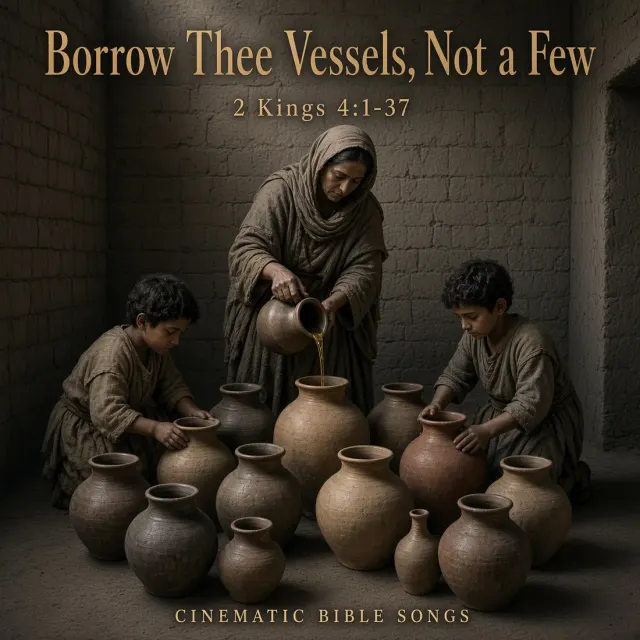
    Empty vessels are the requested contribution. The neighbors are not told to surrender their oil; they are asked to lend the space in which oil can be received. Borrow not a few is wonderfully practical language for instructions that ordinary arithmetic cannot explain. The widow has one source and is told to prepare many destinations.

    The order is exact: gather, enter, shut the door, pour, set aside the full vessels. Her sons are inside with her. The children threatened with removal from the household become participants in its provision, bringing containers while their mother pours. Elisha gives the instructions but is not described as standing over the operation. The visible work belongs to this family behind its own door.

    The shut door should not be turned into a secret technique for reproducing miracles. Its immediate effect in the account is simpler: this is not staged as a public exhibition. The neighbors' role and the family's role are different, and neither requires a crowd gathered to admire the prophet. The command takes a household with almost nothing and gives it the peculiar task of finding enough room for what is coming from one pot.

    Verse by verse

    1. 4:3

      Abroad means outside the home, among the neighbors; it does not mean borrowing in a foreign country.

    2. 4:3

      The vessels are borrowed empty. No exact number or standard capacity is given.

    3. 4:4

      The sons participate in the pouring operation according to 4:5; the account does not place Elisha inside with them.

    2 Kings 4:3-4

    King James Version · 2 verses

    4:3Then he said, Go, borrow thee vessels abroad of all thy neighbours, even empty vessels; borrow not a few.

    4:4And when thou art come in, thou shalt shut the door upon thee and upon thy sons, and shalt pour out into all those vessels, and thou shalt set aside that which is full.

    2 Kings 4:3-4: Borrow not a few
  5. 05

    2 Kings 4:6-7

    The oil stayed

    It stops when the last vessel is full, and the proceeds are directed first at the debt and then at living on the rest.

    The last shortage is not oil. It is another vessel. That reversal is the hinge of the scene: the family begins with almost nothing to pour and finishes with nowhere left to pour it. The oil stayed means that its flow stopped, not that the filled vessels emptied again. The accumulated provision remains available for the purpose Elisha now names.

    His instructions are as concrete as the original danger. Sell. Pay. Live. The debt is addressed, and the remainder supports the widow and her children. The passage does not end merely with a spectacular quantity of oil. It ends with a household given the means to satisfy a creditor without surrendering its sons, and then to continue living.

    Nothing in the account rebukes the widow for failing to borrow more containers or suggests that the stopping proves inadequate faith. Every vessel mentioned has been filled. At Zarephath, the supply continues through the famine; here the pouring stops when the borrowed space is full. The two miracles have different shapes, but neither makes the container the final point. The oil serves the people.

    Verse by verse

    1. 4:6

      Stayed means ceased or stopped flowing; it does not mean that the oil vanished.

    2. 4:6

      The text reports no vessel remaining. It does not blame the widow for the number she borrowed.

    3. 4:7

      The remainder is explicitly for the widow and her children to live on after the debt is paid.

    2 Kings 4:6-7

    King James Version · 2 verses

    4:6And it came to pass, when the vessels were full, that she said unto her son, Bring me yet a vessel. And he said unto her, There is not a vessel more. And the oil stayed.

    4:7Then she came and told the man of God. And he said, Go, sell the oil, and pay thy debt, and live thou and thy children of the rest.

    2 Kings 4:6-7: The oil stayed

Why it matters

The second belongs to a prophet’s widow whose creditor is coming for her two sons. Elisha asks what she has in the house and the answer is not one jar of oil, but a pot of oil. The instruction is strange and entirely practical: borrow vessels abroad of all thy neighbours, even empty vessels, borrow not a few. Then shut the door. The oil stops when the vessels do, and the limit on the miracle turns out to have been set by how many jars she was willing to ask for.

3 songs

The music

Every song in the catalogue whose passage falls inside these chapters.

  1. 1 Kings 16:29-17:24

    The Ravens and the Widow's Barrel

  2. 1 Kings 17

    The Widow's Last Measure

  3. 2 Kings 4:1-37

    Borrow Thee Vessels, Not a Few

Nearby

All the objects

Report an error on this page