The big picture
Israel, the father whose sons give their names to the tribes, heads this chapter. The list then follows Judah, one of those sons, through many branches. David, a later king, appears within this family rather than at the beginning of it. Women, servants, childless men, and families linked with towns also receive names. The chapter gives the family setting for later royal history while keeping other lines of Judah’s descendants in view.
In this chapter
- Judah’s Sons Include Troubled Lives 1 Chronicles 2:1-8
All twelve sons of Israel are named before the account turns to Judah.
- One Branch Leads to David 1 Chronicles 2:9-17
Hezron’s sons include Ram, whose line leads toward David.
- Marriage Links Families and Land 1 Chronicles 2:18-24
Caleb’s family is traced through wives and children, including Hur’s line to Bezaleel.
- A Daughter Continues Sheshan’s Line 1 Chronicles 2:25-41
Jerahmeel’s family branches through sons born to different wives.
- Families Are Linked with Settlements 1 Chronicles 2:42-55
More of Caleb’s descendants appear, including children of concubines, partners with lower standing than wives.
Central truth
Judah’s family record includes the royal line, but also preserves other branches, difficult memories, and links with towns.
Scripture beside the summary
1 Chronicles · King James Version · 551 Chronicles 2:1-8
Judah’s Sons Include Troubled Lives
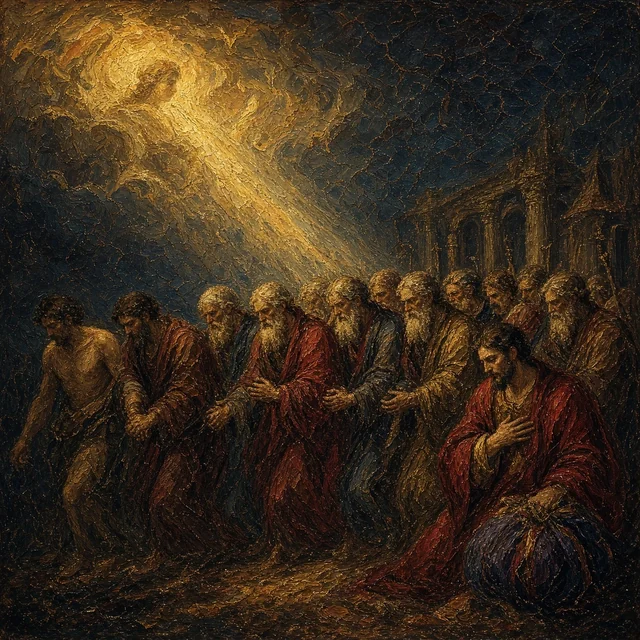
All twelve sons of Israel are named before the account turns to Judah. Three of Judah’s sons are born to the daughter of Shua. His firstborn, Er, is evil in God’s sight, and God kills him. Tamar, Judah’s daughter-in-law, bears him Pharez and Zerah. The list then names descendants from those two sons. It also recalls Achar, who brought trouble on Israel by taking what was forbidden. The family record does not hide shame or wrong because these people belong to an important line.
In everyday life
The careful researcher reads a sealed note beside an old portrait album in a dusty attic. She finds a painful relationship that older charts left unnamed. She records the link without turning the hurt into a tale for the gathering. The page becomes more honest, though harder to read. This careful record cannot measure God’s judgement on the named wrongs.
Notice
1 Chronicles 2:7 Achar’s wrongdoing appears beside his family link. The list preserves what he did to the people, not merely the fact that he belonged among them.
1 Chronicles 2:1-8
King James Version1These are the sons of Israel; Reuben, Simeon, Levi, and Judah, Issachar, and Zebulun,
2Dan, Joseph, and Benjamin, Naphtali, Gad, and Asher.
3The sons of Judah; Er, and Onan, and Shelah: which three were born unto him of the daughter of Shua the Canaanitess. And Er, the firstborn of Judah, was evil in the sight of the LORD; and he slew him.
4And Tamar his daughter in law bare him Pharez and Zerah. All the sons of Judah were five.
5The sons of Pharez; Hezron, and Hamul.
6And the sons of Zerah; Zimri, and Ethan, and Heman, and Calcol, and Dara: five of them in all.
7And the sons of Carmi; Achar, the troubler of Israel, who transgressed in the thing accursed.
8And the sons of Ethan; Azariah.
1 Chronicles 2:9-17
One Branch Leads to David
Hezron’s sons include Ram, whose line leads toward David. Through several generations the list reaches Boaz, Obed, and Jesse. Jesse’s sons are then named in order, with David seventh. His sisters Zeruiah and Abigail also appear. Their sons include men who belong to the same wider family as David. The account therefore gives more than a straight line of fathers. It places the later king among brothers, sisters, and nephews. His royal importance does not erase the relatives beside him on the family record.
In everyday life
A biographer lays family letters around a singer’s photograph inside a recording studio booth. She adds the singer’s siblings and their children to a wall chart. The central figure now sits among relatives rather than alone under a title. Those links explain who appears in the letters. David’s place here leads into royal history, not an artist’s biography.
Notice
1 Chronicles 2:15 David is listed as Jesse’s seventh son. The later king enters as one child among named brothers, rather than replacing them in the record.
1 Chronicles 2:9-17
King James Version9The sons also of Hezron, that were born unto him; Jerahmeel, and Ram, and Chelubai.
10And Ram begat Amminadab; and Amminadab begat Nahshon, prince of the children of Judah;
11And Nahshon begat Salma, and Salma begat Boaz,
12And Boaz begat Obed, and Obed begat Jesse,
13And Jesse begat his firstborn Eliab, and Abinadab the second, and Shimma the third,
14Nethaneel the fourth, Raddai the fifth,
15Ozem the sixth, David the seventh:
16Whose sisters were Zeruiah, and Abigail. And the sons of Zeruiah; Abishai, and Joab, and Asahel, three.
17And Abigail bare Amasa: and the father of Amasa was Jether the Ishmeelite.
1 Chronicles 2:18-24
Marriage Links Families and Land
Caleb’s family is traced through wives and children, including Hur’s line to Bezaleel. The account also returns to Hezron, who marries Machir’s daughter at sixty. Their son Segub becomes the father of Jair, who holds towns in Gilead. A further note connects towns, neighbouring groups, and Machir’s descendants. After Hezron’s death, his wife Abiah bears Ashur, linked with Tekoa. Family ties and landholding sit close together in this record. Births, marriages, and deaths help explain how people and settlements belong within the same wider family.
In everyday life
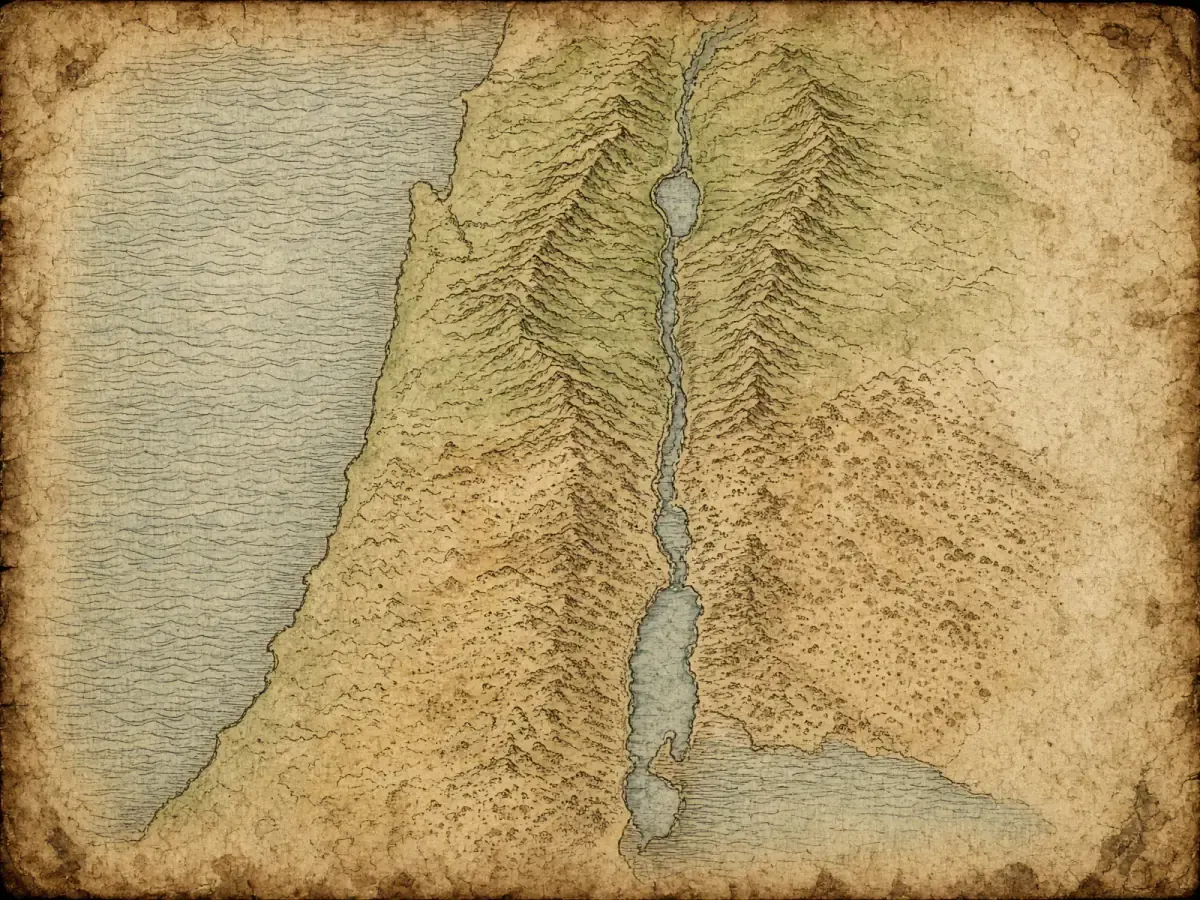
A land clerk spreads old marriage papers beside a valley map in a survey field shelter. She draws a line from one family name to parcels held by its grandchildren. A late marriage explains a branch missing from the earlier map. The papers connect relatives to places on the ground. These modern records use surveyed boundaries that the chapter does not supply.
Notice
1 Chronicles 2:21 Hezron’s age is given when he marries Machir’s daughter. That detail helps place this later branch alongside the other parts of his family.
1 Chronicles 2:18-24
King James Version18And Caleb the son of Hezron begat children of Azubah his wife, and of Jerioth: her sons are these; Jesher, and Shobab, and Ardon.
19And when Azubah was dead, Caleb took unto him Ephrath, which bare him Hur.
20And Hur begat Uri, and Uri begat Bezaleel.
21And afterward Hezron went in to the daughter of Machir the father of Gilead, whom he married when he was threescore years old; and she bare him Segub.
22And Segub begat Jair, who had three and twenty cities in the land of Gilead.
23And he took Geshur, and Aram, with the towns of Jair, from them, with Kenath, and the towns thereof, even threescore cities. All these belonged to the sons of Machir the father of Gilead.
24And after that Hezron was dead in Caleb-ephratah, then Abiah Hezron’s wife bare him Ashur the father of Tekoa.
1 Chronicles 2:25-41
A Daughter Continues Sheshan’s Line
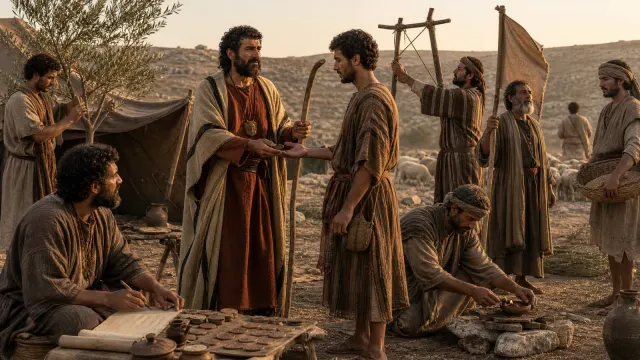
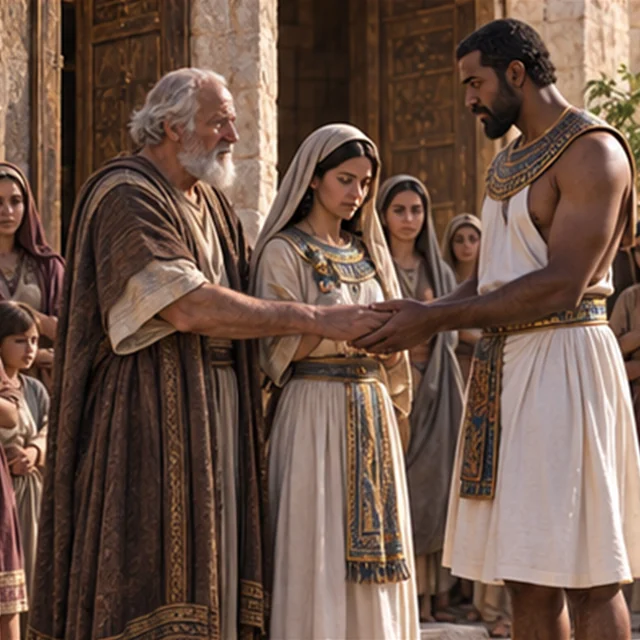
Jerahmeel’s family branches through sons born to different wives. Some descendants are named as dying without children. Sheshan has daughters but no sons. He gives his daughter in marriage to Jarha, his Egyptian servant. Their son Attai begins the line followed through many more generations. The list carries that branch down to Elishama. A family line here continues through a daughter and a man from outside the people. The record also keeps the names of those whose own branches ended without children.
In everyday life
A niece stitches names onto a family quilt laid across her sewing table. She follows a branch through a daughter whose husband came from another country. Beside it she leaves named squares for two relatives without children. They belong on the quilt even without another row beneath them. Jarha’s status as a servant has no match in her marriage chart.
Notice
1 Chronicles 2:34 Sheshan’s lack of sons explains the turn to his daughter and servant. The following generations depend on a link that a sons-only list would miss.
1 Chronicles 2:25-41
King James Version25And the sons of Jerahmeel the firstborn of Hezron were, Ram the firstborn, and Bunah, and Oren, and Ozem, and Ahijah.
26Jerahmeel had also another wife, whose name was Atarah; she was the mother of Onam.
27And the sons of Ram the firstborn of Jerahmeel were, Maaz, and Jamin, and Eker.
28And the sons of Onam were, Shammai, and Jada. And the sons of Shammai; Nadab, and Abishur.
29And the name of the wife of Abishur was Abihail, and she bare him Ahban, and Molid.
30And the sons of Nadab; Seled, and Appaim: but Seled died without children.
31And the sons of Appaim; Ishi. And the sons of Ishi; Sheshan. And the children of Sheshan; Ahlai.
32And the sons of Jada the brother of Shammai; Jether, and Jonathan: and Jether died without children.
33And the sons of Jonathan; Peleth, and Zaza. These were the sons of Jerahmeel.
34Now Sheshan had no sons, but daughters. And Sheshan had a servant, an Egyptian, whose name was Jarha.
35And Sheshan gave his daughter to Jarha his servant to wife; and she bare him Attai.
36And Attai begat Nathan, and Nathan begat Zabad,
37And Zabad begat Ephlal, and Ephlal begat Obed,
38And Obed begat Jehu, and Jehu begat Azariah,
39And Azariah begat Helez, and Helez begat Eleasah,
40And Eleasah begat Sisamai, and Sisamai begat Shallum,
41And Shallum begat Jekamiah, and Jekamiah begat Elishama.
1 Chronicles 2:42-55
Families Are Linked with Settlements
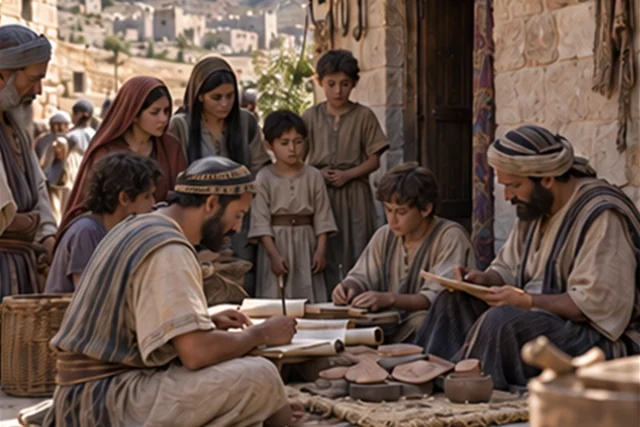
More of Caleb’s descendants appear, including children of concubines, partners with lower standing than wives. The record also names his daughter Achsah. Several men are linked as fathers with places such as Hebron and Beth-zur. These links connect family heads with the settlements their groups belong to. The list then follows branches tied to Kirjath-jearim and Beth-lehem. It ends with families of scribes, people trained to write, who live at Jabez. The chapter reaches from household births to towns and the work of particular families.
In everyday life
A postal worker marks an old delivery map with family names from cottage signs. One lane carries the name of a long-settled household. Another cluster is known for the craft its families share. The map begins to show people behind the place names. The chapter traces ancestral links, not the addresses on a delivery route.
Notice
1 Chronicles 2:55 The final families are identified by their work as scribes. A genealogy can preserve a group’s shared task as well as its place of descent.
1 Chronicles 2:42-55
King James Version42Now the sons of Caleb the brother of Jerahmeel were, Mesha his firstborn, which was the father of Ziph; and the sons of Mareshah the father of Hebron.
43And the sons of Hebron; Korah, and Tappuah, and Rekem, and Shema.
44And Shema begat Raham, the father of Jorkoam: and Rekem begat Shammai.
45And the son of Shammai was Maon: and Maon was the father of Beth-zur.
46And Ephah, Caleb’s concubine, bare Haran, and Moza, and Gazez: and Haran begat Gazez.
47And the sons of Jahdai; Regem, and Jotham, and Geshan, and Pelet, and Ephah, and Shaaph.
48Maachah, Caleb’s concubine, bare Sheber, and Tirhanah.
49She bare also Shaaph the father of Madmannah, Sheva the father of Machbenah, and the father of Gibea: and the daughter of Caleb was Achsah.
50These were the sons of Caleb the son of Hur, the firstborn of Ephratah; Shobal the father of Kirjath-jearim,
51Salma the father of Beth-lehem, Hareph the father of Beth-gader.
52And Shobal the father of Kirjath-jearim had sons; Haroeh, and half of the Manahethites.
53And the families of Kirjath-jearim; the Ithrites, and the Puhites, and the Shumathites, and the Mishraites; of them came the Zareathites, and the Eshtaulites.
54The sons of Salma; Beth-lehem, and the Netophathites, Ataroth, the house of Joab, and half of the Manahethites, the Zorites.
55And the families of the scribes which dwelt at Jabez; the Tirathites, the Shimeathites, and Suchathites. These are the Kenites that came of Hemath, the father of the house of Rechab.
Details worth noticing
The opening image
1 Chronicles 2:1 begins with “These are the sons of Israel; Reuben, Simeon, Levi, and Judah, Issachar, and Zebulun,”
Where the chapter turns
1 Chronicles 2:34 forms a natural hinge: “Now Sheshan had no sons, but daughters. And Sheshan had a servant, an Egyptian, whose name was Jarha.”
The final note
1 Chronicles 2:55 leaves the reader with “And the families of the scribes which dwelt at Jabez; the Tirathites, the Shimeathites, and Suchathites. These are the Kenites that came of Hemath, the…”
A word trail through the chapter
The words sons, begat, father, bare, firstborn, Caleb help reveal the chapter’s repeated concerns.
KJV words made clear
- begat
- became the father of
- unto
- to
Music and video connected to the passage
Related media appears when its Scripture reference overlaps this study. Music and video can illuminate a theme while the biblical text remains the foundation.