
The big picture
The fracture of chapter 3 enters the next generation. Cain's response to divine correction leads to the first murder. The chapter also traces city life, cultural activity, escalating vengeance and the continuation of Adam and Eve's family through Seth.
Scripture beside the summary
Genesis · King James Version · 26Genesis 4:1-7
Offerings and anger
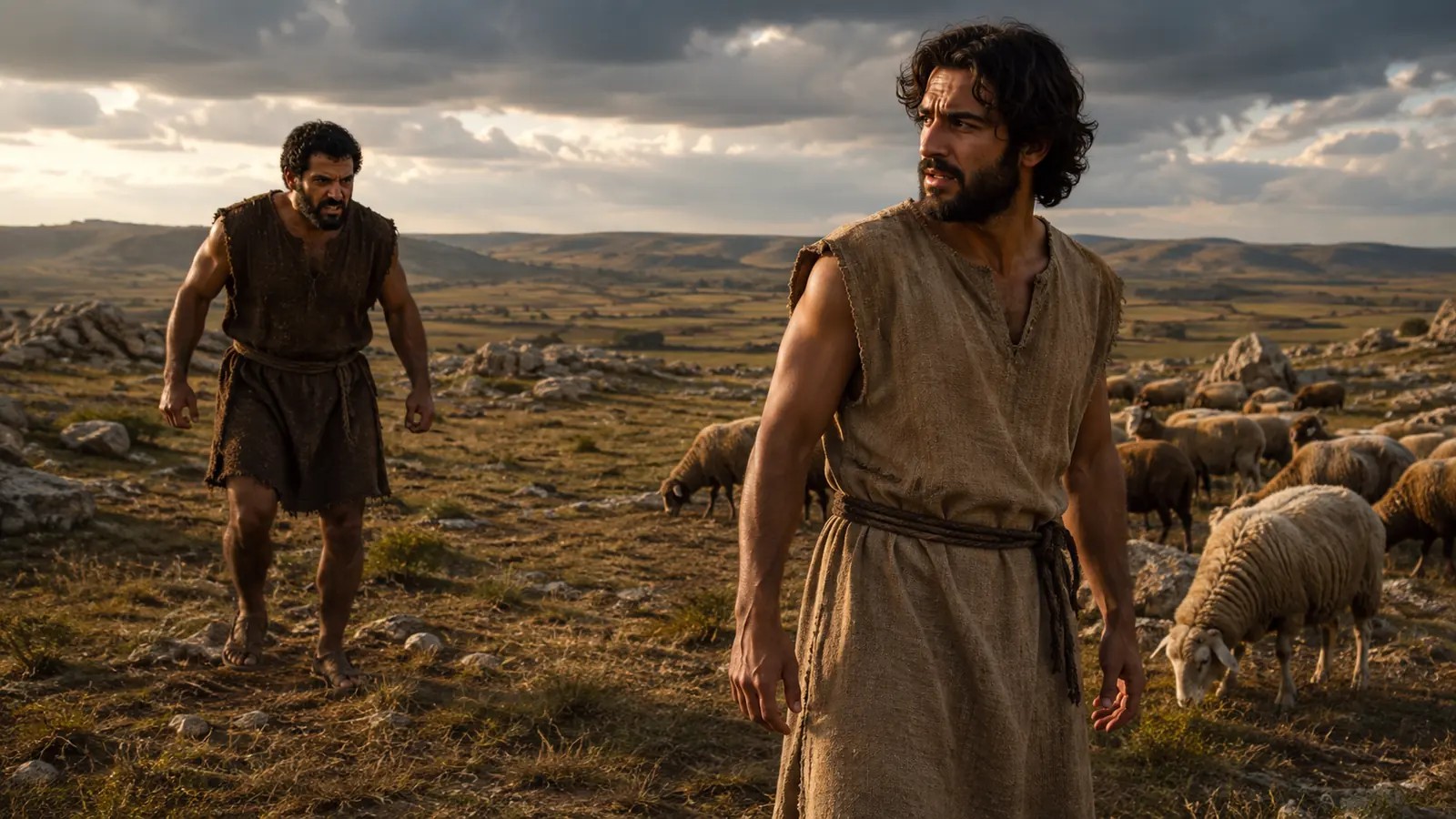
Cain cultivates the ground and Abel keeps sheep. The Lord regards Abel and his offering, while warning Cain about the danger of sin. The narrator does not provide a complete ritual explanation for the different responses. Attention falls on how Cain will act after correction.
Context that brings the passage to life
This block contains 2 explicit questions. They are more than punctuation: they reveal where a voice is searching, challenging, afraid, or trying to understand.
“And Adam knew Eve his wife; and she conceived, and bare Cain, and said, I have gotten a man from the LORD.” Naming Adam and Cain keeps the account rooted in particular people or places. Follow where the name returns and what changes around it.
“And she again bare his brother Abel. And Abel was a keeper of sheep, but Cain was a tiller of the ground.” Naming Abel and Cain keeps the account rooted in particular people or places. Follow where the name returns and what changes around it.
Genesis 4:1-7
King James Version1And Adam knew Eve his wife; and she conceived, and bare Cain, and said, I have gotten a man from the LORD.
2And she again bare his brother Abel. And Abel was a keeper of sheep, but Cain was a tiller of the ground.
3And in process of time it came to pass, that Cain brought of the fruit of the ground an offering unto the LORD.
4And Abel, he also brought of the firstlings of his flock and of the fat thereof. And the LORD had respect unto Abel and to his offering:
5But unto Cain and to his offering he had not respect. And Cain was very wroth, and his countenance fell.
6And the LORD said unto Cain, Why art thou wroth? and why is thy countenance fallen?
7If thou doest well, shalt thou not be accepted? and if thou doest not well, sin lieth at the door. And unto thee shall be his desire, and thou shalt rule over him.
Genesis 4:8-16
A brother's blood
Cain kills Abel and denies responsibility when questioned. Blood cries from the ground, linking violence with the land on which Cain depends. His punishment includes displacement. God also protects him from retaliatory killing, restraining a cycle of vengeance even while judging the murderer.
Context that brings the passage to life
This block contains 2 explicit questions. They are more than punctuation: they reveal where a voice is searching, challenging, afraid, or trying to understand.
“And Cain talked with Abel his brother: and it came to pass, when they were in the field, that Cain rose up against…” This familiar narrative signal moves the clock forward. What follows is a new scene, consequence, or answer to an earlier tension.
“And he said, What hast thou done? the voice of thy brother’s blood crieth unto me from the ground.” The question slows the passage down. Notice who is being pressed to answer, what the question assumes, and whether the next lines provide a response.
“When thou tillest the ground, it shall not henceforth yield unto thee her strength; a fugitive and a vagabond shalt…” The command cannot be understood from the verb alone. Its recipient, purpose, and place in the larger covenant or argument define the responsibility.
Genesis 4:8-16
King James Version8And Cain talked with Abel his brother: and it came to pass, when they were in the field, that Cain rose up against Abel his brother, and slew him.
9And the LORD said unto Cain, Where is Abel thy brother? And he said, I know not: Am I my brother’s keeper?
10And he said, What hast thou done? the voice of thy brother’s blood crieth unto me from the ground.
11And now art thou cursed from the earth, which hath opened her mouth to receive thy brother’s blood from thy hand;
12When thou tillest the ground, it shall not henceforth yield unto thee her strength; a fugitive and a vagabond shalt thou be in the earth.
13And Cain said unto the LORD, My punishment is greater than I can bear.
14Behold, thou hast driven me out this day from the face of the earth; and from thy face shall I be hid; and I shall be a fugitive and a vagabond in the earth; and it shall come to pass, that every one that findeth me shall slay me.
15And the LORD said unto him, Therefore whosoever slayeth Cain, vengeance shall be taken on him sevenfold. And the LORD set a mark upon Cain, lest any finding him should kill him.
16And Cain went out from the presence of the LORD, and dwelt in the land of Nod, on the east of Eden.
Genesis 4:17-26
Culture and competing legacies
Cain's line includes builders, herders, musicians and metalworkers. These developments are placed beside Lamech's boast of disproportionate revenge. Cultural achievement does not cure violence. Seth's birth and the calling on the Lord's name keep the narrative from ending with Cain's line.
Context that brings the passage to life
“And Cain knew his wife; and she conceived, and bare Enoch: and he builded a city, and called the name of the city…” Naming Enoch and Cain keeps the account rooted in particular people or places. Follow where the name returns and what changes around it.
“And Lamech took unto him two wives: the name of the one was Adah, and the name of the other Zillah.” The number two makes the report concrete. Ask whether it measures time, people, distance, repetition, or completeness before deciding what weight it carries.
“And his brother’s name was Jubal: he was the father of all such as handle the harp and organ.” Naming Jubal keeps the account rooted in particular people or places. Follow where the name returns and what changes around it.
“And Lamech said unto his wives, Adah and Zillah, Hear my voice; ye wives of Lamech, hearken unto my speech: for I have…” Naming Lamech and Adah keeps the account rooted in particular people or places. Follow where the name returns and what changes around it.
Genesis 4:17-26
King James Version17And Cain knew his wife; and she conceived, and bare Enoch: and he builded a city, and called the name of the city, after the name of his son, Enoch.
18And unto Enoch was born Irad: and Irad begat Mehujael: and Mehujael begat Methusael: and Methusael begat Lamech.
19And Lamech took unto him two wives: the name of the one was Adah, and the name of the other Zillah.
20And Adah bare Jabal: he was the father of such as dwell in tents, and of such as have cattle.
21And his brother’s name was Jubal: he was the father of all such as handle the harp and organ.
22And Zillah, she also bare Tubal-cain, an instructer of every artificer in brass and iron: and the sister of Tubal-cain was Naamah.
23And Lamech said unto his wives, Adah and Zillah, Hear my voice; ye wives of Lamech, hearken unto my speech: for I have slain a man to my wounding, and a young man to my hurt.
24If Cain shall be avenged sevenfold, truly Lamech seventy and sevenfold.
25And Adam knew his wife again; and she bare a son, and called his name Seth: For God, said she, hath appointed me another seed instead of Abel, whom Cain slew.
26And to Seth, to him also there was born a son; and he called his name Enos: then began men to call upon the name of the LORD.
Details worth noticing
The opening image
Genesis 4:1 begins with “And Adam knew Eve his wife; and she conceived, and bare Cain, and said, I have gotten a man from the LORD.”
Where the chapter turns
Genesis 4:10 forms a natural hinge: “And he said, What hast thou done? the voice of thy brother’s blood crieth unto me from the ground.”
The final note
Genesis 4:26 leaves the reader with “And to Seth, to him also there was born a son; and he called his name Enos: then began men to call upon the name of the LORD.”
A word trail through the chapter
The words Cain, LORD, Abel, name, bare, Lamech help reveal the chapter’s repeated concerns.
What opportunity exists before the murder?
Cain receives a warning and a call to resist sin in verse 7. Anger is not treated as an irresistible excuse.
What do the two speeches about vengeance reveal?
God limits retaliation against Cain; Lamech celebrates escalation.
KJV words made clear
- behold
- look, or pay close attention
- begat
- became the father of
- unto
- to
- thee
- you
- thou
- you
Text first
Where readers differ
The chapter summary begins with what the passage says and how its parts fit together. It does not assume one denomination has already settled every question. Where a conclusion depends on a tradition, literary theory, or historical reconstruction, that dependence is named openly.
The KJV text is presented first. Interpretive conclusions are labeled, and differences are introduced only when they help a reader understand why serious communities do not always reach the same answer.
The text does not describe Cain's mark or identify it with skin color. It gives no permission to stigmatize any people group.