The big picture
The twelve closest followers of Jesus, the teacher and healer, are sent to share his work. They return to see a crowd fed, hear him named as God's chosen king, and learn that suffering lies ahead. Three glimpse his glory on a mountain. Yet the group still misunderstands his path and quarrels over rank. Jesus then turns firmly toward Jerusalem, the city with God's temple. Along the way he rejects revenge and speaks plainly about the cost of following without looking back.
In this chapter
- Sent Followers Stir Herod’s Questions Luke 9:1-9
Jesus gathers the twelve and gives them authority over devils and illness.
- Five Loaves Become a Full Meal Luke 9:10-17
The apostles return with their report, and Jesus takes them toward a quiet place near Bethsaida, a lakeside town.
- Naming the Christ Leads to a Cross Luke 9:18-27
While praying, Jesus asks the followers what people say about him, then asks their own answer.
- Glory Does Not Remove the Coming Death Luke 9:28-36
About eight days later Jesus takes Peter, John, and James up a mountain to pray.
- Failed Help and Rivalry Meet Correction Luke 9:37-50
Down the mountain, a father begs for his only son, whom a spirit convulses and harms.
- A Rejected Welcome Does Not Invite Revenge Luke 9:51-56
As the time of his being taken up approaches, Jesus resolves to go to Jerusalem.
- Following Cannot Be Kept in Reserve Luke 9:57-62
Three exchanges show the cost of following Jesus.
Central truth
Jesus makes his identity known while teaching that following him means costly trust, humble welcome, and a firm refusal of revenge.

Scripture beside the summary
Luke · King James Version · 62Luke 9:1-9
Sent Followers Stir Herod’s Questions
Jesus gathers the twelve and gives them authority over devils and illness. They must preach God's kingdom and heal, carrying no spare provisions, money, or clothing. They should remain with one host until leaving a place. Where people reject them, shaking dust from their feet will bear witness against that refusal. The twelve go through the villages with good news and healing. Herod, the regional ruler, hears reports and is puzzled. Some say John, the preacher Herod beheaded, has risen. Others name Elias, an earlier prophet, or another ancient messenger. Herod wants to see Jesus and learn who is behind these deeds.
In everyday life
A field-survey trainer sends paired trainees with permission to carry out work once reserved for her. Villagers begin reporting what the teams have done, and a distant landlord asks who gave them the role. The work becomes known through those sent. Jesus grants power over illness and evil, not only permission to make a survey.
Notice
Luke 9:9 Herod's curiosity is linked with the man he executed. Reports about Jesus disturb him, but wanting to see Jesus is not yet trust in him.
Luke 9:1-9
King James Version1Then he called his twelve disciples together, and gave them power and authority over all devils, and to cure diseases.
2And he sent them to preach the kingdom of God, and to heal the sick.
3And he said unto them, Take nothing for your journey, neither staves, nor scrip, neither bread, neither money; neither have two coats apiece.
4And whatsoever house ye enter into, there abide, and thence depart.
5And whosoever will not receive you, when ye go out of that city, shake off the very dust from your feet for a testimony against them.
6And they departed, and went through the towns, preaching the gospel, and healing every where.
7Now Herod the tetrarch heard of all that was done by him: and he was perplexed, because that it was said of some, that John was risen from the dead;
8And of some, that Elias had appeared; and of others, that one of the old prophets was risen again.
9And Herod said, John have I beheaded: but who is this, of whom I hear such things? And he desired to see him.
Luke 9:10-17
Five Loaves Become a Full Meal
The apostles return with their report, and Jesus takes them toward a quiet place near Bethsaida, a lakeside town. Crowds follow. He welcomes them, teaches God's kingdom, and heals those in need. Late in the day the twelve urge him to send people away for food and lodging. He tells them to provide food. They have five loaves and two fish for about five thousand men. Jesus has the crowd sit in groups of fifty, blesses the food, and gives it to the followers to pass around. Everyone eats enough. Twelve baskets of fragments remain, showing that the meal has met the crowd's need.
In everyday life
A stranded-tour organiser asks helpers to seat passengers in manageable groups before a delayed food delivery is served. The helpers stop treating the crowd as one impossible problem and begin carrying portions to each row. Care becomes orderly and personal. Jesus supplies abundance from five loaves and two fish, not from a delivery already on its way.
Notice
Luke 9:17 The leftovers come after all have eaten enough. The count describes abundance remaining, rather than food saved by leaving some people hungry.
Luke 9:10-17
King James Version10And the apostles, when they were returned, told him all that they had done. And he took them, and went aside privately into a desert place belonging to the city called Bethsaida.
11And the people, when they knew it, followed him: and he received them, and spake unto them of the kingdom of God, and healed them that had need of healing.
12And when the day began to wear away, then came the twelve, and said unto him, Send the multitude away, that they may go into the towns and country round about, and lodge, and get victuals: for we are here in a desert place.
13But he said unto them, Give ye them to eat. And they said, We have no more but five loaves and two fishes; except we should go and buy meat for all this people.
14For they were about five thousand men. And he said to his disciples, Make them sit down by fifties in a company.
15And they did so, and made them all sit down.
16Then he took the five loaves and the two fishes, and looking up to heaven, he blessed them, and brake, and gave to the disciples to set before the multitude.
17And they did eat, and were all filled: and there was taken up of fragments that remained to them twelve baskets.
Luke 9:18-27
Naming the Christ Leads to a Cross
While praying, Jesus asks the followers what people say about him, then asks their own answer. Peter, one of the twelve, names him as God's Christ, the promised king. Jesus orders silence and says the Son of man, his title for himself, must suffer, be rejected, die, and rise on the third day. Following him means denying self-rule and taking up a cross daily. This is an execution image, not a small inconvenience. Losing life for him leads to saving it; gaining everything cannot replace a lost self. He warns against shame at his words. Some present will see God's kingdom before death.
In everyday life
A conservation worker signs on to defend a threatened wetland, then learns the work will cost her a secure contract. She must decide whether the cause she praised still governs her choice when the price becomes personal. A title on a badge is insufficient. Jesus calls people to risk life for him and promises lasting life, not career satisfaction.
Notice
Luke 9:23 Luke includes daily in the call to carry a cross. The response belongs to a continuing pattern of allegiance, not one dramatic promise made in a crowd.
Luke 9:18-27
King James Version18And it came to pass, as he was alone praying, his disciples were with him: and he asked them, saying, Whom say the people that I am?
19They answering said, John the Baptist; but some say, Elias; and others say, that one of the old prophets is risen again.
20He said unto them, But whom say ye that I am? Peter answering said, The Christ of God.
21And he straitly charged them, and commanded them to tell no man that thing;
22Saying, The Son of man must suffer many things, and be rejected of the elders and chief priests and scribes, and be slain, and be raised the third day.
23And he said to them all, If any man will come after me, let him deny himself, and take up his cross daily, and follow me.
24For whosoever will save his life shall lose it: but whosoever will lose his life for my sake, the same shall save it.
25For what is a man advantaged, if he gain the whole world, and lose himself, or be cast away?
26For whosoever shall be ashamed of me and of my words, of him shall the Son of man be ashamed, when he shall come in his own glory, and in his Father’s, and of the holy angels.
27But I tell you of a truth, there be some standing here, which shall not taste of death, till they see the kingdom of God.
Luke 9:28-36
Glory Does Not Remove the Coming Death
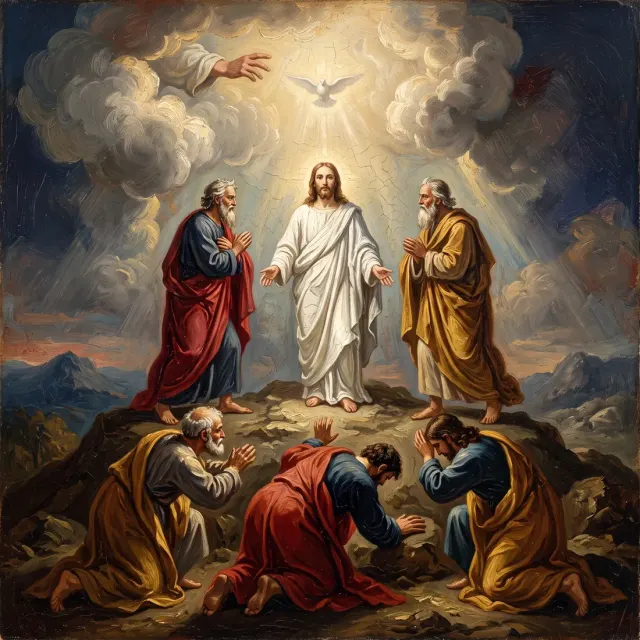
About eight days later Jesus takes Peter, John, and James up a mountain to pray. His face changes and his clothes shine. Moses, the lawgiver, and Elias appear in glory and speak about the death he will fulfil at Jerusalem. The followers are sleepy but wake to see them. As the two men leave, Peter proposes three shelters without grasping what he says. A cloud covers them, and fear comes. A voice names Jesus as the loved Son and tells them to hear him. Then Jesus stands alone. They keep the sight private. The glory they see surrounds a conversation about his coming death.
In everyday life
A cathedral restorer watches hidden colours emerge beneath layers of grime and realises the worn panel's worth. The discovery does not remove the hard repair still needed; it deepens her understanding of the work ahead. She listens more closely to the conservator's plan. Jesus' unveiled glory concerns divine sonship and saving death, not restored artwork.
Notice
Luke 9:31 The visitors speak of what Jesus will accomplish at Jerusalem. His death is not excluded from the mountain's glory but discussed within it.
Luke 9:28-36
King James Version28And it came to pass about an eight days after these sayings, he took Peter and John and James, and went up into a mountain to pray.
29And as he prayed, the fashion of his countenance was altered, and his raiment was white and glistering.
30And, behold, there talked with him two men, which were Moses and Elias:
31Who appeared in glory, and spake of his decease which he should accomplish at Jerusalem.
32But Peter and they that were with him were heavy with sleep: and when they were awake, they saw his glory, and the two men that stood with him.
33And it came to pass, as they departed from him, Peter said unto Jesus, Master, it is good for us to be here: and let us make three tabernacles; one for thee, and one for Moses, and one for Elias: not knowing what he said.
34While he thus spake, there came a cloud, and overshadowed them: and they feared as they entered into the cloud.
35And there came a voice out of the cloud, saying, This is my beloved Son: hear him.
36And when the voice was past, Jesus was found alone. And they kept it close, and told no man in those days any of those things which they had seen.
Luke 9:37-50
Failed Help and Rivalry Meet Correction
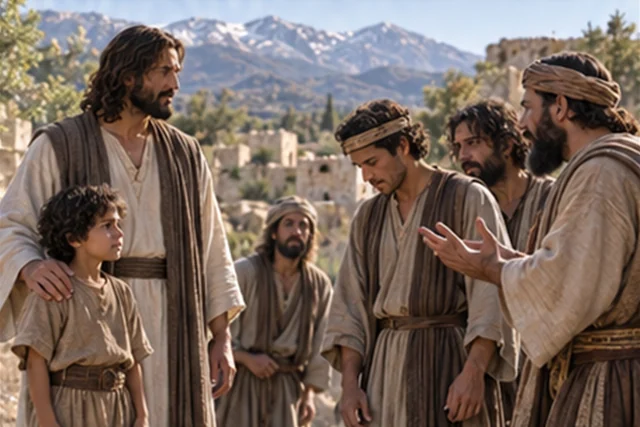
Down the mountain, a father begs for his only son, whom a spirit convulses and harms. The followers could not free him. Jesus rebukes the spirit, heals the boy, and returns him to his father. While people marvel, he again warns the followers that he will be handed over. They do not understand and fear asking. They then debate who is greatest. Jesus places a child beside him and says welcoming the child in his name welcomes him and his sender. The least is great. When John reports stopping an outsider who expels devils in Jesus' name, Jesus says not to stop him. Group pride has misunderstood the work.
In everyday life
The junior orchestra member helps a newcomer find her seat while senior players argue over who deserves the centre position. The conductor thanks the helper and welcomes useful assistance from a visiting player outside the usual group. Service matters more than rank or belonging to the inner circle. Jesus joins this lesson to divine welcome and freedom from spirits.
Notice
Luke 9:48 The child stands beside Jesus as he speaks. Welcoming someone with little rank becomes the test of receiving the one they call great.
Luke 9:37-50
King James Version37And it came to pass, that on the next day, when they were come down from the hill, much people met him.
38And, behold, a man of the company cried out, saying, Master, I beseech thee, look upon my son: for he is mine only child.
39And, lo, a spirit taketh him, and he suddenly crieth out; and it teareth him that he foameth again, and bruising him hardly departeth from him.
40And I besought thy disciples to cast him out; and they could not.
41And Jesus answering said, O faithless and perverse generation, how long shall I be with you, and suffer you? Bring thy son hither.
42And as he was yet a coming, the devil threw him down, and tare him. And Jesus rebuked the unclean spirit, and healed the child, and delivered him again to his father.
43And they were all amazed at the mighty power of God. But while they wondered every one at all things which Jesus did, he said unto his disciples,
44Let these sayings sink down into your ears: for the Son of man shall be delivered into the hands of men.
45But they understood not this saying, and it was hid from them, that they perceived it not: and they feared to ask him of that saying.
46Then there arose a reasoning among them, which of them should be greatest.
47And Jesus, perceiving the thought of their heart, took a child, and set him by him,
48And said unto them, Whosoever shall receive this child in my name receiveth me: and whosoever shall receive me receiveth him that sent me: for he that is least among you all, the same shall be great.
49And John answered and said, Master, we saw one casting out devils in thy name; and we forbad him, because he followeth not with us.
50And Jesus said unto him, Forbid him not: for he that is not against us is for us.
Luke 9:51-56
A Rejected Welcome Does Not Invite Revenge
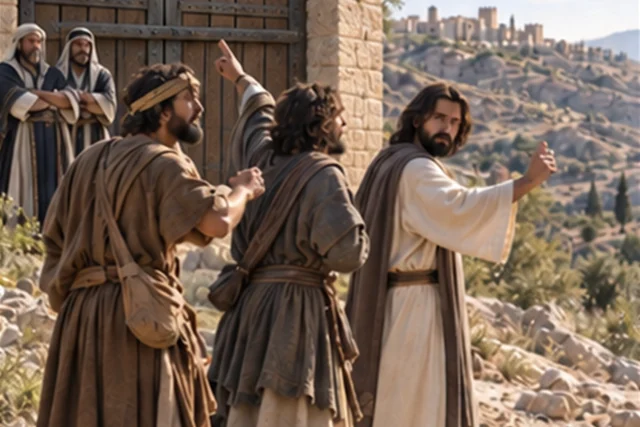
As the time of his being taken up approaches, Jesus resolves to go to Jerusalem. He sends messengers ahead into a Samaritan village, among a people with different worship traditions and strained relations with his own people. The villagers refuse welcome because he is heading to Jerusalem. James and John ask whether to call heavenly fire down as Elias once did. Jesus rebukes them for failing to understand the spirit of his work. He has come to save lives, not destroy them. They go to another village. Rejection changes their lodging, but it does not turn his mission into an act of revenge.
In everyday life
A touring choir organiser receives a hostile refusal from a hall that had been asked to host the group. Angry members propose public humiliation of the hosts. She closes the message and books another venue, refusing to make the refusal a feud. Jesus rejects a request for deadly heavenly judgement, not merely an online argument.
Notice
Luke 9:56 Moving to another village is the practical outcome of Jesus' rebuke. He continues his purpose without punishing the people who refuse to receive him.
Luke 9:51-56
King James Version51And it came to pass, when the time was come that he should be received up, he stedfastly set his face to go to Jerusalem,
52And sent messengers before his face: and they went, and entered into a village of the Samaritans, to make ready for him.
53And they did not receive him, because his face was as though he would go to Jerusalem.
54And when his disciples James and John saw this, they said, Lord, wilt thou that we command fire to come down from heaven, and consume them, even as Elias did?
55But he turned, and rebuked them, and said, Ye know not what manner of spirit ye are of.
56For the Son of man is not come to destroy men’s lives, but to save them. And they went to another village.
Luke 9:57-62
Following Cannot Be Kept in Reserve
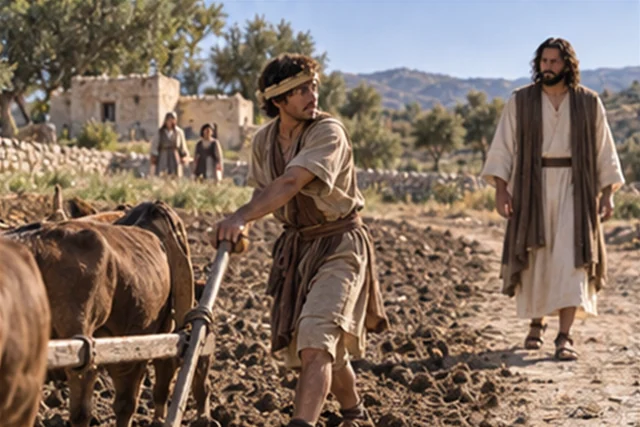
Three exchanges show the cost of following Jesus. To someone promising to go anywhere, he says that animals have resting places while he lacks a home to lay his head. Another wants first to bury his father. Jesus gives a severe answer about leaving the dead to bury their dead and going to proclaim God's kingdom. The precise family situation is not explained. A third asks to say farewell at home. Jesus compares divided attention to ploughing while looking backward. These replies make the urgency and cost plain. Following cannot remain a plan that waits until every other claim has been settled.
In everyday life
A lifeboat recruit reaches the launch with a promise to serve but keeps returning to shore tasks that can wait. The coxswain asks him to face the boat and take his place because the call is happening now. Commitment must become a present choice. Jesus' claim reaches family duties and an unsettled life, not one emergency shift.
Notice
Luke 9:62 The plough image ends with fitness for God's kingdom. Looking back is a picture of divided direction, not a ban on remembering loved ones.
Luke 9:57-62
King James Version57And it came to pass, that, as they went in the way, a certain man said unto him, Lord, I will follow thee whithersoever thou goest.
58And Jesus said unto him, Foxes have holes, and birds of the air have nests; but the Son of man hath not where to lay his head.
59And he said unto another, Follow me. But he said, Lord, suffer me first to go and bury my father.
60Jesus said unto him, Let the dead bury their dead: but go thou and preach the kingdom of God.
61And another also said, Lord, I will follow thee; but let me first go bid them farewell, which are at home at my house.
62And Jesus said unto him, No man, having put his hand to the plough, and looking back, is fit for the kingdom of God.
Details worth noticing
The opening image
Luke 9:1 begins with “Then he called his twelve disciples together, and gave them power and authority over all devils, and to cure diseases.”
Where the chapter turns
Luke 9:32 forms a natural hinge: “But Peter and they that were with him were heavy with sleep: and when they were awake, they saw his glory, and the two men that stood with him.”
The final note
Luke 9:62 leaves the reader with “And Jesus said unto him, No man, having put his hand to the plough, and looking back, is fit for the kingdom of God.”
A word trail through the chapter
The words Jesus, disciples, John, Elias, kingdom, child help reveal the chapter’s repeated concerns.
KJV words made clear
- victuals
- Food or provisions needed for a meal or travel.
- glistering
- Shining brightly with a striking white light.
- decease
- Departure or death, here referring to what Jesus will fulfil at Jerusalem.
Music and video connected to the passage
Related media appears when its Scripture reference overlaps this study. Music and video can illuminate a theme while the biblical text remains the foundation.